Programs do record video interviews—and many of you click “I agree” without even reading the policy.
Let me cut through the folklore you hear on Reddit and in group chats: this is not a simple yes or no question. The reality is messier, and more uncomfortable, than “programs never save anything” or “everything you say is on permanent file forever.”
You’re not powerless, but you are walking into a legal and policy framework most applicants barely understand. That’s the problem.
The Myths You Hear vs What Actually Happens
I keep hearing the same lazy claims:
- “ACGME banned recording interviews.”
- “If they record you, it has to be disclosed and you can just refuse.”
- “ERAS doesn’t let them store anything long-term.”
- “They only record for tech or training, they don’t actually use it to score you.”
All of these are incomplete or flat-out wrong.
Here’s what actually exists:
- ACGME and NRMP don’t have a universal, explicit “no video recording” ban for all interviews.
- Programs operate under institutional privacy and data policies, which vary widely.
- Some video platforms auto-record by default if the host clicks a single button—no extra magic.
- Many institutions are nervous about legal risk and therefore avoid recording. Others see recording as “quality assurance,” “bias reduction,” or “documentation.”
You’re living in a policy gray zone. And gray zones are where stupid assumptions get applicants burned.
Who Actually Sets the Rules About Recording?
Everyone assumes “the Match rules” control everything. They don’t.
There are three main layers of control:
- The video platform vendor (Zoom, Microsoft Teams, Webex, Thalamus, etc.)
- The institution/program policies (university/hospital legal, privacy, HR, GME office)
- Accrediting andMatch-related bodies (ACGME, NRMP, sometimes AMA or specialty orgs)
Let’s break it down.
1. Vendor capability: recording is trivial
If a program is using:
- Zoom: recording is one click if the host has permissions. They can record to local drive or cloud.
- Microsoft Teams: similar—recording to cloud storage with institutional retention rules.
- Webex, BlueJeans, others: same story.
- Thalamus/other specialty med-ed platforms: can integrate or support recording depending on setup.
The takeaway: the technology isn’t the barrier. At all.
2. Institutional policies: where most real limits live
Universities and academic hospitals care—deeply—about:
- FERPA (if students are involved)
- HIPAA (if anything remotely clinical spills in)
- State recording laws (one-party vs all-party consent)
- PR disasters from leaked or misused recordings
- Data retention obligations (if you keep it, you might be forced to produce it in litigation)
So a lot of places have internal rules like:
- “No recording of recruitment interviews without explicit dean or HR approval.”
- “Recordings must be deleted after X months.”
- “If recorded, applicants must be informed and consent documented.”
Notice the pattern: not “never record,” but “if you record, follow rules and don’t be stupid.”
3. ACGME / NRMP: what they actually say
Here’s the myth-busting part.
- NRMP’s focus is on coercion, match violations, post-interview communication, and fairness. They’re not publishing line-by-line video recording bans in the Match Participation Agreement. Their documents focus on conduct, not file formats.
- ACGME cares about program conduct and professionalism, not micromanaging how an institution manages digital files for recruitment.
Where video indirectly shows up:
- Virtual recruitment guidelines and best practices (from AAMC, specialty societies, etc.) generally suggest respecting applicant privacy, limiting recordings, and being transparent.
- Many GME offices interpret this conservatively and issue their own “no recording” or “record only under strict conditions” policies.
Does a blanket national rule say “Programs cannot record interviews”? No. That’s the uncomfortable truth.
So Do Programs Actually Record? The Data vs the Whisper Network
There is no master database telling you which programs record interviews. But we can piece together what’s happening from three sources:
- Public-facing policies on GME or residency program websites
- Internal guidance documents from med schools and GME offices
- Conversations with applicants and faculty who’ve actually been in the room (or Zoom)
What I’ve consistently seen:
A minority of programs explicitly state “we do not record interviews.”
Usually in their virtual interview FAQ: “Interviews are not recorded.” That’s the clearest, safest stance—for them and for you.Some programs openly state that certain components are recorded.
Typical language:- “Asynchronous video responses are recorded and may be reviewed by multiple faculty.”
- “This MMI station is recorded for training and quality assurance.”
These often appear in innovative/holistic review setups, especially with structured, pre-recorded questions.
A big chunk say nothing at all.
This is where people make up comforting stories. “If they were recording, they’d have to tell us.” Not necessarily, depending on the state law and institutional policy. In many US states, only one-party consent is needed: the interviewer can click “record” as the consenting party.
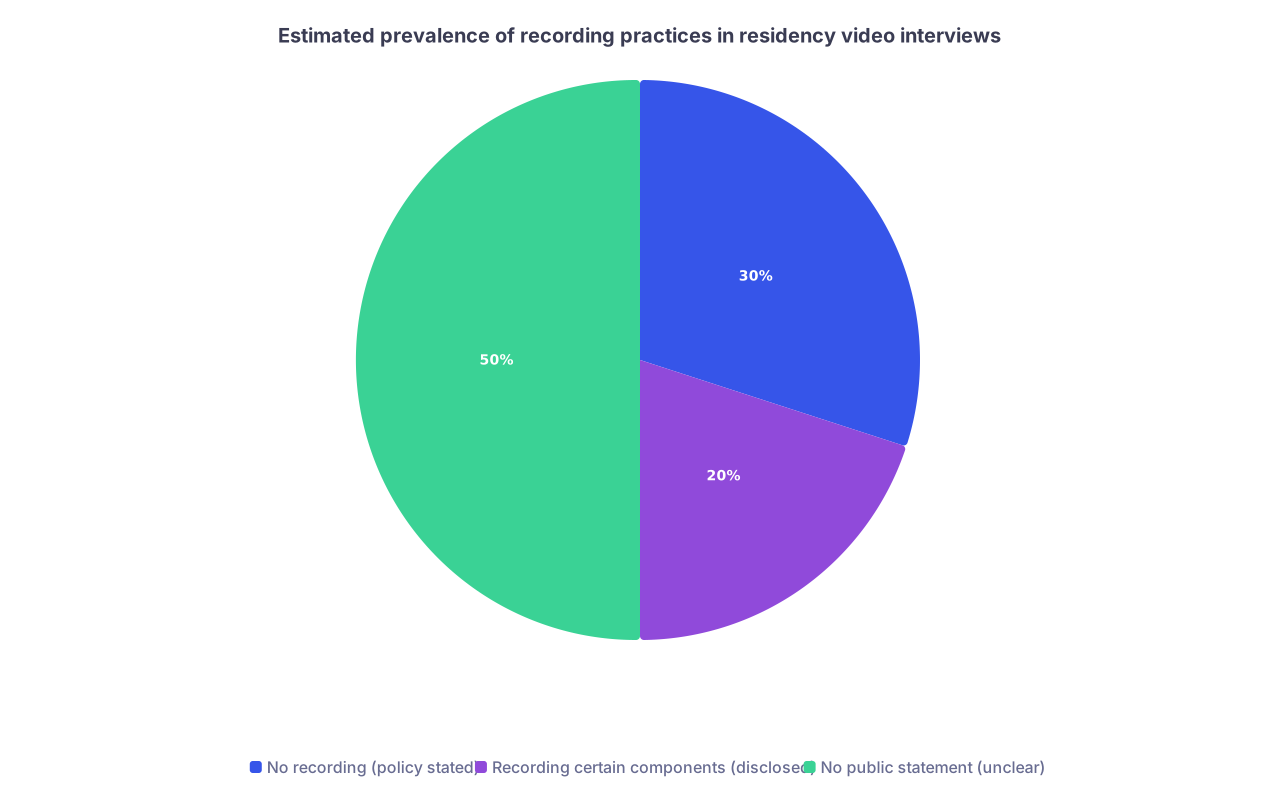
Here’s how the landscape tends to break down, from what I’ve seen across multiple institutions:
| Category | Value |
|---|---|
| No recording (policy stated) | 30 |
| Recording certain components (disclosed) | 20 |
| No public statement (unclear) | 50 |
Is this exact? No. But it reflects the reality: total transparency is not the norm.
Asynchronous Video Interviews: The Part Everyone Forgets
Here’s the part where the myth really collapses.
If your application uses:
- Standardized Video Interview–style tools (some EM programs used these historically)
- Spark Hire, VidCruiter, HireVue, or integrated video response tools in Thalamus or other systems
- “Record your answers to these three questions within the portal”
Then yes, your interview is recorded. By design. That’s the entire mechanism.
Those recordings:
- Are stored on third-party servers
- Are absolutely reviewable by multiple faculty, sometimes at different times
- Are often used for inter-rater reliability and bias studies
- May be retained for months or longer, depending on institutional contracts and policies
And yet you still hear people say, “Programs don’t really record; that’d be against the rules.”
You literally are the recording.
What Programs Actually Use Recordings For (When They Do)
Let’s be blunt: most PDs and faculty are not secretly building personality dossiers on you years into residency. They barely have time to finish notes and sign duty hours.
When recordings exist, they’re typically used for:
Standardization / fairness audits
“Did we ask similar follow-up questions?” “Is this interviewer consistently harder on women or IMGs?”
They may review a sample of recorded segments.Rater disagreement
If two interviewers strongly disagree on you, a third might watch the recording to break the tie.Training faculty
Showing anonymized clips to calibrate scoring or demonstrate good vs bad interviewing styles.Documentation if there’s a complaint
If you allege discriminatory behavior, or they suspect unprofessional behavior from an interviewer or you, recordings can protect either party.
Notice what’s mostly not happening:
They’re not replaying your entire interview three months later just to decide whether to rank you #21 or #24. The rank list meetings rely almost entirely on:
- Interviewers’ written evaluations
- Notes in their tracking spreadsheets
- Your file (scores, letters, personal statement)
- Gut feelings and group discussion
Recording is supplemental, not central.
How Long Do Recordings Stick Around?
Retention is where applicants get unnecessarily paranoid—and sometimes rightly concerned.
Institutions differ, but I’ve seen patterns like:
| Approach | Typical Retention | Where Seen |
|---|---|---|
| No recordings allowed | 0 days | Many academic centers |
| Short-term QA | 30–90 days | GME offices tracking bias/training |
| Cycle-based | Through Match season | Some large IM/EM programs |
| Long retention | 1–3 years | Institutions using videos for broader studies/training |
The key: most GME offices do not want a decade-long archive of applicant videos sitting on servers. That’s a liability nightmare.
But if your video is part of a structured assessment system or a research protocol (for “holistic review,” interviewer bias, etc.), longer retention is very possible—usually with IRB oversight or at least institutional review.
Are Programs Allowed To Record Without Telling You?
Here’s where law, ethics, and culture collide.
Legally (in the U.S.):
- Many states are one-party consent: if the interviewer knows and consents to recording, and they’re a participant, that’s enough legally.
- Some states are all-party consent: everyone must be informed and consent, or it’s illegal.
Ethically and professionally:
- Most serious institutions lean toward disclosure. Not always a giant red warning screen, but at least something in the invitation email or before launching an asynchronous interview:
“Your responses may be recorded and reviewed by members of the admissions committee.”
What I’ve actually seen:
For synchronous Zoom/Teams interviews:
- If recorded, usually there’s a banner at the top that says “This meeting is being recorded.” You’ve all seen it.
- Many GME offices outright tell programs not to record live interviews because of legal/privacy concerns.
For asynchronous systems:
- Recording is self-evident; you’re literally hitting “start recording.”
- They often include fine print about use and storage you never read.
If you ask directly, “Is this interview being recorded?” most PDs or coordinators will answer honestly. They have no incentive to lie about it.
What You Can and Can’t Control as an Applicant
Here’s the power dynamic in plain language:
- You probably cannot “negotiate” recording policy with a program.
- You absolutely can decide what you do on camera and what you leave out.
So, practical reality:
- Don’t say anything on video you wouldn’t be comfortable being reasonably documented. That includes casual offhand comments about other programs, political rants, trashing prior institutions, or borderline jokes you think are harmless.
- Assume any asynchronous response is recorded, stored, and possibly shown to multiple people.
- For synchronous interviews, if you see the “Recording in progress” banner, you can ask:
“Just to clarify, will this recording be used only for internal review and then deleted after this cycle?”
That’s a fair, professional question.
If recording makes you extremely uncomfortable, you can technically decline to proceed. But let’s be adults: in a competitive Match, that’s usually equivalent to withdrawing your application at that program. They’re not going to redesign their process for one applicant.
How To Read Between the Lines of Program Communication
Stop guessing. Start reading.
Go back to your:
- Interview invitation emails
- Program’s GME website
- Virtual interview day info packets or videos
Look for wording like:
- “Interviews will not be recorded.” → Good. Clear.
- “Sessions may be monitored or reviewed for quality assurance.” → Probably some components are recorded or at least observed.
- “Your responses will be recorded and reviewed by multiple raters.” → Asynchronous system with explicit recording.
If there’s nothing:
- It is reasonable to infer that live interviews are probably not being systematically recorded, mostly because it creates work and risk for them.
- It is not safe to assert “they definitely are not recording anything.”
You can always ask the coordinator, once, politely. That’s not a red flag question.
The Real Risk Isn’t Recording—It’s Sloppiness
Here’s the contrarian part: the bigger threat to you usually isn’t that they’re secretly recording you; it’s that you’re treating the interview like a casual FaceTime.
Having watched actual virtual interviews, I’ve seen:
- Applicants rant about “toxic” prior programs on camera.
- People visibly checking their phone, rolling their eyes, or whispering to someone off-screen.
- Someone with an open social media tab in the reflection of their glasses, scrolling during a question.
Whether or not that’s recorded, the damage is done. The interviewer writes:
- “Seemed unprofessional, distracted, complained excessively.”
That note lives in their system far more reliably than any video will.
So yes, recordings matter. Policies matter. But your own behavior is still the primary variable.
Bottom Line: What Policies Really Say vs What You Should Assume
Let’s strip this down to what actually helps you.
There is no universal, national ban on recording residency video interviews.
Limits are mostly institutional, not NRMP/ACGME commandments.Asynchronous video interviews are, by definition, recordings that are stored and reviewed.
Stop pretending those disappear into the ether after you click submit.Many live interviews are not recorded, because institutions don’t want the headache—but you can’t bank on that without explicit confirmation.
Behave on camera like you’re being recorded by a cautious, risk-averse institution that keeps things just long enough to matter—but not forever.
If a program is transparent and says “We do not record,” great. If they say “We record certain parts,” believe them and adjust. If they say nothing, assume minimum privacy, maximum professionalism.
That’s how you stop playing the guessing game and start playing the odds intelligently.