
The way you behave at a virtual social hour can quietly drop you five spots on a rank list. Sometimes more.
Programs say, “It’s just informal, come hang out.” Do not believe that means “not evaluated.” That’s the first dangerous misunderstanding.
You’re being watched. Not with a clipboard. But with group texts, Slack channels, and “what did you think of them?” conversations after you log off. I’ve heard those debriefs. They matter.
Let me walk you through the common virtual social hour missteps that will hurt your rank list—and how to avoid stepping on those landmines.
1. Believing “It’s Casual, So It Doesn’t Count”
This is the core error that poisons everything else.
Residents will explicitly tell you: “This is totally informal, we don’t report anything back, just come as you are.”
Here’s what actually happens after you leave the call:
- “Anyone stand out tonight?”
- “Who was that guy talking over everyone?”
- “The one who kept their camera off the whole time felt kind of checked out.”
- “She seemed great—very thoughtful questions.”
Nobody is formally “scoring” you. But soft impressions bleed into:
- How excited residents feel about you
- Whether someone advocates for you during ranking
- Whether you come up when the PD asks, “Any red flags?”
The mistake: Treating social hour like a throwaway event.
The fix: Treat it like a low‑stakes, high‑impact interview extension.
You don’t need interview-level formality. But you do need:
- Professional baseline (appearance, behavior, respect)
- Genuine engagement
- Self‑awareness about group dynamics
If you remember only one thing:
Virtual social = vibes interview. And vibes absolutely affect rank lists.
2. Camera-Off Culture: Looking Disengaged or Hiding
Yes, occasional camera-off is understandable. Post‑call, awful Wi‑Fi, shared space. But being one of the only black squares on the screen? That gets noticed.
Here’s how residents tend to interpret consistent camera‑off applicants:
- “Checked out”
- “Not that interested in our program”
- “Probably multitasking”
- “Hard to read—don’t really know them”
Are those assumptions always fair? No. Do they still influence discussion? Yes.
Big mistakes:
- Staying camera-off for the entire hour without explanation
- Popping in late with camera off and never turning it on
- Only turning your camera on when the PD pops in, then off again
Better options if you truly can’t keep it on:
- At the start, say briefly:
“Hey everyone, sorry, my internet’s unstable tonight so I may keep my camera off at times, but I’m really glad to be here.” - Turn it on at least for part of the time, especially in small‑group rooms
- Make up for limited video with stronger verbal engagement and chat participation
Bottom line: Being a silent black box sends all the wrong messages. Don’t do it unless you absolutely have to—and if you do, communicate why.
3. Background, Lighting, and “I Didn’t Think They’d Notice”
Virtual doesn’t mean invisible. Programs absolutely notice:
- The unmade bed with laundry piles
- The roommate walking behind you in pajamas
- The cluttered kitchen with dirty dishes
- The dark, backlit cave where your face is barely visible
No, this alone won’t tank you. But it contributes to an impression: “prepared” vs “sloppy.”
Avoid these background mistakes:
- Sitting with a bright window behind you (you become a silhouette)
- Having obviously inappropriate posters or items in frame
- Letting family/roommates wander through consistently
- Eating dinner on camera like you’re on a casual FaceTime
You don’t need a Pinterest-perfect office. You do need “neutral, not distracting, not gross.”
Quick 5‑minute setup rule:
- Angle: Camera at or slightly above eye level
- Lighting: Light source facing you (lamp, window), not behind you
- Background: Wall, bookshelf, or tidy corner
- Sound: Headphones or quiet space if possible
If you can’t control the environment much, at least control what’s in frame. If your only option is your bed, sit at the head of the bed so it reads more like a couch than like you’re literally calling from the pillow.
4. Overtalking, Monologuing, and Dominating Small Groups
This one gets people killed in resident chats.
Virtual social hours often use breakout rooms: 3–6 applicants with 1–2 residents. In small groups, air time is limited. Residents remember two types of people:
- The one who never spoke
- The one who never stopped
Guess who gets complained about more? The second.
Common overtalking missteps:
- Answering every question first
- Turning every prompt into your life story
- Jumping in before quieter applicants finish
- Pivoting every discussion back to yourself (“That reminds me of when I…”)
Residents are tired. They see this and think:
- “This person will be exhausting on a team.”
- “Do they know how to share space?”
- “They’re not reading the room at all.”
You do not need to be silent. You just need to share the oxygen.
Safer behavior:
- Let someone else answer first sometimes
- Keep answers tight—aim for 30–60 seconds, not 3 minutes
- Explicitly invite others: “I’d love to hear what others think too.”
- If you’ve spoken a lot, consciously step back: “I’ve been chatting a ton—someone else want to jump in?”
If your natural tendency is to fill awkward silences, be careful. On Zoom, slight pauses are normal. Do not treat every 2‑second gap as an invitation to re‑launch your personal statement.
5. The Opposite Problem: Silent, Invisible, Forgettable
On the other side: applicants who vanish.
A resident once told me, “We had someone in the room for 40 minutes. They never spoke. Not once. We thought their audio was broken. Then they said bye at the end.”
Do you think that person ended up high on the rank list? No.
Silent missteps:
- Saying nothing beyond your initial introduction
- Only speaking when directly cold‑called
- Giving one-word answers: “Yeah,” “That’s cool,” “Same”
- Staying muted even when you’re clearly being addressed
Programs interpret that as:
- Disinterest
- Anxiety without coping skills
- Limited communication ability
- “Hard to see them handling patient interactions”
You don’t need to perform. You do need to show enough of yourself that residents can picture you as a colleague.
Minimum engagement baseline:
- Introduce yourself in each new breakout room
- Ask at least 2–3 genuine questions over the hour
- Answer at least a couple of group questions with some substance
- Say a quick goodbye or thanks when leaving the room or session
If you’re naturally quiet, prepare a few safe, go‑to questions and comments ahead of time so you aren’t scrambling. Script them if you must. That’s better than silence.
6. Treating It Like a Vent Session About Other Programs
This one is lethal.
Applicants get comfortable, residents seem friendly, and the filter disappears. Suddenly you’re:
- Complaining about another program’s interview day
- Mocking a faculty member from somewhere else
- Sharing gossip about applicants or schools
- Trashing your own med school or classmates
Residents hear this and think, If they talk like this about others, how will they talk about us?
Red‑flag moves:
- “Honestly, [Program X] was a disaster. Their residents seemed miserable.”
- “Yeah, the PD at [School Y] was so awkward; we were roasting them in our group chat.”
- “Our clerkship director is useless; I just did my own thing.”
You may assume residents agree with your take. Doesn’t matter. What you just proved is that you lack judgment in professional settings.
Safer lane:
- You can say, “Some programs felt like less of a fit for me.” Stop there.
- Focus on what you liked, not what you hated.
- If asked about other interviews: be general, not gossipy.
Remember, residents are not your friends. Some might become your friends later. Tonight, though, they’re part of the program’s reputation filter.
7. Alcohol and “It’s Just a Social, Right?” Sloppiness
Virtual happy hour does not mean “unmonitored bar with zero consequence.”
You will occasionally hear: “Feel free to bring a drink!”
That does not mean: “Get tipsy on Zoom with future colleagues.”
Common alcohol‑related mistakes:
- Nursing a giant cocktail or obvious hard liquor on camera
- Getting progressively louder or looser as the hour goes on
- Telling edgy jokes because “I guess it’s more casual”
- Admitting to questionable behavior as “funny stories” once the filter drops
I’ve literally heard: “They were clearly a bit drunk by the end. Hard pass.”
Safe rules:
- If you want something: one drink, max. Sipped slowly.
- Keep anything alcoholic in a normal, non‑showy glass.
- If you’re not sure about the culture: stick to water/coffee. Nobody cares.
If alcohol tends to loosen your judgment or volume control, skip it entirely. You do not need a drink badly enough to risk your rank list.
8. Asking Residents the Wrong Questions (and at the Wrong Time)
Residents are often your best chance at real info. But you can ask questions in a way that helps you—or in a way that makes you look oblivious.
Damaging types of questions:
- Things clearly stated on the website or during the interview day
- “Do you have a night float system?” (it was in the schedule slide)
- Compensation/benefits questions when you haven’t even shown interest in training itself
- “How much moonlighting is allowed?” as your first question
- Questions that sound like you’re looking for shortcuts
- “How strict are they about duty hours really?”
- Hyper‑negative or leading questions
- “So are attendings usually malignant here or just some of them?”
Those make you look:
- Unprepared
- Money‑first instead of education‑first
- Like a problem waiting to happen
Good, resident-appropriate questions:
- “What surprised you most about intern year here?”
- “How do residents support each other on tough rotations?”
- “If you had to change one thing about the program, what would it be?”
- “How does the program respond when residents give feedback?”
You’re trying to show:
- You did your homework
- You think about culture and learning, not just prestige
- You’re someone they’d want in their group chat at 2 a.m.
Have 4–5 solid questions pre‑written. Rotate them by program. Don’t improvise everything.
9. Time Zone, Tech, and Showing Up Late or Chaotic
No, nobody will “fail you” for a tech glitch. But patterns matter.
Common logistical missteps:
- Showing up 15–20 minutes late without explanation
- Logging in, immediately saying you’re “having tech issues,” then disappearing
- Joining from your car while driving (yes, people do this)
- Constantly dropping and rejoining without a quick “Sorry, bad Wi‑Fi”
From the residents’ perspective:
- Reliability is part of being a good colleague.
- If you can’t manage a 1‑hour Zoom, what will long call shifts look like?
Basic protections:
- Triple‑check time zones. Seriously. Programs in CST trip people up every year.
- Log in 5–10 minutes early to handle updates or audio issues.
- Have a backup device ready (phone, tablet) if your computer fails.
- If you are late, enter and briefly own it: “Sorry I’m joining a bit late; my earlier interview ran over.”
You don’t need perfection. You do need to avoid looking careless or disorganized.
10. Tone-Deaf Humor and Oversharing Personal Stuff
Social hours feel looser. That’s the trap.
Applicants sometimes misjudge what’s appropriate and end up:
- Making dark or inappropriate jokes
- Complaining relentlessly about work hours before even starting residency
- Oversharing about mental health or personal drama in a way that alarms residents rather than builds connection
Let’s be clear: having mental health struggles is not the problem. Turning a casual social call into your in‑depth therapy session with strangers who might rank you? That’s the problem.
Examples that backfire:
- “Haha, I’m mostly just looking for a program where I won’t burn out… again.”
- “I’m really hoping to find a chill program because I don’t deal with stress well.”
- “I joke that my coping mechanism is day drinking.” (You think it’s obviously a joke. They’re not sure.)
Residents are listening for:
“Will this person be safe to work with?” “Will they crumble under pressure?”
They are not trained therapists; they’re peers trying to protect their team.
Better approach:
- Keep it light but sincere
- Share interests, hobbies, and what energizes you
- If talking about wellness, focus on how you recharge, not how close to the edge you are
Save vulnerable details for trusted spaces, not recorded-in-people’s-minds social hours.
11. Faking Interest or Over-Flattering the Program
Residents can smell generic flattery.
Missteps:
- Saying, “This is my number one!” to multiple programs
- Gushing excessively: “I just LOVE everything about your program—it’s perfect”
- Parroting obvious website lines: “The commitment to diversity and excellence really speaks to me” with no substance behind it
They’ve heard it 50 times this season. It means nothing.
Worse, if you sound fake, residents will doubt everything you say.
Instead of over-flattering, do this:
- Mention 1–2 specific things you genuinely liked:
- “I really appreciated how transparent the PD was about fellowship match data.”
- “The way you described autonomy on nights made this place stand out.”
- If you’re very interested, say:
“This program is going to be very high on my list.”
That’s honest, strong, and not deceptive.
Don’t try to game the system with flattery. It usually backfires.
12. Forgetting That Residents Talk Across Programs
Here’s the part applicants underestimate: residents know residents at other programs. Same med school, same conferences, same subspecialty interests.
If you act wildly unprofessional at one program’s social, do not assume it stays there.
I’ve seen this exact thing:
- Applicant behaves badly on one Zoom (rude, drunk, etc.)
- A resident texts their friend at another program: “Heads up, we just had this applicant, huge red flag.”
- Word spreads quietly. That applicant’s name is now associated with “problem.”
You are not that important that everyone is tracking you. But you are visible enough that blatant misbehavior can follow you.
The safest move is boring: be consistently decent everywhere.
Quick Comparison: Behaviors That Help vs Hurt You
| Area | Helps Your Rank List | Hurts Your Rank List |
|---|---|---|
| Camera & Presence | Camera on, engaged, occasional comments | Camera off, silent, or visibly distracted |
| Talk Time | Shares space, concise, invites others | Monologues, interrupts, dominates discussion |
| Questions | Program-specific, thoughtful, resident-level | Website-level, negative, or self-serving |
| Professionalism | Polite, appropriate humor, no gossip | Trashing other programs, edgy jokes, oversharing |
| Logistics | On time, stable setup, quick tech recovery | Very late, chaotic environment, driving during call |
What To Do Before Your Next Social Hour
Do not just show up and “see how it goes.” That’s how people walk straight into preventable mistakes.
Use a simple pre‑call checklist:
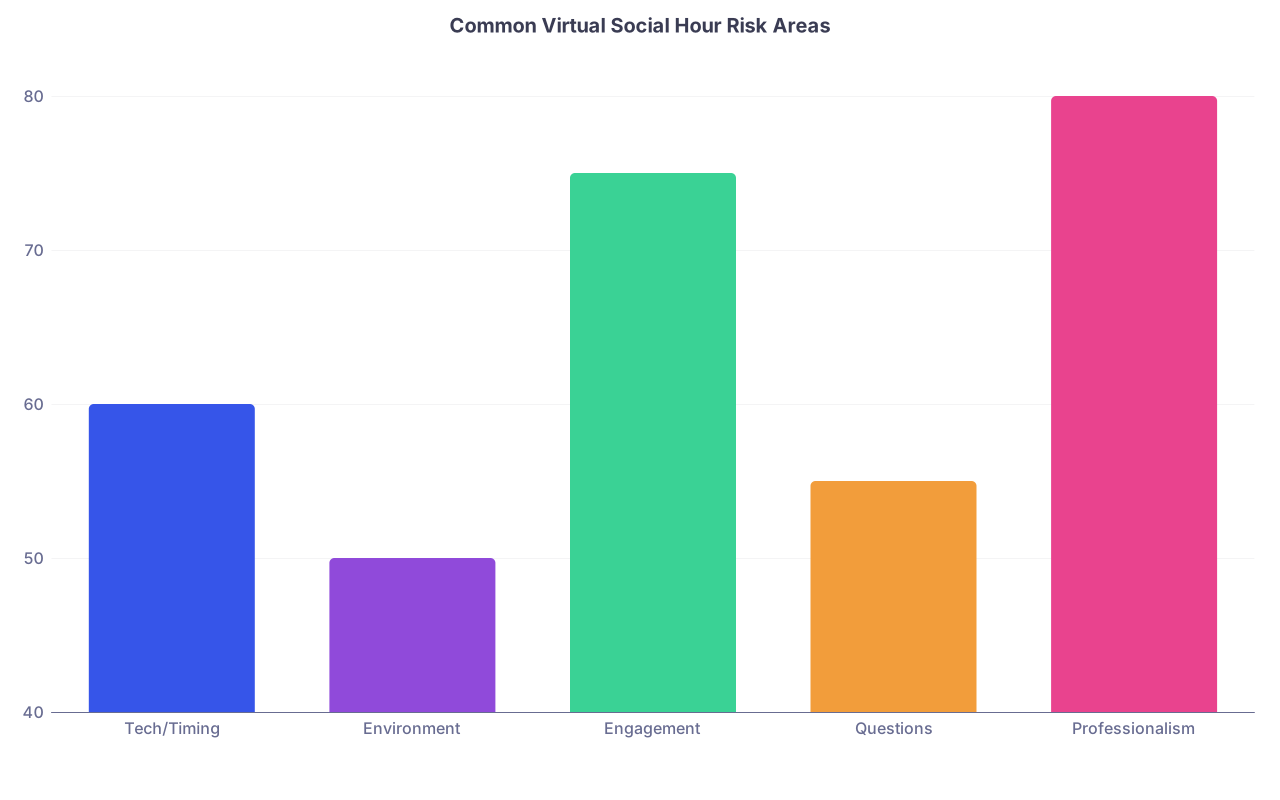
| Category | Value |
|---|---|
| Tech/Timing | 60 |
| Environment | 50 |
| Engagement | 75 |
| Questions | 55 |
| Professionalism | 80 |
Those numbers could just as easily be “how often I’ve seen applicants mess this up (percent of sessions).” Tech and timing failures? Constant. Engagement and professionalism? The most damaging when they go wrong.
10‑Minute Pre‑Call Checklist
- 2 min – Check time zone and link, open Zoom early
- 3 min – Fix camera angle, background, lighting
- 2 min – Glance at program website; note 2 specific things you can mention
- 3 min – Review 4–5 good questions + one quick intro line
That tiny bit of prep puts you ahead of the many people who treat these as casual hangouts.
Visualizing the Flow: How Mistakes Creep In

| Step | Description |
|---|---|
| Step 1 | Join Social Hour |
| Step 2 | Camera Off / Poor Setup |
| Step 3 | Low Engagement |
| Step 4 | Negative Resident Impressions |
| Step 5 | Good Setup & Presence |
| Step 6 | Thoughtful Questions |
| Step 7 | Positive Resident Impressions |
| Step 8 | Lower Rank Position |
| Step 9 | Stable or Higher Rank Position |
| Step 10 | Mindset: Casual or Professional? |
Most damage starts with the wrong mindset: “This doesn’t really matter.” Once you fix that, everything else becomes easier to correct.
FAQ (Exactly 4 Questions)
1. Do virtual social hours actually change my rank position, or is that exaggerated?
They don’t usually swing you from “not ranked” to “ranked to match” by themselves, but they absolutely shift people within the list. More importantly, they surface red flags. A great interviewee who seems arrogant, flaky, or unprofessional at social hour can get quietly downgraded. A borderline applicant who residents really like personally can get a bump. Think of social hours as a tiebreaker and a red‑flag detector.
2. Is it worse to skip a social hour or to attend but be quiet and awkward?
Skipping one social hour isn’t fatal, especially if you have a conflict and you emailed appropriately. But if you attend and are completely disengaged, you actively create a negative data point. If you’re very uncomfortable socially, I’d rather see you attend one or two key programs’ socials with modest, prepared participation than show up to all of them and sit silently like a ghost tile on the screen.
3. Can I tell residents where I’m ranking their program?
You can say things like “I’m very interested in this program” or “You’ll be very high on my list.” Saying “You’re my number one” to multiple programs is dishonest and risky—residents sometimes compare notes across institutions. Also, overselling your interest can backfire if it feels performative. Use clear but honest language, and don’t play games you can’t defend later.
4. What if I already had a bad virtual social hour—am I doomed?
No, you’re not automatically doomed. One off night doesn’t annihilate your chances, especially if your actual interview, letters, and application are strong. What you must not do is repeat the same mistakes at every program. Learn from it now: fix your setup, plan how you’ll engage, avoid risky topics, and treat every remaining social hour as a chance to confirm, not repair, a good impression.
Open your interview calendar right now and circle your next virtual social hour. Spend ten minutes today picking your space, setting your camera angle, and writing three real questions for residents. Do not wait until you’re already on Zoom to figure this out.