
Breakout rooms during residency interviews are not “breaks.” They’re surveillance. Soft, subtle, plausibly deniable surveillance—but surveillance nonetheless.
You think you’re just chatting with other applicants. The program is deciding whether you’re someone they want in their workroom at 2 a.m. in January.
Let me walk you through what actually happens behind the scenes and what faculty, residents, and coordinators are quietly writing next to your name while you think you’re “off the record.”
Why Programs Use Breakout Rooms At All
Programs did not add breakout rooms to be nice or to “simulate camaraderie.” They added them because video interviews killed a huge source of information: how you behave when you’re not being formally evaluated.
On in-person interview days, we watched you:
- At the pre-interview dinner
- With the chief resident during the tour
- At lunch with the interns
- Chatting in the hallway between sessions
Now? You log on, do your 20–30 minute faculty interviews, maybe a group Q&A, then vanish. Programs realized they had almost no read on your social intelligence, your vibe, or your “would I want to be stuck on nights with this person?” factor.
Breakout rooms are the digital replacement for the hallway, lunch table, and resident lounge. They’re primarily used to assess:
- Cultural fit
- Interpersonal skills
- Ego vs humility
- Red flags that won’t show up in your polished 1:1 interview
And here’s the part applicants never quite believe: we absolutely use what happens in those rooms when we rank you.
Who Is Actually Watching Your Breakout Room
Let me kill a myth: “The breakout rooms are only with other applicants, no one is watching.” Wrong.
Programs run three basic models:
Resident-moderated rooms
A PGY-2 or PGY-3 is “just hanging out” with you to answer questions. They’re also texting the group chat:- “Applicant 7 keeps interrupting everyone”
- “Applicant 3 seems really genuine, good team energy”
This feedback always gets to the rank meeting.
Silent observers
Sometimes a coordinator, chief, or junior faculty is in the room with their camera and mic off. You forget they exist after 5 minutes. They do not forget you.No live observer but post-hoc review
Less common, but some sessions get recorded in entirety. Technically “for quality improvement.” In practice, I’ve watched recordings to double-check a concern a resident had about someone’s behavior.
The key point: assume you’re being observed or will be reviewed. Because half the time, you are.
What Your Breakout Behavior Actually Signals
Programs use breakout rooms to answer one core question:
“If this person joins our team, are they going to make our lives easier, the same, or harder?”
They’re not grading you on how impressive you sound. They’re watching for patterns.
1. Who You Are When You’re Not “On Stage”
In 1:1 interviews, everyone is on their best behavior. Scripted. Polished. Slightly fake.
In breakout rooms, your guard drops. And that’s exactly when your true style leaks out:
- Do you listen or just wait to talk?
- Do you make space for quieter people?
- Do you automatically dominate as “the leader,” uninvited?
- Do you connect with others or perform at them?
I’ve sat in committees where someone said, “On paper, they’re amazing. But in the breakout session, they steamrolled everyone. I don’t want that energy on rounds.”
No one will tell you that to your face. They will just rank you lower.
2. Power Dynamics and Ego
You know who terrifies attendings? Not the quiet, uncertain applicant. The one who already acts like a fellow.
In a 6-person applicant breakout room with a single resident, it’s very obvious who thinks they’re top of the heap. You reveal it with tone, timing, and little status games:
- Correcting other applicants on irrelevant details
- Over-explaining your research to show how advanced you are
- Laughing off others’ concerns like you’ve “seen it all” already
- Shifting every topic back to your accomplishments
One resident at a large academic IM program told me flat out:
“Anyone in the breakout who gives ‘I’m above this’ vibes goes straight in my ‘do not rank high’ column. I have no interest in training someone who thinks they’re already faculty.”
You do not want to be that story.
The Specific Behaviors We Notice (And Talk About)
Let me be blunt. We are not tallying every word you say. But some behaviors stand out and get carried into the ranking room. I’ll group them by the real categories we talk about.
“Would I want this person as my co-intern?”
Residents usually phrase it just like that. They’re not doing a competency-based rubric; they’re doing a vibe check.
Green flag behaviors that residents repeatedly bring up:
- You introduce yourself briefly, then ask others about them
- You notice someone has not spoken and invite them in once:
“Hey Sarah, I don’t think we’ve heard from you yet—how’s your year going?” - You answer honestly, not just with program brochure language
- You do not try to turn the room into your TED talk
- You acknowledge others’ comments, not just pivot back to you
Red flags:
- Monologuing for 60–90 seconds at a time, repeatedly
- Talking over people, especially quieter applicants or IMG/DO folks
- Dismissing or subtly mocking questions (“Well, obviously any strong program will have…” tone)
- Never asking residents anything about their lives, only “How competitive is X?” and “How many fellowships do Y?”
If the resident leaves that room thinking, “I’d be okay taking sign-out from them at 6:45 a.m.,” you did well. If they leave thinking, “That would be exhausting,” it sticks.
Your Relationship With Silence
Breakout rooms have awkward pauses. Everyone feels them. How you handle them says more than you realize.
Common fail patterns:
- Panic filler: You start spewing talk just to kill the silence, usually about yourself. Comes off anxious at best, self-centered at worst.
- Camera stare: You freeze, half-smile, not contributing, waiting for someone else to take the hit. Feels checked out.
- Social misread: Resident clearly signals “any questions for me?” You sit in silence for 20 seconds, then out of nowhere launch into a rehearsed question that doesn’t connect to anything said.
Better move? You tolerate a beat or two of silence, then offer something small and others-focused:
“Since things are quiet, I’m actually curious how you all handled the transition from med school to internship—what surprised you most?”
Calm, curious, human. That stands out.
How You Treat Other Applicants
A secret many applicants never hear: how you treat your peers is more predictive of how you’ll treat nurses, consults, and off-service residents than how you treat interviewers.
I’ve seen this play out:
- Applicant is charming with faculty, very collegial.
- In the breakout with residents and other applicants, the mask slips: eye rolls, dismissive tone, clear hierarchy energy.
- That person gets destroyed in the debrief. “They were low-key rude to others.” That’s all it takes.
We notice things like:
- Do you talk differently to the MD/PhD Harvard grad vs the Caribbean IMG?
- Do you try to one-up other applicants’ experiences, or do you acknowledge them?
- When someone shares a struggle (family, finances, remediation), do you pivot away quickly, or do you say something simple like, “That sounds like a lot to carry during applications”?
We’re not expecting you to be a therapist. We’re watching whether you act like a decent future colleague.
The Hidden Rubrics Programs Actually Use
Most programs will never admit they have an informal “breakout room rubric,” but they absolutely do. It lives in resident group chats, Slack channels, and “quick impression” surveys.
| Dimension | What Residents Are Really Asking |
|---|---|
| Collegiality | Would I want them on my team? |
| Humility | Do they know they’re still learning? |
| Communication | Can they talk like a normal human? |
| Emotional tone | Calm vs chaotic vs performative |
| Red flags | Any ‘absolutely not’ behavior? |
And here’s the hierarchy: a single serious red flag outweighs three areas of strength. Programs are burned out on “brilliant but toxic.” They’d rather rank a solid, less shiny applicant higher than the superstar who gave everyone the ick in the breakout room.
Yes, that’s the level of influence these sessions can have.
What Different Programs Emphasize in Breakout Rooms
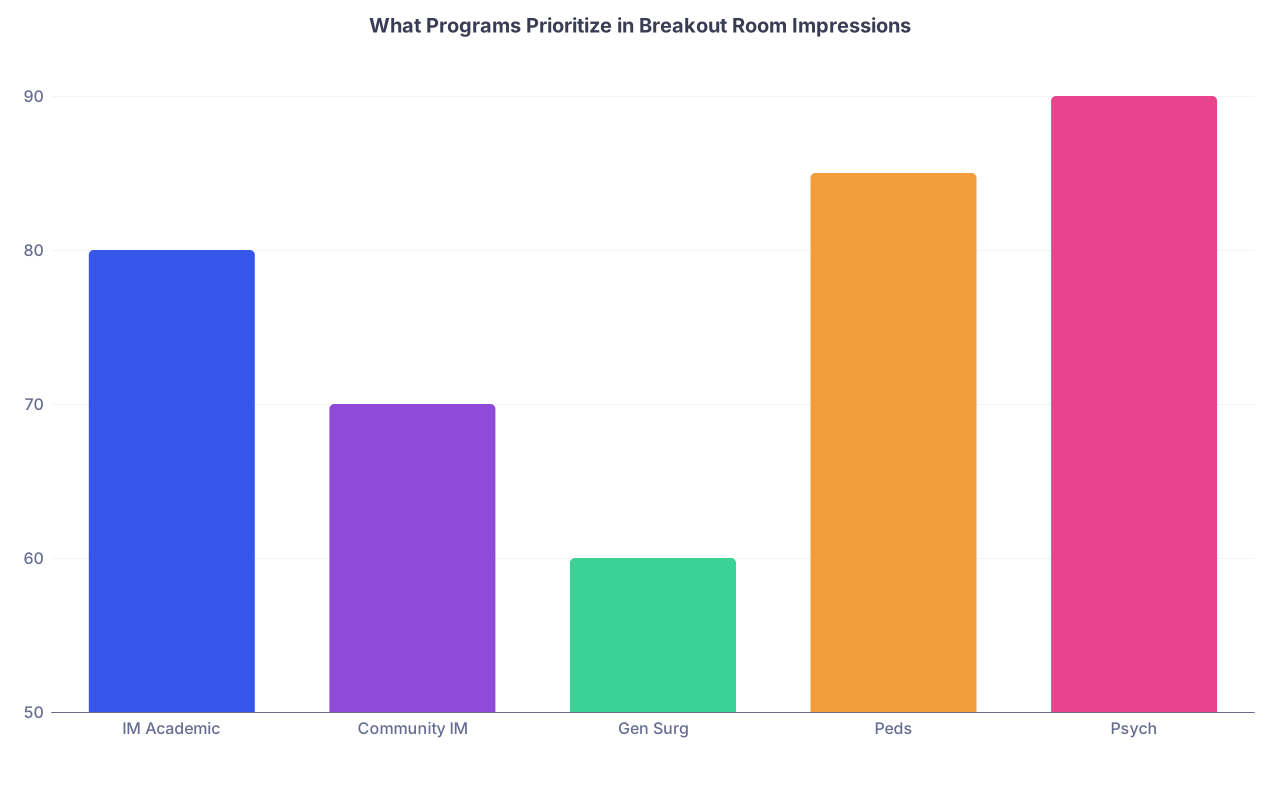
Not every specialty values the same behaviors. You’re not being judged against some universal standard; you’re being measured against that program’s culture.
| Category | Value |
|---|---|
| IM Academic | 80 |
| Community IM | 70 |
| Gen Surg | 60 |
| Peds | 85 |
| Psych | 90 |
The numbers here represent, roughly, “percentage of decision weight” faculty informally admit they give to personality/fit from these informal spaces. It’s not exact, but the trend is real: peds and psych live and die on “do we like you as a human.” Academic IM is not far behind. Surgery cares too, but they’re more explicit about “grit” and “workhorse energy.”
So in a peds or psych breakout room, you trying to be hyper-polished and “on message” can backfire. The resident wants to know if you’re someone they’d trust with a scared family at 3 a.m., not whether you memorized program statistics.
The Technical Stuff That Quietly Hurts You
Let me hit the boring but real factors: your tech and environment.
If two applicants are equal on paper and one comes across clean and present, while the other is chaotic and hard to hear, the first wins. People pretend that doesn’t matter. It does.
The “This Person Will Be Hard to Work With Remotely” Signal
Zoom chaos during the interview implies Zoom chaos during didactics, telehealth, and remote sign-out. We see:
- Constant background noise you clearly didn’t attempt to minimize
- Terrible lighting where your face is a shadow (reads as unprepared, not poor)
- You repeatedly dropping from the room because you chose an unstable Wi-Fi spot
- 10-second delays before you respond, making discussions choppy
No one is cruel about this in the meeting. But someone will say, “Their setup was a mess—I worry about reliability.” That can be the nudge that drops you behind the next person.
Breakout rooms magnify this because they’re unscripted and fast-paced. You seem “slower” or “checked out” if you’re fighting with your mic button.
Resident Debrief: What Actually Gets Said About You
After interview day, residents talk. Some programs formalize it, others just funnel impressions to the chiefs or PD.
Here’s what that conversation actually sounds like when they pull up the list of names:
“Anyone have strong feelings about [Your Name]?”
“Yeah, they were in our breakout. Seemed really kind, asked others questions, didn’t dominate. I liked them.”
“Same here.”
“Okay, plus for them on ‘fit.’”
Or the opposite:
“Any concerns?”
“They kind of took over our room. Every question turned into a mini-lecture. It wasn’t awful, but it was a lot.”
“Yeah, I noticed that too in the resident Q&A.”
“Alright, maybe not top of our list if we have similar applicants.”
No one says, “They were perfect.” Strong positive or strong negative usually comes from these informal spaces, not the faculty 1:1.
How to Behave in Breakout Rooms Without Being Fake
You don’t need a character. You need some guardrails.
1. Default to “Thoughtful Second Speaker”
You don’t need to jump in first every time. In fact, always speaking first reads as attention-seeking.
In a new breakout:
- Let someone else ask the first question or respond
- Listen, then build or pivot with something short:
“That’s actually something I was going to ask too—especially about how you all support each other on tough rotations.”
You still look engaged, but not desperate for spotlight.
2. Ask One Good Question Per Room
Do not rapid-fire a list of five questions. That’s a hostage situation, not a conversation.
Aim for one strong, open-ended question that invites real answers, something like:
- “What kind of resident doesn’t do well here?”
- “What’s one thing that surprised you about the program, good or bad?”
- “When you’re on your hardest month, what’s the culture like among residents?”
These questions do double work: they give you actual information, and they make you sound like someone who’s thinking about team dynamics, not just prestige.
3. Make Space Intentionally (But Casually)
The most powerful move in a breakout is this simple line, used once, naturally:
“I feel like I’ve been talking a bit—does anyone else want to jump in?”
Faculty don’t teach you that line. Residents notice it. It screams “good co-intern.”
Use it once. Do not turn it into a bit.
4. Stop Trying to Impress Other Applicants
Here’s the quiet truth: other applicants’ opinion of you is irrelevant. They don’t rank you. Residents and faculty do.
When you start trying to impress your peers, your questions and comments become performative. Overly long. Buzzword-heavy. Residents can feel when you’re talking to them vs talking for them.
Keep it simple. Plain language. Real curiosity. You’re interviewing your future coworkers, not defending a grant.
Timeline of How Breakout Impressions End Up on Your Rank
To make it concrete, here’s how your behavior travels through the system.

| Step | Description |
|---|---|
| Step 1 | Breakout Session |
| Step 2 | Resident Impression |
| Step 3 | Group Chat / Debrief |
| Step 4 | Chief / Coordinator Notes |
| Step 5 | Rank Meeting Discussion |
| Step 6 | Final Rank List |
Once someone has either a strong positive or strong negative impression of you from a breakout room, it is very hard to erase downstream. Neutral impressions usually fade. Memorable ones stick.
The Biggest Red Flags We’ll Quietly Nuke You For
No one writes these in the official rubric, but they absolutely kill applicants:
- Trashing other programs by name in casual conversation
- Humblebragging to an absurd degree (“I only took Step once the week after my R01 got funded…”)
- Clearly not listening and asking a question that was answered 5 minutes ago
- Acting annoyed or impatient with tech issues or delays
- Making jokes that land even slightly sexist, racist, or punching down
I have sat in a ranking meeting where someone said, “They made a joke about nurses in the resident room that didn’t feel right.” That applicant dropped 20–30 spots. Instantly.
You will never see that written in your file. But it happens.
Quick Reality Check: What Matters Most From Breakout Rooms
Let me put this in perspective. Breakout rooms are not more important than:
- Your letters
- Your clinical performance
- Major professionalism issues in your record
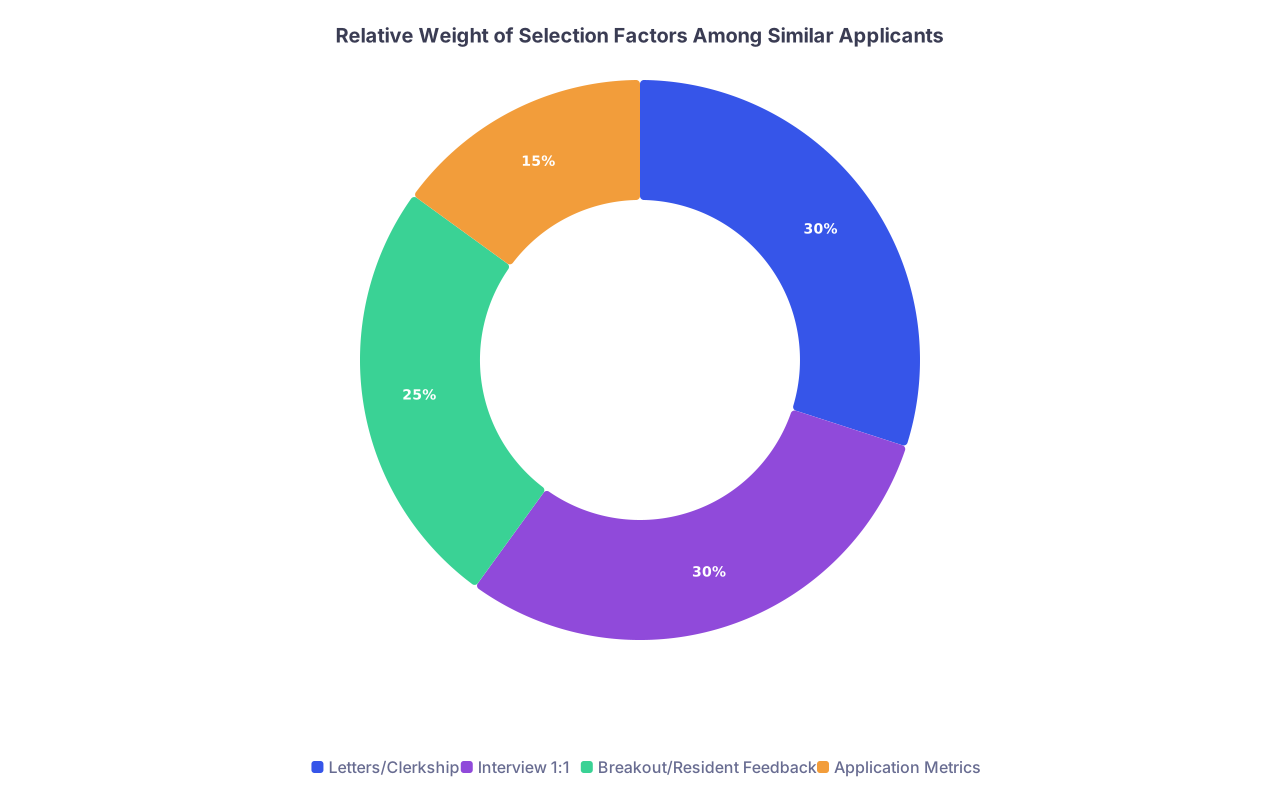
But among applicants who look similar on paper—and there are many—breakout impressions are one of the loudest tiebreakers.
They answer what we care about far more than your “Why this program?” speech:
Do we actually want to work with you?
| Category | Value |
|---|---|
| Letters/Clerkship | 30 |
| Interview 1:1 | 30 |
| Breakout/Resident Feedback | 25 |
| Application Metrics | 15 |
For two roughly equivalent candidates, 20–30% of that final “gut call” can be resident impression. Most of that is forged in these semi-informal spaces.
FAQs
1. If I’m naturally introverted, am I at a disadvantage in breakout rooms?
Not automatically. Programs are not looking for the loudest person; they’re looking for someone who’s engaged and decent. If you contribute a few thoughtful comments, ask one good question, and show you’re listening (nodding, brief verbal acknowledgments), that’s enough. What hurts you is disappearing completely—camera on but stone silent the entire time. Speak up occasionally, even briefly. You don’t need to perform extroversion.
2. Are resident-only rooms really used in ranking, or is that just lip service?
They’re used. Heavily. Some PDs will say, “If our residents hate someone, I’m not forcing that person on them.” Resident feedback isn’t always a strict veto, but a strong negative from multiple residents can tank you. Conversely, a couple of residents strongly vouching for you from breakout interactions can pull you up a tier when the committee is on the fence.
3. Should I try to “lead” the breakout room to stand out?
Usually no. Forced leadership reads as insecurity. If the room is dying and no one is talking, it’s fine to break the ice or redirect with a question to the resident. But don’t act like the moderator. Aim for “good teammate,” not “self-appointed chief.” Share the space, invite others in occasionally, and focus on genuine conversation over performance. That’s what programs remember.
Key points: Breakout rooms are not downtime; they’re how programs gauge what you’re like off-script. Residents are the primary judges there, and their impressions directly shape your rank. You’ll win those spaces not by performing, but by acting like the colleague you’d want beside you on the worst night of the year.