
The biggest mistakes in residency applications are not on interview day. They happen in the 24–72 hours after, when most applicants drift and a few act strategically.
You want to be in that second group.
This is your post-interview day timeline: same-day, 48-hour, and 1-week tasks. Hour by hour, so you are not guessing what to do next or wondering if you should send that email.
Same-Day Timeline: From “End Meeting” To Bedtime
You log off Zoom. Or leave the virtual interview platform. At this point, your brain is fried and your judgment is worse than you think. So you need a simple, mechanical sequence.
First 15–30 minutes: Immediate decompression (but not Netflix)
At this point you should:
Step away from your screen.
- 10–15 minutes. Walk. Stretch. Drink water.
- No texting co-applicants to debrief. No Reddit. Your memory is fragile right now.
Capture raw impressions (voice or shorthand).
As soon as your head clears a bit (within 30 minutes), open your phone and record:- A quick voice memo or
- A messy notes app entry
Hit these points in bullets, not paragraphs:
- Overall vibe: supportive, rushed, cold, “felt like home”
- Standout people: PD, chief, that one faculty who grilled you, resident who felt real
- Red flags: disorganization, missing residents, weird comments, scheduling chaos
- What surprised you (good or bad)
Do not try to craft final rank thoughts yet. You just want memory anchors.
Within 1–2 hours: Structured notes while memory is fresh
Now you switch from raw to structured. This is where a lot of applicants get lazy. They “remember” they liked it and nothing else in January.
Create or open your program impressions template. If you do not have one, build it now.
| Category | Example Entries |
|---|---|
| Program Name | University Hospital IM |
| Interview Date | 2025-11-03 |
| Overall Vibe (1–5) | 4 |
| Residents | Supportive, good camaraderie |
| PD/Leadership | Transparent, clear expectations |
| Education | Strong morning report, weak didactics |
| Schedule/Lifestyle | Q4 call, 1 day off post-call |
| Location | Medium COL, urban, good transit |
| Red Flags | Late start, missing faculty |
| Follow-up Questions | Ask about research time flexibility |
At this point you should fill in, while the day is still sharp:
- Rating (1–5) for major domains:
- Program culture
- Resident happiness
- Education
- Research/academic support
- Location / family fit
- Schedule / wellness
- Specifics you will forget later:
- “Interns leave by 6 pm on non-call days”
- “Mandatory research project, but they help you find one”
- “Only 1 ICU month as PGY-1, 2 months as PGY-2”
- Exact phrases people used that hit you:
- PD: “We protect education time no matter how busy the hospital is.”
- Resident: “People actually cover for you if you are drowning.”
Do this for 20–30 minutes. No more. Perfection is not the goal; preservation is.
Same evening (within 6–8 hours): Thank-you email planning (not sending)
This is where people screw up timing. They write and fire off a generic thank-you blast 30 minutes after logging off. It reads formulaic, and sometimes it literally has the wrong program name.
Same day, you should:
List everyone you interviewed with.
From the schedule or your memory:- PD / APD
- Individual faculty interviewers
- Chief/resident interviewers (depends on program culture if you email them)
Decide who actually gets a thank-you.
My rule:- Always: PD, APD, formal faculty interviewers
- Often: Chief resident if they interviewed you one-on-one
- Optional: Resident social / lunch hosts. If someone really helped you, yes.
Draft skeleton thank-you templates.
Do not hit send. Just draft:- A PD/APD version
- A faculty interviewer version
- A resident version
Each template should have:
- One specific detail from your conversation
- One tie-in to your interests or goals
- One closing line about fit or future
You will personalize and send these within the 24–48-hour window. Not tonight.
Before bed: Quick emotional snapshot
At this point in the day, your emotions are loud and your judgment is skewed, but that emotional snapshot matters later.
Write down in one sentence:
- “Right now, this feels like a top choice / mid-tier / back-up.”
- Add 1–2 reasons why, in plain language.
This gives you a reference when you are more analytical in a few weeks and wondering, “Did I actually like this place, or do I just like their name?”
0–48 Hours: Follow-Up, Clarification, and Professional Presence
The intense part is over. Now the timeline matters, because this is where small lapses look unprofessional.
Within 24 hours: Clean up your footprint and logistics
Day-after tasks are boring but critical. At this point you should:
Check your email for any program follow-up.
- Survey links
- Required forms (e.g., preference for tracks, location lists)
- Instructions for second-look, if they still do that virtually
Calendar everything.
- Add the program name and interview date to your master rank list tracker.
- Note deadlines for:
- Program open houses
- Second looks
- Any “please complete this by X” tasks
Lock in your file naming and folder system.
If you interviewed at:- Program_01_UniversityHospital_IM
Then create: - Notes file
- Email thread label/tag
- Screenshot folder (if you captured slides or schedules)
- Program_01_UniversityHospital_IM
You will thank yourself in February when everything is not in one chaotic folder called “Interviews.”
24–36 hours: Write and send individualized thank-you emails
This is the window I recommend. You are not desperate-fast, not late-forgotten.
At this point you should:
Personalize each email.
Use your skeleton from interview day and add 1–2 targeted details. Example:- Reference a specific patient population you discussed.
- Mention the research project or QI idea that came up.
- Call back a moment of connection (“I appreciated your honesty about burnout…”).
Keep them short.
5–8 sentences. Anything longer is self-indulgent and will not be fully read.Basic structure:
- Thank them for their time.
- Name one or two specific takeaways.
- Connect that to your interests or values.
- End with a professional, neutral closing (no premature commitment language).
Common mistakes to avoid:
- Sending identical emails to multiple faculty who know each other.
- Misspelling names or titles.
- Over-selling: “Your program is my top choice” to six places in November. That is how you lose credibility.
Who not to email:
- Generic program account, unless instructed.
- People you did not meet.
- Residents from the social you barely interacted with, unless you have something real to say.
24–48 hours: Clarify factual questions while they remember you
If something important was fuzzy or never answered, now is the time to ask. Program coordinators and PDs remember you best in that 1–2 day window.
Good follow-up questions within 48 hours:
- “Could you clarify how many elective months residents typically have in PGY-2 and PGY-3?”
- “Is there formal mentoring for residents interested in cardiology fellowship?”
- “For residents with partners in other fields, how flexible is scheduling during interview season?”
Bad follow-ups:
- Anything answered clearly in the pre-interview packet.
- Questions Google could answer in 30 seconds (parking, general city info).
- Aggressive questions about ranking or guaranteed spots.
Send these to the program coordinator, unless your question is clearly for PD/APD.
2–7 Days: Reflection, Comparison, and Rank List Seed Planting
The week after your interview is where serious applicants separate from “going with my gut at the end.” You are building the scaffolding for your final rank list, program by program.
Days 2–3: Formalize program scores and initial rank zone
At this point you should reopen your notes and translate impressions into something comparable.
I like a 1–5 scoring system. Not perfect, but better than vibes.
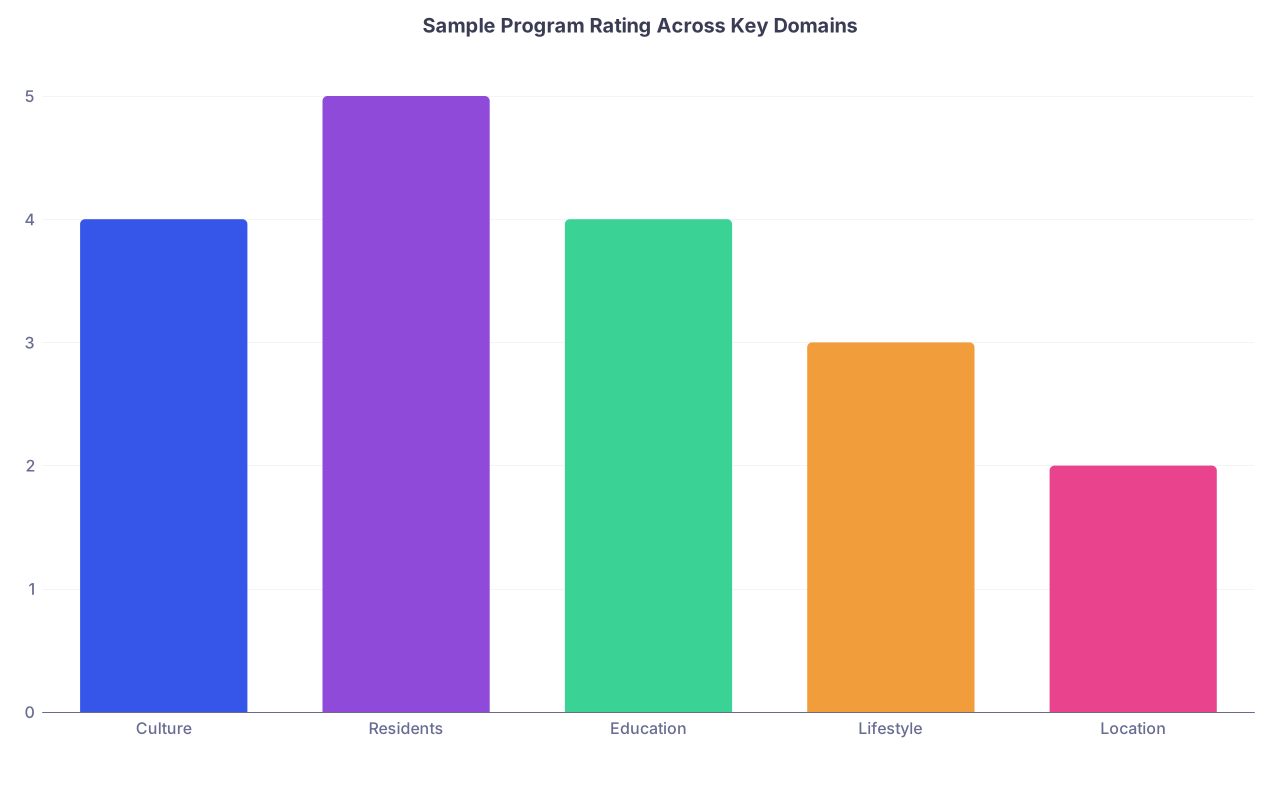
| Category | Value |
|---|---|
| Culture | 4 |
| Residents | 5 |
| Education | 4 |
| Lifestyle | 3 |
| Location | 2 |
Do this for each program:
Assign numeric scores (1–5) for:
- Program culture (supportive vs malignant)
- Resident happiness (did they actually look alive?)
- Education quality (conferences, teaching, supervision)
- Clinical exposure (acuity, volume, diversity of pathology)
- Schedule/lifestyle (call structure, days off, night float)
- Location/personal fit (family, spouse, cost of living)
Label the emotional rank zone.
- “Top-tier for me”
- “Middle of the list”
- “Only if I need backup”
You are not fixing final order, just rough tiers.
Write a 2–3 sentence program summary.
Example:Academic IM with strong fellowship placement, rigorous ICU exposure, and residents who seem genuinely close. Location is less ideal for family but manageable. Would be happy here if I match.
This is what you will reference when comparing against 10–15 other places later, not your memory of one “funny resident” from the social.
Days 3–5: Compare against previous interviews (not hypothetical ones)
By now you likely have multiple interviews completed. This is where a simple comparison table helps.
| Program | Culture (1–5) | Lifestyle (1–5) | Location (1–5) | Tier Label |
|---|---|---|---|---|
| University IM A | 4 | 3 | 2 | Top-tier |
| Community IM B | 3 | 4 | 4 | Mid-high |
| County IM C | 5 | 2 | 3 | Top-tier |
At this point you should:
Slot the new program into your evolving rank list.
- Do not wait until February to start ranking.
- Ask: “Today, do I like this more or less than Program X and Y that I already saw?”
Use direct comparison questions:
- “Where would I rather intern on my worst call month?”
- “Where would I want to be if I had a bad month mentally?”
- “Where did I feel like myself, not performing a role?”
Adjust tiers as you accumulate more data.
If everything is “top tier,” you are lying to yourself. Force yourself to create:- Top 3–5
- Middle chunk
- Safety/backup group
Days 5–7: Strategic outreach and loose ends
By the end of the first week post-interview, your tasks are less about politeness and more about positioning and clarity.
At this point you should:
Close the loop on any promised follow-up.
- If you told an interviewer you would send a paper you worked on or a poster abstract, send it.
- If you mentioned a mentor by name, consider giving that mentor a heads-up that they might be contacted.
Decide whether the program needs more information about you.
Most of the time, they do not. But in some cases:- You have a new publication accepted.
- You have a significant award or leadership role change.
- You discovered a specific niche in their program that aligns with your work (e.g., global health track).
If you email, keep it short and non-desperate:
- “Wanted to share a brief update since we met…”
Not: “I want to reiterate how much I loved your program” every week.
Mark any programs that may need a second look.
For those:- Note specific questions you still have: “actual duty hours,” “moonlighting policy,” “partner job market.”
- Keep a running list; some programs will later offer virtual second looks or Q&A sessions.
Update your master timeline.
Here is what your one-program micro-timeline roughly looks like from interview to one week:
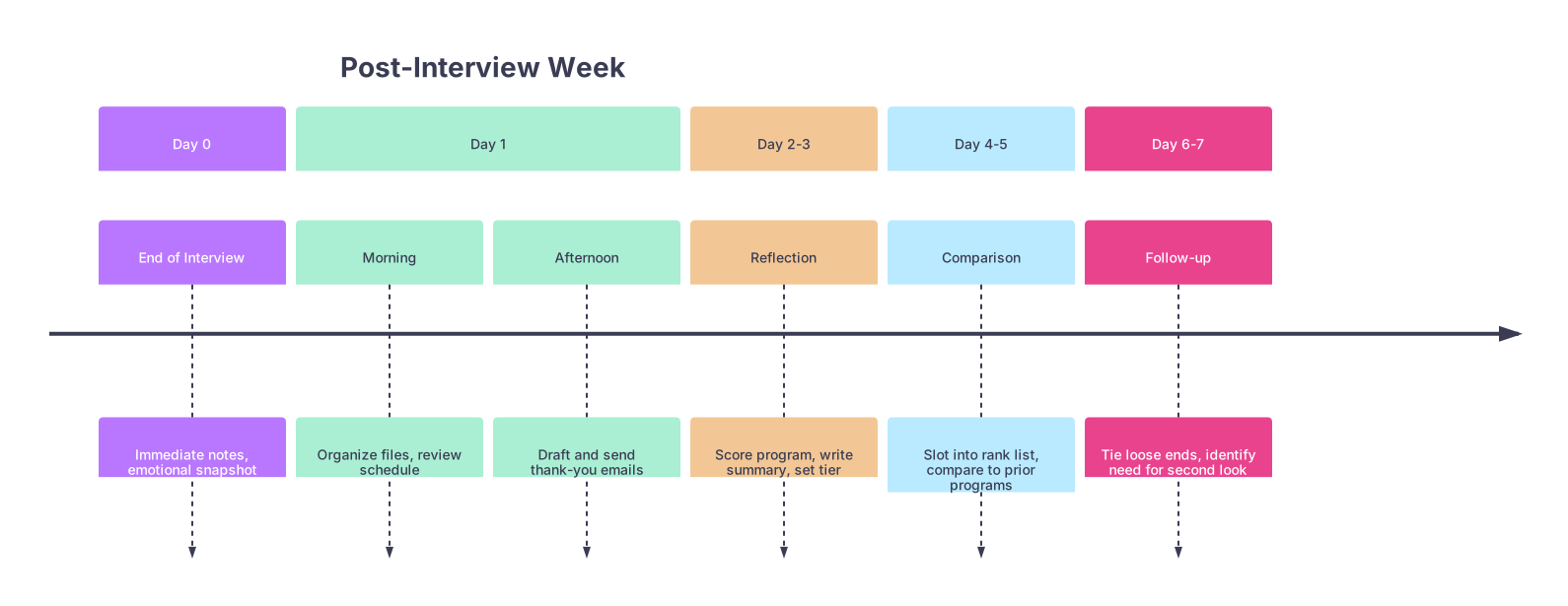
| Period | Event |
|---|---|
| Day 0 - End of Interview | Immediate notes, emotional snapshot |
| Day 1 - Morning | Organize files, review schedule |
| Day 1 - Afternoon | Draft and send thank-you emails |
| Day 2-3 - Reflection | Score program, write summary, set tier |
| Day 4-5 - Comparison | Slot into rank list, compare to prior programs |
| Day 6-7 - Follow-up | Tie loose ends, identify need for second look |
Repeat that for each program, and your February will be orderly instead of chaotic.
Video Interview–Specific Adjustments
Since you asked in the context of video interviews, there are a few extra timeline-specific details that matter.
Same day: Tech and environment debrief
Right after your interview (same day), you should quickly note:
- Tech issues you had:
- Audio lag
- Poor lighting on your side
- Background distractions
Do not obsess, but if something went clearly wrong (your mic cut out, Zoom rebooted, etc.), mention it if and only if it impacted the conversation.
Within 24 hours, if it was serious:
- Brief note to the coordinator:
- Acknowledge the glitch, thank them for patience, and reassure that you are reachable if they need clarification on anything that may have been cut off.
Minor issues (slight lag, one “sorry you froze for a second”) do not need follow-up. Everyone knows video is imperfect.
Within 48 hours: Rehearse micro-fixes for next interviews
Use the experience to refine for upcoming video days.
At this point you should:
- Adjust:
- Camera height
- Lighting angle
- Background clutter
- Note any awkward transitions or delays in breakout rooms and mentally prepare:
- Keep a neutral face while waiting.
- Have 1–2 default “small talk” lines ready for residents during tech pauses.
You are not just reacting. You are iterating.
What Not To Do During This Week
A few time-based traps that derail people:
Same-day ranking commitments.
Do not email: “You are my top choice” right after the interview. It sounds impulsive and, frankly, untrustworthy.48-hour over-communication.
One polite thank-you email per interviewer is enough. No “just checking if you received my previous email.”1-week manipulation attempts.
Do not press for where you are on their list, or fish for promises. Program leadership hates that. They remember.
Use this week to show you are organized, thoughtful, and appropriately professional. Not clingy.
The Core Moves You Must Hit
Boil it down to three essentials:
- Same day: Capture everything while it is fresh—raw notes, structured impressions, and a one-line emotional take. Do not send anything yet.
- Within 48 hours: Send targeted, specific thank-you emails and clarify any real unanswered questions. Log the program into your master system.
- Within 1 week: Score, compare, and slot the program into your evolving rank list. Close any promised follow-ups and mark programs that may need a second look.
If you run that playbook for every interview, your post-interview timeline will be sharper than most of your competition—and your final rank list will actually reflect reality, not fuzzy memories from a very long season.