
It’s 5:27 p.m. on a Thursday in January.
Your Zoom interview just ended. You’re replaying every answer, obsessing over that one awkward joke, the one clinical question you fumbled a bit. On your end, the screen is black. Silence.
On their end?
The attending un-mutes first: “Alright, so… what do we think?”
That’s the moment this article is about. The 10–20 minutes after you log off. The resident de-brief. The faculty huddle. The “post-game” that decides whether your name ends up on the “fight for” column or the “meh, safe to drop” column.
You never see this. But I have—and I’ve sat in more of these rooms than I can count. Let me walk you through what really happens, and what they actually say about you when you’re not there.
How De-Briefs Actually Run (Not What You Read on Brochures)
Let’s kill the fantasy.
Programs love to talk about “holistic review” and “structured scoring rubrics.” Some actually use them well. Many… sort of gesture toward them and then do what they want.
Here’s the usual sequence in a video interview-based program:
- Interview day running on Zoom or Teams. Residents and faculty each have small groups or 1:1 interviews.
- You log off.
- Within minutes, there’s a group room or a physical conference room where everyone who interviewed you gathers (or drops in virtually).
- The coordinator is either quietly taking notes or later will collect scores/comments through a form.
- Each applicant gets anywhere from 2–10 minutes of airtime in that de-brief. That’s it. Your whole professional soul distilled into a very short, sometimes chaotic discussion.

| Step | Description |
|---|---|
| Step 1 | Applicant Logs Off |
| Step 2 | Immediate Gut Reactions |
| Step 3 | Scoring / Anchoring |
| Step 4 | Resident Comments |
| Step 5 | Faculty / PD Comments |
| Step 6 | Preliminary Category: Strong / Middle / No |
| Step 7 | Notes for Rank Meeting |
There are two big truths:
- The first person to talk shapes the entire discussion.
- The resident voice is more powerful than you think in borderline cases, and less powerful than you think in absolute cases.
We’ll get to that. But first, let’s talk about the categories they silently drop you into.
The Three Buckets: Where You Really End Up
Every program has its own flavor, but behind closed doors, almost everyone is classifying you into one of three unspoken buckets:
- “Yes, please”
- “Fine, but replaceable”
- “No, not a fit”
Here’s how that actually looks in the de-brief.
1. “Yes, please” – The Ones They’ll Fight For
The conversation sounds like this:
- “I really liked them.”
- “I would absolutely work nights with this person.”
- “Smart, normal, not awkward. I’d be happy if they matched here.”
Notice: they’re not saying, “Their Step score is 255” or “They had 11 publications.” That already got you in the room. The de-brief is almost entirely about:
- Would we trust you on day one?
- Would we suffer having you on a 28-hour call?
- Will you embarrass us in front of patients or leadership?
The “yes, please” people usually trigger a quick consensus. A typical sequence:
- One attending or senior resident says, “Strong yes from me.”
- Others either echo or nod: “Yeah, I liked them too.”
- Someone throws in a detail: “Also, did research in X, could help with our QI stuff.”
The coordinator writes something like: “Strong resident support, good fit, easy to talk to, solid clinical judgment. Rank to match range.”
You think they remember your beautiful answer about health equity. They don’t. They remember: “Liked them. Sharp. Chill.”
2. “Fine, but replaceable” – The Quiet Graveyard
This is where most applicants land.
De-brief sounds like this:
- “They were fine.”
- “Seemed nice. Nothing concerning.”
- “I don’t really remember them, to be honest, but nothing stood out.”
That last one is death by blandness. If someone says, “I don’t remember them,” the room will not fight to bring you back to life. Programs have way too many decent applicants to rescue forgettable ones.
These candidates still get ranked. But they’re ranked purely based on the paper metrics, school, and whatever vague impression was logged.
What comments get documented?
- “Pleasant, appropriate, solid.”
- “Middle of the pack; would be fine here.”
- “No red flags, but didn’t pop.”
That’s how your interviews actually translate.
3. “No, not a fit” – The Quiet Assassination
If a resident or attending says one of these phrases, you’re done:
- “Something felt off.”
- “I wouldn’t want to be on call with them.”
- “I got weird vibes.”
- “They talked a lot, but didn’t say much.”
- “Came off arrogant / dismissive / uninterested.”
Unless your application is god-tier and the comment is mild, this usually drops you dramatically. And not because they’re cruel. It’s risk management. Programs are terrified of bringing in one toxic or unsafe person; they’ll gladly pass on someone with a good CV if there’s a hint of trouble.
The note the coordinator writes is something like:
- “Concerns from resident about fit; seemed disengaged.”
- “Possible professionalism concern – minimized feedback, talked over interviewer.”
- “Did not show clear interest in program; limited questions, seemed checked out.”
You will never see that comment. But it will sit there when they build the rank list.
What Residents Actually Look For (And Say Out Loud)
You’re reading this because you specifically asked about resident de-briefs. Good. Residents drive a lot of the social and culture commentary. PDs know they ignore resident input at their own peril.
Here’s the truth: residents are not grading your obscure research or your exact Step score. They’re grading:
- Would I trust this person with my patients?
- Would I trust them with my sanity at 3 a.m.?
Typical resident-driven comments in de-brief sessions:
- “They actually asked about our call schedule in a real way, not just fishing. Felt like they understand what residency is actually like.”
- “They asked everyone else about research but didn’t ask the residents anything—felt like they didn’t care what our experience was.”
- “They lit up when we talked about [X patient population / bread and butter cases]. Seemed genuinely into the work.”

The Residents’ Unspoken Rubric
They won’t spell this out, but here’s the mental checklist they use:
- Normal person test: Can you have a conversation without weird social friction?
- Humility vs. insecurity: Are you teachable without being a doormat?
- Team awareness: Do you ever say “we” instead of only “I” when you talk about clinical work?
- Workhorse potential: Do you sound like you understand that residency is hard, or are you giving delusional “work–life balance” answers for malignant-level programs?
- Interest signal: Did you bother learning anything specific about this program or city?
What do they actually say when those boxes are or are not checked?
Positive examples:
- “Felt like someone who’d jump in and help without complaining.”
- “Really appreciated that they asked what we would change about the program—that’s a savvy question.”
- “You can tell they’ve worked on busy services before; they weren’t naïve about workload.”
Negative examples:
- “They kept asking if we get our weekends protected… felt like their priority is time off, not training.”
- “Didn’t know we’re a county hospital. Like, at all. Felt unprepared.”
- “Talked over me a few times when I answered. That’s going to be bad with nurses and staff.”
Those single sentences carry more weight than another publication ever will.
Faculty and PDs: How They Translate Your Interview Into the Rank List
Residents care if they want to work with you. Faculty care if they want their name attached to you.
Their de-brief comments often center on:
- Clinical reasoning
- Professionalism
- Red flags (subtle and obvious)
- Risk to the program’s reputation
You’ll hear phrases like:
- “They think like an intern already.”
- “They’re very green. Might struggle early, but seems coachable.”
- “Their answers felt rehearsed.”
- “I’m a bit concerned about their understanding of their weaknesses—they deflected a lot.”
And from PDs or APDs:
- “We liked them a lot, but are they likely to rank us high? Any sense of that from the residents?”
- “We already have three from [their med school]. Diversity of background matters here.”
- “We need at least a couple of residents interested in academics—this one would fit that niche.”
They’re not just ranking you individually. They’re building a class. Balancing service-heavy workers, academic types, quiet grinders, outspoken advocates. Your de-brief comments become data points in that puzzle.
Video vs In-Person: What Changes In De-Briefs
With virtual interviews, something important happened: your on-screen presence became a separate line item.
Programs pretend they’re only scoring content. They’re not. They’re humans staring at faces in boxes for hours. They absolutely comment on:
- Eye contact (or staring at a second monitor)
- Audio/video quality if it interferes with communication
- Background disaster (messy bed, chaotic noise, weird lighting)
- Overall vibe on camera
They won’t write “bad camera quality” as a red flag. But you’ll hear:
- “They seemed really disengaged—kept looking off screen.”
- “Hard to connect with them over Zoom; maybe they’d be better in person, but we don’t have that luxury.”
- “Felt kind of flat. I couldn’t get a sense of their personality.”
On the flip side, strong virtual presence gets translated like this:
- “For Zoom, they were great—easy to talk to, good energy.”
- “Really clear communicator even over video—patients will like them.”
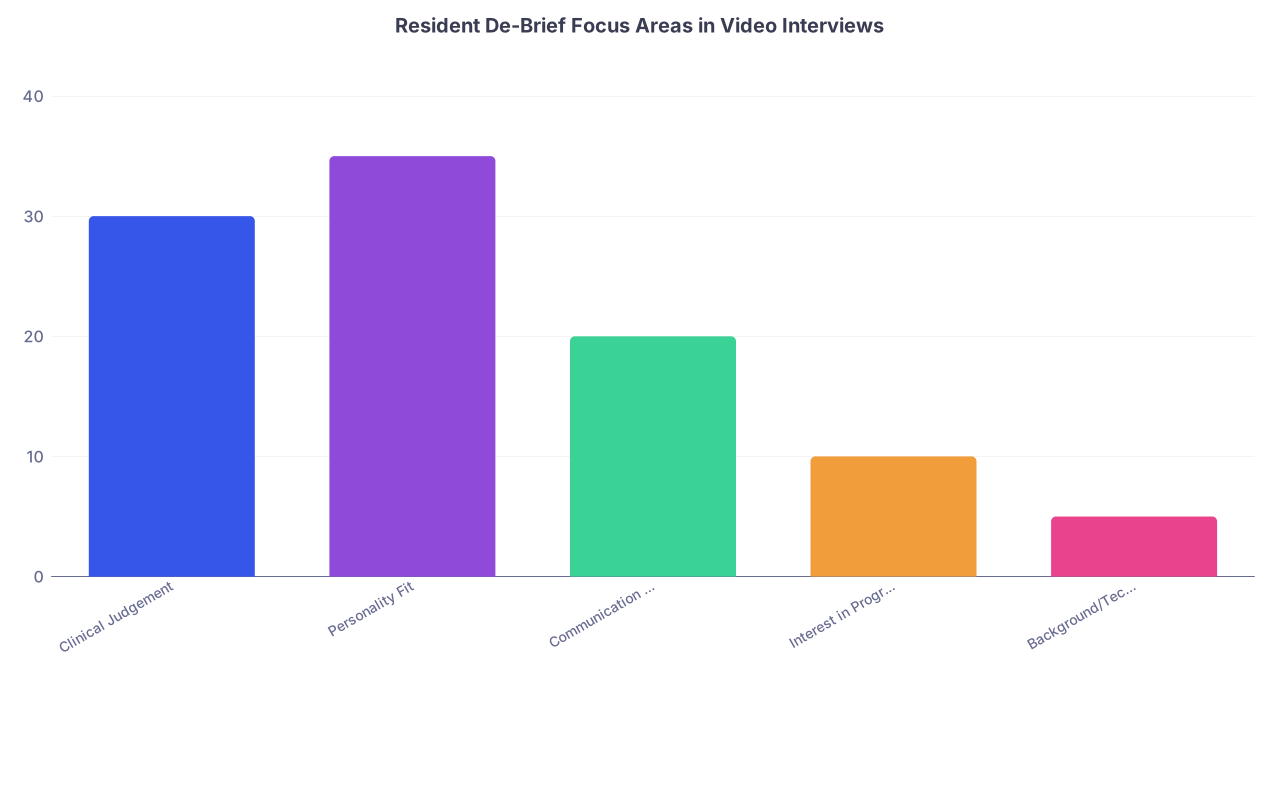
| Category | Value |
|---|---|
| Clinical Judgement | 30 |
| Personality Fit | 35 |
| Communication on Video | 20 |
| Interest in Program | 10 |
| Background/Tech Issues | 5 |
Those numbers are approximate, but that’s the hierarchy: your actual answers matter, but the filter is always “Do I like this person enough to work with them?”
The Phrases You Want Them to Use (And How to Earn Them)
You can’t control the entire narrative, but you can push them toward certain phrases. There are a few comments that almost always correlate with a healthy rank:
- “I would be happy if they matched here.”
- “Top half of the group today for me.”
- “Feels like one of ours.”
- “Resident favorite.”
How do people earn those labels?
They do three things very consistently:
They sound like they’ve actually been in the trenches.
Not just flexing clerkship anecdotes, but speaking in a way that shows they’ve seen volume, handled uncertainty, and understand what being responsible feels like.They ask questions that reveal judgment, not desperation.
Questions like:
– “How does feedback actually show up in your day-to-day as residents?”
– “What differentiates your graduates when they leave compared to other programs in the region?”
That triggers, “Okay, this person is thinking like a resident, not a tourist.”They’re memorable for one authentic thing.
Not a gimmick. A clear interest, a story, a pattern.
“That’s the applicant who worked as an EMT for years before med school—remember?”
“That’s the one who wants to do addiction medicine and had that story about the clinic.”
Remember: being memorable is less about being flashy and more about having a coherent, believable identity.
How Much Do Residents Really Influence the Rank List?
Depends on the program. Here’s the behind-the-scenes breakdown you won’t see on any website:
| Program Type | Resident Influence |
|---|---|
| Community, resident-run | Very High |
| Mid-tier university, large class | Moderate–High |
| Elite academic, highly hierarchical | Moderate |
| Malignant / old-school surgical | Low–Moderate |
| Small program with PD microcontrol | Variable |
At many medicine, peds, EM, psych programs, you’ll hear variations of:
- “If residents hate someone, we’re not ranking them high. Period.”
- “We filter out anyone with big resident concerns—too risky.”
At more hierarchical or old-school surgical programs, residents’ voices are more about social fit, less about academic rank placement:
- “We can’t have someone who will implode the team dynamic. I don’t care if they have 20 papers.”
One more quiet truth: resident “hard no” carries more weight than resident “hard yes.”
If residents say, “Absolutely not,” PDs get very nervous about ignoring that. If residents say, “We love them,” but faculty are lukewarm? That applicant gets bumped up a bit, not catapulted to #1.
How Your Interview Actually Gets Written Down
Most programs use some combination of:
- Numeric scores (1–5 or 1–10) across domains
- Free-text comments
- “Overall rank preference” or “would you rank this applicant in our top 1/3, middle 1/3, bottom 1/3?”
The part that haunts you later (and you never see) is the short free-text summary that survives until rank day. It’s usually pulled straight from the de-brief language.
Your summary might look like:
- “Strong candidate, good clinical reasoning, very collegial, residents liked them, clear interest in underserved population – top 1/3.”
- “Pleasant, but generic interview; no specific interest in our program, moderate communication skills – middle 1/3.”
- “Some concerns raised about defensiveness when discussing weaknesses, limited insight; would not rank highly – bottom 1/3.”
When they sit down weeks later to construct the actual rank list, nobody remembers your face. They remember those 2–3 lines. That’s what your interview becomes.
How To Tilt The De-Brief In Your Favor
You asked for what happens in the room. I’ve given you that. Now, how do you exploit it?
Three things, bluntly:
Optimize for being easy to advocate for.
You want a resident or attending to feel comfortable saying, “I really liked them.” That means:
– Show up prepared (know the program basics).
– Be normal to talk to.
– Be clear about your interests without sounding rigid or entitled.
No one wants to defend someone who was high-maintenance, spacey, or vague.Give them phrases they can reuse.
Say things like:
– “I really value being part of a tight resident group where we have each other’s backs.”
– “I’m drawn to heavy clinical training early.”
They will literally repeat that in de-brief: “They said they really want heavy clinical exposure early on—that’s us.”Avoid triggering the vague negative.
The worst outcome isn’t “bad interview.” It’s “something felt off.”
That gets you crushed.
Slow down. Listen when residents talk. Don’t monologue. Don’t over-sell. Answer what you’re asked. Admit what you don’t know without spinning.
You’re not auditioning to be perfect. You’re auditioning to be trusted.
FAQ – Resident De-Briefs, Unfiltered
1. Can one bad resident comment tank my chances?
If it’s a single mild comment (“a bit quiet,” “seemed nervous”), usually no. That gets averaged out. But a strong, specific negative comment—especially about professionalism, arrogance, or weird behavior—can absolutely sink you, even if your faculty interviews were fine. Programs are deeply allergic to interpersonal risk.
2. Do they really care if I seem interested in their program specifically?
Yes. Not in the fake, flattery way. But if your questions make it obvious you didn’t bother learning that they’re a county program, or you mix them up with a rival program, residents will say, “They’re just applying everywhere.” That doesn’t always kill you, but it drops you into the “replaceable” bucket instead of “someone we want to recruit.”
3. How much does nervousness hurt me in de-briefs?
Mild nervousness? Almost nobody cares. They’ll say, “Clearly nervous but nice, solid answers.” Chronic rambling, inability to answer directly, or coming off disorganized—yes, that gets mentioned and can push you down. If you’re anxious, aim for clear structure in your answers more than charm.
4. Do they talk about my Step scores or school in the de-brief?
They already saw those. By de-brief time, your scores and school are mostly baked into their baseline expectations. They might say, “They’re coming from [X school], so they’ll handle our volume fine,” or “Step is on the lower side, but I didn’t see any red flags clinically.” The discussion is overwhelmingly about fit, judgment, and how you came across—not raw metrics.
Two things to remember as you close that Zoom window next time:
- They’re not dissecting every phrase. They’re deciding, fast, “Would I work with this person?”
- Your goal is not to impress everyone. Your goal is to make it very easy for one or two people in that room to say, “I liked them. I hope they match here.”
That’s what actually survives into the rank list.