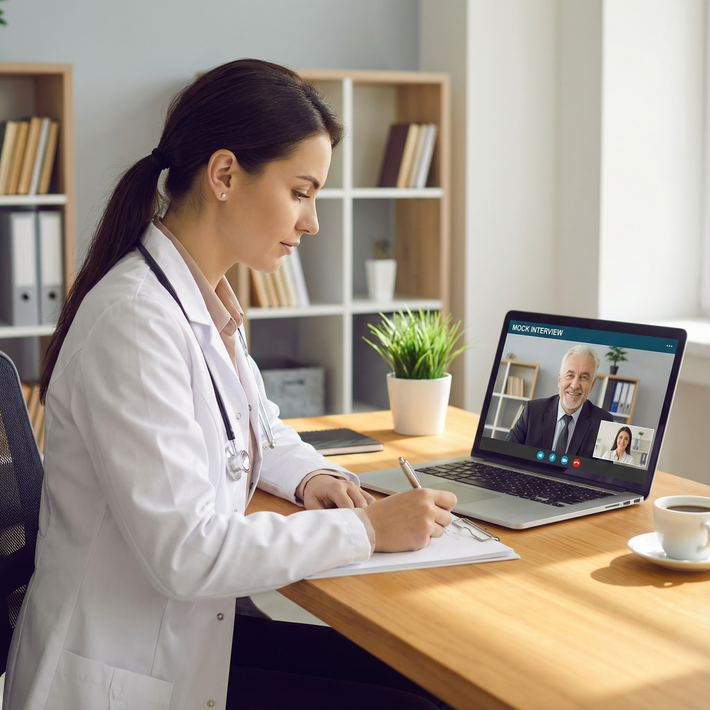
Program directors are judging your background harder than you think.
Not just “is it clean” or “do they have a ring light.” They’re reading your space the way they read your ERAS: for patterns, for red flags, for quiet tells about judgment, maturity, and how you’ll look in front of patients and faculty.
I’ve sat in PD offices after a full day of Zoom interviews and listened to the commentary. They don’t always say it in front of you, but they absolutely talk about your surroundings when your square disappears from the screen.
Let me walk you through what they’re really seeing when they look past your face.
The First 5 Seconds: Snap Judgments They Never Admit
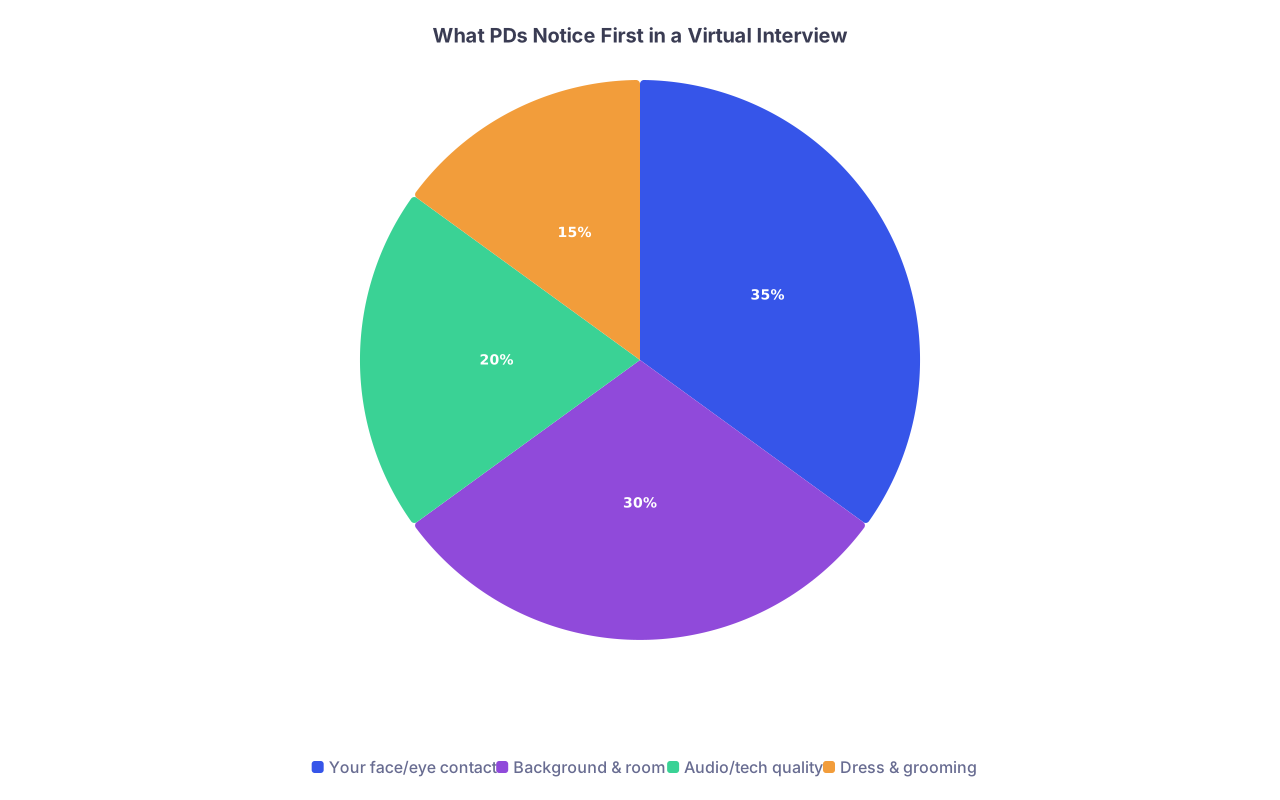
| Category | Value |
|---|---|
| Your face/eye contact | 35 |
| Background & room | 30 |
| Audio/tech quality | 20 |
| Dress & grooming | 15 |
The first few seconds of a virtual interview are brutal. PDs and faculty are forming impressions before you finish your greeting.
They’ll never write “messy bedroom” in the evaluation form. But here’s the kind of thing you actually hear:
- “Her background was… chaotic. I worry she’ll be disorganized on the wards.”
- “He took that from his bed? On interview day? That’s a no for me.”
- “He looked like he was in a basement. Weird lighting. Kind of off-putting.”
They’re not trained in environmental psychology. They just react like humans who have hired a lot of people and watched a lot of residents fail for predictable reasons.
What they’re really asking, subconsciously:
- Does this person take this seriously?
- Can I see them representing our program professionally?
- Do they look like someone who’ll be reliable at 3 a.m.?
Your surroundings answer those questions before you say a word.
The Room You Choose: What It Signals About You
This is the part no one explains well. The type of room you use might not be explicitly judged, but it’s definitely interpreted.
The Bedroom Setup
If they clearly see a bed behind you, here’s what runs through minds on the committee side:
- “They couldn’t find anywhere else?”
- “Why didn’t they angle the camera differently?”
- “Did their school not give them space? Or did they not bother to ask?”
Is a bedroom an automatic rejection? No. I’ve seen people match into very competitive fields from bedrooms. But if the bed is unmade, there’s laundry, open closet, clutter on the floor—now you’ve crossed into “judgment” territory.
The unspoken assumptions:
- You may have poor boundaries between personal/professional life.
- You may be disorganized, which translates in their minds to missed notes, forgotten orders, late responses.
- You didn’t prepare thoroughly, which they extrapolate to how you’ll prep for patients and procedures.
The Kitchen / Dining Table Setup
This gets more leniency. Many faculty children did school from the kitchen during COVID; PDs get it.
But they still notice:
- Dishes or clutter in the background → “distracted, not detail-oriented”
- People moving behind you → “lack of planning, poor control of environment”
- Fridge covered in magnets, personal photos → “they didn’t think about what we’d see”
A clean kitchen or dining area with nothing moving behind you? That’s usually fine. Neutral.
The “Institutional” Setup (School Room, Library, Office)
This reads as: “I took this seriously enough to find a quiet, professional space.”
Most PDs like this. They know med schools/residency advising offices provide spaces for interviews. When they see:
- Blank-ish walls
- Decent lighting
- No bed / no obvious home chaos
They think: solid planning, professional, probably organized.
The “Nice Apartment” Setup
Here’s the unspoken truth: if your background looks like a page out of a West Elm catalog, some people are impressed and some are slightly suspicious.
Comments I’ve actually heard:
- “Wow, nice place for a med student.”
- “Well-lit, very put-together. Looks mature.”
- Or from an older faculty: “Hope they like 3 a.m. call as much as they like that decor.”
It won’t tank you. But flaunting wealth or aesthetic obsession can sometimes create distance. Your goal isn’t to impress them with your interior design. You want them to basically forget your background after 15 seconds. That’s the ideal.
Clutter, Cleanliness, and What That White Wall Actually Says

Let me be blunt: the amount and type of clutter behind you is read as a proxy for how you function under pressure.
No one expects an architect magazine spread. But they do expect intentionality.
Visible Mess = Visible Risk
When a PD sees:
- Open closet with clothes spilling out
- Piles of laundry on a chair
- Random boxes stacked behind you
- Trash can in frame
Here’s where the conversation goes later:
“I know it’s just a room, but that background was a disaster. What does their workroom desk look like? Their sign-out? I do not want that person on my ICU rotation.”
They’re not being fair. They’re being human. They have hundreds of applicants. Any negative cue becomes a simple way to differentiate.
Overly Empty Wall: The “Hostage Video” Look
On the other end, the pure blank white wall, harsh overhead lighting, no depth—it doesn’t offend anyone, but it can make you look flat, tense, almost like a passport photo.
PD thoughts:
- “Looks anxious.”
- “Feels sterile.”
- “Hard to get a sense of their personality.”
If all you can manage is a blank wall, that’s fine. But if you can place one simple object—a plant, neutral framed print, a bookshelf—suddenly the frame feels intentional instead of bare.
The Sweet Spot: Deliberate Neutral
What actually scores you silent points:
- A reasonably tidy room, no obvious mess in the background
- Simple, neutral objects: a plant, a few books, maybe one diploma
- Nothing moving behind you
- Nothing that screams for attention
The magic here is you communicate: “I understand professional norms. I thought about how I appear on screen. I know this is an interview, not FaceTime.”
That’s the underlying competency PDs care about.
The Books, Posters, and Art Behind You: Tiny Details, Big Assumptions
This is where applicants get cute and sometimes shoot themselves in the foot.
Bookshelves: What Your Spine Titles Whisper
You think your bookshelf looks intellectual. Faculty are absolutely reading titles.
I’ve watched an associate PD zoom in on their monitor and say:
“Is that 48 Laws of Power behind them? Absolutely not.”
What gets silent nods:
- Med textbooks or review books (not a ton, just a couple)
- A few non-medical books: literature, history, biography
- Maybe one or two related to resilience, leadership, or education
What raises eyebrows:
- Obvious self-help clichés stacked together (“Think and Grow Rich”, “Millionaire Habits”, “Crush It”) → interpreted as shallow or performative
- Anything overtly polarizing (political memoirs front and center)
- A whole collection of true crime / horror front-facing
Again, no one will reject you because of a book. But if there’s a borderline and you already had minor professionalism concerns, this piles on.
Posters and Wall Art: Where People Get Burned
PDs notice:
- Political posters
- Activist slogans
- Alcohol branding (beer posters, bar signs)
- Risqué art
- Massive fandom paraphernalia (posters of anime, rock bands, gaming banners)
I’ve heard:
“Great candidate, but that was an odd choice to have a giant poster of [band] behind them. Not the judgment I’d expect from someone who knows how medicine works.”
You do not need to erase your identity. But you have to be smart about what’s visible on interview day. If it could start a debate, distract, or date you as extremely young and immature, take it down or move the angle.
A plain print, abstract art, or simple framed photo? Perfect. Quietly human without starting any conversations you do not control.
Tech Setup: What They Infer from Your Camera, Audio, and Lighting
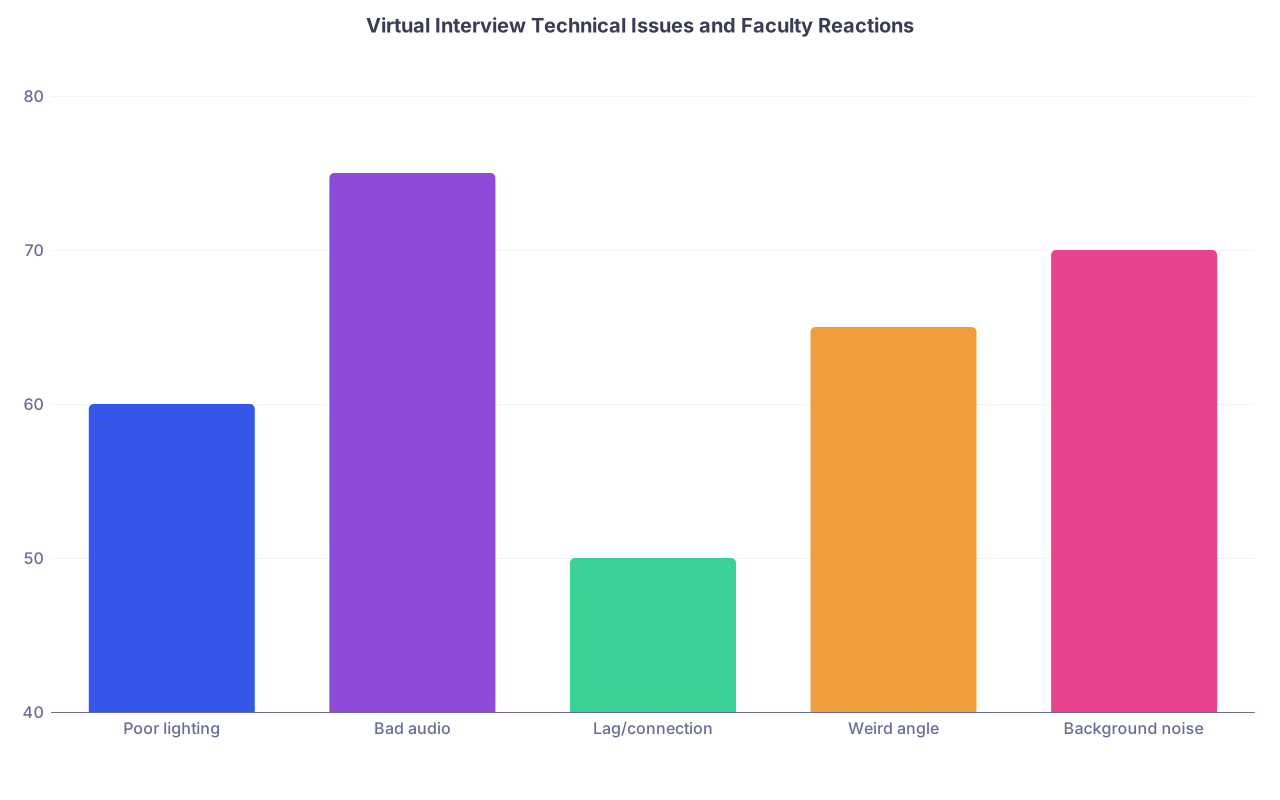
| Category | Value |
|---|---|
| Poor lighting | 60 |
| Bad audio | 75 |
| Lag/connection | 50 |
| Weird angle | 65 |
| Background noise | 70 |
Everyone talks about “check your tech,” but they usually stop at “test your internet.” PDs go further, even when they don’t articulate it.
Camera Angle: The “I’ve Never Used Zoom Before” Problem
Camera below your face looking up your nose? I promise you, someone on that panel thinks: “How did they get this far without learning basic video etiquette?”
Camera way off to the side so you’re not centered? Reads as distracted, off, not fully present.
When your face is well-framed, eyes roughly at camera level, slight downward angle? That silently tells them: I’ve done telehealth or at least understand what professional remote communication looks like.
No one writes that down. But it shifts their baseline comfort with you.
Lighting: The Mood You Didn’t Mean to Set
Dim, backlit, basically a silhouette: they’ll say “hard to see their expressions.” Translation: “I don’t feel like I know this person as much as others.”
Harsh overhead light from a single bulb casting shadows under your eyes? You look exhausted and stressed even if you’re not.
Soft frontal light (window or lamp behind the camera) where they can see your face clearly and your eyes aren’t shaded? They feel like they can “read” you. That increases trust. Very simple, very real.
Audio and Background Noise: Professionalism vs. Chaos
This is a big one. Bad audio actually irritates interviewers more than bad video.
Typical PD comments:
- “I had trouble hearing them; that was frustrating.”
- “Background noise was constant, felt like they didn’t control their environment.”
What they infer if there’s barking dogs, TV noise, people talking in the background:
- You didn’t warn your household or secure a quiet space
- You might not advocate well for your needs
- You might bring that same lack of boundary-setting into the hospital environment
They will forgive a one-off siren, a short-lived neighbor noise, a brief interruption. But sustained chaos says: “my life is out of control and I can’t fix it for 30 minutes on my biggest professional day.”
Virtual Backgrounds: The Silent Red Flag No One Explains

Let me be clear: most faculty hate fake virtual backgrounds. They won’t always say it, but they do.
Not all, but many. Especially older PDs.
The problem isn’t the concept. It’s what it communicates.
The “Zoom Beach” and Corporate Stock Image Problem
If you use:
- Tropical beach
- Space/galaxy
- Fake ultra-modern office from Zoom presets
They translate that as: “Doesn’t understand professional context. Tone-deaf.”
They expect you to know the difference between a game night with friends and a residency interview that will determine your career. Using a playful or overly stylized background reads as a massive judgment error.
The Blurred Background
Blur is usually fine, and in some institutions it’s even preferred if you’re in a shared space.
Blur communicates: “I care about privacy and I want you focused on me, not the environment.” That’s acceptable.
Just make sure your face is in sharp focus and the blur doesn’t constantly glitch around your hair or hands.
Branded or “Professional” Virtual Backgrounds
Your medical school may give you a branded background. This gets mixed reactions.
Some PDs like it: “They’re representing their school, looks clean.”
Others feel it looks artificial, stiff, like you’re hiding a disaster behind you.
Use if:
- Your real background is truly unusable
- The virtual backdrop is subtle, not screaming logos, and not misaligned
If you can create a decent real background, do that. Real almost always beats fake in terms of how “trustworthy” you seem on screen.
How Surroundings Influence Ranking: The Part No One Wants to Admit

| Step | Description |
|---|---|
| Step 1 | Virtual Surroundings |
| Step 2 | Focus on Content of Interview |
| Step 3 | Subtle Doubts About Judgment |
| Step 4 | More Weight on Small Mistakes |
| Step 5 | Evaluate Based on Fit & Credentials |
| Step 6 | Neutral/Professional? |
Will a messy background alone get you rejected from residency? Usually no. But it can tilt the scale in a close call.
Here’s how the real decision-making plays out in rank meetings:
They’re not saying “Let’s rank them lower because their apartment looked bad.” They’re saying:
- “I didn’t get a professional vibe.”
- “Something felt off.”
- “Seemed disorganized / scattered.”
And then they remember the chaotic background. The roommate walking behind you. The crumpled sheets. The sports posters. All the little signals that lined up with their feeling.
On the flip side, when your surroundings are dialed in:
- They forget about your environment quickly
- They focus on your answers, your personality, your potential
- You remove a common source of “minor concern” comments
This is not about aesthetics. It’s about not giving your interviewer extra reasons to doubt your judgment.
How to Set Up a Space That Sends the Right Message
I’m not going to patronize you with “make sure it’s clean” and walk away. Here’s how people who’ve watched thousands of these actually think through it.
Priorities in Order of PD Impact
- Silence and privacy – A slightly ugly room that’s quiet beats a beautiful room with noise and interruptions every time.
- Stable, centered framing – Camera at eye level, your face centered, not weirdly off to the side.
- Neutral, tidy background – No obvious mess, no controversial content, no strong visual distractions.
- Clear lighting on your face – Ideally from in front of you, not overhead or behind.
- Subtle personality – One or two small personal touches that make you look human, not robotic.
If you’re limited—crowded home, shared apartment, noisy neighborhood—lean hard into: quiet, neutral, controlled.
Borrow a corner in a friend’s place. Ask your school for a room. Book a study room at a library. I’ve seen students do interviews sitting in their car with a phone mount, using a mobile hotspot—with better professional impression than the person in their bedroom with roommates yelling in the background.
Because the PDs read: this person problem-solved and protected this time.
FAQ: What PDs Really Think About Your Virtual Setup
1. Is a bedroom background an automatic red flag?
No. But a visible, unmade bed or messy bedroom is absolutely a yellow flag. If the bed is in frame, it needs to be made, simple, and non-distracting. Better yet, angle your camera so the bed isn’t visible at all. The less they’re reminded that you’re literally in bed territory, the more they’ll focus on you.
2. Can I show personal items, like photos or hobbies, to “stand out”?
You can, but very carefully. One or two small, non-controversial personal touches are fine—a plant, a simple framed landscape, a single family photo that isn’t obvious up close. Massive photo walls, sports banners, fandom posters, or hobby shrines are distracting and invite judgments you can’t control. Stand out with your conversation, not your decor.
3. Are virtual backgrounds a bad idea across the board?
Fake-looking virtual backgrounds (beach scenes, fake fancy offices, busy logos) are usually a bad idea. They look artificial and sometimes childish. A mild blur is generally safe. A clean, real background is best if you can manage it. If your only real option is truly chaotic, then a subtle branded or neutral virtual backdrop is better than exposing clutter and chaos.
4. How much do surroundings actually affect my rank compared to scores and letters?
Scores and letters matter more. Always. But surroundings can influence how your interview is interpreted. If you’re on the border with several candidates, the one who looked polished, thoughtful, and professional in their environment tends to feel like a safer bet. Think of it as tie-breaker territory: it rarely saves a weak file, but it can easily sink a marginal one or boost a solid one.
If you remember nothing else:
Your surroundings are silent commentary on your judgment.
Clean, neutral, and intentional beats impressive every time.
Make their attention default back to you—not your room.