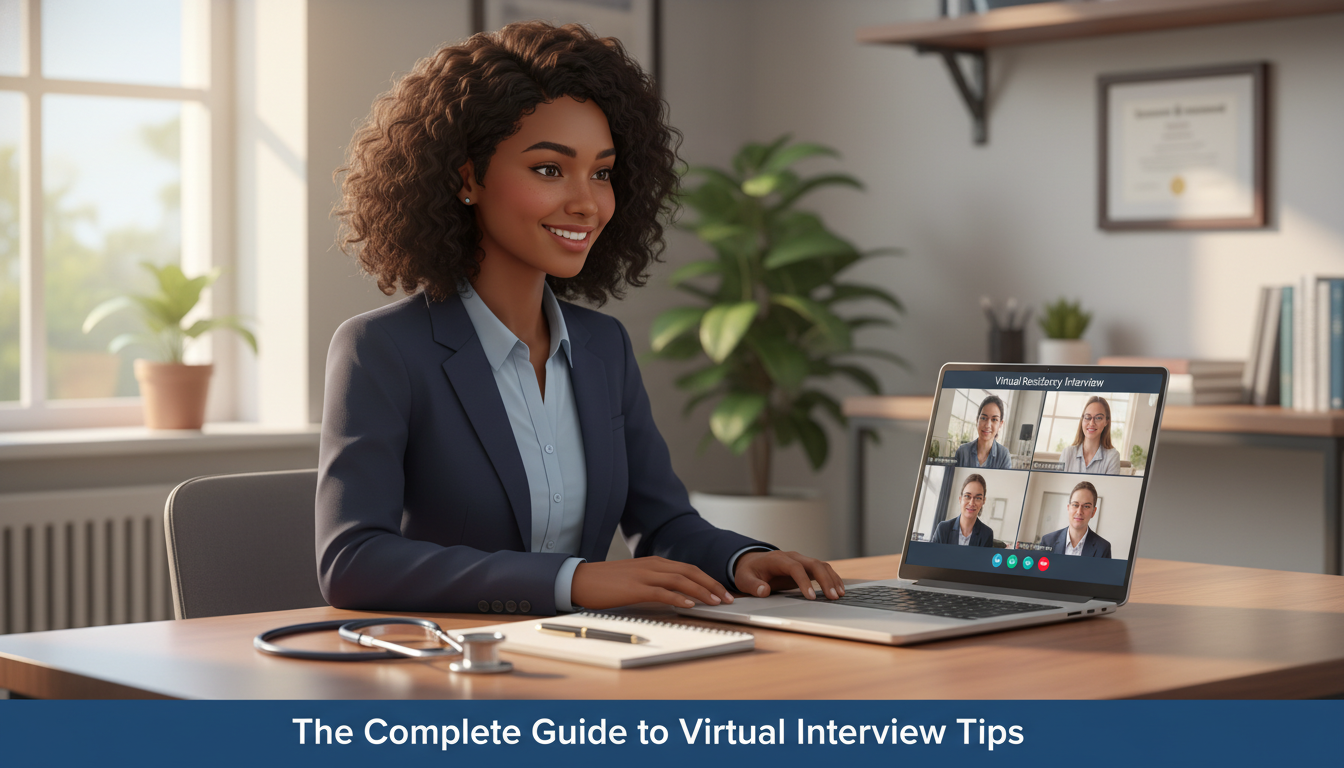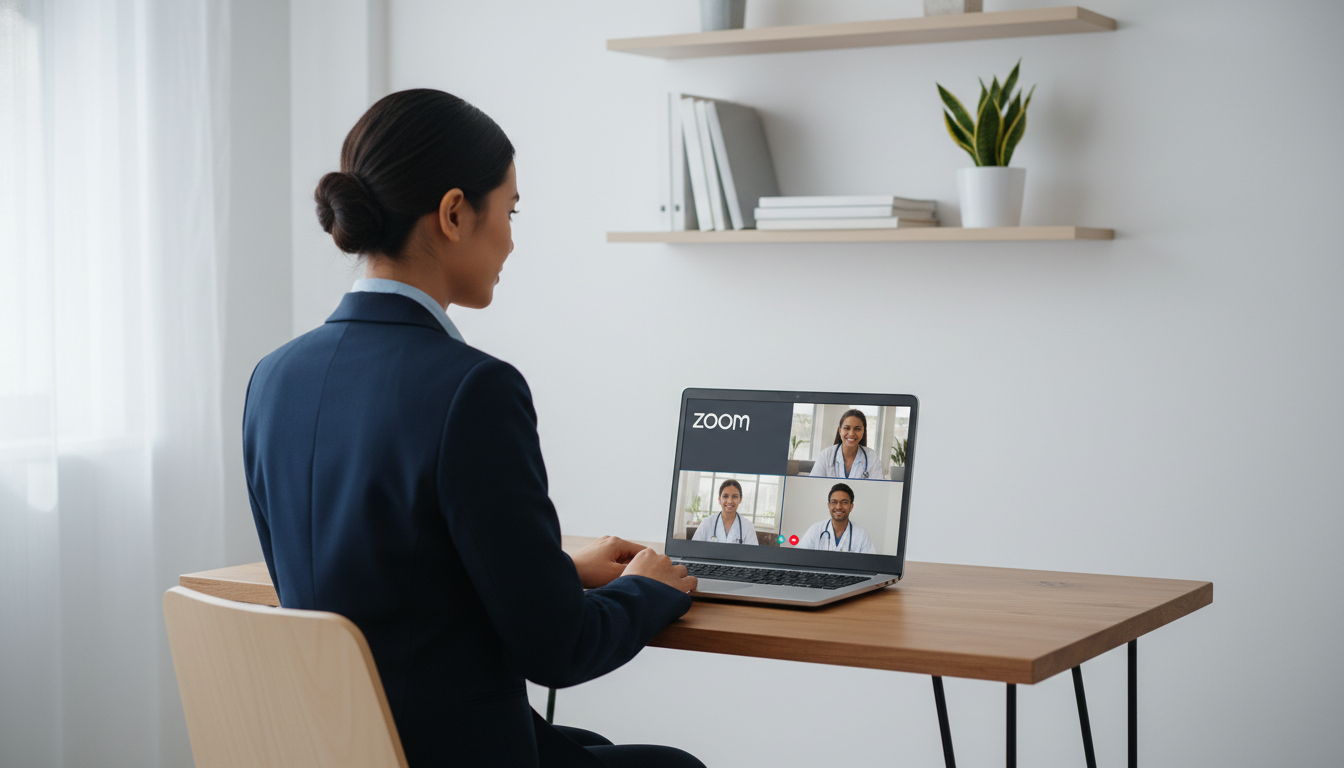
Understanding the Virtual Residency Interview Landscape as a Non‑US Citizen IMG
For a non-US citizen IMG (international medical graduate), the virtual residency interview is often the most important—and sometimes the only—chance to make a live impression on a program. You’re not just trying to show you are clinically strong; you’re also demonstrating that you can communicate well in English, function smoothly in US clinical environments, and integrate into a residency team.
Virtual formats (Zoom, Webex, Teams) have created a more level playing field in some ways, but they also introduce new challenges:
- You may be interviewing from a different time zone (often very early morning or late night).
- You might have less access to high-speed internet, quiet professional spaces, or US-style technology setups.
- You may worry about accent, cultural differences, or visa questions on top of standard interview stress.
This guide focuses on virtual residency interview skills and online interview preparation specifically for the foreign national medical graduate. You’ll learn concrete strategies for:
- Technical setup and environment
- Appearance, body language, and communication
- Answer structure and storytelling
- Handling visa and non-US citizenship questions
- Dealing with time zones, fatigue, and nerves
- Succeeding in informal sessions and social hours
Throughout, the emphasis is on actionable steps you can implement before your next Zoom interview or other online platform.
1. Technical Setup and Environment: Building a Professional Virtual Stage
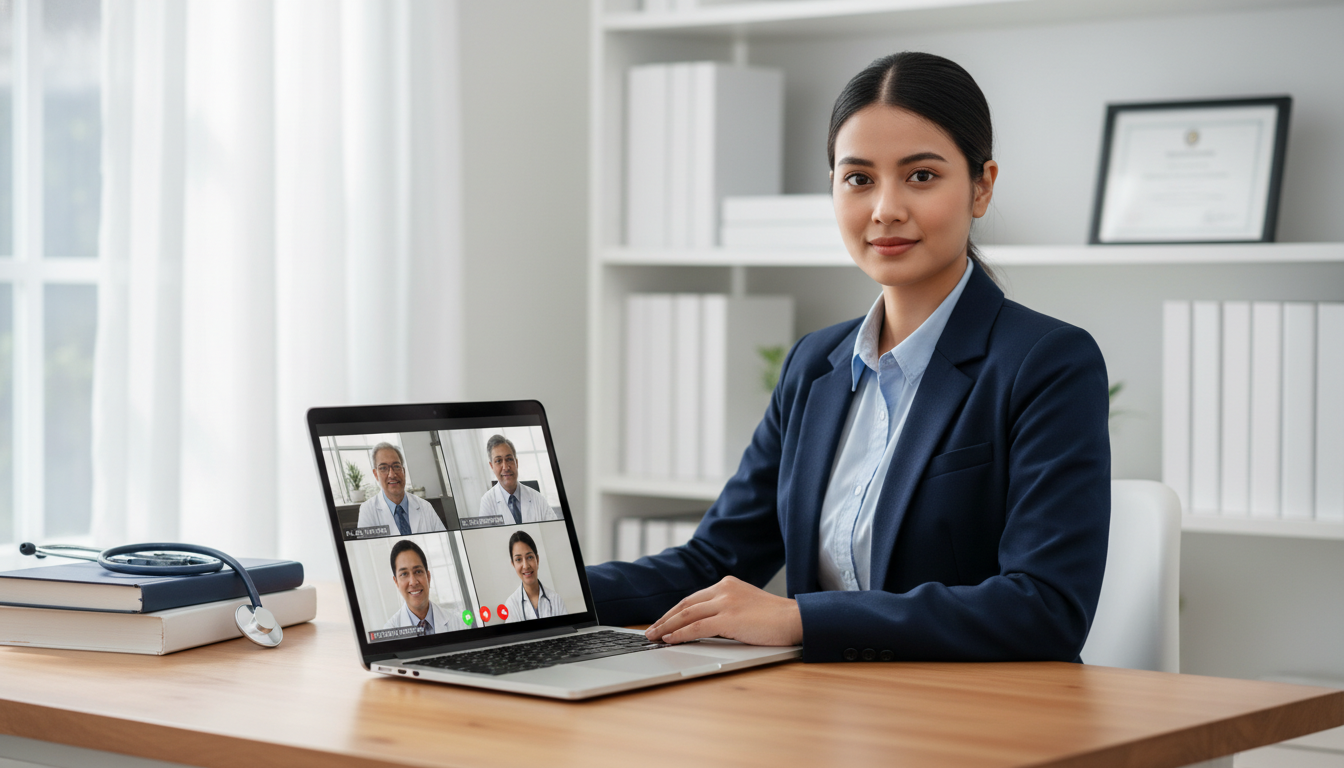
Your technical setup is the foundation. Programs often infer your professionalism and attention to detail from how you present online. Fortunately, you can create an excellent setup even on a limited budget.
1.1 Internet, Device, and Backup Plans
Internet connection
- Aim for wired Ethernet if possible; it’s more stable than Wi‑Fi.
- If you must use Wi‑Fi:
- Sit close to the router.
- Ask family/roommates not to stream videos or games during your interview.
- Run a speed test (e.g., speedtest.net). Aim for at least 5–10 Mbps upload.
- Have a backup:
- Mobile hotspot (test it in advance).
- Second location (nearby library, coworking space, or friend’s house) pre-arranged in case of an emergency.
Computer vs. phone
- Use a laptop or desktop whenever possible. It:
- Looks more professional.
- Is easier for note-taking and viewing multiple faces.
- Do not rely on a phone unless there is no alternative. If you must:
- Use a stand so the phone is at eye level.
- Plug into power so battery doesn’t die.
- Turn off notifications and calls.
Backup plans (very important for non-US citizen IMGs)
- Prepare a brief, polite message in case of connection issues:
- “I’m experiencing a technical issue on my side; I’m working to reconnect. Thank you for your patience.”
- Save the program coordinator’s email and phone number on your phone and in a text file on your laptop.
- If you disconnect:
- Rejoin immediately.
- After reconnecting, briefly apologize and move on:
“I’m sorry, my connection briefly dropped. Thank you for your patience.”
1.2 Camera, Audio, and Lighting
You do not need professional studio equipment, but clear image and sound are non-negotiable.
Camera
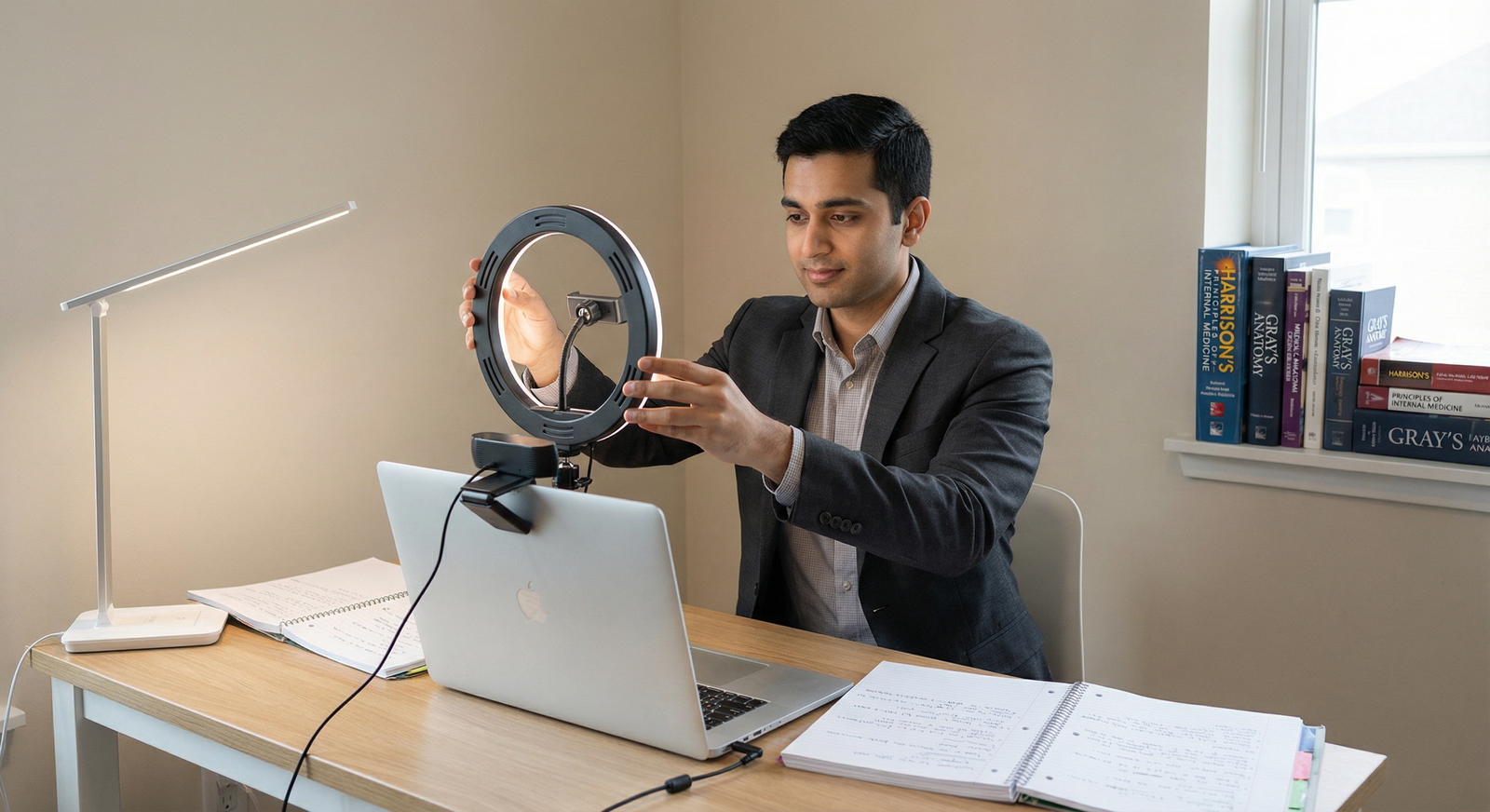
- A modern laptop webcam is often adequate; if not, consider a basic external webcam (1080p).
- Position:
- At eye level (use books or a stand).
- About an arm’s length away, framing head and upper torso.
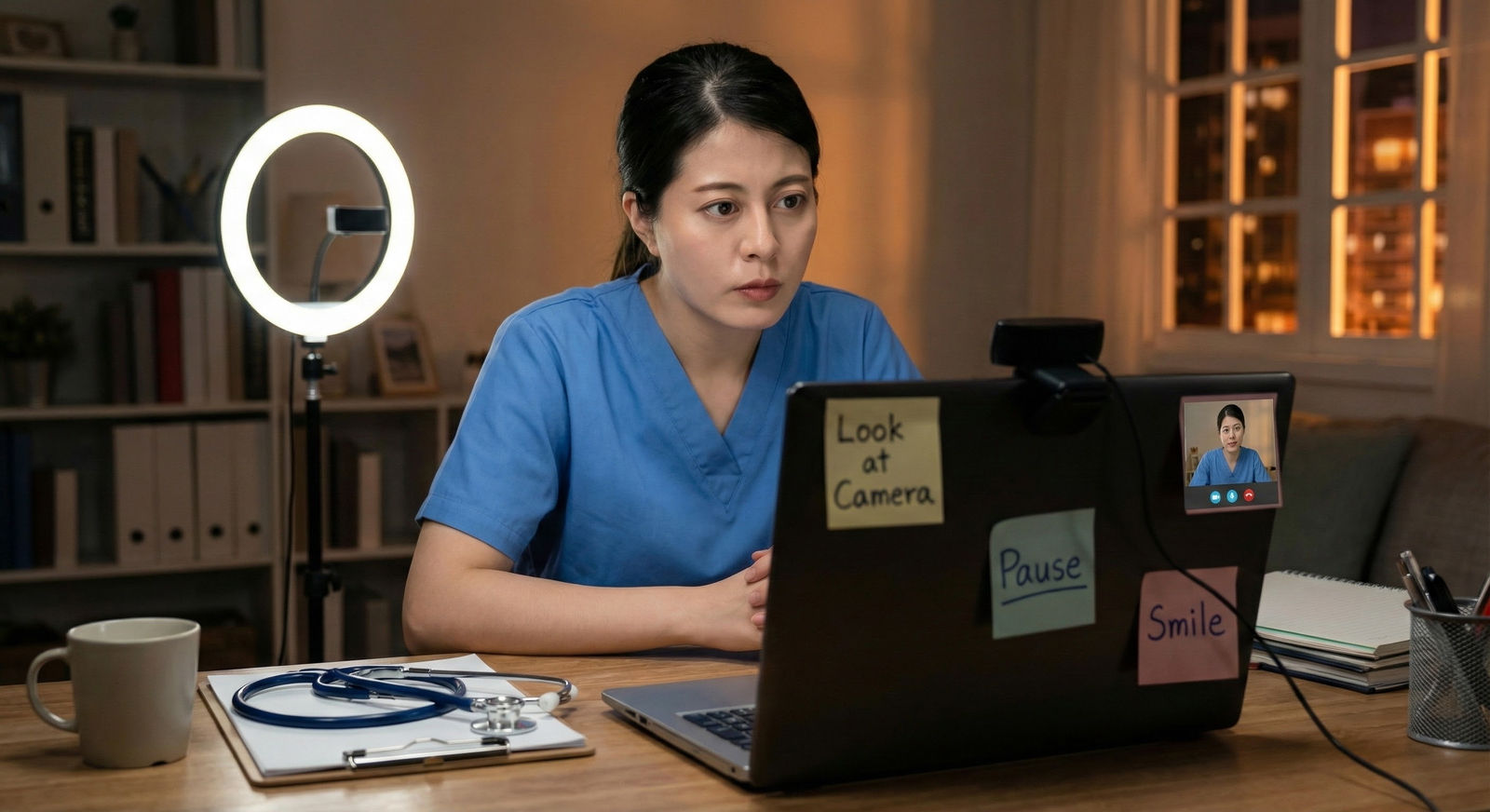
- Look directly at the camera when speaking, especially during important statements (this simulates eye contact).
Audio
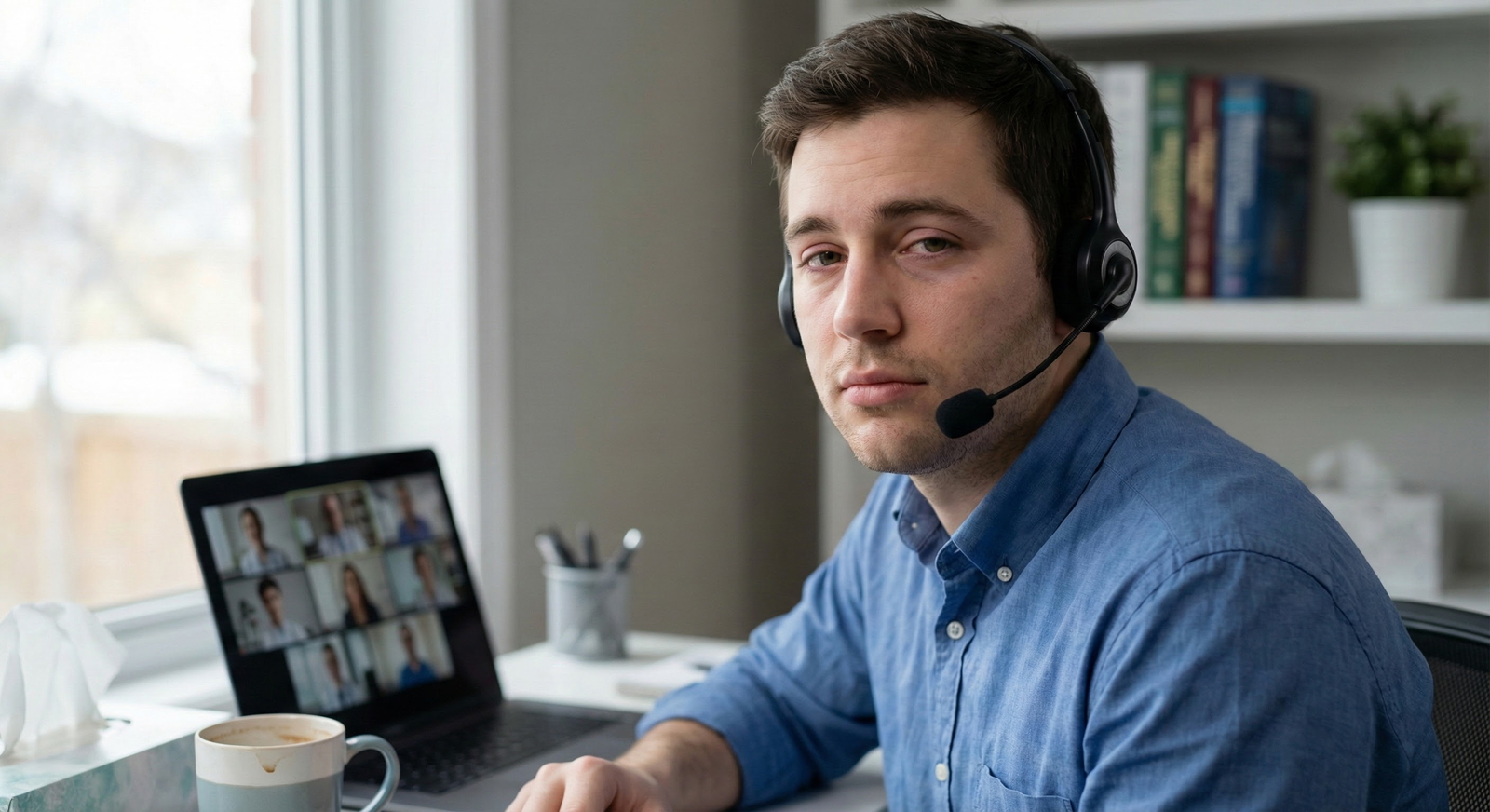
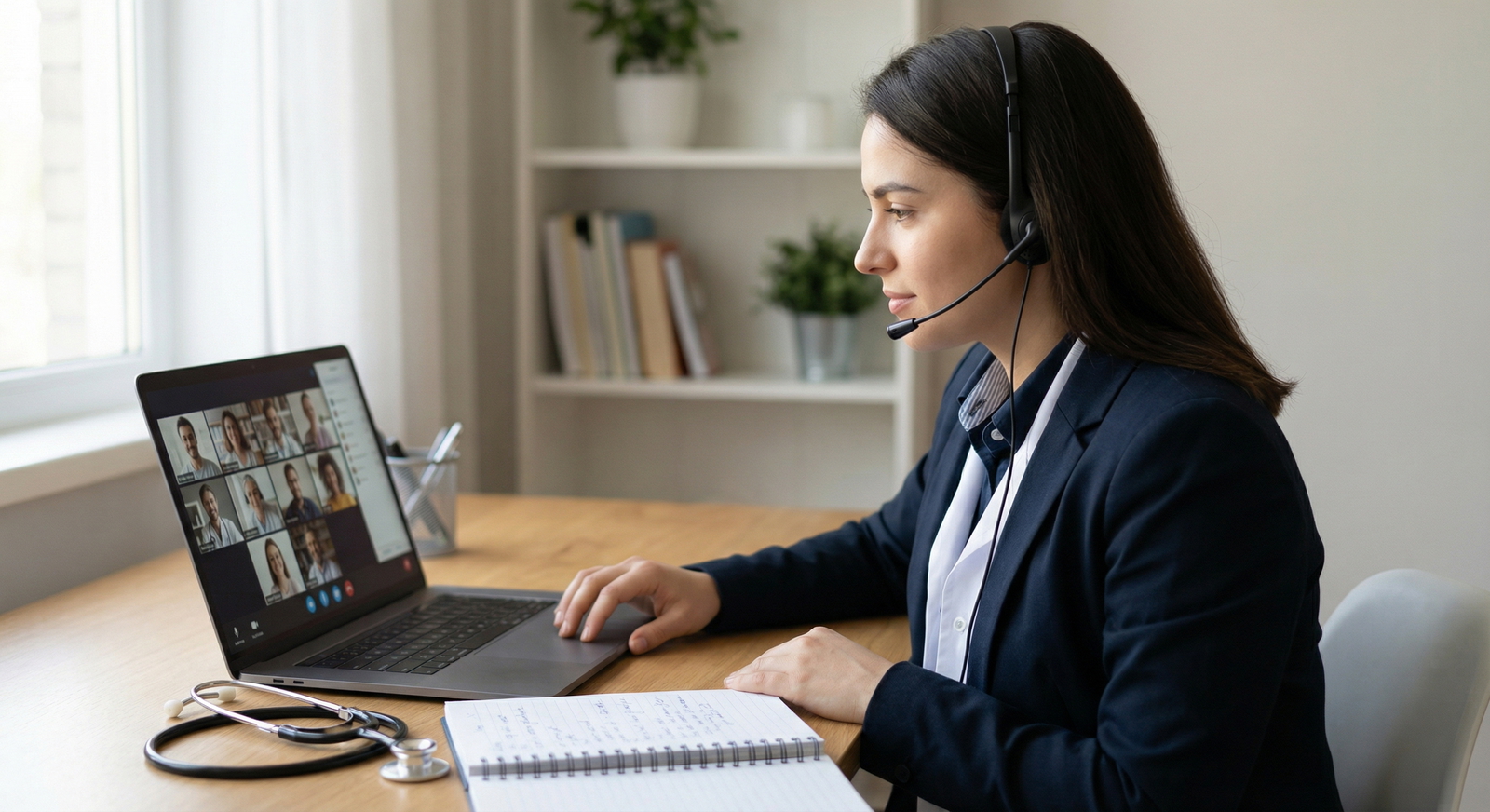
- Use wired earphones with a microphone or a good-quality headset.
- They reduce echo and background noise.
- They improve clarity, especially if your accent is strong or internet is less stable.
- Test mic volume in Zoom or other platforms and ask a friend for feedback.
- Avoid using laptop speakers and built-in mic alone if the sound is echoey or muffled.
Lighting
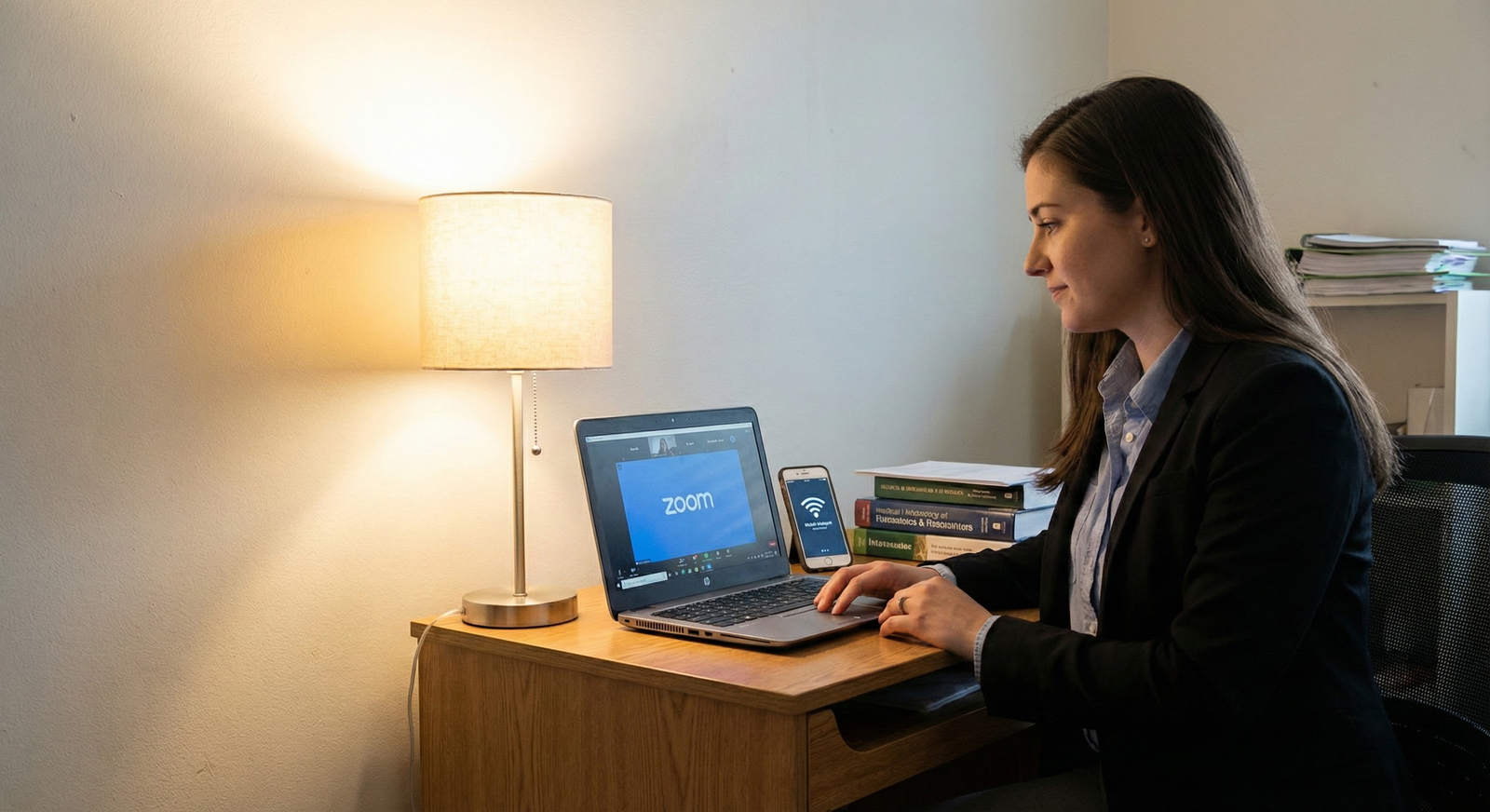
- Your face should be brighter than the background:
- Sit facing a window for natural light if possible.
- If not, place a lamp behind your screen shining toward your face (not behind you).
- Avoid:
- Strong light sources behind you (they create silhouette).
- Flickering fluorescent lights or colored lights.
1.3 Background, Camera Framing, and Distractions
Your background communicates professionalism and respect for the interview.
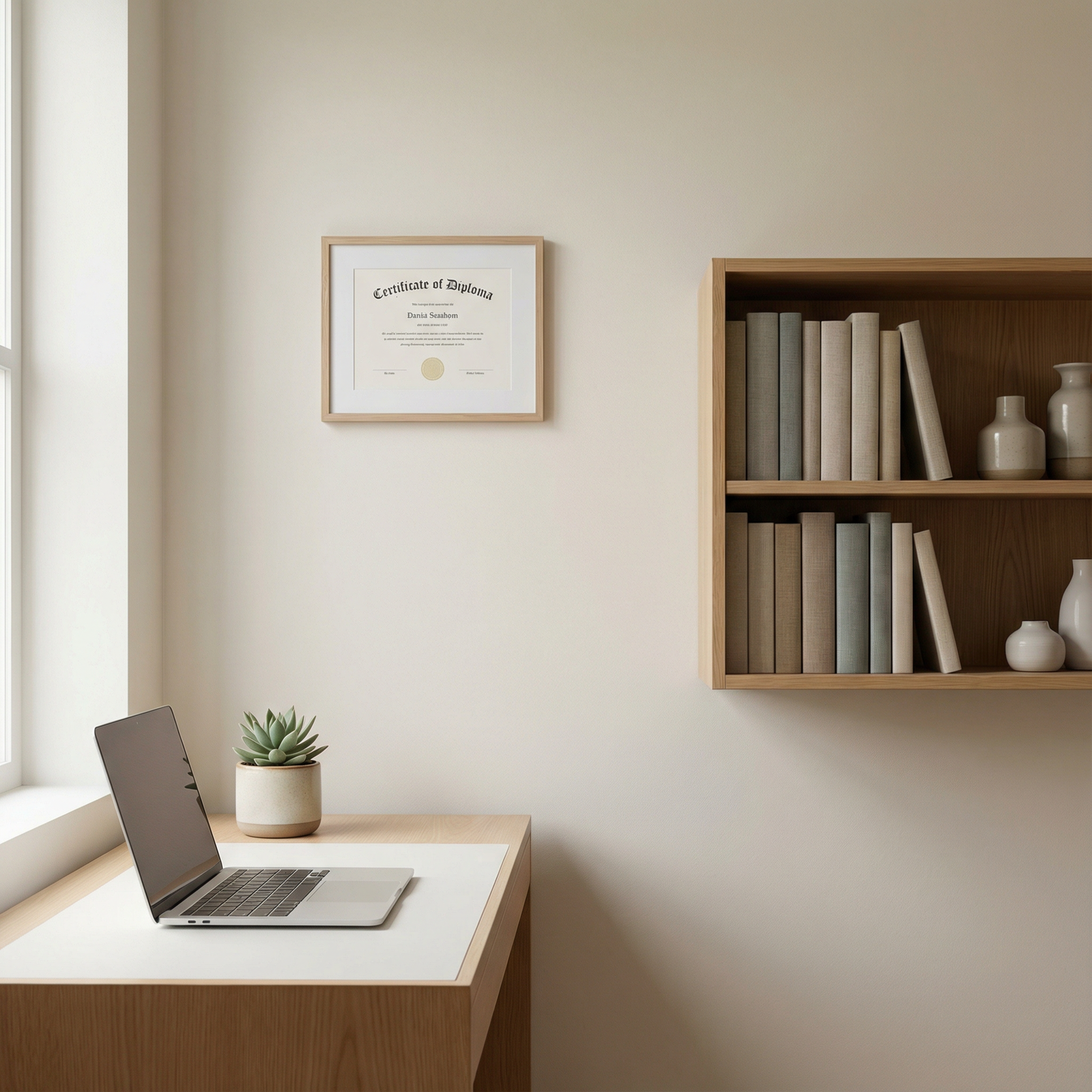
- Choose a simple, clean background:
- Plain wall, neatly arranged bookshelf, or a tidy corner with a plant.
- Remove clutter, laundry, posters that might be distracting or controversial.
- Virtual backgrounds:
- Use cautiously. If your actual background is very busy, a subtle, professional virtual background can be acceptable.
- Avoid novelty images or anything that looks artificial and glitchy.
- Camera framing:
- Leave some space above your head.
- Make sure shoulders and upper chest are visible (helps with body language).
- Minimize distractions:
- Inform family or roommates of your schedule.
- Put a sign on the door (e.g., “Interview in progress: Please do not disturb”).
- Silence phone notifications on all devices.
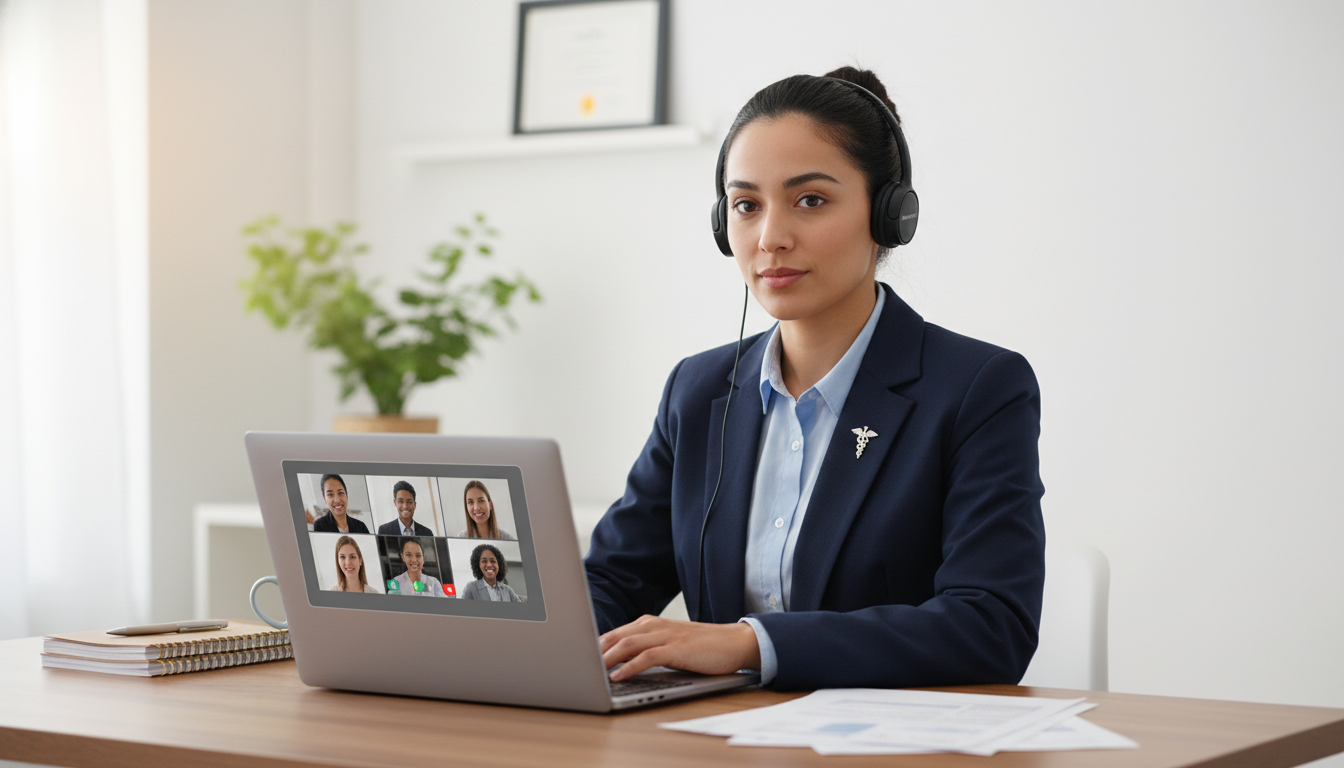
2. Professional Appearance and Non-Verbal Communication Online
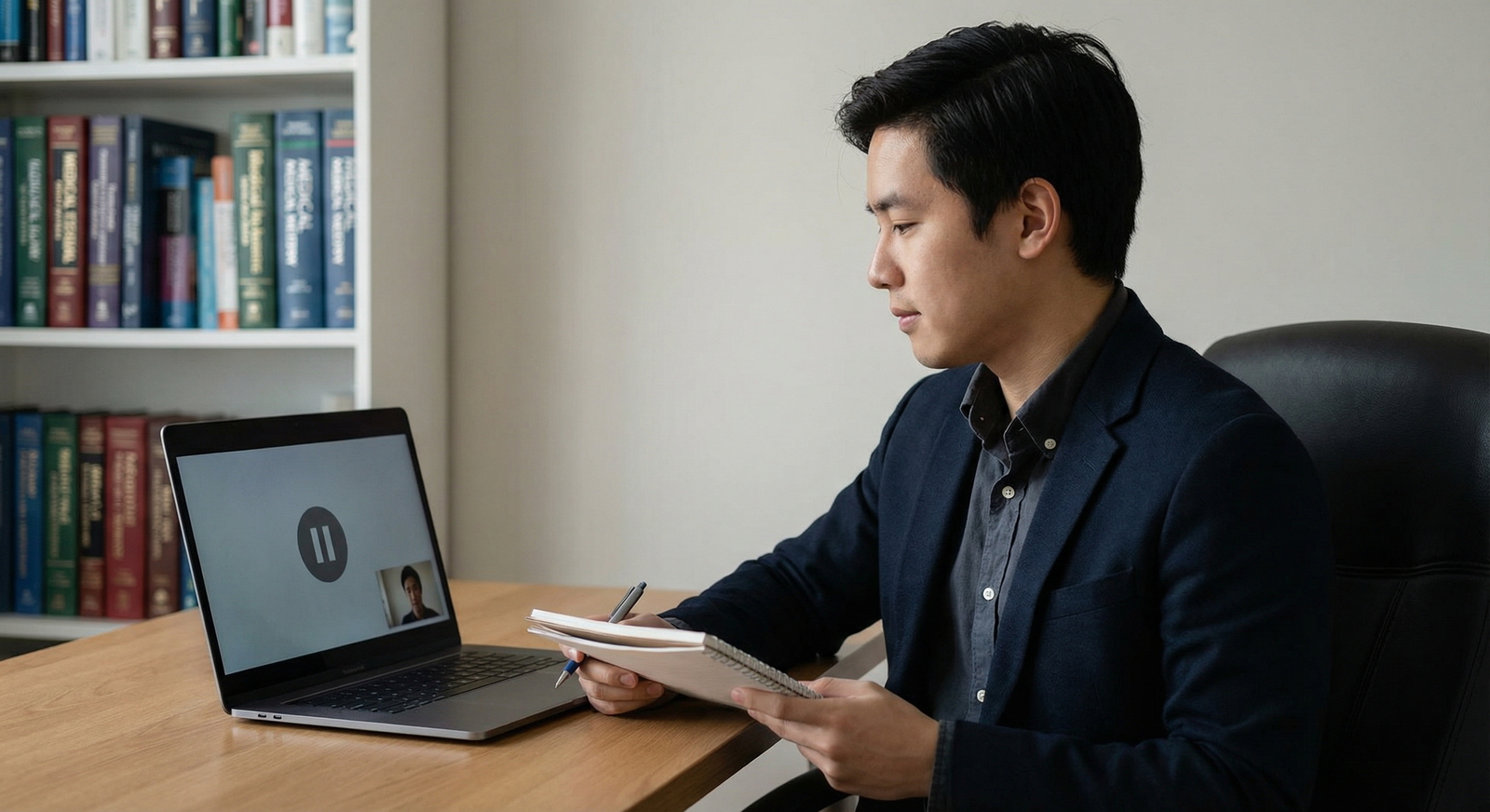
Virtual interviews compress many non-verbal cues into a small rectangle. You must be intentional about body language, facial expressions, and overall “presence.”
2.1 Dress Code for Virtual Interviews
Dress as if you were physically in a US hospital conference room.
- General guidelines:
- Business formal: suit jacket or blazer, dress shirt or blouse.
- Conservative colors: navy, gray, black, or subtle patterns.
- Ensure clothing contrasts with your background (avoid white shirt with white wall).
- For men:
- Button-down shirt; tie is usually appropriate.
- Shave or keep beard neatly trimmed.
- For women:
- Blouse or top that is not too bright or flashy.
- Avoid noisy jewelry or anything that reflects strongly on camera.
- Bottoms:
- Wear professional pants or skirt even if only your upper body is visible. You may need to stand up unexpectedly.
2.2 Posture, Eye Contact, and Facial Expression
Even small adjustments can change how confident and engaged you appear.
- Posture:
- Sit up straight, both feet on the floor or supported.
- Lean very slightly forward; it signals engagement.
- Avoid swaying, rolling on a chair, or leaning too far back.
- Eye contact:
- When speaking: Look at the camera lens, not the faces on the screen, especially when making key points.
- When listening: You may look at the interviewer’s image on the screen.
- Practice switching between camera and screen so it feels natural.
- Facial expression:
- Maintain a neutral to positive expression; a gentle, natural smile often helps.
- Nod occasionally to show you are following.
- Avoid overly serious or frozen facial expressions caused by nervousness.
2.3 Using Hands and Body Language on Screen
- Keep your hands partially visible when speaking; moderate gestures help convey enthusiasm.
- Avoid:
- Repeatedly touching your face or hair.
- Clicking pens, tapping on the table, or other visible fidgeting.
- If nervous energy is a problem, hold a pen or small object out of view and focus your energy there instead of in frame.
3. Communication Skills: Overcoming Distance, Accent, and Cultural Gaps
As a foreign national medical graduate, you may feel extra pressure about language, accent, and cultural nuances. Virtual interviews can magnify or reduce these issues depending on how you manage them.
3.1 Clarity of Speech and Pace
Many IMGs are highly fluent but speak faster when nervous. On a virtual platform, with potential audio delays, clarity matters more than speed.
- Speak slightly slower than your natural pace.
- Articulate consonants clearly (especially “t,” “d,” “p,” “b”).
- Pause briefly between sentences to allow for internet lag and to let interviewers process your response.
- If you have a strong accent:
- Don’t apologize or be self-conscious.
- Focus on clear pronunciation and structure.
- Ask friends or US-based mentors to tell you which words are often misunderstood and practice those.
Practice strategy
- Record yourself answering common questions (e.g., “Tell me about yourself,” “Why this specialty?”).
- Listen back and check:
- Are you speaking too fast?
- Are there filler words (uh, um, like) you can reduce?
- Are you answering the actual question asked?
3.2 Structured, Concise Answers (STAR and 3-Part Frameworks)
Structure helps you stay focused and easy to follow.
For behavioral questions (“Tell me about a time when…”), use STAR:
- Situation – Brief background.
- Task – What was your role or responsibility?
- Action – What you specifically did.
- Result – Outcome and what you learned.
Example (adapted for a non-US citizen IMG):
“During my internship in India (S), our internal medicine ward had a sudden shortage of nurses due to illness. As the senior intern on night duty (T), I coordinated with the resident to redistribute tasks, created a quick checklist to prioritize critical patients, and personally took vitals and blood draws on the sickest patients (A). As a result, all critical medications were given on time, and the attending the next morning praised our organization under pressure. I learned the importance of clear task delegation and staying calm when resources are limited, which I believe is very relevant to residency in the US as well (R).”
For general questions, a simple 3-part structure works well:
- Direct answer
- Supporting explanation or example
- Connection to the program or specialty
Example: “Why are you interested in our program?”
- “I’m particularly interested in your program because of its strong focus on community-based care and education.”
- “During my observership in a community clinic in New York, I saw how critical primary care is for underserved populations, and I developed a strong interest in health equity and patient education.”
- “Your program’s continuity clinics, community outreach initiatives, and strong mentorship in ambulatory medicine align exactly with how I hope to practice and grow during residency.”
3.3 Handling Common Questions for Non-US Citizen IMGs
You will likely receive questions that indirectly test your adaptation to the US system and your stability as a non-US citizen IMG.
Examples and strategic answers:
“Tell me about your US clinical experience.”
- Highlight: Observerships, externships, research, telemedicine experiences.
- Emphasize what you learned specifically about:
- Interdisciplinary teamwork
- Communication with patients
- Documentation and EMR (if applicable)
“How do you handle communication with patients who are different from you culturally or linguistically?”
- Use an example from your home country or USCE.
- Emphasize:
- Use of interpreters
- Simplifying medical language
- Respect for cultural beliefs
“What challenges do you anticipate transitioning to residency in the US?”
- Be honest but solution-focused:
- Example: “I anticipate that documentation and some aspects of the healthcare system will be an adjustment, but I have already begun familiarizing myself with US guidelines and EMR systems through online modules and my observership.”
- Show that you are proactive, not overwhelmed.
- Be honest but solution-focused:
“Tell me about a weakness.”
- Choose something real but improvable (e.g., being overly self-critical, initial difficulty speaking up in large groups).
- Show specific steps you are taking to improve.
4. Online Interview Preparation: A Step-by-Step Game Plan
Proper online interview preparation is especially important when you’re in a different country or time zone. Preparation reduces anxiety and helps you perform at your best.
4.1 Researching Programs and Preparing Talking Points
For each program:
- Review:
- Program website: curriculum, clinics, hospitals, research areas.
- Mission statement and values.
- Any special tracks (e.g., global health, primary care, research).
- Prepare:
- 2–3 specific reasons you like that particular program.
- 1–2 questions tailored to their program (not easily answered by website).
Examples of strong questions:
- “How does your program support international graduates in adjusting to the US healthcare system?”
- “Can you tell me how residents are supported if they are interested in visa-dependent career paths such as fellowships or academic positions?”
Keep a short document or notebook open (but not visible or distracting) with bullet points—not full scripts.
4.2 Mock Interviews and Simulation in Your Actual Setup
Simulate the exact conditions of your virtual residency interview:
- Dress in full interview attire.
- Use the same device, internet connection, headphones, and lighting.
- Ask a mentor, friend, or colleague to conduct a mock Zoom interview:
- Include both common and difficult questions.
- Ask for feedback on:
- Clarity of answers
- Professionalism of setup
- Body language and facial expressions
- If you lack access to mentors:
- Record yourself answering 8–10 typical questions.
- Watch the recording critically.
- Repeat 2–3 times until you see clear improvement.
4.3 Managing Time Zones and Interview Day Logisitics
Many non-US citizen IMGs interview from abroad, with large time differences.
Calculate time zones carefully:
- Confirm all times in US local time and convert to your local time with a reliable tool (timeanddate.com, phone world clock).
- Double-check AM/PM and daylight saving time if applicable.
- Create a schedule in your local time, including:
- Log-in time (10–15 minutes early).
- Breaks between sessions.
- Time for meals and rest.
Night or early-morning interviews
- If your interview is at 3:00 AM local time:
- Shift your sleep schedule gradually (1–2 hours earlier or later each day) for 2–3 days before.
- Do a “dress rehearsal” at the same time 1–2 days before to see how you feel.
- On interview day:
- Avoid heavy meals or too much caffeine if they make you jittery.
- Keep water nearby (but not on your laptop).
4.4 Organizing Documents and Notes
Have digital and physical backups:
- Digital folder on your desktop with:
- CV and ERAS application (PDF).
- Personal statement.
- List of research, QI projects, key cases.
- Brief bullet-point notes:
- 3–4 key strengths.
- 2–3 main weaknesses (and how you monitor/improve them).
- Your top 5 programs and why you like them.
- Keep only short prompts visible during the interview; avoid reading full answers.
5. Zoom Interview Tips and Strategy: During and After the Interview
Now that you’ve prepared, how do you perform optimally during the virtual residency interview itself?
5.1 Entering and Navigating Virtual Rooms
- Log in 10–15 minutes early.
- Test audio and video as the platform allows.
- When you first see the interviewer:
- Smile, greet them by name if shown on screen.
- Example: “Good morning, Dr. Smith. Thank you for taking the time to speak with me today.”
If the platform uses breakout rooms:
- Follow staff instructions carefully.
- Don’t panic if you’re briefly alone in a waiting room—this is normal.
- Keep your posture professional at all times, even when you think no one is watching.
5.2 Answering Questions in a Virtual Format
Combine structured answers with strong non-verbal communication:
- Listen completely before answering; don’t interrupt.
- It’s okay to pause 2–3 seconds to think before responding.
- If you didn’t hear or understand:
- Politely clarify: “I’m sorry, could you please repeat or rephrase the question?” or “I want to make sure I answer correctly—did you mean…?”
- Keep most answers to around 1–2 minutes unless asked to elaborate.
5.3 Asking Intelligent Questions and Showing Genuine Interest
Programs are assessing your curiosity and fit, not just your knowledge.
Good question types include:
- Curriculum and clinical exposure
- Resident support and wellness
- Opportunities for research or leadership
- Support for non-US citizen IMGs, such as:
- “Do you currently have residents on visas, and how do you support them?”
- “How does the program assist international graduates in preparing for board examinations and fellowship applications?”
Avoid:
- Questions easily answered by a quick website visit (“Do you have a night float system?” if it’s clearly written online).
- Salary or benefits as your first question (can be discussed later or with residents).
5.4 Virtual Social Hours and Resident Mixers
Many programs include informal virtual social sessions. These are crucial for you as a foreign national medical graduate because:
- You see the culture of the program.
- Residents can give honest perspectives on visa support, supervision, and work–life balance.
- Programs see if you would fit in socially.
Tips:
- Maintain professional but slightly relaxed attire (you can skip the tie, but still look polished).
- Turn your camera on unless there is a strong reason not to.
- Introduce yourself briefly when appropriate: name, medical school, one interest.
- Ask residents:
- “How has the program supported you when you faced challenges?”
- “How do international graduates adapt to life in this city and hospital?”
5.5 After the Interview: Notes and Thank-You Emails
Immediately after leaving the call:
- Write down:
- Names and roles of interviewers.
- Unique aspects you liked about the program.
- Any concerns or red flags.
- You can send polite thank-you emails within 24–48 hours:
- Short (3–5 sentences).
- Personalize 1–2 details from your conversation.
- Reaffirm your interest but avoid committing to rank order unless you truly mean it (and follow NRMP rules).
Example:
“Dear Dr. Smith,
Thank you for taking the time to speak with me yesterday during my virtual interview for the Internal Medicine Residency Program. I especially appreciated our discussion about your clinic’s work with underserved populations and the mentorship available for residents interested in primary care. Our conversation strengthened my interest in your program, and I would be honored to train in such a supportive environment.
Sincerely,
[Name]”
6. Visa, Non-US Citizenship, and Unique IMG Concerns in Virtual Interviews
As a non-US citizen IMG, you bring valuable diversity and global experience. Programs will inevitably consider visa issues and your long-term stability, but this can be addressed professionally and positively.
6.1 If Visa Sponsorship Comes Up
Programs may ask about your visa status or long-term plans. Keep answers factual and calm.
- If they sponsor your needed visa type:
- “I will require [J-1/H-1B, depending on your situation], and I understand that your institution has sponsored this in the past. I’m fully committed to completing residency and contributing long-term to patient care and the program.”
- If they do not sponsor your preferred visa, but you still want to apply:
- Be honest about your visa needs. Do not misrepresent your status.
- You can still emphasize your dedication and flexibility if you have multiple options.
6.2 Addressing Gaps, Attempts, or Non-Traditional Paths
Virtual interviews are a chance to contextualize aspects of your application that may look concerning on paper.
- Be ready to explain:
- Time gaps
- Multiple USMLE attempts
- Career shifts or specialty changes
- Use a growth-oriented narrative:
- What happened?
- What did you change?
- What specific improvements resulted?
Programs often appreciate resilience and maturity, especially from IMGs who had to navigate complex paths.
6.3 Highlighting Strengths Unique to Non-US Citizen IMGs
Do not let the conversation revolve only around challenges. Emphasize advantages you bring:
- Multilingual skills and ability to connect with diverse patients.
- Experience in resource-limited settings, which translates into adaptability.
- Strong motivation and perseverance shown by navigating exams, ECFMG, and multiple systems.
When asked about your strengths, tie them to your international background in a way that shows added value to their residents and patients.
FAQ: Virtual Interviews for Non-US Citizen IMGs
1. How can I overcome nervousness about my accent during virtual residency interviews?
Focus on clarity, structure, and practice rather than accent elimination. Record yourself, slow your pace slightly, and get feedback from US-based mentors or friends if possible. Most program directors are used to a wide range of accents from non-US citizen IMGs. Show that you can be clearly understood and that you listen carefully to questions.
2. Is it acceptable to take notes during a Zoom residency interview?
Yes, but do it discreetly. It’s better to jot down brief keywords than to look down for long periods. Avoid typing loudly on a keyboard. Short notes can help you remember important details for thank-you emails or ranking decisions.
3. What should I do if my internet connection fails during the interview?
Rejoin the meeting as quickly as possible. On returning, briefly apologize: “I’m sorry, my connection dropped for a moment; thank you for your patience.” If you cannot reconnect, email or call the program coordinator immediately, explain the technical problem, and politely ask if rescheduling part of the interview is possible. Having a backup hotspot or location prepared in advance reduces the risk of this happening.
4. Are virtual social events as important as the formal interviews?
Absolutely. Programs often discuss how applicants behaved and interacted during informal virtual sessions. For a foreign national medical graduate, this is a key opportunity to demonstrate that you will fit well with the resident team, ask thoughtful questions, and show genuine interest in the program and the city.
By approaching your virtual residency interview with careful technical preparation, polished communication, and strategic storytelling, you can overcome distance, accent concerns, and time zones. As a non-US citizen IMG, your background is a strength—use the virtual format to showcase your adaptability, cultural competence, and readiness to thrive in a US residency program.