You’re on nights. Your interview is at 10 AM. Now what?
It’s 7:15 AM. You just signed out a full list from ICU or night float. You’ve been awake all night, your N95 lines are still on your face, and your interview is at 10:00 AM… on Zoom… for a program you actually care about.
Your co-resident says, “Just stay up and crush it.”
Your body says, “Lay down on the floor and never get up.”
The program says, “We’re excited to meet you!”
You’re in the classic trap: virtual interviews, but you’re on one of the worst rotations for it—ICU or nights. And nobody structured this rotation around your interview season. They rarely do.
So here’s what I’m going to do: walk you through exactly how to handle virtual interviews while on ICU or night float—logistics, scripts to use with attendings, how to avoid looking wrecked on camera, how to schedule safely, and what to do if things go sideways.
This is not going to be “remember to get a good night’s sleep” level nonsense. You already know that and you can’t. We’re going to work with the reality you’re in.
Step 1: Fix the calendar before it fixes you
The worst mistake I see: people wait until they have interview invites to think about how ICU/nights will work.
A. Know your exact constraints
Pull up three things right now:
- Your ICU/night float schedule
- Your interview dates (and time zones)
- Your institution’s leave policy for residents / students on rotation
You want to map out three buckets of days:
- Safe days – post-call days with enough buffer, days off, golden weekends.
- Risky but possible days – end of a night shift but with a real nap window and coverage.
- Absolutely not days – admitting nights, high-acuity call, times you know the unit explodes.
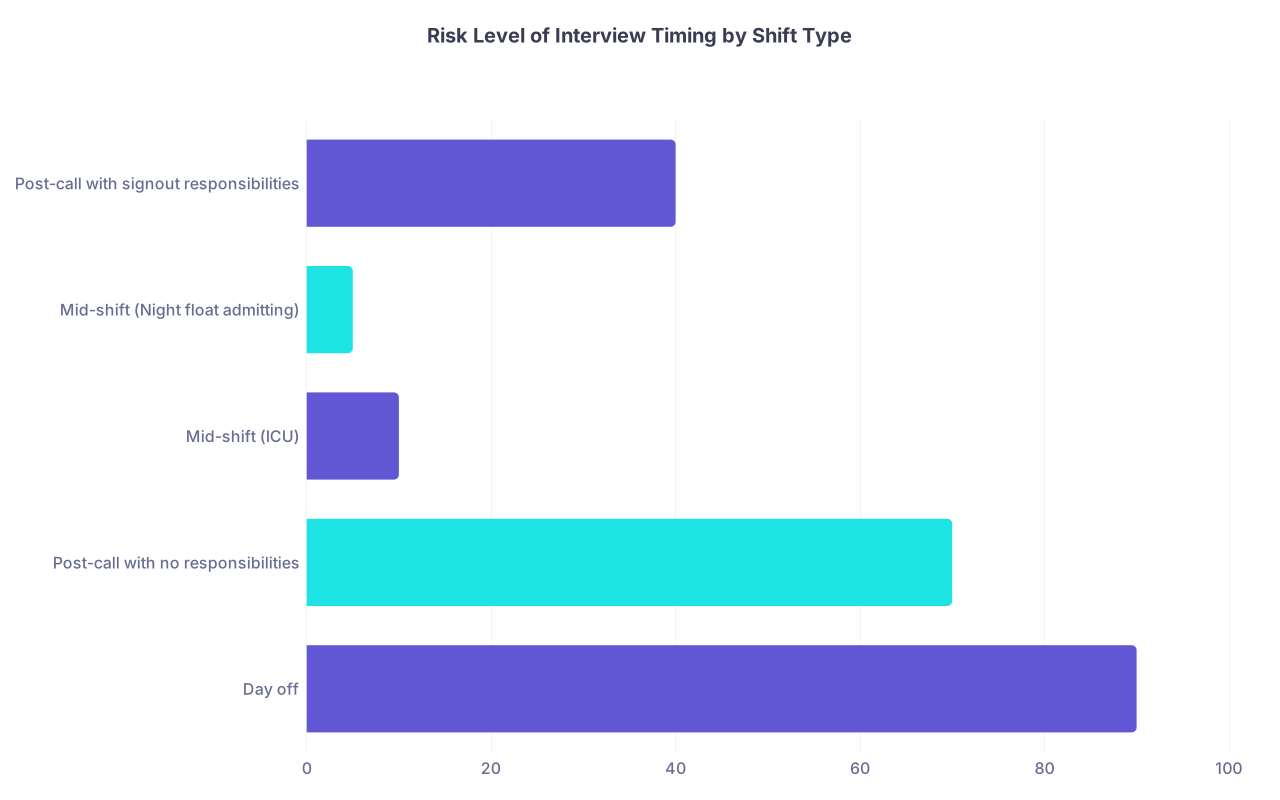
| Category | Value |
|---|---|
| Day off | 90 |
| Post-call with no responsibilities | 70 |
| Mid-shift (ICU) | 10 |
| Mid-shift (Night float admitting) | 5 |
| Post-call with signout responsibilities | 40 |
If you’re still MS4: your leverage is before the rotation starts. If this ICU month is upcoming, email the clerkship coordinator now and say:
“I’m scheduled to interview for residency during this month. Could we avoid scheduling me on nights during mid-October if possible, or cluster my nights either earlier or later? I’m happy to be flexible with other shifts.”
Sometimes they’ll shrug. Sometimes they’ll quietly fix your entire month. Ask.
If you’re a resident: you already know the game. You swap. You beg your co-residents. You bribe with food. Do that before the month starts.
B. Set hard rules for yourself
Decide this now, not at 3 AM mid-shift:
- You will not interview mid-shift from a work room while your team is covering the unit. That’s unprofessional and you will be distracted, guaranteed.
- You will not schedule an interview to start less than 90 minutes after signout on a night shift. You’ll be late, or you’ll get stuck with a crashing patient.
- You will cap yourself: For example, no more than 2 interviews per week while on ICU or nights.
If that means you have to ask for a different date or decline an interview, so be it. A half‑asleep, sloppy interview is worse than rescheduling.
Step 2: Talk to your attending early and like a professional
You need air cover from leadership. Not day-of. Not when your eyes are already red.
A. The email to send a week in advance
Here’s a script. Use it, tweak it, but do not write a novel.
Subject: Schedule request – residency interview on [DATE]
Hi Dr. [Name],
I wanted to give you a heads up that I have a virtual residency interview on [Day, Date] from [Time – Time, time zone]. I’m on [ICU / Night Float] that week.
Would it be possible to:
– Be excused from clinical duties from [30 minutes before] to [30 minutes after] the interview
– Arrange coverage for any pages during that windowI’m happy to make up the time in any reasonable way (coming in early another day, staying late, extra cross-cover, etc.).
I really appreciate your help with this,
[Your Name]
This tells them three things:
- You respect the rotation.
- You’re planning ahead.
- You’re not trying to vanish for half a day; you’re asking for a narrow, concrete block.
If you’re on nights, add:
“I’m post‑call that morning and plan to sleep before the interview, then come back on time for my shift.”
Signals you’re not planning to shortchange the team.
B. The face‑to‑face clarification
On rounds or at a lull:
“Just circling back on that email about my interview on Thursday. I’ll be off the unit from 9:30–11:30 AM. Is there anyone in particular you’d like me to hand off to before I log off?”
You want them thinking about coverage with you, not discovering at 9:32 AM that you’re gone.
Step 3: If you’re on nights: structure the 24 hours so you don’t implode
This is where people get wrecked. Let’s take a sample scenario.
You work: 7 PM–7 AM
Your interview: 10 AM–12 PM
Here’s a realistic plan.
A. The night before
- 3–4 AM: Start front‑loading dispo and notes. Give yourself breathing room toward the end of the shift.
- 6:30–7:00 AM: Aggressive signout. Don’t hang around “helping” until 8:30. You’re done. Go home.
- 7:45–8:00 AM: At home, black out your room (curtains, phone on do not disturb, laptop plugged in). Clothes for interview laid out. Zoom link double‑checked.
B. Sleep block
- 8:00–9:10 AM: Real sleep. This is short and it will suck, but it’s something.
- 9:10–9:25 AM: Wake up, caffeine immediately (not 5 minutes before you go live; give it time to hit). Wash face, eye drops if your eyes are red.
- 9:25–9:40 AM: Quick snack with protein + carbs. No heavy greasy breakfast that will tank your attention.
- 9:40–9:55 AM: Log in early, check camera, mic, background. Stretch. Slow breathing. Get your voice warmed up.
If your interview is later, say 1 PM, split it: short nap after shift (8–11 AM), wake for lunch + setup, then another nap 3–5 PM before you go in that night. It’s not pretty, but it works better than one giant block on either end.
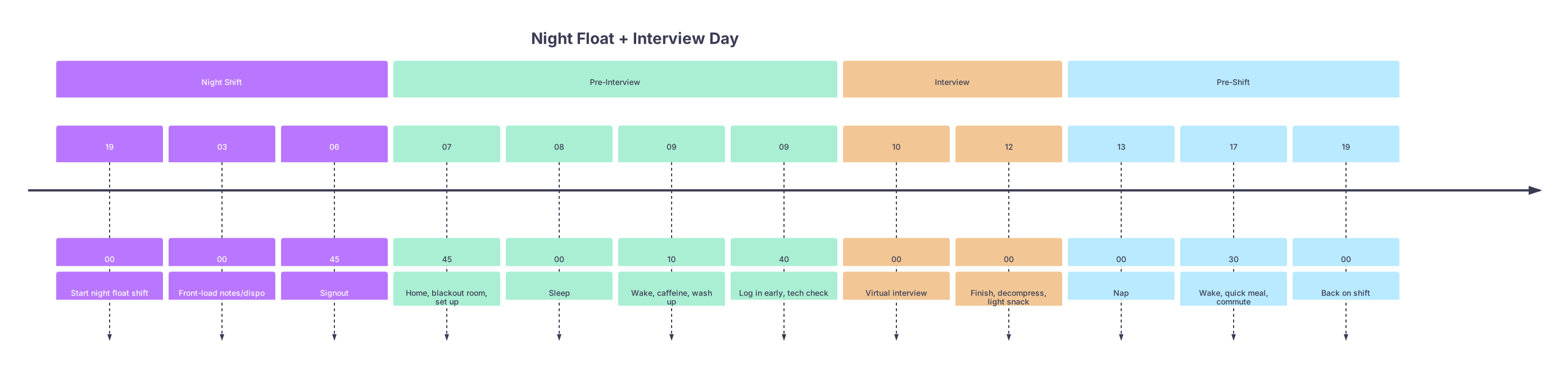
| Period | Event |
|---|---|
| Night Shift - 19 | 00 |
| Night Shift - 03 | 00 |
| Night Shift - 06 | 45 |
| Pre-Interview - 07 | 45 |
| Pre-Interview - 08 | 00 |
| Pre-Interview - 09 | 10 |
| Pre-Interview - 09 | 40 |
| Interview - 10 | 00 |
| Interview - 12 | 00 |
| Pre-Shift - 13 | 00 |
| Pre-Shift - 17 | 30 |
| Pre-Shift - 19 | 00 |
Key rule: Do not “just stay up” from 7 AM to your interview. Your word‑finding will drop, your face will tell on you, and every story will ramble.
Step 4: If you’re on ICU days: defend a clean interview block
ICU is chaos, but there are patterns. Mornings are worst. Mid‑afternoon can be calmer. However, programs love 9 AM and 1 PM slots. Terrible for you.
A. If possible, request PM interviews
When you get an invite, respond fast. A lot of systems let you choose between slots. Grab the latest one that isn’t borderline ridiculous.
If it’s non‑negotiable (e.g., “10 AM only”), then you do this:
- Be totally explicit with your team: “I’ll be off the unit 9:30–11:30.”
- Assign who’s covering your patients. Write it down.
- Get pre‑rounding and notes done before you leave. Round on your sickest patients first.
B. Do not “just Zoom in the call room between rounds”
I’ve seen people do mid‑round interviews. It always looks like this: pager going off, door opening, someone yelling “we’re going to CT now,” audio cutting out, candidate’s eyes darting off-screen.
Programs hate this. It screams poor planning, or worse, that you don’t respect either place enough to give it full attention.
You want a physically separate, quiet space. Either:
- A workroom that can be locked / clearly marked “do not disturb”
- A conference room you book in advance
- Or — if your hospital is too chaotic — your car in the parking garage with a hotspot, assuming signal is stable
Tell your senior: “I’m not reachable for these two hours. If anything explodes, handle it like I’m off-site.”
Step 5: Set up your environment like you’re not at a hospital
You’re probably doing this from a call room, resident office, or your tiny apartment next to the hospital. You still need to look like a professional, not like someone on hour 27 of a call.
A. Background and lighting
Strip the environment of identifiable hospital junk. No patient names, no census boards behind you, no random coworker wandering through.
You want:
- Neutral wall or curtain behind you
- Soft light from in front or slightly above your laptop (desk lamp facing you, not behind you)
- Camera at eye level — stack books or boxes, don’t angle up from your lap
If you’re stuck in a dark call room: turn off the horrible overhead fluorescent and use a lamp facing you at a 45° angle. It looks 10x better on camera.
B. Dress code: no, you don’t wear scrubs
Unless a program explicitly says “scrubs are fine,” you put on normal interview attire from the waist up, minimum: shirt, tie or blouse, blazer if you have it.
Is it ridiculous to put a tie on at 9:45 AM when you’ll be back in the unit in scrubs at noon? Yes. Do it anyway.
Keep your badge off-camera. They don’t need to know you’re standing in an ICU consult room.
Step 6: Managing how you look when you’re exhausted
You cannot magically erase a night shift from your face, but you can blunt the damage.
Concrete fixes:
- Hydrate the hour before. Dehydration makes you look more sunken and sluggish.
- Use eye drops if your eyes are red or dry from masks / no sleep.
- Quick cold water on your face and behind your neck 10 minutes before.
- Tiny bit of caffeine, not a whole pot, right before — you want alert, not jittery.
Body language on camera when you’re tired tends to sag: shoulders forward, low voice, slow responses. You have to intentionally overcorrect:
- Sit slightly forward in the chair
- Keep your camera just above eye level so you’re looking slightly up, not down
- Smile at the beginning of each new interviewer, even if it feels fake at first
- Speak 10–15% slower than you think you should; tired brains rush and then ramble
Step 7: Be honest but not apologetic about your rotation
The question will come: “How is your interview season going? Are you on a tough rotation right now?”
You do not need to dramatically describe how destroyed you feel. But you can humanize it and also show work ethic.
Something like:
- “I’m on our MICU month and nights this week. It’s been a lot, but I made sure I had protected time this morning so I could be present with you.”
- “Yes, I’m on night float, but I really wanted to keep this interview instead of rescheduling, so I planned my sleep around it.”
That signals commitment, not martyrdom.
What you do not say:
- “Sorry if I’m a little out of it, I’ve been up all night.”
- “I’m post‑call, so if I ramble, that’s why.”
They might understand privately, but on paper you’re another applicant, and they’re judging your communication today, not hypothetically when you’re well-rested.
Step 8: If things blow up clinically
Eventually, someone’s patient will crump 20 minutes before your scheduled protected time. Or you’ll be the only resident on a busy night with cross-cover firefighting.
Here’s how to handle it without looking flaky.
A. If it’s before interview day
Let’s say your ICU attending says, “Look, that day is going to be a disaster, we cannot spare you.”
You email the program coordinator immediately:
“Dear [Coordinator],
I’m scheduled for a virtual interview on [Date, Time]. I just learned I will be covering our intensive care unit during that time and, due to patient acuity and staffing, I won’t be able to step away safely.
I remain very interested in your program. Would there be any possibility of an alternate interview slot or date?
Best,
[Name]”
Most programs will try to help you. They’re not monsters; they understand ICU staffing.
B. If it’s during your interview window
Worst case: code blue at 9:25; interview at 9:30.
You have two choices:
- If you are truly essential (you’re the only resident, it’s your patient, etc.) — you stay. You do not abandon a crashing patient for an interview. That story will follow you.
- If there’s enough staff and you’d just be another body in the room, and your attending explicitly says, “Go, we’re good,” then go — but text/email the coordinator:
“We’re having an active emergency in our ICU right now; I may be 10–15 minutes late logging in. I apologize for the short notice.”
Then log in as soon as humanly possible, composed, not flustered, with a one-sentence explanation if they ask. Not a whole dramatic story.
Step 9: Protect your performance with micro-prep
You’re not going to have three free evenings to perfect answers. You’re doing notes at 1 AM. So you change how you prep.
Micro-prep means:
- 10–15 minute blocks on your phone or a notepad between pages
- One question at a time: “Tell me about yourself,” “Why this specialty,” “Why our program”
- Bullet your points, not scripts — you’re too tired to memorize, and scripts sound fake
During nights, I’ve seen residents do this: pull up a note on their phone at 2 AM and quickly jot down:
- One story for “teamwork”
- One story for “conflict”
- One story for “failure and what you learned”
That’s enough. You do not need a novel for each question. You need 3–4 clear stories you can adapt.
Step 10: After the interview: recovery and damage control
You finish the interview at noon. You’re still on nights. The temptation is to mindlessly scroll for an hour and then crash too late.
Don’t.
Do this instead:
- 5–10 minutes: brain dump. Jot down any notes about the program, names, anything you want to mention in a thank‑you email or later when ranking.
- One short, polite thank‑you email to the PD or your main interviewer, if it feels appropriate. Don’t overdo it.
- Eat something real. Then sleep. Commit to a hard sleep start time (e.g., 1 PM) and a wake‑up time (e.g., 5:30 PM).
If you’re on ICU days: go back to the unit on time. Don’t drift in an hour late “because interview.” That breeds silent resentment. You got a protected block; honor that by respecting the rotation outside of it.
Example day breakdowns
To make this painfully concrete, here are two sample timelines.
| Scenario | Pre-interview Sleep | Interview Time | Post-interview Plan |
|---|---|---|---|
| Night Float (7P–7A) | 8:00–9:10 AM | 10:00–12:00 | Eat, notes, 1:00–5:30 PM sleep |
| ICU Days (6A–5P) | Normal overnight | 1:00–3:00 PM | Back to unit 3:15 PM, stay until finish |
| ICU Days, 9AM Interview | Normal overnight | 9:00–11:00 AM | Return 11:15 AM, pre-round on remaining patients |
Are these ideal? No. Are they realistic and survivable? Yes.
One more thing: your mindset
You’re going to feel guilty no matter what. Guilty for leaving the unit. Guilty if you don’t. Guilty for being tired in the interview. Guilty for not being superhuman.
Here’s the reality: both things matter. Caring for your current patients and caring about where you train next. You’re allowed to protect time for your future while still being a responsible clinician.
Programs know people interview while on rough rotations. I’ve sat on the other side of that Zoom and thought, “Yup, that person is post‑call,” and still ranked them highly because they were thoughtful, prepared, and present.
Your job is not to be perfect. Your job is to be intentional.
Your next step today
Open your schedule right now and identify every interview date that overlaps with ICU or night float.
For each one, write down:
- Where you’ll physically be
- When you’ll sleep
- What room you’ll use and who’s covering you
Then draft one email to your attending or chief for the next interview on the calendar asking for that protected block. Send it today, not “sometime this week.”
That one email is the difference between scrambling half‑awake in a call room… and walking into a high‑stakes virtual interview looking like you actually belong there.