
They’ve already judged you before you say a single word.
On Zoom, your “interview” starts the millisecond your camera turns on, not when you open your mouth. And program directors, coordinators, and faculty are absolutely making decisions—small, fast, often subconscious—off those first three seconds of video.
You think you’re “just logging on.” They think they’re already seeing who you’ll be at 3 a.m. on call.
Let me walk you through what really happens on their side of the screen.
What The Program Director Actually Sees When You Log On
You imagine the PD sitting alone, staring intently at your face, emotionally invested in your life story.
Reality is much colder.
Picture a Tuesday interview morning for a mid‑tier IM program:
- The PD is on their third day of interviews that week.
- The coordinator has a spreadsheet open with applicant names, schools, Step 2 scores, and notes.
- There’s a Brady Bunch grid of 12 nervous faces popping in and out of the waiting room.
- An associate PD is pretending to listen while answering emails.
- Residents are logging on late from the workroom.
When you enter the main room, here’s what happens in those first five seconds:
- Your name and school flash in the participant list. Some faculty quickly scan it and think: “Oh, DO,” or “Top 20 school,” or “Never heard of that place.”
- Your video turns on. There’s an instant gut reaction: put‑together or sloppy, polished or chaotic, serious or disengaged.
- Your audio unmutes (maybe). They hear background noise, roommates, traffic, or blessed silence.
- Someone—not always consciously—makes that first mental label: “Professional.” “Awkward.” “Tech mess.” “Looks sharp.” “Looks exhausted.”
Faculty are absolutely talking about it behind the scenes. I’ve heard verbatim comments in private chat:
- “Who’s in the messy bedroom?”
- “White coat on Zoom… seriously?”
- “Guy with AirPods and backwards cap?”
- “She looks like she’s done this 50 times. Nice.”
You think none of that matters. It does. Because on Zoom, all they have early on is your presence and your environment. They’ll use it.
The Silent Rubric: How They’re Scoring You Before You Talk
No one will show you this, and if you asked a PD directly, they’d soft‑pedal it. But in real discussions, here’s what they’re informally rating in those first moments.
| Category | What They’re Really Thinking |
|---|---|
| Background | Organizational skills, respect for process |
| Lighting/Camera | Attention to detail, effort, self-awareness |
| Audio Quality | Reliability, planning, ability to function in systems |
| Dress/Appearance | Professional identity, judgment, maturity |
| Eye Contact | Communication skills, social ease |
Let’s break these down the way they actually talk about them.
1. Your Background: It’s Not Just A Wall, It’s A Personality Test
I’ve sat in post‑interview debriefs where the background alone came up multiple times for the same applicant.
They’re scanning for:
- Chaos. Unmade beds, clothes on the floor, overflowing laundry, junk everywhere. This gets mentally filed as “disorganized,” “overwhelmed,” “probably struggles with life logistics.” No one is thinking, “But maybe they were just busy.” They assume this is just you.
- Privacy. Random people walking behind you, roommates in and out, parents cooking behind you in the kitchen. That goes straight to “boundaries,” “maturity,” and “insight.”
- Try‑hard professionalism. The full white coat, stethoscope, framed medical diploma essentially placed next to your head. That can read as “overcompensating,” “performative,” or “hasn’t developed a normal professional identity yet.”
- Neutral and clean. Plain wall, bookshelf, simple decor, nothing distracting. This is what gets an internal nod: “Okay, they prepared. They respect the process.”
I’ve literally heard: “She was great, but I couldn’t get past the bed with no sheets in the background.” Harsh? Yes. Real? Also yes.
If your background screams chaos, they assume you’ll bring that chaos into sign‑out, documentation, and patient care.
2. Lighting and Camera Angle: The Fastest Professionalism Filter
Zoom lighting has become the new handshake. It’s an instant, visceral impression.
Here’s how they read it:
- Face clearly lit, no harsh shadows, no light blasting from behind you: “This person prepared. They tested this. They cared.”
- Overhead fluorescent lighting washing you out: “Dorm energy.” Not enough to tank you, but it doesn’t help.
- Sitting in front of a window so your face is a silhouette: “Didn’t even rehearse this once.” That’s laziness to them. And laziness is contagious in residency.
- Camera below your face, looking up your nose: “They didn’t bother to raise the laptop an inch?” It signals lack of attention to detail.
- Camera a little above or at eye level, framed chest up: “Looks like I’m speaking to a colleague.” That’s the goal.
The underlying question they’re answering: When something matters, do you put in the minimal thought to do it well—or do you shrug and just show up?
3. Audio: Tech Problems Are Not Neutral
You think tech errors are just bad luck. Faculty rarely see it that way.
They distinguish between:
- One genuine, rare glitch (“We had a quick reconnect, then perfect audio all day”) — no one cares.
- Chronic jank: echo, background noise, muffled sound, cutting in and out, obviously never tested equipment.
Here’s the dirty secret: a good chunk of faculty are technologically hopeless themselves. So when you, the digital‑native applicant, cannot manage decent audio, it stands out even more.
Internal monologue from an APD I sat with last cycle: “If they can’t figure out Zoom after three years of this, they’re going to drown in our EMR.”
Harsh. But there’s a reason they think this way. Residency is endless systems:
- New EMR updates
- Online learning modules
- Order sets
- Pager systems
- Remote checkouts
If you come across as “tech‑clumsy” in a fully scheduled, pre‑planned, high‑stakes Zoom interview, the fear is you’ll be a black hole of time on the floors.
4. Dress and Grooming: They’re Comparing You to Their Residents, Not to Other Students
On Zoom, the bar is not “better than your classmates.” The bar is: “Does this person look like someone who could sign out to me at 6 p.m. and not embarrass the program?”
What they actually notice:
- The default: Business casual, solid or subtle pattern shirt, no wild colors, nothing flashy. This reads as “normal” and disappears from conscious discussion. That’s good.
- Full suit and tie, sitting at your bedroom desk: Sometimes reads as stiff, over‑formal, or disconnected from reality. Some older PDs love it. Some younger faculty quietly roll their eyes. But it’s rarely a dealbreaker.
- Scrubs on Zoom: Programs are split. Strong surgical PDs sometimes like it: “They’re already living in scrubs.” Medicine/psych/peds folks often see it as too casual unless the rest is immaculate.
- Visible lack of effort: T‑shirt, hoodie, messy hair, poor grooming. This doesn’t get “Oh, they’re just relaxed.” It gets “No insight,” “Doesn’t care,” “Poor judgment.”
There’s also the unspoken piece: gender and appearance bias. It exists. I’ve heard female applicants dissected more on hair, makeup, and “polish” than male applicants ever are. It’s unfair, but pretending it doesn’t exist is naive. You protect yourself by controlling what you can.
5. Eye Contact and Nonverbal Presence: They Watch You Before You Know You’re Being Watched
On interview mornings, there are always a few awkward moments:
- You think you’re still “off to the side” in a breakout room, but you’re visible.
- People are joining, cameras are on, no one’s said your name yet.
- Faculty are quietly evaluating who looks tense, checked out, annoyed, or bored.
They notice:
- Who’s looking at the screen attentively, even when not speaking.
- Who is fiddling nonstop with a pen, bouncing their leg visibly, glancing at their phone.
- Who stares down and never looks up, clearly reading a second monitor or notes like a teleprompter.
- Who has that “I’d rather be anywhere else” face when someone else is talking.
I sat in a Zoom pre‑brief where one faculty quietly messaged the group: “Anyone else feel like applicant #7 looks miserable?” That label stuck. In their 1:1, the applicant was fine. Not phenomenal, not awful. But the “miserable” tag was already seeded.
So even before you formally “start,” you’re already in a category.
The Background You Don’t See: Your File vs Your Face
Another behind‑the‑scenes reality: by the time you show up on Zoom, every person in that room has already constructed a story about you from your file.
Your on‑screen presence either confirms or challenges that narrative. Instantly.
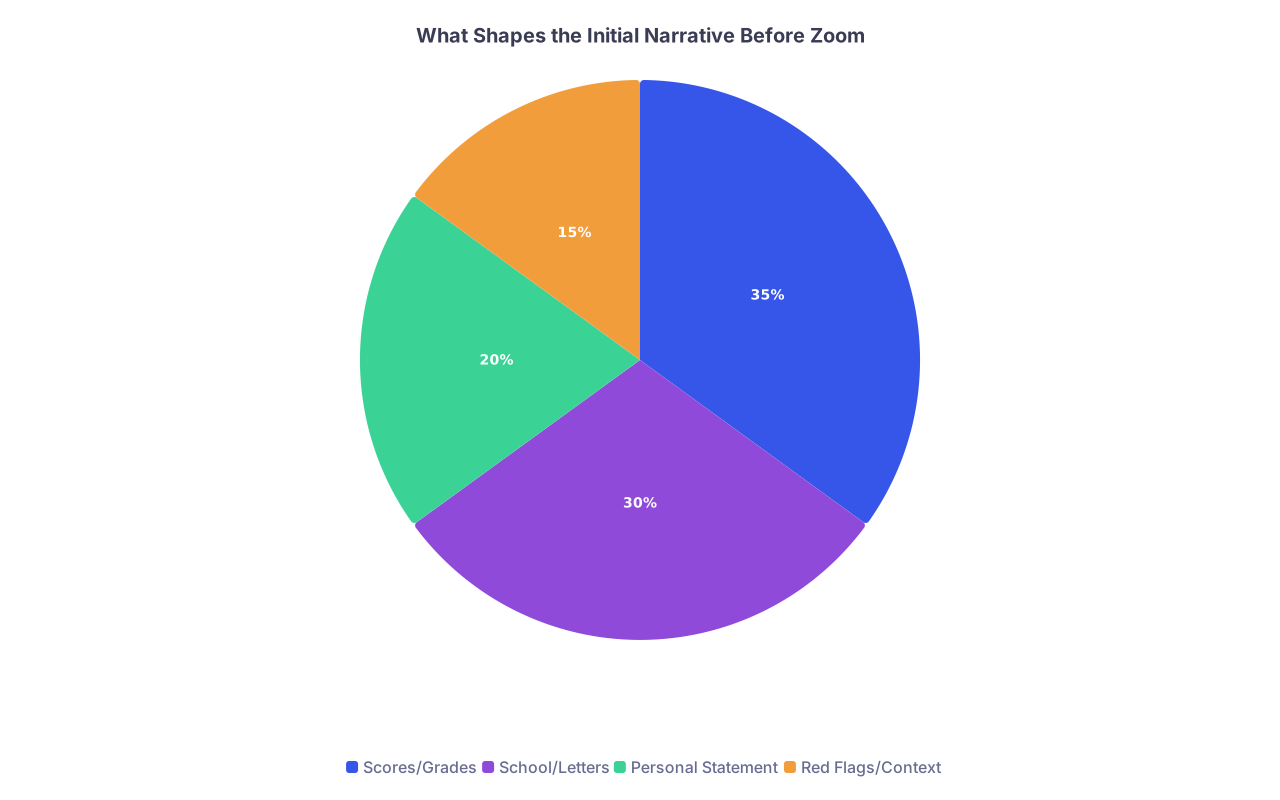
| Category | Value |
|---|---|
| Scores/Grades | 35 |
| School/Letters | 30 |
| Personal Statement | 20 |
| Red Flags/Context | 15 |
Roughly, here’s what’s happening in their heads.
“Strong file, probably a star”
This is the 250+ Step 2, great letters, solid school, clean narrative applicant. People are expecting to like you.
If you log on and look:
- Put together
- Relaxed but professional
- Technically competent
You confirm what they already believe. You’re now in the “safe to rank highly” bucket, barring something strange later.
If you present as chaotic, sloppy, or apathetic on Zoom, that disconnect bothers them. I’ve heard: “On paper, they look amazing, but something felt off. Did you get that too?” That line kills people in final ranking meetings.
“On the fence, could go either way”
This might be a mid‑tier file, average Step 2, some weaker clerkships, lower‑tier school, or simply nothing remarkable.
For you, those first visual impressions matter more. This is where people get moved up or down based purely on human reactions.
Faculties say this kind of thing: “I didn’t remember much from their file, but they were really polished on Zoom” or “Nothing wrong on paper, but I got an odd vibe from them all morning.”
That “vibe” is heavily shaped by everything before you talk.
“Potential concern, want to see them live”
This is the applicant with:
- A leave of absence
- Step fail then pass
- Big gap in training
- Disciplinary note vaguely explained
Those applicants are scrutinized harder on Zoom. Not just on answers, but on affect.
If you show up with:
- Disorganized background
- Low energy, flat affect
- Sloppy dress
Faculty connect those dots: “The story in the PS and the LORs about ‘growth’ and ‘maturity’ doesn’t match what I see.”
How Breakout Rooms and Social Time Expose You Before You’re Ready
You think the only important part is your 1:1 interview.
That’s not how programs see it anymore. The “informal” stuff on Zoom has become a major part of evaluation—especially for fit and red flags.

| Step | Description |
|---|---|
| Step 1 | Main Welcome Room |
| Step 2 | Faculty Introductions |
| Step 3 | Applicant Breakout Groups |
| Step 4 | Resident-Only Session |
| Step 5 | 1:1 or Panel Interviews |
| Step 6 | Final Q&A and Group Goodbye |
Here’s where they’re quietly assessing you before you realize it.
Group welcome and intros
PDs look at who:
- Nods or smiles when others speak
- Stares blankly like they’re at a mandatory HR meeting
- Has their camera on but clearly isn’t mentally present
The ones who look engaged stand out early. You don’t need to be hyperactive. Just awake and present.
Resident rooms: the real report
You think the resident‑only rooms are your chance to “be yourself.” They are. But residents absolutely report back.
After one Zoom day, I once heard residents give this summary to the PD:
- “That guy from [X school] basically talked over everyone.”
- “The DO applicant was really genuine, asked great questions.”
- “The one with the suit and tie was weirdly formal, didn’t loosen up at all.”
- “Someone had their camera off for most of it unless they were speaking.”
Guess which ones got bumped up or down in the rank meeting.
Residents are harsh in a different way than faculty. They care less about your test scores and more about: “Can I sit next to this person at 2 a.m. and not lose my mind?”
What You Can Control: The Silent Setup That Sells You
You cannot control your Step 1 policy change timing. You cannot control your school brand. But you can absolutely control the signals you send before speaking.
Let me be very direct about what programs read as “this person gets it.”
The physical setup
- Neutral background. Plain wall, bookcase, simple art. No bed in frame. If you have to use a bedroom, sit with your head/torso blocking most of it, or turn the desk.
- Camera at or slightly above eye level. Stack books, get a laptop stand, whatever it takes.
- Light source in front of you. Cheap ring light, lamp behind your laptop, window in front of your face—not behind you.
- Test run with a real human. Not just “I turned Zoom on once by myself.” Someone needs to say, “I can hear you clearly,” “You look dark,” or “Your camera is weirdly angled.”
Your “idle” presence
Remember: you are watched when you’re not talking.
Adopt this default posture:
- Sit up, shoulders relaxed, slight forward lean.
- Neutral or slight positive expression. Not a creepy permanent grin, but at least “I’m awake and open.”
- Hands visible occasionally, not constantly fidgeting or touching your face.
When someone else is speaking, act like you’re actually listening in person: occasional nods, brief glances down to jot notes, eyes back to screen.
Technology choices that quietly reassure them
- Wired headphones or good quality mic. AirPods are fine if they’re reliable. Constant Bluetooth disconnects are not.
- Name on Zoom as: “First Last, Med School (Optional)”—not “iPhone,” not “Mike,” not “Michael123.”
- Camera on the entire time unless there’s a clear, voiced reason. The silent camera‑off approach reads as disengaged.
None of this is about being fake. It’s about removing distractions so they can see the best version of you without static.
A Real Example: Same Applicant, Different Perception
Let me show you how brutally fast this goes sideways—or works in your favor.
Applicant A: mid‑tier US MD, Step 2 = 238, average letters, no major red flags. Typical candidate.
Scenario 1 – Sloppy Zoom
- Logs on 2 minutes late to group room, a little flustered.
- Background: bed with wrinkled sheets, laundry basket in the corner.
- Lighting: bright window behind them, face in shadow.
- Audio: AirPods cutting in and out; occasionally an echo.
- Dress: wrinkled button‑down, no tie, hair clearly not groomed that morning.
- During resident session: mostly quiet, camera occasionally “mysteriously” off, checks phone a lot.
Afterward, comments from faculty/residents:
- “File was okay, but I didn’t get much from them.”
- “Seemed tired, kind of disengaged.”
- “Messy background, to be honest.”
Verdict: drifts into the middle or bottom of the rank list. Not actively disliked, just not memorable and slightly negative vibe.
Scenario 2 – Same applicant, professional Zoom
- Logs on 5–10 minutes early, already in the waiting room.
- Background: neutral wall, maybe a plant or shelf behind. Nothing distracting.
- Lighting: simple lamp + window in front; face clearly visible.
- Audio: clear, wired headphones, no echo.
- Dress: clean, well‑fitted business‑casual shirt, hair neat.
- During resident session: asks 1–2 good questions, reacts visibly to others, camera stays on.
Afterward, comments sound like:
- “Honestly, I liked them more than their file suggested.”
- “Came across as more mature than I expected from the numbers.”
- “Felt like they’d be easy to work with.”
Verdict: bumped up a tier on the rank list. Same scores. Same school. Completely different read.
That’s the game you’re actually playing.
FAQs
1. Do virtual backgrounds hurt me?
If they’re clean and subtle, not really. But fake‑looking, glitchy backgrounds where your hair keeps disappearing, or anything goofy (beach, galaxy, memes) makes you look unserious. Many PDs still prefer a real, neutral background. If your real space is truly awful, a plain, non‑distracting virtual background is acceptable. Just test it so you’re not flickering in and out.
2. Is it bad if I’m a bit quiet during the group parts?
You don’t have to dominate. But being a ghost hurts you. Say something at least a few times—ask 1–2 thoughtful questions, respond briefly when given the chance. Programs notice applicants who contribute just enough without hijacking the room. Pure silence plus a flat affect reads as “socially off” or disinterested.
3. How early should I log on to the Zoom interview?
Five to ten minutes early is the sweet spot. Too early and you just sit there. Right on time is acceptable, but one tech hiccup away from being late. Consistently cutting it close or popping in at the exact start time with visible stress is not the tone you want. Early says: I respect this, I’m not improvising my life.
4. How much does all of this really matter compared to my scores and letters?
Numbers and letters still get you in the door. But once you’re on that Zoom grid, every applicant they’re seeing has “enough” on paper. At that point, this stuff—the silent evaluation before you speak—decides who they trust, who they remember, and who feels like a future resident. It will not save a catastrophically weak file, but it absolutely moves you up or down within your tier. And that’s the difference between matching at a place you want—or not.
Remember:
First, they see your space and your face.
Then, they decide how seriously to take your words.
Make those first three seconds work for you, not against you.