
Signals of Genuine Interest PDs Look For on Virtual Interview Day
It’s 8:02 a.m. on your virtual interview day.
You’re logged into Zoom, staring at your own face in the tiny preview window, trying not to obsess over your tie angle or the glare on your glasses.
You’ve already sent the “Thank you so much for the opportunity” email. Your ERAS personal statement has “lifelong passion” written all over it. You clicked “Yes” on the signaling token for this program—maybe even two.
Now you’re thinking the real thought everyone has but rarely says out loud:
“How do I convince them I actually want to be here—and not just anywhere that will take me?”
Let me tell you what happens on the other side of that screen.
Program directors, associate PDs, chief residents—they’re not just listening to your answers. They’re hunting for signals. Real interest vs. scripted enthusiasm. People they can rank high without worrying they’ll slide on Match Day because the applicant never cared in the first place.
Virtual interviews stripped away the hallway chatter, the body language over lunch, the subtle energy you feel when someone is genuinely excited about a place. So PDs adapted. The game changed. The signals did not disappear; they just went digital.
I’m going to walk you through what PDs and faculty actually use as evidence that you’re truly interested, especially in a virtual format—what moves the needle, what’s neutral, and what secretly hurts you.
The Pre-Interview “Research” That Actually Shows Up
You think “I read your website” sounds like you did your homework. It doesn’t.
What matters is whether that “research” translates into the way you talk about the program and the questions you ask.
Here’s what insiders look for:
1. Specificity that only comes from real prep
Vague: “I love your focus on resident education.”
Real: “I noticed your PGY-2s rotate at the county hospital for four months straight—how has that changed their autonomy compared to prior years?”
When I sit in post-interview debriefs, I hear the same line from faculty:
“She clearly knew our program. She’s been paying attention.”
That doesn’t mean you recite facts. It means you connect facts to your own trajectory.
Examples of interest-signaling specificity:
- You reference recent program changes: new ED, new clinic model, switch to night float, new PD.
- You mention something from the pre-interview Q&A or resident panel—then bring it back later in a 1:1.
- You ask about outcomes that normal tourists wouldn’t care about: chief resident selection, fellowship placement patterns, recent ACGME citation fixes, EPIC build changes.
What PDs think when you’re generic:
“Nice kid. Could give this exact answer at 20 other programs. Safe, but not invested.”
What PDs think when you’re specific (and not creepy-specific):
“Okay, this one has done the work. Higher chance they actually rank us.”
On-Screen Behavior: Micro-Signals That Scream “I Care”
Let’s talk about what your square on the screen is actually saying about you.
2. The setup that says “I respect this”
No one will say, “We didn’t rank them because their background was bad.” But it’s absolutely part of the gestalt.
What they notice:
- Lighting: Can they see your face clearly or are you a silhouette?
- Angle: Are you looking straight ahead or are we staring up your nose?
- Distractions: Are people walking behind you? Are you clearly in a busy kitchen?
You’re not getting bonus points for a fake bookshelf. But you do get credit—quietly—for looking like you took this as seriously as an in-person interview day.
Behind closed doors:
“Yeah, she was in a quiet space, looked prepared.”
vs.
“He was in a Starbucks, kept looking off-screen. That’s not a top-10 candidate.”
3. Real-time engagement tells them more than your words
On virtual, engagement is half your interview.
Signals of genuine interest they pick up subconsciously:
- You nod while others are speaking.
- Your facial expression changes when residents talk about call, wellness, changes in schedule.
- You answer quickly when someone asks, “Any questions for us?” rather than staring blankly for 7 seconds.
If you sit stone-faced, arms crossed, camera slightly off, you might think you’re “neutral.” You’re not. You look checked out. And programs have options.
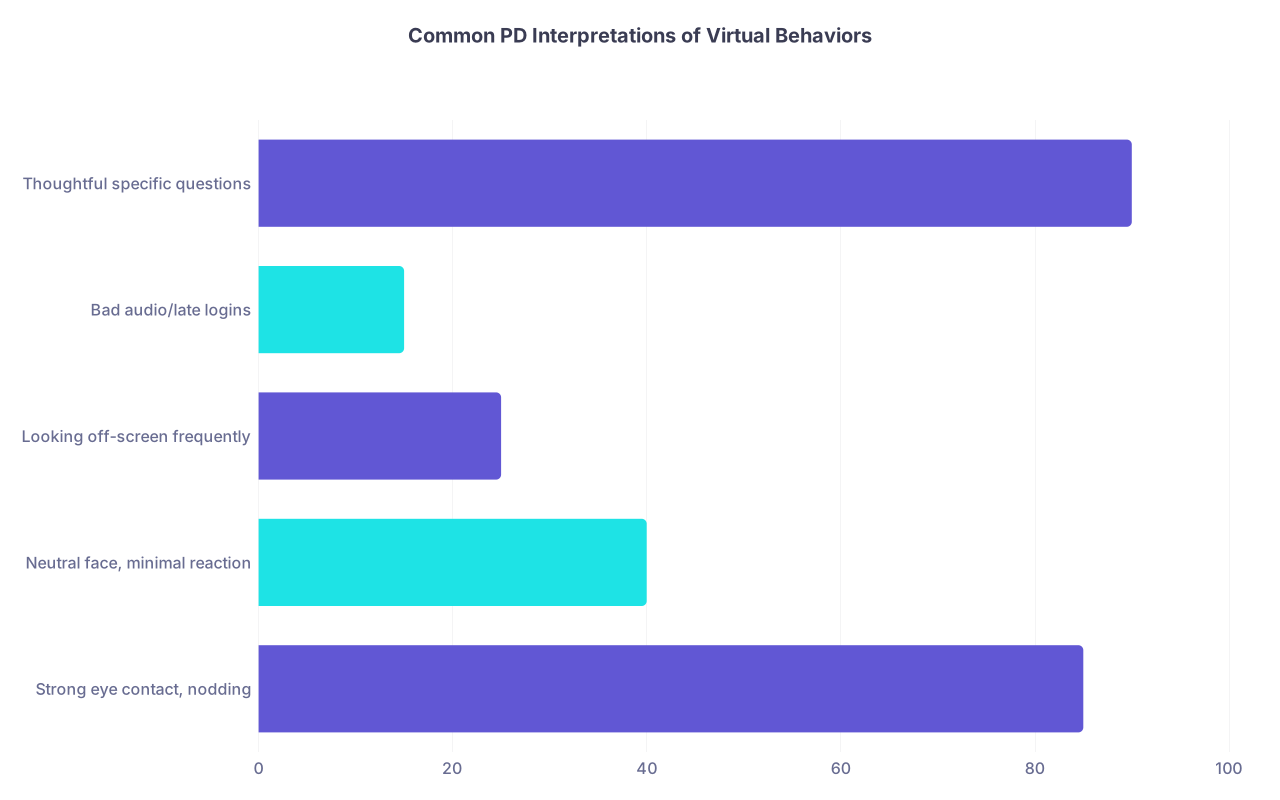
| Category | Value |
|---|---|
| Strong eye contact, nodding | 85 |
| Neutral face, minimal reaction | 40 |
| Looking off-screen frequently | 25 |
| Bad audio/late logins | 15 |
| Thoughtful specific questions | 90 |
Those numbers aren’t from a single paper; they reflect what PDs say in meetings—the relative weight they unconsciously give to each behavior. Thoughtful questions and engagement dominate. Tech chaos and distraction kill you.
The Question Game: Where Genuine Interest Lives or Dies
If you want to know the fastest way PDs distinguish “mass applying” from “this person actually wants to be here,” it’s your questions.
4. Scripted vs. targeted questions
Programs can smell Reddit- or group-chat-generated question lists a mile away. They’ve heard:
- “What are your program’s strengths and weaknesses?”
- “How do you promote resident wellness?”
- “What are you looking for in a resident?”
Ten. Thousand. Times.
Those are fine warmups, but they don’t signal much.
What actually reads as interest:
- Questions that tie your background to their structure.
“My medical school didn’t have a county hospital, so I’m really interested in your county site. How do residents split their time between academic and county, and who tends to thrive at each location?” - Questions that assume you’ve thought long-term about being there.
“If I were here and interested in cardiology fellowship, how early do residents usually start working with the cardiology faculty?” - Questions that build on something they told you 20 minutes ago.
“Earlier you mentioned shifting to X scheduling model—how has that affected intern-level autonomy?”
When we debrief interview days, I’ve literally heard:
“She’s the only one who asked about the changes we made this year.”
“He connected his background to our county experience. Felt like he’d already pictured himself here.”
That’s “genuine interest” in PD language.
5. Consistency of your questions across interviewers
This one’s subtle, but very real.
If you ask every single interviewer, “What do you like most about the program?” we chalk that up as generic.
But if:
- You ask the PD about vision and changes in the next 3–5 years
- You ask a junior resident about day-to-day workflow and where they actually live
- You ask a faculty member in your subspecialty of interest about research or niche opportunities
That looks like a person trying to understand whether they’d thrive at this specific program—not just collecting enough fluff to write a thank-you email.
Insider truth: Multiple interviewers often enter short comments into the system. You don’t see them. But they stack.
“Prepared, specific questions” x 3 people? That’s how you climb spots on the rank list.
Interactions With Residents: Where Programs Test Your Real Priorities
PDs watch how you interact with their residents like hawks. Not always directly, sometimes indirectly through resident feedback forms—but it all feeds back.
6. The resident room isn’t “break time”; it’s surveillance
Those breakout rooms with residents only? PD goldmine. After you log off, there is always a version of this meeting:
“So, who stood out? Who felt like they’d actually want to be here?”
Residents will mention:
- You were attentive in the resident Q&A, didn’t keep your camera off.
- You asked questions you’d only ask if you actually envisioned yourself there: housing prices, commute, childcare, moonlighting, how they feel about switching sites.
- You came back later in the day and referenced what they said. That’s huge.
Resident comments often sound like:
- “He seemed really interested in our county rotations.”
- “She followed up on that ICU schedule thing with the PD. She’s paying attention.”
- “He didn’t ask anything. Quiet the whole time. Hard to get a read.”
Quiet doesn’t kill you, but it never helps. Programs have plenty of “nice but blank” applicants.
7. How you respond to the “warts”
Residents often test you a bit. They’ll drop a mild negative:
“Yeah, the commute to the VA can be rough some days.”
Or: “We’re still working on our outpatient workflow; it’s been a pain point.”
Your reaction is a signal.
Red flag: Defensive laughter, awkward silence, or you pivot instantly to a new topic—looks like you’re collecting only positives, not honestly assessing fit.
Green light: Calm curiosity.
“How have you all managed that? Does it tend to get better later in residency?”
PDs like people who can absorb imperfection without flinching. If you’re still engaged after hearing the “warts,” that screams genuine interest.
Verbal Content: How You Talk About Your Rank List Without Saying It
Programs know you can’t tell every place they’re “number one.” They don’t expect that. But they are absolutely listening for where they sit in your mental hierarchy.
8. Level of fit-thinking in your answers
There’s a difference between: “I want strong clinical training and good fellowship placement.”
and
“From what I’ve seen, your graduates do well both matching into cardiology and going straight into community practice. I like that you’re not a program where everyone does a fellowship—I’m not 100% sure yet, so that flexibility matters to me.”
The second answer says: I’ve looked at you, not just “a midwestern academic program.”
Any time you answer with that level of nuance about their outcomes, that’s logged under “this person has seriously considered us.”
9. The way you talk about geography and life outside the hospital
PDs are not fooled by “I love the Midwest” said to ten different cities.
What registers is:
- You know neighborhoods.
- You’ve looked at rental prices.
- You reference realistic personal circumstances: partner, kids, visa issues, family ties.
If you say: “My partner is remote and we’ve already started looking at apartments within 20–30 minutes of the hospital—being close to X neighborhood seems important to us,”
that’s a huge signal: you’ve pictured a life there, not just a job.
On the other hand, vague lines like “I could be happy anywhere” read as: “You’ll probably rank us mid-list and go somewhere else if you can.”
Technical and Logistical Behavior: Boring but Loud Signals
You’d think people would have the basics handled. You’d be wrong.
10. Tech readiness and punctuality
Virtual removed your excuse to be late because of traffic. PDs know this. So their tolerance for tech chaos is low.
Here’s how it plays behind the scenes:
- 1–2 minutes late with a clear, quick apology and smooth recovery? Fine.
- 5–10 minutes late, no prior notice, and fumbling audio? You just slid down the list.
Programs equate tech prep with conscientiousness. It’s not fair; some people truly have bad internet. But in ranking meetings, I’ve watched people say:
“If they couldn’t bother to test their setup, what will sign-out look like?”
Brutal, but that’s how humans think.
Post-Interview Signals: What Actually Matters vs. Myth
You’re going to hear all sorts of nonsense about “love letters” and “signals of interest” after the interview. Most of it is half-right.
Let’s be blunt.
11. Thank-you emails: weak tiebreakers, not golden tickets
Programs are drowning in thank-you notes.
What PDs pay attention to:
- Are they personalized?
- Do they reference one specific thing from your conversation?
- Do they read like you could have sent them to five other programs by changing the name?
Will a great thank-you letter pull you from the middle of the pack to a top-3 rank? No. That’s fantasy.
But I’ve seen it break ties. If two applicants are relatively equivalent and one clearly valued the conversation, that can nudge you up a few spots.
What does hurt you sometimes: obvious copy-paste jobs sent to every single faculty member with identical wording. That screams “checkbox,” not genuine interest.
12. Post-interview contact: when it helps, when it backfires
The strongest signal after the interview is not volume—it’s clarity.
Strong, appropriate signal:
- One email to the PD after all interviews are done, saying something like:
“After completing my interviews, I can honestly say your program stands out as one of my top choices because of X, Y, Z.”
Not “number one” (unless you mean it), but clearly “high.”
PDs absolutely file that away. They won’t promise you anything back (NRMP rules), but they remember.
Backfire behavior:
- Multiple follow-ups asking, “Where do I stand?”
- Fishing for reassurance.
- Obvious desperation emails sent to half the faculty.
Excessive contact reads as neediness, not interest. Programs want residents who genuinely like them, not people who are trying to hedge the Match algorithm.
How PDs Actually Integrate These Signals on Rank Day
Let’s zoom out: How much do these “interest signals” really matter when the list gets built?
Rough internal weighting I’ve seen and heard at real programs:
| Factor | Relative Weight* |
|---|---|
| File (scores, letters, MSPE) | 40–50% |
| Interview performance/content | 25–30% |
| Resident & faculty impressions | 15–20% |
| Perceived genuine interest | 10–15% |
*Not from a published study. This is how PDs act when doors are closed.
Perceived interest is rarely the #1 factor. But here’s the key:
You’re not competing with the 240 Step, AOA, 10-pub superstar if you’re not that person. You’re competing with people near your range.
Between two similar candidates, the one who:
- Looked prepared on screen
- Asked sharp, program-specific questions
- Clearly imagined a real life there
- Had residents say, “Yeah, I think they’d actually come”
That’s the person who rises.
This is also where timeline comes in.
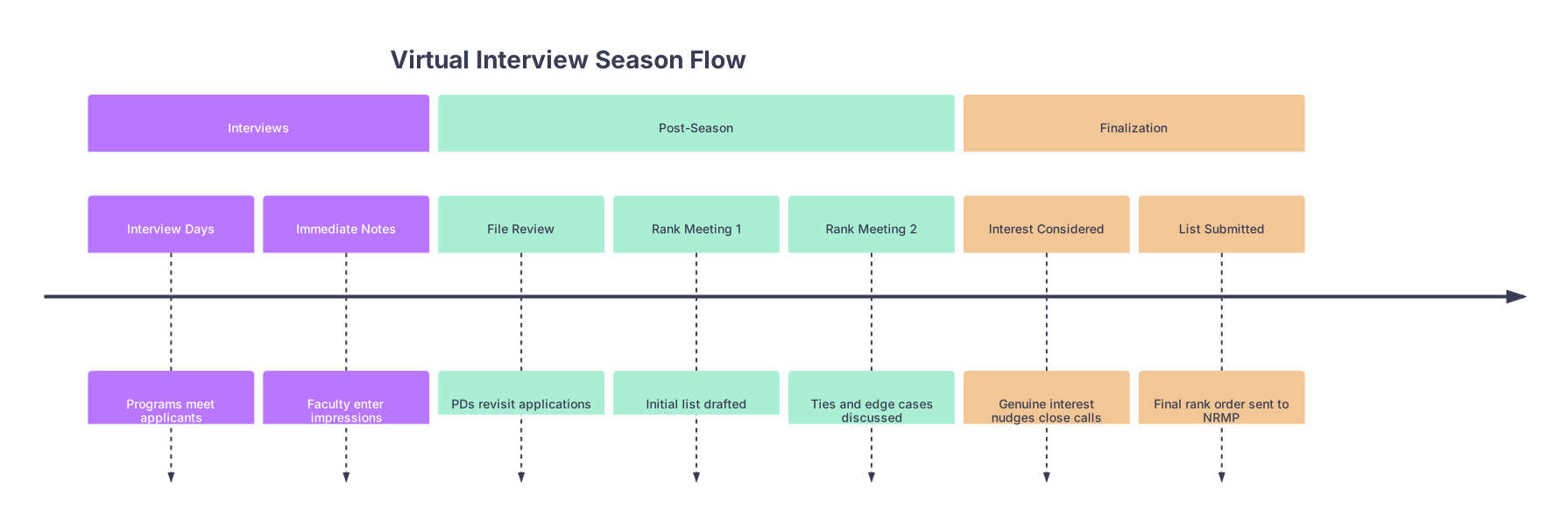
| Period | Event |
|---|---|
| Interviews - Interview Days | Programs meet applicants |
| Interviews - Immediate Notes | Faculty enter impressions |
| Post-Season - File Review | PDs revisit applications |
| Post-Season - Rank Meeting 1 | Initial list drafted |
| Post-Season - Rank Meeting 2 | Ties and edge cases discussed |
| Finalization - Interest Considered | Genuine interest nudges close calls |
| Finalization - List Submitted | Final rank order sent to NRMP |
Interest doesn’t save a disastrous interview. But it absolutely settles close calls during Rank Meeting 2 when they’re arguing about applicant #18 vs #24 vs #31.
Putting It All Together: How YOU Show Genuine Interest Without Being Fake
You don’t need to act like a cheerleader. PDs hate that as much as you do. They’re not looking for over-the-top flattery. They’re looking for reality.
Here’s the distilled version of what works:
- Do enough specific prep that you can talk about the program like you’ve actually pictured yourself there.
- Show up on screen like this matters to you—good setup, present, engaged.
- Ask questions that connect your actual goals and limitations to their actual structure and culture.
- Treat residents like future colleagues, not props in an info session.
- Send one or two honest, grounded signals after interviews if the program is high on your list.
That’s it. No magic incantations. Just grown-up, intentional behavior.