
Virtual social hours matter more to your rank than half your formal interview day. And no one will admit it to you directly.
I’ve sat in ranking meetings where a single offhand comment from a resident about a Zoom social completely flipped how a candidate was perceived. Not the faculty interview. Not the CV. The “optional” happy hour you thought didn’t really count.
Let me walk you through what really happens behind the scenes with these virtual socials, because the official line programs feed you is sanitized beyond recognition.
What Programs Pretend vs What Actually Happens
Programs love to say: “The virtual social hour is just for you to get to know the residents. It won’t affect your ranking.”
That’s not exactly a lie. It’s just incomplete.
Here’s the truth: residents are not usually filling out “scores” on you after the social. But what they say the next day in the resident-only debrief and in front of the program director absolutely shapes where you land on the rank list. Especially if you’re on the bubble.
Residents are the culture police of a program. Faculty know it. PDs respect it. So when residents volunteer opinions about you—even if nobody formally asked—it sticks.
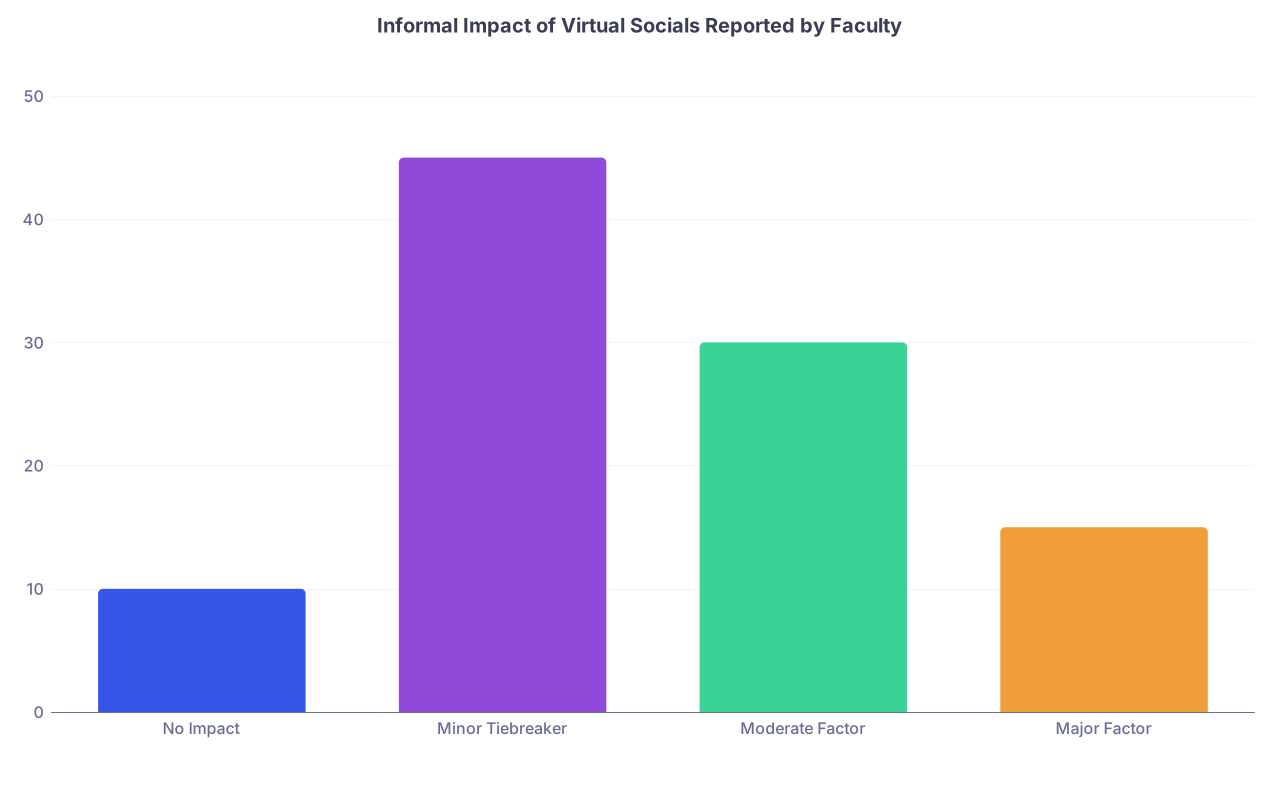
| Category | Value |
|---|---|
| No Impact | 10 |
| Minor Tiebreaker | 45 |
| Moderate Factor | 30 |
| Major Factor | 15 |
Those numbers line up eerily well with what I’ve seen: for a big chunk of applicants, the social hour is the difference between “top third” and “middle third,” or “we’d be happy to have them” vs “ehh, pass if we have better options.”
No, they don’t say, “We dropped this person because they were quiet at Zoom happy hour.” They say:
- “I couldn’t get a sense of them at all; they didn’t engage much.”
- “They talked over everyone.”
- “They seemed checked out / distracted.”
- “They vibed really well with the interns, I’d love to work with them.”
And then the PD writes: “Residents strongly positive” or “resident feedback lukewarm” next to your name. Translation: your rank just shifted.
What Actually Gets Noticed in Virtual Social Hours
People think they’re being evaluated on how “fun” or “outgoing” they are in virtual socials. That’s wrong. This isn’t med school pre-interview mixers where everyone is faking it.
Faculty and residents are scanning for something much more specific: “Would I want to be on call with this person at 2 a.m. when everything is on fire?”
Let me break down what gets quietly logged—because it’s not what most applicants obsess over.
1. Your Engagement Level (Not Volume)
We’re not counting the number of times you speak. We’re noticing whether you actually seem present.
Residents notice:
- Did you turn your camera on? (Yes, this matters more than anyone admits.)
- When you were in a breakout room, did you participate or sit as a silent tile?
- Do you look like you’re listening when others talk—or are you glancing sideways at a second screen?
You don’t need to dominate the room. But if you disappear into the background in every breakout, multiple residents will say, “I never got a sense of them.” In ranking discussions, that translates to: “Safe, but not exciting. Middle of the pack.”
2. Your Vibe Under Low-Stakes Pressure
This is where virtual socials have become the new stress test.
You’re tired. It’s the end of a long interview day. The platform’s glitchy. They’re watching how you deal with all of it:
- Do you roll with technical issues with a sense of humor?
- Do you look openly annoyed when things are awkward?
- Do you keep your composure when you’re tossed into a breakout with three second-years who clearly know each other better than you?
Residents come back and say things like:
- “They were really easy to talk to, even when we had to keep re-asking questions.”
- “They looked visibly irritated every time the internet lagged.”
- “They gave off ‘too good for this’ energy.”
Those are not neutral comments. They change your narrative.
3. How You Treat Junior People
This is the one that kills strong candidates and they never know why.
If there’s a PGY-1 or PGY-2 in your breakout and you basically ignore them and focus on the senior or chief resident, that gets noted. I’ve watched residents say:
- “She only answered when the chief asked something, completely ignored the intern sitting right there.”
- “He clearly didn’t care about the junior residents’ experience.”
And PDs hear that as: “Hierarchy-dependent, not a team player.” That’s death in modern residency culture.
Programs want people who respect interns, nurses, and co-residents, not just leaders. Social hours expose this brutally.
4. Subtle Red Flags You Think No One Caught
I’ve seen applicants sink themselves over stuff they thought was harmless small talk.
Actual examples from resident debriefs:
- “He made a joke about ‘mid-levels’ that landed really badly with our PA-heavy team.”
- “She kept pushing for call schedule specifics and how to avoid ‘bad rotations’—felt like she was already trying to game the system.”
- “He made a comment about ‘not wanting to deal with drama from nurses’—huge no from me.”
Those aren’t “weird impressions.” Those are veto-level comments sometimes.
Not every off-color statement gets written down formally, but they stick in the room.
How Residents Actually Talk About You Afterward
Let me pull back the curtain on what really happens the day after your virtual social hour.
Most programs run some version of this process:
- Interview day with faculty + official resident interviews.
- Evening virtual social (optional… officially).
- Within a few days: resident-only debrief, then a combined ranking or review meeting.
Here’s what the resident portion sounds like behind closed doors:
“Who did you all like from Tuesday’s group?”
No CSVs. No Likert scales at this point. Just vibes and memory.
Then it turns into:
“I really liked [Name]—they asked good questions, seemed genuinely curious.”
or
“[Name] felt a little robotic, like they were reading off a script even in the social.”
or
“I got a weird vibe—hard to explain, but I wouldn’t want them as a co-intern.”
The PD is listening for patterns. If three residents independently bring up your name positively, you just got a boost. If three quietly shrug or say “meh” or “I don’t remember them,” you slide toward the anonymous middle.
If someone says “hard no” with a specific reason, I’ve watched PDs quietly lower that candidate on the list even if the faculty interview was glowing.
They’ll never email you that. You’ll never see it in your ERAS feedback (which doesn’t exist anyway). You’ll just “mysteriously” not match at a place where you thought your interviews went great.
The Politics: Why Programs Lie About This
Programs downplay virtual social hours for one simple reason: they don’t want to scare you off or create liability.
If they say, “Yes, this affects your ranking,” then that becomes a semi-formal evaluation event, and suddenly you’ve got fairness, access, and discrimination questions.
So they tell you:
- “It’s optional.”
- “It won’t affect your ranking.”
- “It’s just for you to get to know us.”
Then they turn around and heavily weight what their residents say about you from that exact event.
You can be pissed about the inconsistency, or you can understand the game and play it strategically.
The unspoken reality:
“Optional” = “Optional in theory, risky to skip in practice.”
| Aspect | Official Line | Behind-the-Scenes Reality |
|---|---|---|
| Attendance | Optional | Noted if you skip without clear reason |
| Formal scoring | Not scored | Informal but influential resident feedback |
| Weight in ranking | Minimal or none | Used as tiebreaker or vibe check |
| Purpose | For you to ask questions | For them to assess fit and red flags |
How Skipping a Virtual Social Really Plays Out
Let’s address the question half of you are asking: “Can I skip a virtual social without tanking my chances?”
Sometimes yes. But you better understand the nuance.
Scenario 1: You’re a clear top applicant on paper
High Step 2 (260+), strong letters, AOA, meaningful research, great faculty interview. If you miss the social at one program because of a conflict, they’ll usually overlook it—especially if you gave a heads-up and apologized.
What residents say in that case:
“Yeah, we didn’t meet them on social, but their interview was strong. Fine with me.”
You might drop from “top 5” to “top 10” but you’re not getting annihilated.
Scenario 2: You’re one of many solid mid-range applicants
This is most of you.
You’ve got decent scores, good letters, nothing that screams superstar or disaster. For you, the social is often the main differentiator among a sea of “would be fine” candidates.
If two applicants look identical on paper, and one came to social and connected with residents and the other didn’t show up?
The one who showed up gets nudged up. Every time.
Scenario 3: You skip multiple socials at the same program
Now residents start saying:
“Did anyone ever actually meet this person?”
“Were they at anything?”
“Feels like they’re not serious about us.”
And then in the ranking discussion, someone says, “We have enough people who clearly want to be here. Let’s move them down.”
They might not tank you to the bottom, but your chance of matching there just took a real hit.
How to “Win” the Virtual Social Without Being Fake
Let me be very clear: you do not need to be the most charismatic person in the room. Programs are not only looking for extroverts. What they want is someone who’s:
- Normal
- Respectful
- Curious
- Easy to work with
That’s it.
Here’s how you signal that in the virtual social without turning it into a performance.
Show Up Like You Actually Want to Be There
Camera on unless you have a genuinely good reason. Clean, non-chaotic background. Decent lighting. Not eating dinner on camera. Not half-lying in bed.
Residents absolutely notice the person who looks like they just rolled out of bed and turned on Zoom.
If you’re exhausted, say something like:
“Long day but I’m really glad to be able to talk to you all more informally—interviews can be so stiff.”
You’ve just humanized yourself and acknowledged reality without sounding ungrateful.
Contribute In Each Room—Briefly but Meaningfully
You don’t need to monologue in every breakout. But you should:
- Answer at least 1–2 questions in each room with some personality.
- Ask 1–2 thoughtful, non-scripted questions.
If you’re truly introverted, lean on good questions. Things like:
- “What surprised you most about intern year here compared to what you expected?”
- “When you’re post-call, what do you actually do? Do people really have time for hobbies?”
- “What makes a resident here not fit well, in your experience?”
These questions get residents talking, and while they talk, they’ll form an impression of you as engaged and mature.
Read the Room and Stop Selling
Residents can smell scripted applicants a mile away. If you’re delivering rehearsed lines like you’re still in the faculty interview, it comes off stiff.
Don’t go on and on about how the program is “your number one” to every breakout room. It sounds disingenuous and desperate.
Instead, anchor on specifics:
- “Talking to you all tonight actually helped clarify what I liked during the interview day—especially the sense of camaraderie you all have.”
Short. Specific. Human.
Red Flags That Will Haunt You Later
These are behaviors I’ve personally seen get talked about in ranking meetings. Some of them sank people who otherwise were competitive.
- Turning camera off the whole time without explanation.
- Dominating conversation and not letting other applicants speak.
- Making jokes about patient loads, “dumping ground” hospitals, or laziness.
- Complaining at length about prior programs, schools, or “toxic attendings.”
- Pushing residents to trash talk their program or leadership.
- Non-stop questions about vacation, moonlighting, and “how to avoid X rotation.”
Do residents talk about vacation and moonlighting among themselves? Constantly.
Do they want to hear you, as an applicant, laser-focused only on your own comfort? No.
There’s a difference between:
“What’s your vacation system like—do people feel like they can actually unplug?”
and
“How do I get the ‘good’ vacation blocks and avoid all the bad ones?”
One sounds reasonable. The other sounds like work-avoidant energy.
A Quick Reality Check on Equity and Access
Let’s address the uncomfortable part: virtual socials are not equally easy for everyone.
People have:
- Unstable internet
- Childcare responsibilities
- Shared living spaces
- Time zone challenges
- Social anxiety
Some programs are actually thoughtful and give a lot of grace. Others… don’t.
If you have a real barrier:
- Email the coordinator ahead of time. Brief, direct. “I may have connectivity/childcare issues but will do my best to attend; just wanted you to be aware.”
- If you get kicked off Zoom repeatedly, come back, apologize once, and move on. Residents are not monsters; they know tech issues happen.
- If you truly cannot attend, say so upfront and consider asking if there are opportunities to connect 1:1 with a resident later.
That won’t perfectly cancel out the hit from missing, but it’ll buffer it a lot compared to just ghosting.
How Programs Use Socials When They’re On the Fence
Let me give you an actual composite scenario from ranking week:
Two applicants for the same mid-tier academic IM program.
- Both: Step in the 240s, no red flags, decent letters.
- Applicant A: Polished faculty interview, weaker resident interview, skipped social.
- Applicant B: Solid but not extraordinary faculty interview, residents loved them at social.
In the final rank meeting, the conversation sounds like this:
“Between A and B, who would you rather have as a co-intern?”
Residents: “Definitely B. We actually know them. They fit our group.”
Result: B ends up 10–15 spots higher than A.
Applicant A never knows why they didn’t match there despite thinking their interviews “went better.” Applicant B never realizes the social hour saved them.
This happens at every single program I’ve ever seen that runs virtual socials.

| Step | Description |
|---|---|
| Step 1 | Application + ERAS File |
| Step 2 | Interview Day |
| Step 3 | Faculty Impression |
| Step 4 | Resident Interview Impression |
| Step 5 | Virtual Social Hour |
| Step 6 | Resident Debrief |
| Step 7 | Rank Meeting |
| Step 8 | Final Rank Position |
FAQs
1. If a program says the social hour is “optional,” do I really need to go?
If you’re serious about that program and logistically able, yes. “Optional” in PD-speak usually means “we’re not legally calling this an evaluation, but we will remember who came and how they came across.” Missing one social at one program won’t destroy you; consistently skipping them or seeming disengaged can hurt you more than you think.
2. I’m introverted and hate group Zooms. Will that sink me?
No, being introverted won’t sink you. Being invisible might. You don’t need to be the loudest in the room; you just need to be clearly present. Turn your camera on, answer when asked, ask a couple of honest questions, react to what others say. Thoughtful, calm, low-key applicants do very well—as long as residents can actually get a sense of who you are.
3. What if my internet is terrible or I get disconnected multiple times?
It happens. The difference is whether you look unreliable or just unlucky. Tell the coordinator beforehand if you expect issues. When it happens, rejoin, briefly apologize, then re-engage. Residents are forgiving when they see you trying. What kills you is vanishing with no explanation or looking checked out even when you’re connected.
4. Can I tell residents their program is my “number one” at the social?
You can, but it’s often not as impressive as you think. Residents have heard “you’re my top choice” from half the applicant pool every year. It matters more that you show you’ve paid attention to specifics: what about their culture, schedule, or training actually fits you. Empty flattery sounds like what it is—strategy, not sincerity.
5. Do residents and PDs really remember what happened in a one-hour Zoom months later?
Individually, details blur. Collectively, patterns stick. Residents might not remember your exact words, but they remember, “That was the person who asked genuine questions and felt easy to talk to,” or “That was the one who made that weird comment about nurses.” In rank meetings, those remembered impressions—good or bad—are often the only thing separating you from the person next to you on the list.
Key takeaways:
Virtual social hours are not a throwaway formality; they’re a quiet but real filter for fit, red flags, and likeability. Residents’ impressions from those “optional” sessions reach the PD’s ears and reshuffle the rank list far more than official messaging admits. Show up, be present, treat everyone well, and give people a reason to remember you for the right reasons.