The panic you feel when you see your terrible camera angle mid-interview is way worse than the angle itself.
You know that moment. You glance at the tiny self-view box and realize: the camera is basically up your nose, or the lighting is making you look like a villain, or your head’s chopped off at the forehead. And your brain immediately goes:
“Oh my god. I look unprofessional. They think I don’t care. I’ve ruined it. Should I fix it? Is it rude to fix it? If I move now will they think I’m unprepared? What do I do?”
Let’s walk through this like someone who has lived in that exact spiral. Because I have. More than once.
First: Reality Check About “Bad Angles”
You’re catastrophizing the angle. They’re not.
Program faculty are dealing with:
- Broken audio
- Frozen screens
- People trying to interview from hospital call rooms
- Kids screaming in the background
- Ring lights dying mid-day
- Applicants totally dropping off Zoom
Your slightly awkward camera angle? That’s background noise.
I’ve literally watched an attending at a big-name IM program do an entire interview with the camera basically pointed at his forehead and ceiling tile. Nobody cared. The applicant didn’t lose points because the interviewer had a bad angle.
So let’s separate the actual problem from the anxiety monster in your head:
- Actual problem: You’re a bit off-center / slightly low / slightly high / side-lit.
- Anxiety problem: “I look so unprofessional they’ll never rank me.”
Those are not the same thing.
Here’s the bigger truth: they’re judging whether they can work with you at 3 a.m. on call. Not whether your webcam framing could win a cinematography award.
What You Should Do In The Moment (Mid-Interview)
You’re mid-interview. You notice the angle. Your stomach drops. What now?
Short version: Yes, you can adjust it. You just have to do it like a functioning adult, not like someone whose soul just left their body.
Option 1: The 5–Second Fix (Ideal)
If it’s something tiny and fixable without making a scene, do it quickly and move on.
Example: Your camera is pointed a bit too low and you’re half out of frame. You can:
- With one hand, subtly tilt the laptop screen a bit.
- Or shift your chair slightly forward/backward.
- Or slide a book under the laptop during a question you’re answering.
You don’t have to announce it. Just:
- Interviewer asks a question.
- You start answering, then while you’re talking you nudge the laptop.
- Done in 3–5 seconds.
Most people won’t even register what you did. And if they do, they’ll read it as: “Oh, they’re adjusting to be on camera better” — which actually looks conscientious, not chaotic.
Option 2: Brief Acknowledgment + Fix (If It’s Really Bad)
If the angle is really bad — like they’re basically staring at the side of your head or your forehead only — a one-sentence acknowledgment is fine.
Something like:
“Sorry, let me just adjust my camera slightly so you can see me better… okay, that’s better.”
Then you shut up and keep going.
No rambling apology. No “my setup is usually better, this never happens, I’m so sorry.” That just draws attention and screams nervous energy.
Short. Neutral. Functional. Move on.
Option 3: Do Nothing (And Save Your Sanity)
If the angle is slightly unflattering, your jawline isn’t at its best, or the lighting isn’t perfect?
Do. Absolutely. Nothing.
Your brain wants to fix your face. The program wants to hear your thinking. Stopping to adjust for vanity-level stuff can actually hurt your flow more than it helps.
Ask yourself this blunt question:
“Is this making it hard for them to see me, or just making me not love how I look?”
If it’s just self-criticism? Leave it.
How Bad Is “Bad”? What Programs Actually Notice
Here’s where your worst-case-scenario brain lies to you.
You think “bad angle” means “interview ruined.” But most programs are focused on clarity and connection, not aesthetics.
Let me rank the stuff that actually bothers interviewers:
| Issue | How Bad It Really Is |
|---|---|
| Audio cutting in and out | Very bad |
| Constant freezing/disconnections | Very bad |
| Super distracting background | Moderate to bad |
| Terrible lighting (can’t see you) | Moderate |
| Camera too close/far | Mild |
| Slightly weird angle | Very mild |
You’ll notice “weird angle” is at the bottom. Because it is.
Attending at a midwestern FM program told me straight-up: “We’re just happy when people show up on time and their mic works. I don’t care if the camera is a little off; half of us don’t know how to fix ours either.”
The only time angle becomes a real problem is if:
- They literally can’t see your face well at all
- You’re half off-screen the entire time
- You look like you’re talking to someone else because your eyes are way off-camera
Even then, if you fix it once early and don’t make a thing out of it? Over.
How To Fix It Without Spiraling On Camera
The move that actually tanks people isn’t the angle. It’s the panic. You can see it: they notice, they flinch, they get flustered, they start apologizing every 30 seconds. That’s what interviewers remember.
Here’s a way to handle it like you’ve done this before, even if your heart is pounding.
Step 1: Regroup Mentally
You notice the angle. Your anxious brain screams. You:
- Take one slow breath out. (Not in. Out.)
- Tell yourself: “They probably haven’t noticed. If they did, they don’t care as much as I do.”
- Decide: Fix quickly or leave it.
Having a deliberate choice calms your brain more than anything.
Step 2: Time Your Adjustment
If you’re going to fix it:
- Do it between questions if you can.
- Or while you’re answering something you’re comfortable with (your background, hobbies, etc.), when you’re more on autopilot.
- Avoid adjusting right as they ask something heavy like, “Tell me about a time you failed.”
You don’t want the physical movement to compete with an emotionally serious answer.
Step 3: Body Language Recovery
After you adjust, don’t shrink.
What a lot of anxious applicants do: they adjust, then kind of sit smaller, tense, apologetic. It telegraphs, “I messed up, I’m sorry for existing.”
Instead:
- Sit back into a normal, natural posture.
- Keep your shoulders relaxed.
- Make soft eye contact with the camera.
You’re signaling: “All good, moving on.”
Will This Hurt My Rank? The Ugly Truth
Let me be annoyingly honest: your camera angle is never the thing that makes or breaks your rank list position.
Programs rank you on:
- How you communicate your experiences and thoughts
- Whether you seem like someone they can trust on call
- How you respond to stress/curveballs
- Whether you seem like a decent teammate
A slightly off camera angle isn’t even in the top 20.
Here’s the kind of stuff faculty actually talk about when they debrief:
- “She was really thoughtful about patient autonomy.”
- “He couldn’t clearly explain his role on that research project.”
- “They seemed defensive when asked about a weak Step score.”
- “They were warm, easy to talk to.”
Nobody is saying: “Yeah, I liked them but their laptop was angled a bit low so rank them lower.” That would be insane.
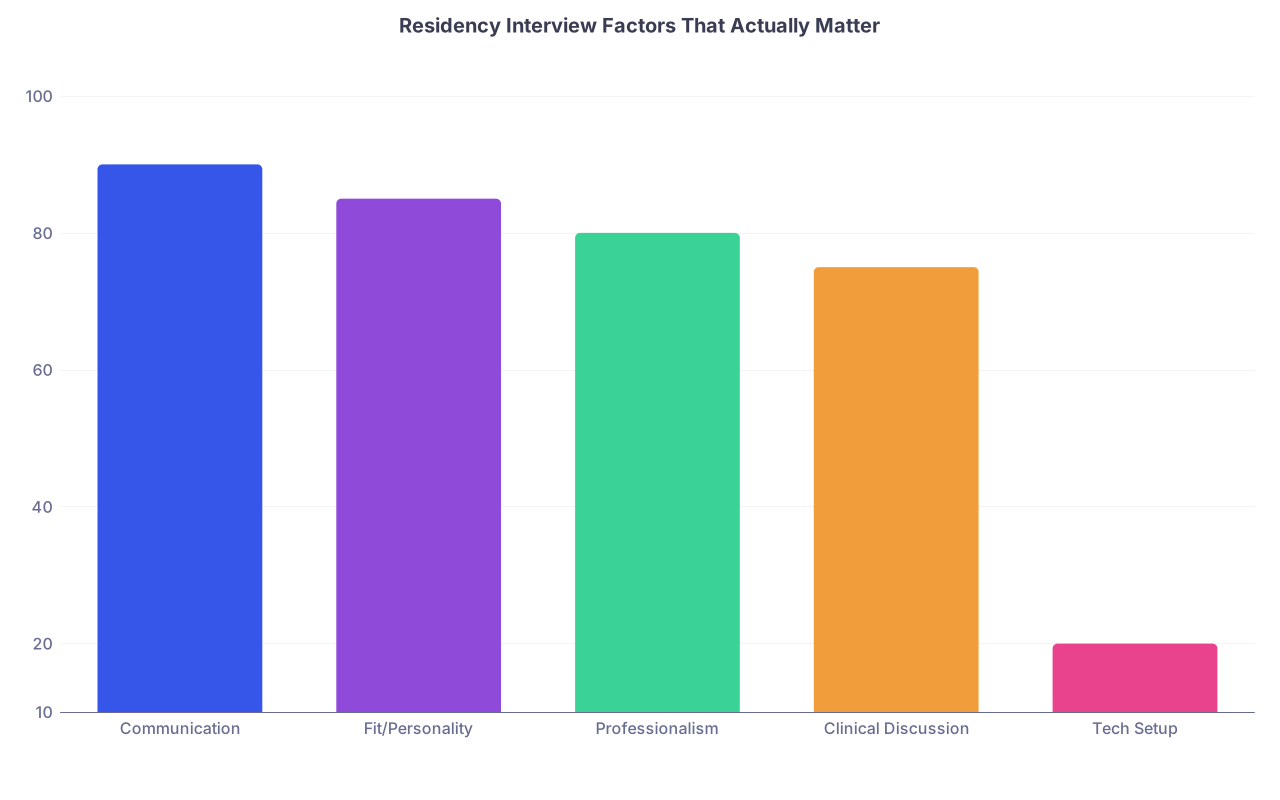
To put this in perspective:
| Category | Value |
|---|---|
| Communication | 90 |
| Fit/Personality | 85 |
| Professionalism | 80 |
| Clinical Discussion | 75 |
| Tech Setup | 20 |
“Tech setup” (which includes angle, lighting, background) does matter a little — but mostly if it’s distracting or chaotic. It’s not a core competency.
If your worst interview “mistake” is “my camera was at a weird angle for a bit and then I fixed it,” you’re actually doing fine.
The Post-Interview Spiral: “Did I Ruin Everything?”
This is where most of us live: after the interview, replaying every second in our heads like our brain is doing a frame-by-frame autopsy.
“I saw myself half off-screen in the first room.”
“I adjusted twice, is that too much?”
“I probably looked disorganized.”
“They definitely noticed. They probably laughed about me after.”
Let me be blunt: the interviewers are exhausted and barely remembering their own lunch, let alone your 3-second camera adjustment.
Their day looks like:
- 6–10 applicants in a row
- Same questions over and over
- Tech issues from someone every block
- Trying to get through eval forms before the next session
They’re not rewinding your angle in their minds. They’re barely keeping track of who was which school.
If you absolutely can’t stop thinking about it, do this:
Write down on paper:
“Thing I’m obsessing about: bad camera angle mid-interview.”Under that, list:
- What actually happened (plain facts).
- What I’m afraid it means (“they think I’m unprofessional”).
- Evidence against that fear (they smiled, they kept asking questions, etc.).
Then answer this:
“If another applicant told me this exact story, would I tell them their match is doomed?”
No? Then treat yourself the same way.
It’s not that your anxiety is fake. It’s that it’s exaggerating the danger.
How To Prevent This Next Time (Without Going Insane)
Future you wants fewer mid-interview surprises. Totally fair.
Do one short tech check before your interview day, then stop obsessing. Don’t keep touching it 500 times; that just creates more chances to mess it up.
Basic pre-check:
- Open Zoom/Teams/whatever.
- Turn on video. Look at yourself realistically, not like a critic.
- Ask: “Can they see my entire face and top of shoulders? Am I roughly centered?”
- Sit the way you’ll actually sit — not bolt upright if you know you’ll slouch a bit in real life.
If possible, do a quick call with a friend and ask, “Do I look normal? Anything weird with my framing?” When they say “You’re fine,” believe them and walk away.
You don’t need ring lights and DSLR setups. You need:
- Stable camera
- Clear audio
- Visible face
- Non-chaotic background
That’s it.
When The Angle Really Is Out of Your Control
Some people are interviewing:
- In a shared space
- On a desktop they can’t move
- With a hospital or library computer
So the monitor is too high or too low and you’re stuck.
If you’re doing your best and still can’t get a perfect eye-level angle, here’s what helps:
- Sit a bit further back so less distortion.
- Stack a couple books under your chair/laptop if possible.
- Position yourself in the center of whatever frame you do have.
If it’s way off, you can even say at the beginning, briefly:
“Just a heads up — this computer is a bit high so the angle may be a little off, but I’ll do my best to stay centered.”
Then you move on. It signals you’re aware, you care, but you’re also functional and not spiraling.
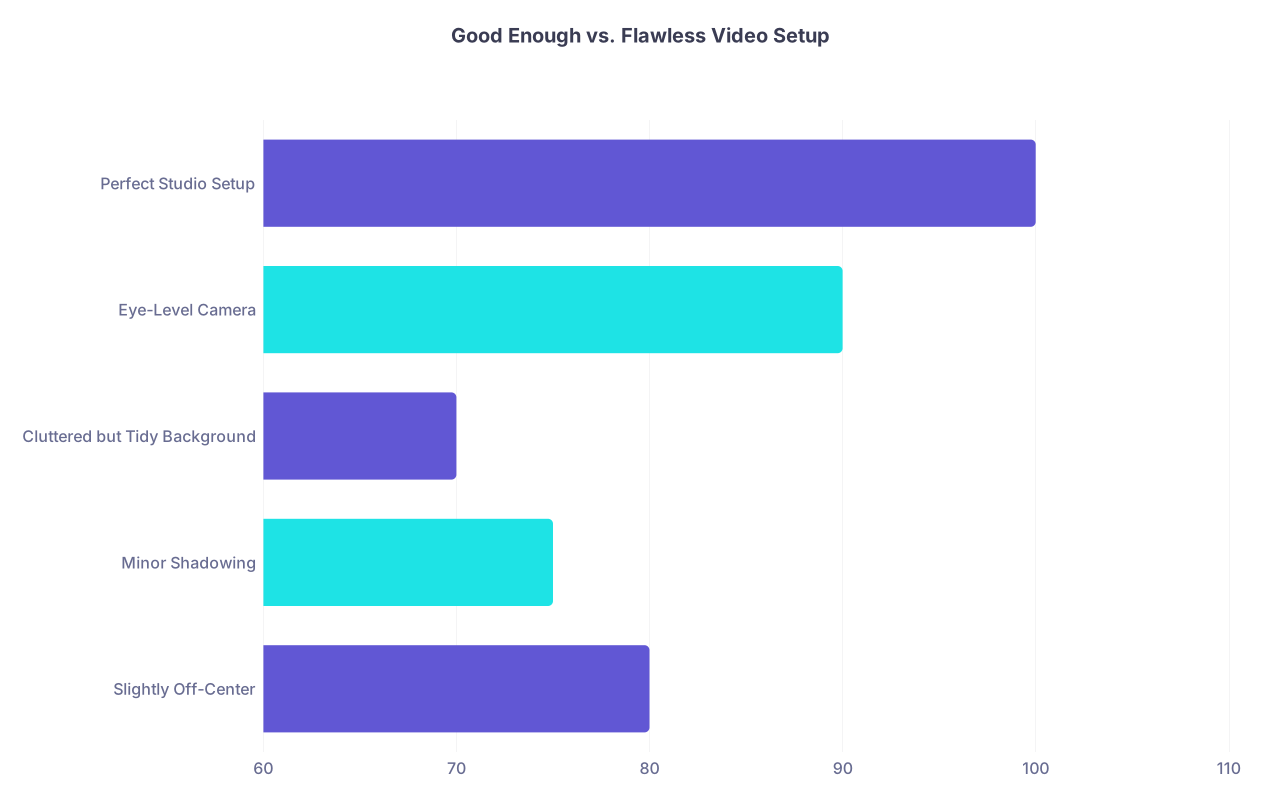
Quick Visual: What “Good Enough” Actually Looks Like
Let’s kill perfectionism for a second. You don’t need YouTuber-level framing.
Think in terms of “good enough,” not “flawless.”
| Category | Value |
|---|---|
| Slightly Off-Center | 80 |
| Minor Shadowing | 75 |
| Cluttered but Tidy Background | 70 |
| Eye-Level Camera | 90 |
| Perfect Studio Setup | 100 |
If you hit eye-level-ish camera and they can see you clearly? You’re 90% of the way there. Everything else is minor optimization.
Tiny Scripts To Keep In Your Back Pocket
If you freeze mid-interview and need words, steal these:
For a quick fix:
“Let me just adjust my camera so you can see me a little better… there we go.”
If something shifts (laptop slides, stand moves):
“Sorry, my laptop shifted for a second — all set now.”
If you’re stuck with a weird angle:
“This setup is a bit fixed, but I’ll try to stay as centered as I can.”
Then no more apologizing. Just answer the next question like you belong there. Because you do.

| Step | Description |
|---|---|
| Step 1 | Notice bad angle mid-interview |
| Step 2 | Adjust quietly during answer |
| Step 3 | Return to normal posture and continue |
| Step 4 | Leave it, focus on content |
| Step 5 | Briefly say youll adjust, then fix |
| Step 6 | Can I fix it in 5 seconds? |
| Step 7 | Is my face mostly visible? |
FAQ (You’re Not The Only One Freaking Out About This)
1. I adjusted my camera twice in one interview. Do I look super unprepared?
No. You look like a human adjusting tech in a tech-heavy process. If you weren’t frantically apologizing both times and you settled afterward, it’s a non-event. Interviewers are used to much worse (full disconnects, wrong links, audio disasters).
2. My face was partly cut off for the first ~10 minutes before I noticed. Is that fatal?
Not even close. If you corrected it once you realized, they’ll just register it as, “Oh, they fixed their camera.” People often spend the first few minutes warming up; they’re listening to your answers, not running a cinematography critique.
3. The interviewer’s camera was bad too. Does that change anything?
If anything, it helps you. If their angle, lighting, or background is off, they’re the last person who’s going to judge you harshly for minor setup issues. Shared imperfection actually makes the whole interaction feel more human.
4. Should I email the program after to apologize for tech / angle issues?
For a minor angle issue? Absolutely not. That just forces them to think about something they probably didn’t notice or already forgot. Email only if there was a true major tech failure (e.g., you got disconnected for 10 minutes and missed part of it).
5. I have multiple interviews coming up and now I’m obsessed with my angle. How do I stop?
Do one realistic test call (with a friend if possible), get a “you look fine,” and then lock the setup. Don’t keep tweaking on interview day. Obsessing usually makes things worse and cranks your anxiety up. Once you’re at “good enough,” your energy belongs in your answers, not your webcam.
Key takeaways:
- A bad or slightly off camera angle is an anxiety trigger, not a match-killer.
- If you can fix it in a few seconds, do it calmly once and move on. If not, let it go.
- Programs are ranking you on how you communicate and who you are, not on whether your webcam deserves an Oscar.