
What actually happens if your roommate slams a door or starts blasting music right in the middle of your residency interview answer about professionalism?
Because that’s the nightmare, right? You’ve spent a decade getting here and it all tanks because someone microwaves leftover fish and yells down the hallway.
Let’s walk through this like people who are stressed and tired and trying not to blow this.
First: Will This Ruin My Chances?
Short answer: no, not by itself. Even if it feels catastrophic in the moment.
I’ve watched this happen in real time on Zoom and Webex more times than I can count. Kids screaming. Fire trucks. Dogs losing their mind. A roommate coming in hot asking, “Yo, did you eat my food?” on full volume.
Did any of those people get auto-rejected?
No.
Did it hurt some of them? Sometimes. But not because of the noise. Because of how they handled it.
Programs know we’re not living in soundproof condos. They started doing virtual interviews during COVID, when literally everyone was stuck at home with roommates, family, pets, thin walls, and chaos. They’ve seen it all.
What they’re really evaluating is:
- Do you stay calm or completely fall apart?
- Do you communicate clearly about what’s happening?
- Do you show basic professionalism and problem-solving?
If you mute yourself, apologize once, handle it, and continue like a normal human? They move on. Honestly, half the time, they’ll forget it happened.
The people who get into trouble are the ones who:
- Spend 3 minutes over-apologizing and spiraling
- Snap in a rude way at whoever made the noise
- Look visibly angry or flustered and never recover
Your roommate won’t sink your app. Your reaction might. And that part, unfortunately, is on you.
That sounds harsh, but it’s also the part you can actually control.
Before the Interview: Controlling What You Can (When You Don’t Have a Quiet Life)
You can’t magically conjure a private home office. But you can stack the odds.
1. Have the painfully direct roommate talk
Not a vague “I have something tomorrow morning.” A very specific, borderline awkward conversation.
You say something like:
“Hey, I have a really important residency interview on [day] from [time to time]. This is a huge deal for me. Can we please keep noise down and avoid using the kitchen/bathroom hallway during that time? I’ll be in [location]. I’m seriously anxious about this, and I’d really appreciate your help.”
If you’re able, offer something in return:
“If you can give me that quiet window, I’ll totally work around your schedule for [X thing] next week.”
Spell out what “noise” means. Door slams, loud calls, playing music, dishes, shower. People don’t always connect that “washing one dish” = clanking + water noise through thin walls.
Most roommates are not villains. They’re just distracted. If you frame it as “this is my future job on the line,” they usually get it.
2. Backup plan: somewhere that isn’t your apartment
Ideally, you ask:
- Your med school: a private study room, office, or conference room
- The hospital: a quiet call room, education office, or library room
- A library: reserve a private room (double-check Wi-Fi and outlet spots)
- A friend with a quieter place: bedroom, office, basement
Yes, it’s annoying to commute somewhere just to sit in front of a laptop. But if your roommates are historically loud, unreliable, or flat-out don’t care, this is less stressful than spending your entire interview listening for footsteps.
Here’s how this usually breaks down in real life:
| Location | Noise Risk | Wi-Fi Reliability | Privacy |
|---|---|---|---|
| Shared Apartment | High | Medium | Low |
| Med School Room | Low | High | High |
| Library Room | Medium | Medium-High | Medium |
| Hospital Room | Low | High | High |
| Friend’s Place | Variable | Variable | Medium |
If your anxiety is already at a 9/10, choose the option that minimizes unknowns. That’s usually your school or hospital.
During the Interview: What If the Worst Actually Happens?
Let’s say it’s go time. You did everything right. And then:
You’re giving a thoughtful answer about a difficult patient encounter, and your roommate starts a blender.
Or someone shouts your name from the hallway.
Or a door slams so loud your mic peaks and the interviewer jumps.
What do you do in those 10 horrible seconds?
1. The second you hear noise: prioritize mute over explanation
Your first move: hit mute. Immediately.
Don’t start talking over the noise. Don’t try to power through like nothing’s happening. They can hear it. You’re not fooling anyone.
Mute, give a quick “one second” hand gesture if needed, then handle it.
2. Short, professional explanation. Not a confessional.
Once it’s quiet enough to talk again, unmute and say something like:
“I’m so sorry about that, my apologies. I’m in a shared space and there was some unexpected noise. I’ve taken care of it.”
That’s it. No 2-minute backstory. No, “My roommate is the worst, I told them…”
The more you ramble, the worse it looks. Own it, show you’ve fixed it, move on.
If the interruption was brief and didn’t fully derail the conversation, you can tone it down even more:
“Apologies for the background noise there — it should be quiet now.”
That’s enough.
3. If you totally lose your train of thought
You don’t have to pretend you didn’t just get derailed.
Say:
“I’m sorry, I got a bit distracted by the noise. Would you mind if I just restated the last part of my answer?”
or
“I apologize, I lost my train of thought with that interruption. I was talking about [brief recap] and the main point I wanted to highlight is…”
This doesn’t make you look weak. It makes you look self-aware and honest. That’s good.
How Programs Actually See This (Not the Way Your Anxiety Sees It)
You’re imagining they’ll say, “We can never rank this person — they live with other humans, disgusting.”
Reality: faculty are doing these calls from their offices, homes, and sometimes literal clinic rooms. I’ve sat in interviews where:
- An attending’s toddler walked in on camera mid-question
- A fire alarm test blared overhead
- Their office mate barged in, saw the screen, mouthed “sorry” and ran away
No one thought they were unprofessional disasters. They thought, “Yeah, 2020s life.”
Here’s what they’re subconsciously scoring when something goes wrong:
- Did you stay composed?
- Did you act like a colleague who can handle disruptions on a busy ward?
- Did you treat others (including the person making the noise) with basic respect?
If you roll your eyes dramatically, swear under your breath, or snap at your roommate loud enough for the mic to pick up? That’s a bigger red flag than the noise itself.
You’re not being judged for having roommates. You are being judged for how you deal with not having control.
To put it bluntly: if a program dings you purely because your roommate closed a door too hard, that’s a program with terrible perspective. And probably not somewhere you’d be happy training.
Underneath the Noise: What You’re Really Afraid Of
This panic about roommates and noise isn’t just about sound. It’s about this:
“I’ve done everything right for years, and something stupid and random could wreck it.”
That loss of control is the part that makes your stomach drop.
Residency applications feel like that across the board:
- One awkward question
- One slow Wi-Fi glitch
- One weird facial expression you made on camera
Your brain files all of them under “this is the thing that ruins everything.”
Let me be blunt: no single small thing ruins everything, unless you totally unravel and never recover.
I’ve seen people match at insanely competitive programs who:
- Froze on a question and had to ask to restart
- Had their internet drop mid-interview
- Had a dog bark 7 times in a row (yes, I counted)
They matched because the rest of their interview showed: mature, calm under pressure, not dramatic, not blaming.
Programs are looking at a whole person over 20–30 minutes, not a single 5‑second clip of background noise.
Concrete Prep Steps So You’re Not White-Knuckling It
You’re anxious. Fair. Let’s at least give your anxiety fewer scenarios to latch onto.
Physical setup stuff you actually control
- Closed door. Always. If you can, lock it. Tape a big note outside: “Quiet please – interview in progress 8–11am.”
- Headphones with a mic. They help with hearing the interviewer over any mild background sounds.
- Stable surface. Don’t sit at a wobbly kitchen table where someone can bump you on their way by.
- Camera angle that doesn’t show high-traffic zones. If your door is in frame, every shadow will spike your heart rate.
Environment agreements
- Tell roommates: “Imagine I’m doing a presentation to 20 attendings. Because I kind of am.” That framing helps.
- Ask them to avoid: vacuuming, cooking, loud calls, video games, showers if pipes are insanely loud.
- If they’ll be home, ask if they’d be okay wearing headphones themselves. It makes a huge difference.
If you’re in a situation where you can’t rely on them — you’ve had issues before, they drink, they’re just not considerate — stop trying to make your apartment work. Go somewhere else. Your brain will thank you.
And If It Goes Wrong Anyway…
Let’s say you’re reading this after the fact. The noise already happened. You’re sure you’re doomed.
Ask yourself:
- Did I mute as quickly as I could?
- Did I apologize once and move on?
- Did I keep my tone respectful and not lash out?
- Did I answer the rest of the questions reasonably well?
If yes, you probably care 100x more than they did.
Interview days are a blur for faculty. They remember:
- The clearly unprofessional applicants
- The extremely strong ones
- The ones who said something concerning or inappropriate
Random background noise? That’s not making their debrief list.
If the interview really got derailed — like multiple long interruptions, Wi-Fi drops, chaos — you can consider a short, calm email to the coordinator afterward. Something like:
“Thank you again for the opportunity to interview with your program today. I wanted to briefly apologize for the background noise earlier — I’m currently in a shared living situation, and despite planning ahead, there were some unexpected interruptions. I appreciate your understanding and the chance to speak with your team.”
Short, responsible, not dramatic. Then you let it go. Seriously. You have other interviews to prep for.
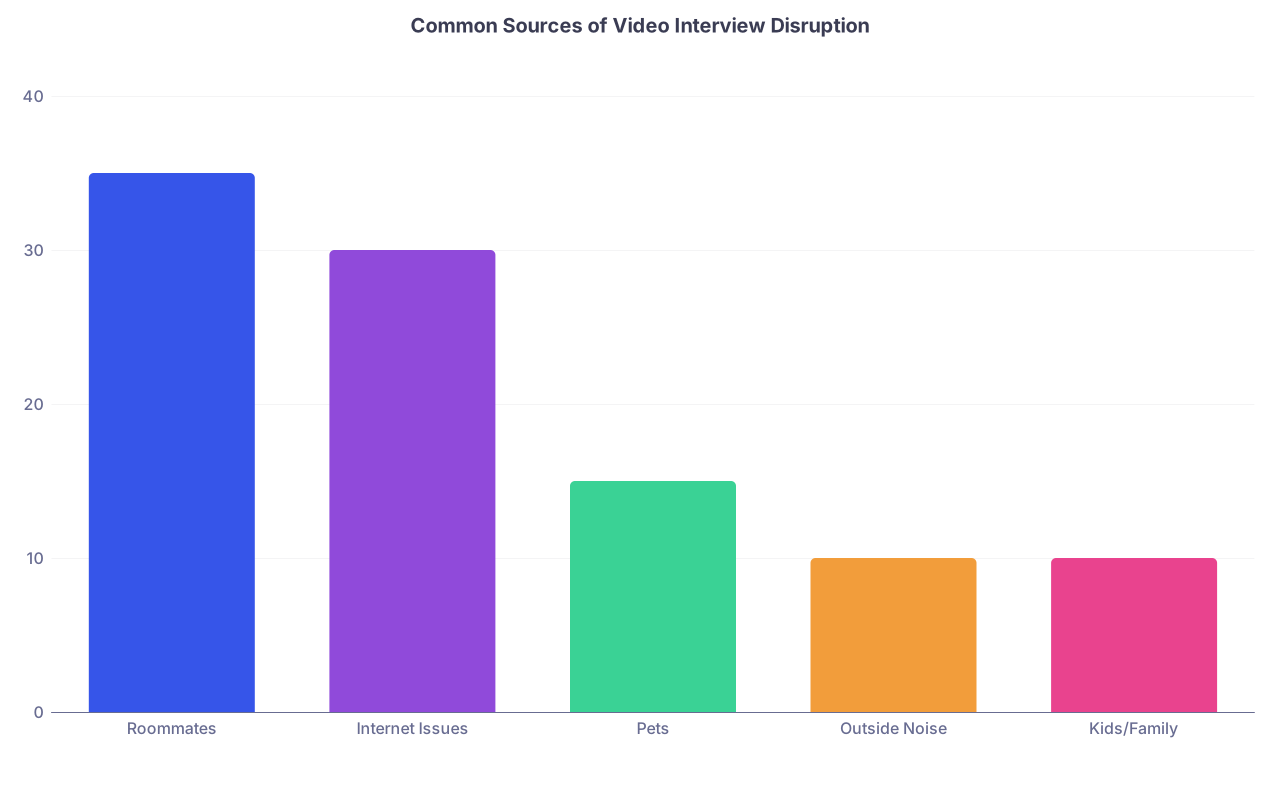
| Category | Value |
|---|---|
| Roommates | 35 |
| Internet Issues | 30 |
| Pets | 15 |
| Outside Noise | 10 |
| Kids/Family | 10 |

| Step | Description |
|---|---|
| Step 1 | Hear Noise |
| Step 2 | Hit Mute Immediately |
| Step 3 | Finish Sentence Quickly |
| Step 4 | Address Noise Off-Camera |
| Step 5 | Unmute |
| Step 6 | Brief Apology |
| Step 7 | Resume Answer Calmly |
| Step 8 | Can you mute quickly? |
FAQ – Exactly What You’re Too Nervous to Ask Out Loud
1. Should I tell programs ahead of time that I have roommates and my place might be noisy?
No. That just creates a problem in their mind that may never actually happen. Prepare your space, talk to your roommates, have a backup location if needed. If something does go wrong during the interview, address it in the moment. You don’t need to pre-apologize for your living situation.
2. Will they think I’m unprofessional for not having a perfectly quiet, private home office?
No. You’re a med student or recent grad, not a CEO. They know many applicants live with roommates, family, even in shared housing near hospitals. What looks unprofessional isn’t the lack of a home office — it’s being irritated, rude, disorganized, or clearly unprepared. A simple, lived-in room is totally fine.
3. What if my roommate walks through the background on camera?
If it’s brief and not chaotic, just say:
“Apologies for that — I’m in a shared apartment, but I’ve asked everyone to give me space. It shouldn’t happen again.”
Then move on. If it keeps happening, that’s a sign you should have done this from somewhere else. But a single quick walk-by isn’t a death sentence.
4. Is it okay to reschedule if I realize my apartment will be loud (construction, landlord visit, etc.)?
Yes, if you do it early and politely. Email the coordinator as soon as you know and say something like:
“I just found out there will be construction/maintenance in my building during my scheduled interview time, which will likely cause significant noise. Would it be possible to reschedule to ensure a professional environment?”
They may say yes, they may say no. But asking once, respectfully, doesn’t hurt you.
5. I already had a noisy interruption — should I mention it in a post-interview email or leave it alone?
If it was minor (a single loud noise, quick roommate cameo, dog bark), leave it alone. Re-raising it just reminds them. If it was truly disruptive — repeated interruptions or clearly derailed a key question — a short, one- or two-sentence acknowledgment in a thank-you email is fine. Don’t over-explain. Don’t dramatize. Own it and shift focus back to your interest in the program.
Key things to hold onto:
- Noise won’t kill your chances. Your reaction matters more than the interruption itself.
- Control what you can ahead of time, and have a backup location if your living situation is chaos-prone.
- If the worst happens, mute fast, apologize once, handle it, and move on. That calm recovery is exactly what good programs want in a resident.