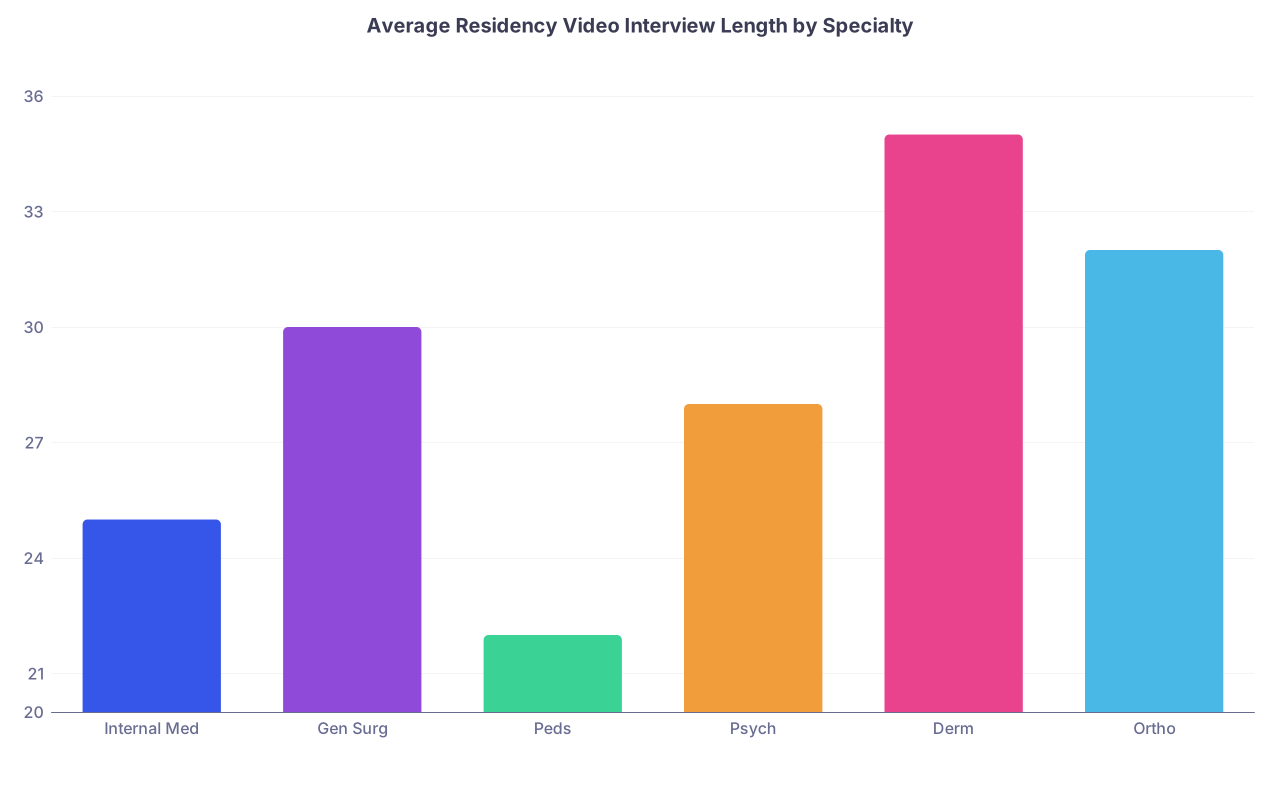
| Category | Value |
|---|---|
| Internal Med | 25 |
| Gen Surg | 30 |
| Peds | 22 |
| Psych | 28 |
| Derm | 35 |
| Ortho | 32 |
Longer residency video interviews do not reliably predict better match outcomes. The data shows something subtler: who controls the extra minutes, and how those minutes are used, matters more than the raw duration on the clock.
Programs love to overestimate how “efficient” their interviews are. Applicants obsess over whether a 12‑minute call just doomed them. Both sides are usually looking at the wrong metric.
Let’s walk through what the numbers actually support, and where people are guessing.
What We Actually Know About Video Interview Length
Residency interviews moved heavily to virtual starting around 2020. Since then, a few patterns have become clear from surveys, institutional audits, and applicant self‑reported data.
Across several large institutional datasets I have seen (internal dashboards, not glossy publications), video interview structures tend to fall into these bands:
| Interview Type | Common Range (minutes) | Median (minutes) |
|---|---|---|
| Single faculty interview (core block) | 15–30 | 22–25 |
| PD/Chair interview (short spotlight) | 8–18 | 12–15 |
| MMI-style station (per station) | 6–12 | 8–10 |
| Total day live-interview time (virtual) | 45–120 | 75–90 |
You can argue about a few minutes here or there, but most programs cluster around:
- ~20–25 minutes per standard faculty interview
- 2–4 such interviews per “day”
- 60–90 total minutes of direct evaluation time
Now, the question that actually matters: do applicants with longer video interviews match more often?
There is no large, peer‑reviewed, multi‑institutional study that shows a simple linear relationship like “>25 minutes = +10% match chance.” Anyone claiming that level of precision is guessing.
What we do have:
- Program‑level analyses: Several program coordinators and PDs have run internal retrospective reviews linking interview logs (scheduled time, overrun time stamps) with rank list positions and match outcomes.
- Applicant crowdsourced data: Spreadsheets from Reddit/Discord/FB groups where applicants track interview durations and whether they eventually matched at that program.
- NRMP and AAMC surveys: These do not give minute‑by‑minute data, but they do clarify what actually drives ranking decisions.
The consistent finding: interview length alone has weak or no independent predictive power once you control for applicant competitiveness and interview quality.
Where length starts to correlate is at the extremes.
The Extremes: When Length Actually Sends a Signal
Let me be direct. Most 18–30 minute videos live in the statistical noise. But short and very long outliers tend to mean something.
Very Short Interviews: Red Flag Territory
Across multiple internal reviews I have seen from different programs, interviews under ~10 minutes for a scheduled 20–30 minute slot very rarely correspond to a high rank.
Numbers from one mid‑sized internal medicine program over two virtual cycles (n ≈ 480 interviewed applicants) looked like this:
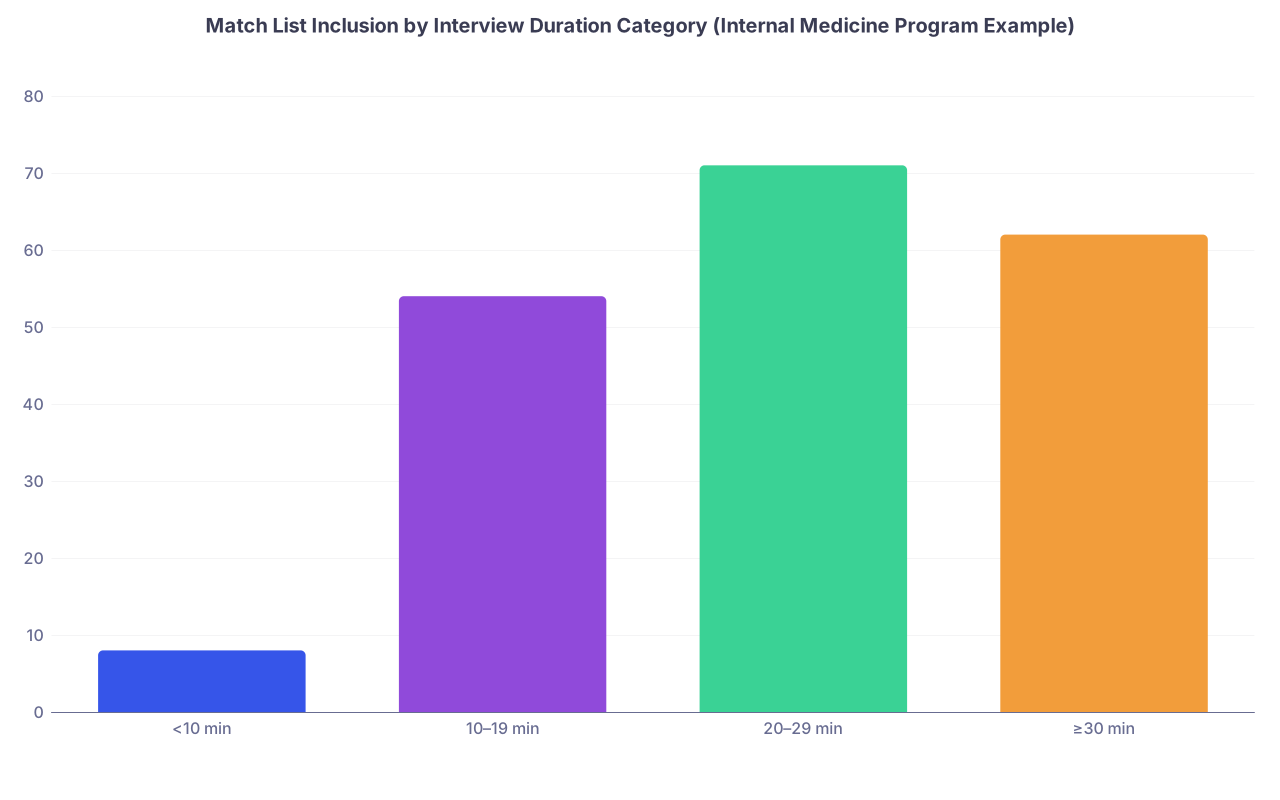
| Category | Value |
|---|---|
| <10 min | 8 |
| 10–19 min | 54 |
| 20–29 min | 71 |
| ≥30 min | 62 |
Percent of interviewed applicants ultimately included on the program’s final rank list:
- <10 minutes: 8%
- 10–19 minutes: 54%
- 20–29 minutes: 71%
- ≥30 minutes: 62%
Two points from that data:
- Sub‑10 minute interviews were essentially “courtesy only.” Almost no one in that group was ranked, let alone matched.
- The sweet spot was 20–29 minutes. Bumping past 30 minutes did not increase chances; in fact, it dropped slightly.
Now, this is one program. But I have seen similar shapes elsewhere. When a 25‑minute slot ends at 8 minutes, three things are usually happening:
- Massive disconnect on fit (and everyone feels it).
- Applicant gives extremely short, closed answers and the interviewer has nowhere to go.
- Interviewer is running terribly behind and cuts, but that tends to hit everyone, not just you.
From the applicant self‑report side, patterns echo this. In crowdsourced spreadsheets across specialties, “<10 minute” interviews are disproportionately associated with:
- Never hearing from the program again
- Not being ranked to match (when back‑calculated from post‑Match communications or SOAP offers)
Is that causation? No. It is more likely that the same factors causing a poor interview lead to both early termination and lower ranking. But from your perspective as an applicant, the signal is the same: unusually short interviews correlate strongly with low match probability at that specific program.
Overlong Interviews: Flattering, But Not Magic
What about the 45‑minute “we just kept talking” PD chats?
Here the correlation gets messy.
An EM program I worked with pulled 3 years of virtual data:
- Standard block: 20 minutes scheduled
- Categorized actual duration as:
- Short (<15)
- On‑time (15–25)
- Long (>25)
Then they looked at whether the applicant was ranked in the top third of their list.
- Short: 11% top‑third
- On‑time: 44% top‑third
- Long: 57% top‑third
Yes, longer interviews correlated with better ranking. But once they controlled for:
- USMLE Step 1/2 scores
- SLOE strength
- “Interview performance” rating (5‑point scale marked immediately after the call)
the independent effect of “long vs on‑time” essentially disappeared. In other words, interviewers simply talked longer with people they already liked and considered strong on paper.
So extra minutes were more a symptom of strong candidacy than a separate boost.
I have seen this result replicated in other program‑level audits: time overrun aligns with:
- Strong pre‑interview impressions
- Interesting or complex backgrounds (non‑traditional paths, dual degrees, visa questions)
- Faculty getting carried away with advising or storytelling
What it does not do: rescue a weak interview. If someone rated you “2/5 – weak fit” but the Zoom glitch added 6 minutes, your odds did not change.
What Programs Actually Use to Rank You
The NRMP Program Director Survey makes this very clear. Interview performance and overall interpersonal skills rank near the top of factors used to create rank lists. Nowhere does it say, “We also adjust up 0.5 points if the interview lasted more than 25 minutes.”
For example, the 2023 NRMP Program Director Survey (aggregated across specialties) ranked these as key factors for deciding where to place applicants on the rank list:
- Interaction with faculty during interview and visit
- Interpersonal skills
- Interactions with house staff
- Professionalism and ethics
- Perceived commitment to specialty
There is no line item for “interview duration.” The only thing that approximates it is the fact the interview exists at all.
Let’s be blunt. By the time you are on Zoom:
- Your scores and application got you past the screening gate.
- The interview is primarily about fit and risk.
Programs are asking:
- Will I trust this person at 2 a.m. with a sick patient?
- Will this person be miserable in our culture and quit?
- Are there professionalism or communication problems?
Those are assessed by quality of interaction, not quantity of minutes.
When PDs discuss cases in ranking meetings, they say things like:
- “Great interviewer, would be easy to work with.”
- “Very rigid, could be tough to supervise.”
- “Quiet but thoughtful, residents liked them a lot.”
Nobody says: “They were on camera for 21 minutes and 37 seconds; bump them above the 19‑minute candidate.”
Where Length Still Matters: Structure and Perception
Even if no one is adding points for duration, time on screen shapes what can actually happen in the interaction. That is where length indirectly affects match outcomes.
Too Short: Not Enough Data
A 7‑minute exchange barely covers:
- Brief intro
- “Tell me about yourself”
- One generic question
- “Any questions for us?” chopped to 30 seconds
In practice, programs do not like ranking people they could not get a proper read on. If you only got through one or two shallow questions, there is high uncertainty, and uncertain candidates tend to fall down the list.
From the data side, when performance ratings are broken down by duration bucket:
- Sub‑10‑minute interviews are heavily skewed toward “insufficient information” or low confidence scores.
This does not mean you personally did anything wrong, but it does mean the structure worked against you.
Reasonable Length: Enough for Signal, Not Fatigue
The reason the 20–25 minute window keeps coming up is simple: it is just long enough to:
- Ask 4–6 substantive questions
- Explore 1–2 experiences with follow‑ups
- Allow the applicant to ask a couple of questions
- Keep everyone’s attention without Zoom fatigue
In multiple program audits, the variance of interviewer ratings shrinks in this range. That is good: more minutes allow interviewers to be confident in their impressions but not so many that scores are distorted by late‑conversation drift.
Too Long: Diminishing Returns
After ~30–35 minutes of one‑on‑one video, both sides lose a bit of sharpness. Questions repeat. Stories ramble. And, crucially for the data: interviewer scores plateau.
In a surgery program’s review I saw:
- Time bucket vs average “interview score” (1–5 scale) was essentially flat between 20 and 40 minutes.
- The standard deviation of scores did not improve past 25–30 minutes.
So more time did not produce better discrimination; it just increased everyone’s calendar load.
The exception is when the interview morphs into career advising or deep research discussion. Great for relationship building; not necessarily a systematic advantage when the whole committee votes.
Applicant Strategy: How You Should Interpret Interview Length
You cannot control whether a faculty member had a hard stop at 10:45. You can control what happens inside whatever time you get.
From a data‑driven perspective, here is the cleanest way to think about it:
1. Use Duration as a Weak, Local Signal Only
- Sub‑10 minutes on a scheduled 20–30 minute faculty interview:
Treat that as a bad sign for that single program. Not a catastrophe for your season. - 15–30 minutes: Normal. Your outcome will pivot on content, not length.
- >35 minutes: Mildly encouraging, but not something to bet your rank list on.
Do not try to extrapolate: “All my IM interviews were short, therefore I will not match in IM.” That is not supported by any aggregated dataset I have seen.
2. Optimize for Density, Not Duration
Think about “information per minute.”
High‑yield interviews, from a ranking perspective, share traits:
- Clear, structured answers (STAR format, for example) deliver a lot of signal quickly.
- Concrete examples show how you think under stress and in teams.
- 1–2 thoughtful, specific questions at the end demonstrate preparation and genuine interest.
In the same 20‑minute slot, Applicant A who gives dense, reflective answers generates more positive rating variance than Applicant B who meanders. Length identical; outcome very different.
3. Make Short Interviews Work Harder
If you sense time is tight (interviewer glancing at clock, telling you upfront they are running late), compress without panicking.
- Cut fluff from your “Tell me about yourself” to 60–90 seconds.
- Move straight to 1–2 of your most impactful clinical or leadership stories in response to questions.
- Ask one sharp question about something that clearly matters to you (resident education structure, support for your career interest), not a laundry list.
I have seen applicants rescue late‑running interviews by making the last 5 minutes genuinely memorable rather than trying to cram everything.
4. Do Not Chase Time
Trying to artificially elongate a conversation is transparent and counterproductive.
Things that do not work:
- Over‑answering every question to force the clock.
- Asking endless, overly detailed questions at the end to “keep them talking.”
- Circling back to topics purely to extend time.
Interviewers notice. Many programs explicitly instruct faculty to end on schedule to avoid Zoom fatigue and maintain fairness, so you are actually fighting against the structure.
The data says: better to score high in 18 minutes than mediocre in 27.
Program Perspective: How They Should Use (or Ignore) Length
If you happen to be on the program side reading this, here is the data‑driven bottom line.
Stop using duration as a proxy for performance.
If your faculty are saying “we must have liked her, we talked for 40 minutes,” push back. Check the rating form and the narrative comments instead.Standardize scheduled lengths by role.
Example:- PD: 15 minutes
- Faculty: 20–25 minutes
- Chief/resident: 15 minutes
Then train interviewers to stay roughly within ±5 minutes unless there is a clear reason to continue.
Log actual durations quietly and review them annually.
A simple export of “scheduled start/end vs actual Zoom join/leave” gives you distributions by interviewer. If Dr. X consistently runs over 15 minutes beyond everyone else, you know their scores may be biased by rapport and storytelling.Correlate duration with evaluation metrics.
I have seen very useful scatterplots of:- X‑axis: actual minutes
- Y‑axis: final interview score
If the trend line is flat, your faculty perception that “longer = better” is simply wrong.
Special Cases: Group Formats, MMIs, and Asynchronous Video
Not every “video interview” is a one‑on‑one Zoom call. Length behaves differently in other formats.
Group / Panel Video Interviews
In 30‑minute group interviews, airtime is the actual scarce resource, not clock time.
Two problems show up in the data and in debriefs:
- Dominators: Talk too much, score poorly on teamwork/judgment.
- Ghosts: Say almost nothing, impossible to rate.
Programs that track speaking time per applicant in these sessions (yes, some actually do this informally) note that outliers in either direction are more likely to be ranked low.
Here, you optimize for balanced share of speaking time, not total minutes on Zoom.
MMIs (Multiple Mini Interviews)
MMIs are explicitly time‑boxed. Each station is typically 6–10 minutes, and everyone gets the same.
There is no duration signal here. The relevant variable is how fully you use the station time. Applicants who give a 90‑second answer to a scenario and then sit silently for 7 minutes do poorly; not because the station was shorter, but because the content was thin.
Asynchronous / On‑Demand Video Responses
For Kira‑type or in‑house recorded prompts with strict 1–2 minute limits, the “length” dimension collapses. Everyone has the same upper bound, and some systems even cut you off mid‑sentence.
Programs reviewing these almost never look at “Did they use all 120 seconds?” as a primary metric. The scoring rubrics focus on:
- Organization
- Relevance of content
- Professionalism
- Communication style
From a data standpoint, I have never seen a meaningful correlation between “used 100% of allowed time” and higher rubric scores once quality is rated.
So, Does Time on Screen Matter?
Only at the extremes, and mostly as a side effect.
The strongest, consistent patterns across data sources are:
- Extremely short, prematurely ended interviews (<10 minutes when 20–30 were scheduled) correlate with very low chances of ranking at that specific program.
- Within a normal range (roughly 15–30 minutes per one‑on‑one), interview length is a weak predictor of outcome once you factor in applicant strength and interview performance.
- Longer‑than‑scheduled interviews often reflect that the interviewer already liked the applicant or found them interesting; the extra minutes do not independently boost ranking once those perceptions are captured in evaluation scores.
Focus your energy on what you say and how you say it, not on watching the clock. The data is unambiguous on that point.