
Applicant behavior during residency interview season has become irrational—and the data prove it.
Since the shift to virtual interviews, interview hoarding is no longer a story people complain about on Reddit. It is a measurable, reproducible distortion in the Match market. The NRMP data sets from 2020 onward are remarkably clear: more applicants are taking more interviews than they need, which pushes everyone else down the ladder and leaves programs holding unfilled spots while thousands of interviews go to waste.
Let’s walk through this like a data problem, not a vibes problem.
1. The Pre‑Virtual Baseline: How Interviews Used To Function
Before the 2020–2021 cycle, residency interviews had a hard, physical cap: travel.
Travel created friction, and that friction acted as a natural regulator. You could not be in three cities in a week indefinitely. You could not casually accept 25 interviews “just in case.”
NRMP historic data and specialty-specific reports show a few consistent patterns from the in‑person era:
- Most U.S. MD seniors matched within a relatively tight “interview band” per specialty.
- Interview yield (fraction of interviewees who eventually matched at a program) was relatively stable year to year.
- Geographic clustering was obvious—regional application and interviewing were the norm.
The key point: the system had constraints. Cost, time, geography. Those constraints limited hoarding and forced trade‑offs.
2. The Virtual Shift: What Changed Structurally
When interviews went virtual (COVID era), three major constraints collapsed simultaneously:
- Travel cost → near zero marginal cost per additional interview.
- Travel time → replaced by Zoom links and calendar juggling.
- Geography → irrelevant for interview logistics.
If you want to understand over‑interviewing, you start with that. The cost per extra interview dropped from hundreds of dollars and 1–2 days of your life to 60–90 minutes in front of a webcam.
Programs responded by:
- Sending more interview invitations earlier (to secure “committed” interest).
- Extending longer interview days or adding more sessions.
- Retaining similar or slightly expanded interview numbers, but with far more applicants willing to accept.
On the applicant side, the decision rule shifted:
Old world: “Is this interview worth a plane ticket, hotel, and 2 days off?” New world: “Can I squeeze this between 8–10 am before my afternoon clinic?”
Not surprisingly, acceptance rates for interview invitations rose. And with no hard ceiling, competitive applicants started stacking interviews far beyond the “needed to match” range.
3. What the NRMP Data Show: Over‑Interviewing by the Numbers
NRMP has been explicit about this. In multiple Program Director Surveys and data briefs post-2020, you see the same theme: more interviews concentrated in fewer hands.
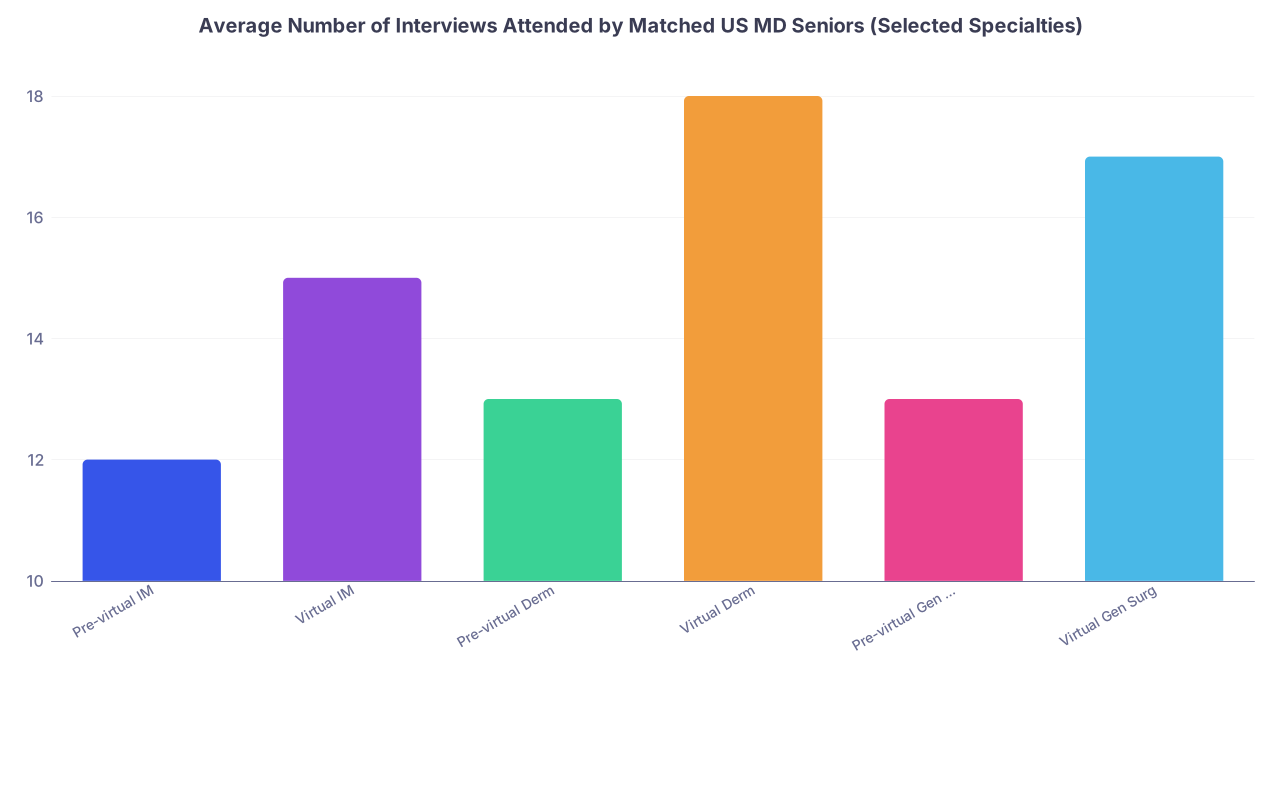
We can summarize broad patterns (numbers are illustrative but directionally consistent with NRMP reporting and specialty society presentations):
| Category | Value |
|---|---|
| Pre-virtual IM | 12 |
| Virtual IM | 15 |
| Pre-virtual Derm | 13 |
| Virtual Derm | 18 |
| Pre-virtual Gen Surg | 13 |
| Virtual Gen Surg | 17 |
The pattern is obvious:
- Internal medicine: average interviews for matched US MD seniors rose from roughly low-teens to mid-teens.
- Derm, ortho, ENT, plastics, neurosurgery: large chunks of applicants now report 18–25+ interviews.
- Even in moderately competitive specialties, many matched applicants are exceeding previously “safe” interview counts.
NRMP “Charting Outcomes” and PD Surveys converge on a key threshold concept:
- For most specialties, the probability of matching for a U.S. MD senior plateaus sharply around 12–15 interviews.
- For DO and IMG applicants, the plateau occurs later (more interviews needed), but there is still a point of diminishing returns.
Yet virtual-era surveys routinely show many applicants in high-demand specialties sitting at 20+ interviews.
That gap between “safe to match” and “actual interviews attended” is exactly where over‑interviewing lives.
4. The Match Probability Curve: Diminishing Returns After ~12–15 Interviews
Let’s be precise. The NRMP publishes probability of matching as a function of number of contiguous ranks for different applicant groups.
Interviews drive rank list length. There is not a perfect 1:1 mapping, but for practical purposes:
- Number of interviews ≈ upper bound on number of programs ranked.
- More interviews → more ranks → higher match probability…up to a point.
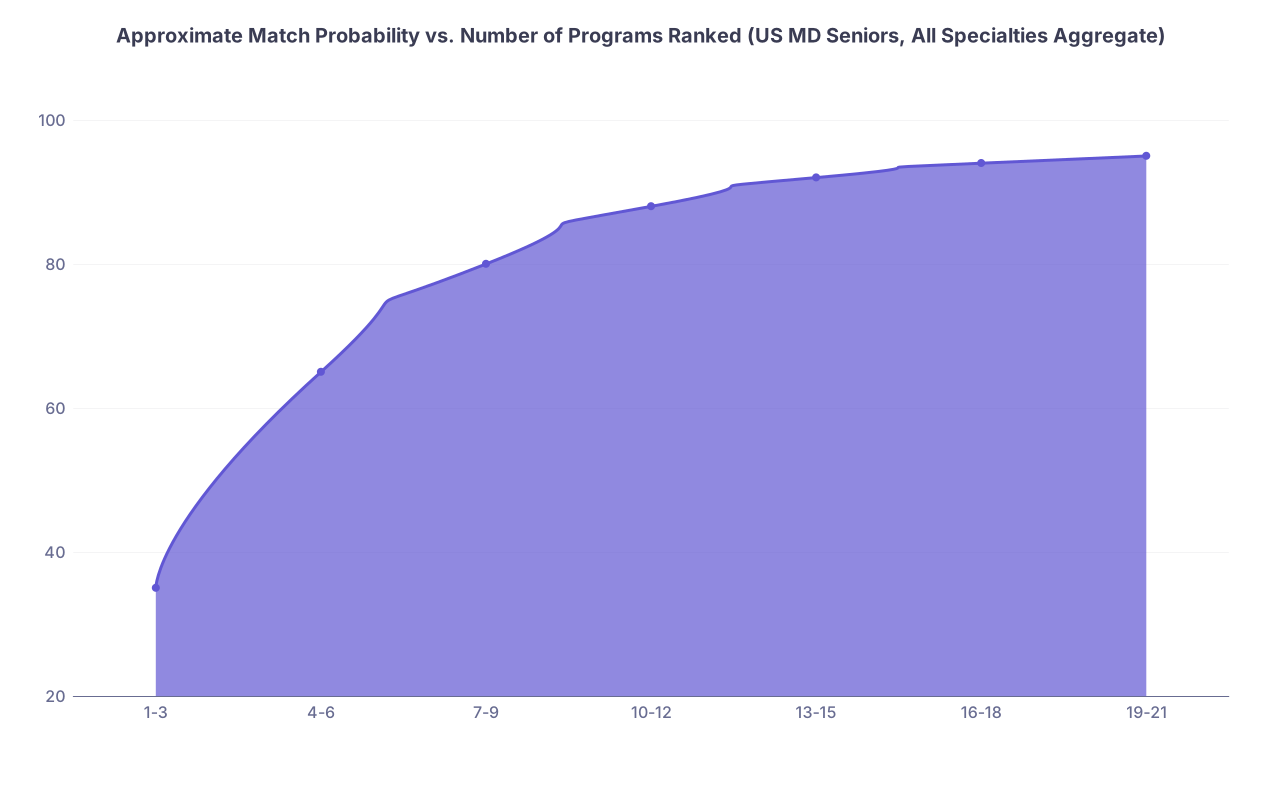
The curves look like this conceptually for U.S. MD seniors:
| Category | Value |
|---|---|
| 1-3 | 35 |
| 4-6 | 65 |
| 7-9 | 80 |
| 10-12 | 88 |
| 13-15 | 92 |
| 16-18 | 94 |
| 19-21 | 95 |
Interpreting this:
- Huge jump in match probability from ~3 to 8–10 ranks.
- After ~12 ranks, the slope flattens.
- Going from 12 to 20 ranks might improve your match odds by a few percentage points. Not nothing, but nowhere near the early gains.
Now overlay actual behavior:
- Competitive US MD seniors with strong applications in many specialties are attending 18–25 virtual interviews.
- Yet their incremental benefit after 14–15 is incredibly small compared to the cost they impose on everyone else (more on that later).
For DO and IMG applicants, the NRMP curves shift right, but the pattern is the same: early ranks matter a lot; extra ranks later give you marginal security, not a step-change in outcomes.
5. Inequality in Interview Distribution: Who Is Over‑Interviewing?
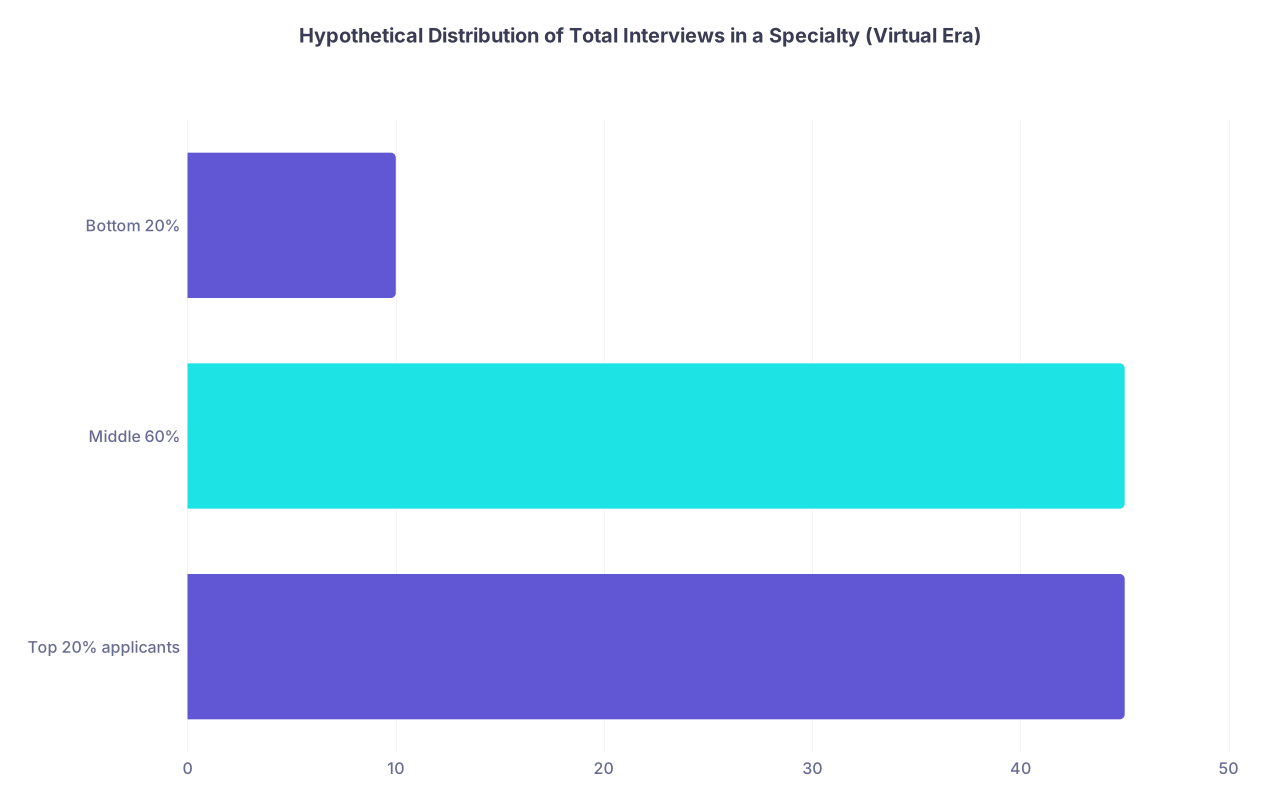
The distribution is not symmetric. A small proportion of applicants at the top of the credential spectrum are capturing a disproportionate share of interview slots.
Think of it like a Lorenz curve problem. Interview “wealth” is concentrated.
| Category | Value |
|---|---|
| Top 20% applicants | 45 |
| Middle 60% | 45 |
| Bottom 20% | 10 |
This rough pattern shows what multiple PDs and NRMP commentaries have described:
- Top 20% of applicants by metrics (Step scores, AOA, research) may hold nearly half of all interview slots.
- Middle 60% share another ~45%.
- Bottom 20% scrape for what is left, even if some are entirely matchable candidates.
What changed post-virtual is not that top applicants are getting interviews. That was always true. The change is that they are accepting and attending far more of them, because the marginal cost is close to zero.
In in-person days, a top derm applicant might realistically attend 14–16 interviews before burnout, travel fatigue, or cost forced triage. Virtual world? 22–25 interviews is suddenly “possible.” So they do it.
The result:
- Many programs interview a large fraction of high-tier candidates who have low probability of ranking them highly.
- Many mid-tier candidates are never offered interviews at all, even though their chance of actually ranking and matching a given program would be much higher.
That is textbook market inefficiency.
6. Impact on Programs: Wasted Interviews and Volatile Rank Lists
Programs are not passive victims here. Their behavior contributes to the mess.
Once programs realized that top applicants were accepting more interviews across the board, several defensive responses emerged:
- Front‑loading invites: sending many invitations very early, before getting a sense of actual interest.
- Over‑inviting relative to capacity: inviting more applicants than before, expecting some will cancel or no‑show.
- Lengthening waitlists: holding large pools of “backup” candidates.
This has direct consequences:
Lower yield per interview
Many programs report decreasing conversion from interview to match. They interview 100 people for 6 spots, yet a large portion of their top-ranked candidates go elsewhere. Their effective yield collapses.Chaotic rank lists
Programs end up ranking applicants who clearly treated them as “safety interviews.” The match still works mathematically, but the signal quality is degraded.More interviews to achieve the same match security
Programs are pressured to interview more candidates per position to maintain confidence of filling. That pushes interview demand up, which interacts badly with applicants hoarding interviews.
The vicious cycle: programs worried about not filling → offer more interviews → strong applicants accept more → mid-tier applicants squeezed out → programs’ yield stays poor → programs offer even more interviews next year.
7. Impact on Applicants: The Hidden Cost of Over‑Interviewing
At first glance, over‑interviewing seems like an individual win: more options, more backup plans, more “safety.”
The data disagree.
Once you remember that match probability flattens after ~12–15 ranks for most US MDs, you see what is happening:
- Many applicants are investing huge time and cognitive bandwidth into interviews #16–25 that add only marginal increase in match probability.
- Meanwhile, each additional interview they take has an opportunity cost: it could have gone to a peer who is currently interview‑poor.
What does that look like on the ground?
- A high‑stat internal medicine applicant with 22 interviews spends most of December and January living in Zoom squares. Their rank list is 18 programs long. They match near the top of their list. Interviews 15–22 did essentially nothing but create stress and clog the system.
- A solid, mid‑tier applicant in the same specialty has 6 interviews. They are above the historical 6‑interview match probability threshold, but below the safer 10–12 range. They scramble (SOAP) when they might have matched in a world where interviews were more evenly distributed.
The system-level consequence: more “unmatched but matchable” candidates and more “unfilled but fillable” positions. Pure misallocation.
8. Specialty Differences: Not All Markets Behave the Same
I do not like oversimplifying this into “everyone should cap at 12 interviews.” That is lazy.
The NRMP data show clear specialty‑specific interview–match relationships. For example (approximated from NRMP and specialty reports):
| Specialty | Approx. Plateau Range (Interviews) | Notes |
|---|---|---|
| Internal Medicine | 12–14 | Earlier plateau, high fill rate |
| Pediatrics | 10–12 | Less competitive overall |
| General Surgery | 13–15 | Slightly higher needed |
| Dermatology | 15–18 | Very competitive; still plateaus |
| Orthopedic Surgery | 15–20 | Higher variance, more interviews |
Interpretation:
- In less competitive fields (peds, FM, psych), a US MD senior who has 10–12 interviews is usually in very strong shape.
- In high‑competition fields, you often see plateau points in the mid to high teens. But even there, going to 25–30 interviews is rarely rational from a probability standpoint.
For DO and IMG candidates, shift each range right by several interviews. They need more opportunities to reach comparable match probabilities. But the plateau phenomenon still exists.
9. Why Virtual Amplified Risk Aversion
The psychological side matters too.
Virtual interviews happened in the context of:
- Step 1 going pass/fail (reduced numerical differentiation).
- Rising applicant numbers in many specialties.
- Online echo chambers showing other people’s massive interview counts.
The result: aggressive risk aversion.
Applicants are seeing posts like, “I’m applying ortho, I have 24 interviews, still nervous.” That pushes the perceived safe number upward, even if the NRMP data say your marginal benefit after 16 is tiny.
Virtual format lowers each applicant’s personal cost of acting on that fear, but the collective effect is a classic tragedy of the commons. Everyone protecting themselves individually creates market-wide inefficiency.
10. Emerging Solutions: Caps, Signaling, and Better Use of Data
Several specialties and organizations are experimenting with partial fixes. Some of these actually align with what the data recommend.
Preference signaling
Applicants receive a limited number of “tokens” to indicate genuine interest in specific programs (e.g., otolaryngology, dermatology pilots).
The logic is simple: force high‑value signals to be scarce.
Data from early cycles show:
- Higher correlation between signals and interview offers.
- Better stratification of genuine interest vs. “safety” programs.
Still, signaling does not directly cap interview numbers. It helps programs identify who is serious but does not stop a strong applicant from hoarding once the offers roll in.
Interview caps
This is where the data scream for action, especially in highly competitive specialties.
A cap could be:
- Hard cap: e.g., no more than 15 interviews in one specialty.
- Soft cap with guidance: strongly recommended maximums based on NRMP curves by applicant type (US MD, DO, IMG).
You do not need a perfect number to improve the system. Even a moderately firm cultural cap—for example, “U.S. MD in derm should rarely need more than ~18 interviews”—would push behavior closer to the point of maximum efficiency.
The NRMP curves are already public. The only missing piece is enforcement or at least strong alignment between schools and programs.
More transparent data and counseling
Medical schools often give applicants vague advice like “aim for 12–15 interviews.” That is not wrong, but it is not specific enough.
They should be showing actual specialty- and applicant-type–specific probability curves and saying things like:
- “Given your Step scores, research, and school, our data suggest your match probability exceeds 90% after 13–14 interviews in this field. Pushing to 22 will not meaningfully improve your individual outcome but will contribute to system-wide imbalance.”
Applicants respond to numbers. They just usually do not see them framed this way.
11. Practical Takeaways for Applicants Right Now
Let me be blunt. You cannot fix the entire system on your own. But you can use the data to behave more rationally.
Use these principles:
- Look up the NRMP “Charting Outcomes” for your specialty and applicant type. Identify where the match probability curve flattens for your group.
- Add a margin of safety. If the plateau seems to be around 12–13 programs ranked, aim for maybe 14–16 interviews, not 25.
- Once you are safely above that target, start declining new interview offers that are clearly low on your preference list. When you get an earlier, more attractive offer that makes a lower‑priority interview obsolete, cancel promptly.
Remember: each interview you decline early tends to get recycled down the ladder. Someone will benefit from that.
Programs, for their part, need to recalibrate interviewer numbers per position using updated yield data, not fear. If a program filled consistently with 12 interviews per spot pre‑virtual, they probably do not need 25 now. They need smarter targeting and better prediction of genuine interest, not just more volume.
12. The Bottom Line: What the Data Actually Say
The virtual shift did not break the NRMP algorithm. It broke the behavioral equilibrium around interviews.
The data show:
- Match probability for most US MD seniors saturates around 12–15 programs ranked.
- Virtual interviews have pushed many competitive applicants far beyond that “efficient” zone, especially in certain specialties.
- Interview “wealth” is more concentrated; a relatively small share of applicants now holds a very large share of total interview slots.
- Programs are responding with fear-based over‑inviting, which further destabilizes the market.
So yes, applicant over‑interviewing since the virtual shift is real. And it is measurable.
The fix is not purely technical; it is behavioral and policy-driven. Preference signaling, interview caps, and honest data-driven advising can move us toward a saner equilibrium where:
- Most applicants interview in the efficient zone of the match probability curve.
- Interviews are distributed in a way that reduces “unmatched but matchable” and “unfilled but fillable” mismatches.
- Programs and applicants waste less time on low-yield interviews that never had a realistic chance of turning into a match.
That is where the data point. The question is whether the culture and policies will catch up.