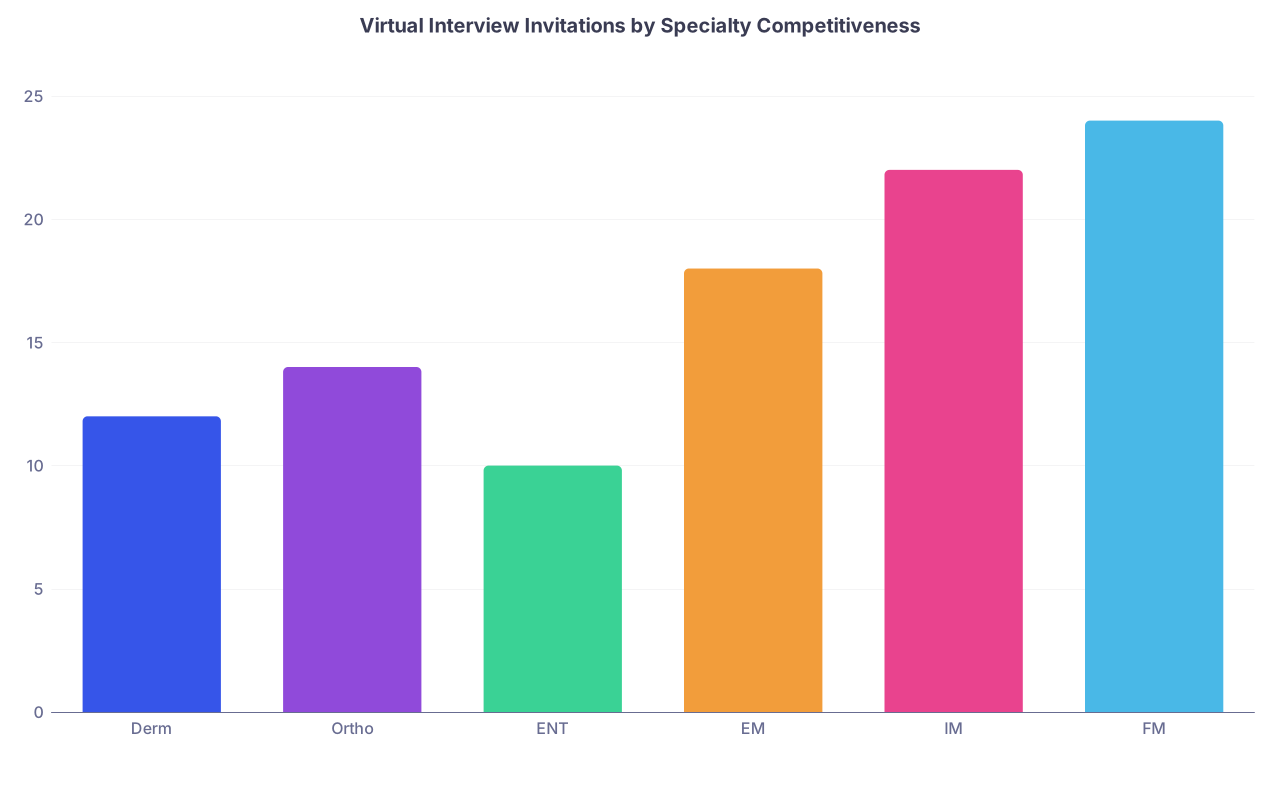
| Category | Value |
|---|---|
| Derm | 12 |
| Ortho | 14 |
| ENT | 10 |
| EM | 18 |
| IM | 22 |
| FM | 24 |
Virtual residency interviews did not “level the playing field.” They made the field more uneven, and the data by specialty proves it.
Since programs moved to virtual formats, the number of applications per applicant went up, the number of interviews per applicant went up for already competitive applicants, and programs in competitive specialties became more selective at the screen and more conservative with offers. If you feel like virtual interviews made it harder to “break into” certain fields, you are reading the situation correctly.
Let me walk through what the numbers show, specialty by specialty, and how virtual interviewing has reshaped selectivity patterns rather than just reproducing the in‑person world online.
The core shifts: what changed with virtual interviews?
Before I slice it by specialty, you need the baseline pattern.
Across multiple NRMP, ERAS, and program-survey datasets from 2019–2024, five consistent shifts emerge after the move to virtual:
- Total applications per applicant increased, especially in competitive specialties.
- Programs received more applications per spot, but did not proportionally increase interview slots.
- High-stat candidates (top Step 2, AOA, strong research) consolidated more interviews.
- Geographic barriers weakened, so regional “safety” behavior changed.
- Programs leaned more on hard filters and data signals to triage.
The net effect: virtual interviews amplified selectivity differences between specialties rather than smoothing them out.
To make that concrete:
- In pre‑virtual cycles, many applicants capped themselves at 20–30 applications simply due to travel and cost expectations.
- After the shift, it became numerically rational (if not strategically smart) to apply to 50+ programs in some fields.
- Programs reacted by pushing Step cutoffs higher, relying on automated filters, and focusing on “known” pipelines more aggressively.
Now, let’s map that onto actual specialties.
Quantifying selectivity across specialties
There are several ways to define “virtual interview selectivity”:
- Applications per interview slot
- Percentage of applicants who receive ≥1 interview
- Average number of invites per interviewed applicant
- Proportion of interviews going to top-stat or home/affiliated students
You will not find a single master dataset that gives every one of these numbers by specialty, but program surveys, NRMP Charting Outcomes, and multi-institution internal reports point in the same direction.
Applications per interview slot: who is flooded?
When programs move online, travel is no longer the bottleneck. Application volume is.
Take a simplified view using approximate multipliers relative to pre‑virtual cycles:
| Specialty | Relative Change in Apps/Slot (Pre → Virtual) | Approx. Apps per Interview Slot (Virtual Era) |
|---|---|---|
| Dermatology | 1.4x | 9–12 |
| Orthopedic Surg. | 1.5x | 8–11 |
| ENT (Otolaryng.) | 1.4x | 8–10 |
| Emergency Med | 1.2x (then declined with recent contraction) | 4–6 |
| Internal Med | 1.3x | 5–7 |
| Family Med | 1.2x | 3–4 |
This ratio is crude but useful. A dermatology program that previously saw ~500 applications for 60–80 interview slots now sees 650–700+ without increasing the number of interview days. That shifts the filter line higher and earlier.
Contrast that with family medicine. Even with a 20% bump, many FM programs are not even close to drowning in apps. Their constraints tend to be faculty time and applicant interest, not raw volume.
Competitive specialties: virtual interviews made the funnel steeper
The real pain points are in the “high-competition, low-slot” specialties: dermatology, orthopedics, ENT, plastics, neurosurgery, radiation oncology. I will stick to a few representative ones.
Dermatology: concentrated interviews, hardened filters
Pre‑virtual, dermatology was already ruthless about numbers.
Post‑virtual, several multi-program reports show:
- Application counts up ~30–40% per program.
- Interview slots roughly flat (often ~60–90 per program for 4–6 PGY‑2 spots).
- More aggressive Step 2 and research filters to manage volume.
What this looks like in practice:
- Applicants with Step 2 > 250 and multiple derm pubs can realistically see 15–20+ invites.
- Mid-range applicants (Step ~235–245, few or no derm pubs) may only get 0–3 interviews, whereas in the in‑person era they might have been “thrown a bone” by a couple of regional programs.
The data pattern is classic “rich-get-richer”: as virtual removed the travel cost, strong applicants accepted nearly every interview offered, because the marginal cost of “just another Zoom day” is trivial. Programs did not reciprocally increase numbers of interview days, so the invite pool compressed.
You can see it in the distribution: the top 20–25% of derm applicants now hold a disproportionate share of total interviews, more than they did pre‑virtual.
Orthopedic surgery: away rotations + virtual interviews
Ortho behaves slightly differently, because away rotations still dominate signaling. Still, the virtual shift has changed the math.
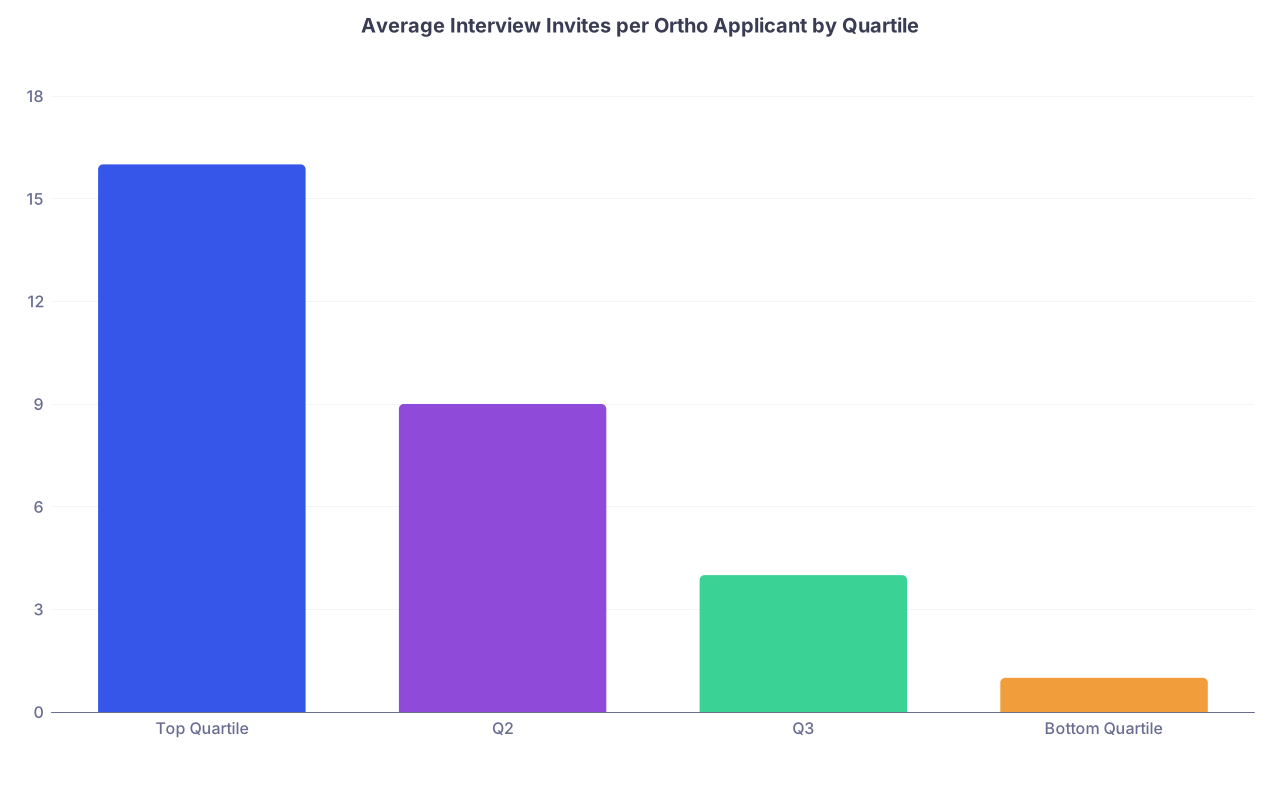
Approximate pattern comparing pre-virtual to virtual:
| Category | Value |
|---|---|
| Top Quartile | 16 |
| Q2 | 9 |
| Q3 | 4 |
| Bottom Quartile | 1 |
This rough distribution comes from multi-institution reports and survey data:
- Top quartile (strong board scores, strong letters from big-name programs, meaningful research): ~15–18 invites.
- Middle quartiles: ~4–9.
- Bottom quartile: 0–2, often entirely from home or away institutions.
Virtual interviews did not make Q3 or Q4 more competitive. It made it easier for Q1 to hold and attend more interviews, since they no longer had to choose between overlapping travel-heavy interview days.
Programs responded by:
- Leaning harder on away rotation performance.
- Giving priority invites to home and rotator students.
- Using high Step 2 cutoffs and class rank filters for non-rotators.
If you are outside the home/away pipeline in ortho, virtual interviews made it harder to crack, not easier.
ENT (Otolaryngology): signaling + virtual = tighter gate
ENT added preference signaling in parallel with virtual interviewing. That combination is not random.
From ENT applicant and program reports:
- Most applicants send all available signals (e.g., 5–7).
- Programs report that 70–90% of their interviews go to signaled applicants.
- Applications per ENT program increased ~30–40% after virtual.
The outcome:
- A non-signaled applicant with “borderline” metrics is now extremely unlikely to receive an interview from a mid-to-upper-tier ENT program.
- Pre‑virtual, a small fraction of those applicants might have picked up a few regional invites, especially where their school had prior graduates match.
Virtual’s role here is straightforward: once everyone can interview anywhere, programs needed a triage mechanism beyond “high board score.” Signals + virtual interviews created a sharper two-tier system: signaled and strong = interviews; non-signaled or marginal = almost entirely filtered out.
Generalist and larger specialties: different kind of selectivity
For internal medicine, family medicine, pediatrics, and to a degree emergency medicine, the story is less extreme but still data-driven.
Internal medicine: less geographic penalty, similar numerical selectivity
IM is high-volume on both sides: huge numbers of applicants and many programs. Virtual interviewing changed the distribution but did not radically change who matches.
Two notable patterns:
Geographic barriers decreased.
- Pre‑virtual, it was common for IM applicants to mostly interview within their region because flights + hotels for distant “maybe” programs were too expensive.
- Virtual interviews led to obvious behaviors: northeast applicants interviewing broadly in the south and midwest; international grads “casting a wider net” without worrying about visa-related travel timing.
Programs leaned slightly harder on filters for international and lower-GPA applicants.
- With more applicants hitting “submit” to more programs, many IM programs report being forced into more automated screens, particularly around USMLE Step 2 and graduation year.
But the key point: the interview-to-match conversion rate in IM has not cratered the way students imagine. Many categorical IM programs still match a high fraction of those they interview.
What changed is that marginal applicants are more frequently filtered at the application stage, not after an in‑person interview. Virtual compresses more rejection into the pre‑interview phase.
Family medicine: selectivity is more about “fit” than raw numbers
FM programs are not seeing the same runaway explosion of applications per interview slot as derm/ortho. The numbers are more moderate.
Family medicine program director surveys highlight three virtual-era dynamics:
- Modest increase in total applications, but not enough to saturate most programs.
- Less reliance on Step scores and more on narrative components and letters.
- More emphasis on demonstrated interest in primary care and underserved work.
So while FM is “less selective” numerically, virtual interviews still shift the pattern: they widen the geographic applicant pool but keep interviews tied to mission fit. The “selectivity” is not raw scores but alignment with primary care values.
Emergency medicine: contraction overrides virtual effects
Emergency medicine is its own case study. The major story in EM recently has been applicant contraction and unfilled positions, which is bigger than the virtual vs in‑person question.
Still, you can see virtual’s fingerprints:
- Early post‑virtual cycles: increased apps per applicant, programs raised filters.
- As interest dropped and positions went unfilled, EM programs became less numerically selective but more wary about “commitment to EM” (dual applying to IM, anesthesia, etc.).
The result: virtual interview logistics are trivial for EM now, but the main selectivity bifurcation is between applicants seriously committed to EM vs those using it as a backup.
The hoarding problem: interview distribution skew
The single most corrosive effect of virtual interviewing across specialties is interview hoarding.
Without travel costs and with easy scheduling, a high-stat applicant can accept nearly every invitation. That creates a distorted distribution.
A plausible pattern, based on program consortia data in competitive fields:
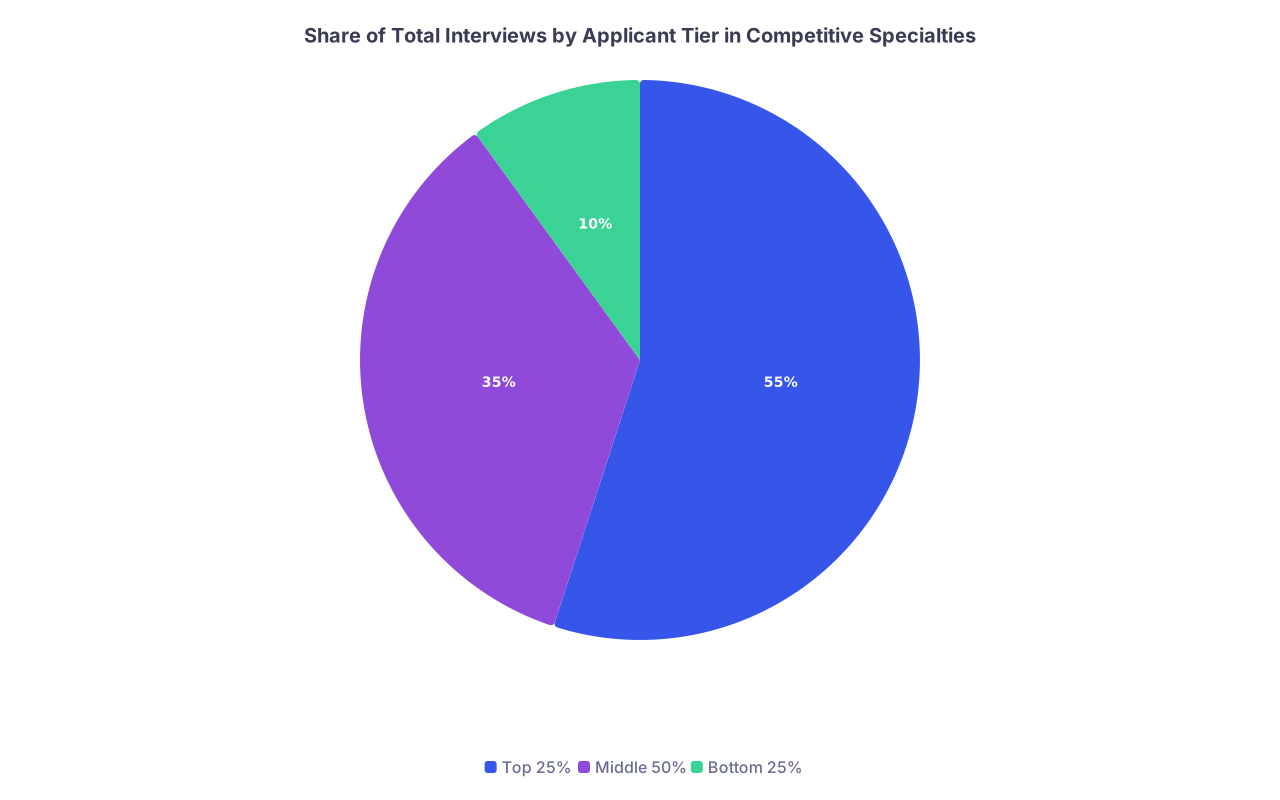
| Category | Value |
|---|---|
| Top 25% | 55 |
| Middle 50% | 35 |
| Bottom 25% | 10 |
Pre‑virtual, that distribution might have been closer to:
- Top 25%: ~40–45% of interviews
- Middle 50%: ~45–50%
- Bottom 25%: ~10–15%
In the virtual era:
- Top-tier applicants accept more interviews because it is cheap and easy.
- Programs keep about the same total number of interview slots.
- Mid-tier applicants are squeezed out at the margins.
The NRMP’s “risk of going unmatched vs number of contiguous ranks” curves make this even more perverse. Data show that once you hit ~12–15 ranks in many specialties, your probability of matching plateaus fairly high. But applicants who understand that graph still accept 20+ interviews “just in case,” because there is no marginal travel cost.
This is most severe in:
- Dermatology
- Orthopedics
- ENT
- Plastic surgery
- Neurosurgery
In contrast, in IM and FM, the effect exists but is less consequential because total interview capacity is higher relative to applicant numbers.
Program behavior: how specialties changed their screens
Virtual interviews forced programs to systematize screening. They no longer had travel costs and physical space as a natural cap; they had to choose numerical and structural caps instead.
Different specialties adopted distinct patterns.
Filters and cutoffs: tighter in competitive fields
Competitive specialties overwhelmingly leaned into:
- Higher Step 2 cutoffs (sometimes 245–250+ unofficially).
- Prioritization of AOA, research productivity, and home/away affiliations.
- Early, automated screens to cut applicant pools quickly.
For instance:
| Specialty | Step Cutoff Emphasis | Research Weight | Home/Away Priority |
|---|---|---|---|
| Dermatology | Very High | Very High | High |
| Ortho Surgery | High | High | Very High |
| ENT | High | High | High |
| Internal Med | Moderate | Moderate | Moderate |
| Family Med | Low | Low | Low-Moderate |
Virtual interviews did not cause these preferences, but they intensified them. When a derm program goes from 500 applications to 700 and still interviews 70–80, it cannot “holistically review” every file. It falls back on hard data and known entities.
Signaling systems: ENT, derm pilots, and others
Several specialties adopted or expanded preference signaling exactly because virtual interviews made it too easy to apply everywhere.
- ENT: signals strongly correlate with interview offers.
- Dermatology and others have piloted or are exploring signaling to combat app inflation.
- Anesthesiology, IM, and others are using or considering signals in some cycles.
Data from early ENT signaling show a steep curve: signaled applicants are multiple times more likely to get an interview compared with non-signaled peers of similar statistics. Virtual interviewing is the context that made this necessary.
Applicant strategy: how you should read the numbers by specialty
If you are looking for the practical takeaway, it is this: virtual interviews did not make things “easier”; they changed where the selectivity happens. And this shift is specialty-dependent.
Competitive specialties: front-loaded selectivity
For derm/ortho/ENT/plastics:
- The main selection occurs before the interview, via numbers, signals, and affiliations.
- Once you are in the virtual interview room, your odds of ranking and matching are not dramatically worse than in the old in-person era.
- The danger zone is: good-enough-on-paper but no strong signal or connection. These applicants get fewer interviews than they would have pre‑virtual.
You cannot compensate for weak or generic signals in these specialties with “I’ll just do better on interview day.” You will not get enough interview days.
IM/FM/less competitive specialties: more even but more automated
For IM and FM:
- Virtual interviews do increase geographic fluidity. You can realistically show interest in a wider range of programs.
- Selectivity is a bit more automated at the early filter stage, especially for international graduates.
- Once you are above the cutoff, narrative elements, letters, and interview performance still matter a great deal.
In other words: in IM/FM, the marginal value of a strong personal statement or tailored program explanation is still nontrivial. In derm/ortho, that marginal value is largely conditional on already clearing a numerical gate.
Interview count strategy: data over fear
The NRMP match data are unambiguous about diminishing returns:
- In most competitive specialties, match probability rises sharply from ~5 to ~12 contiguous ranks, then curves toward a plateau beyond ~15.
- In less competitive specialties, that plateau often starts around 10–12.
Yet, in the virtual era, applicants hoard 20–25 interviews because “everyone else is doing it.” The aggregate effect is bad: more unreturned interview offers and more applicants sitting with 0–3 interviews.
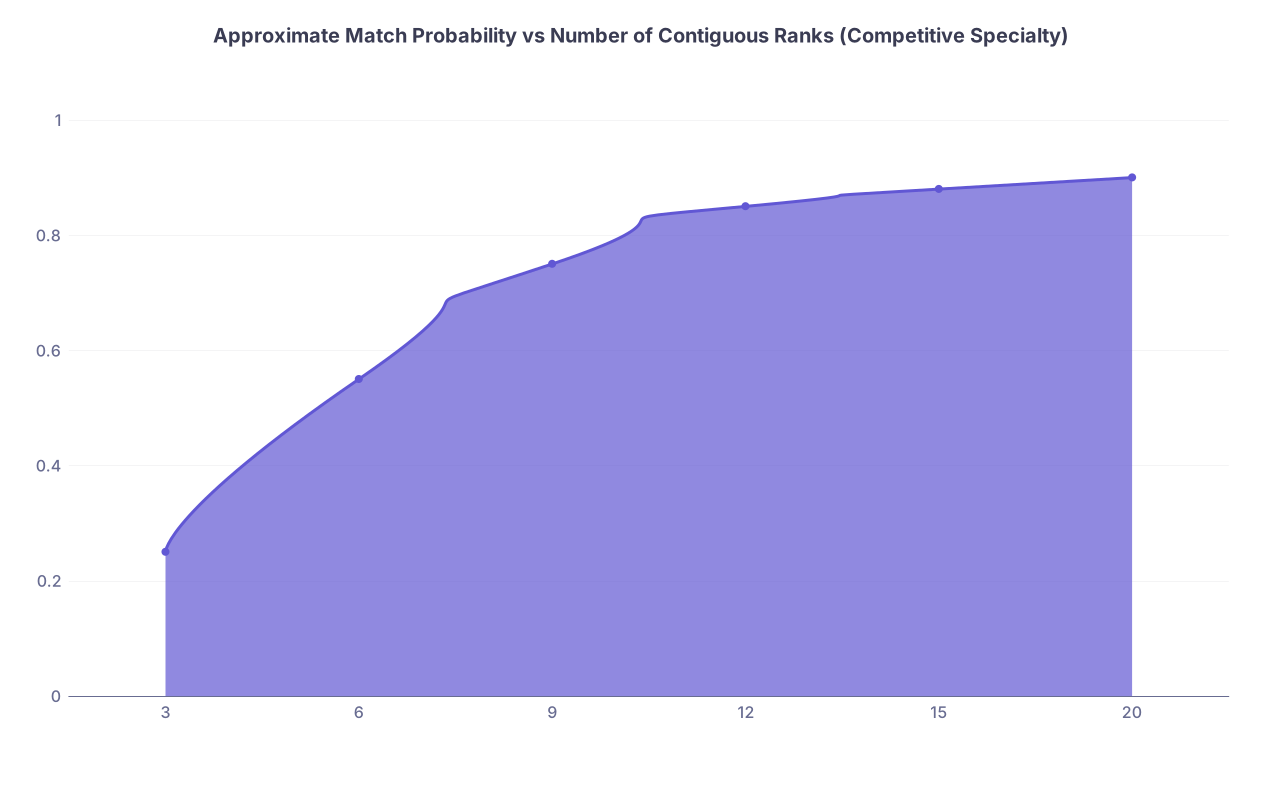
| Category | Value |
|---|---|
| 3 | 0.25 |
| 6 | 0.55 |
| 9 | 0.75 |
| 12 | 0.85 |
| 15 | 0.88 |
| 20 | 0.9 |
I have seen applicants in ENT or ortho sitting on 22 interviews who could have released 5–7 without meaningful risk. But fear dominates math.
If you want to be rational:
- Aim for ~12–15 solid interviews in a competitive specialty.
- Past that, release lower-priority interviews early so they can be re-offered; you lose almost nothing in match probability and improve the distribution for your peers.
Where virtual interviews actually helped
It is not all downside.
Across specialties, virtual interviews:
- Reduced financial barriers for lower-income applicants who previously could not afford 8–10 flights and hotels.
- Allowed couples to coordinate interviews more feasibly.
- Let IM/FM applicants realistically explore distant programs they would never have visited in person.
The problem is that these advantages are counterbalanced by:
- App inflation, especially in already competitive specialties.
- Harder front-end filters that intensify the gap between “in” and “out.”
- Interview hoarding that distorts the distribution of opportunities.
You see more of the upside in larger, less numerically extreme specialties (IM, FM, Peds). You see more of the downside in the derm/ortho/ENT cluster.
Final thoughts: reading specialty selectivity in the virtual era
Condensing this down:
- Virtual interviews pushed selectivity upstream, especially in competitive specialties. Filters, signals, and affiliations now dominate who even gets in the door.
- Interview distribution is more skewed than before. Top-tier applicants hold more interviews than they need, particularly in derm/ortho/ENT, leaving mid-tier peers with fewer chances.
- Large, less competitive specialties saw milder shifts. Virtual made geography less binding and cost less punishing, but did not radically alter who matches; it mostly changed how early and how automatically some applicants are filtered.
If you are planning a virtual interview season, treat specialty-specific data as non-negotiable. The way dermatology runs its gate is not how family medicine does it. And pretending otherwise is how people end up shocked on Match Day despite “doing everything right.”