
Most applicants are asking the wrong question. It is not “How many virtual interviews do I need to go on?” The real question is “At what point does each additional virtual interview stop meaningfully increasing my probability of matching?” The data are clear: returns diminish quickly, and chasing raw interview counts can actually hurt you.
I will walk through this like an analyst, not a cheerleader. Numbers first, opinions derived from those numbers.
What the Data Actually Say About Interview Count and Match Rates
Start with the core relationship: more ranked programs → higher probability of matching. That is not controversial. The nuance is the shape of that curve and how virtual formats have shifted it.
Historical NRMP Charting Outcomes (pre– and post–virtual transition) consistently show:
- For U.S. MD seniors, probability of matching rises steeply between ~3–12 ranked programs, then flattens.
- For IMGs, the curve is shifted right: they typically need more interviews (and thus more ranks) to hit similar probabilities.
Virtual interviews changed access and volume, not the underlying math of the match algorithm.
Approximate Match Probability by Number of Interviews
You do not rank programs you did not interview at. For most people, “number of ranks” ≈ “number of interviews attended,” minus programs you decide not to rank.
Based on NRMP patterns and post-2020 virtual-era studies (program surveys, institutional data), the trajectory for a typical U.S. MD applicant in a moderately competitive specialty looks roughly like this:
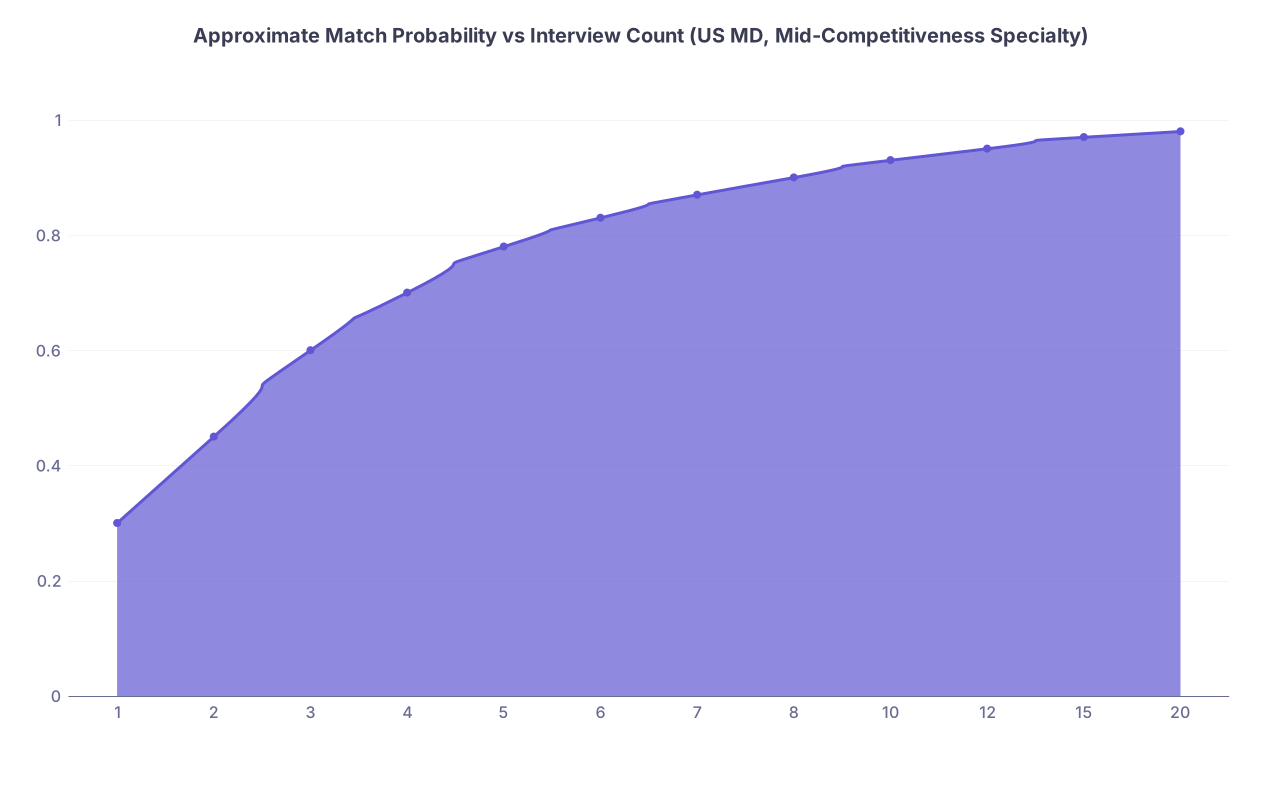
| Category | Value |
|---|---|
| 1 | 0.3 |
| 2 | 0.45 |
| 3 | 0.6 |
| 4 | 0.7 |
| 5 | 0.78 |
| 6 | 0.83 |
| 7 | 0.87 |
| 8 | 0.9 |
| 10 | 0.93 |
| 12 | 0.95 |
| 15 | 0.97 |
| 20 | 0.98 |
Key observations:
- The jump from 1 to 5 interviews: +48 percentage points (30% → 78%).
- The jump from 5 to 10: +15 points (78% → 93%).
- The jump from 10 to 15: +4 points.
- The jump from 15 to 20: +1 point.
Mathematically: very high marginal benefit early; tiny marginal benefit late. You are trading time, energy, and opportunity cost for increasingly small gains.
For IMGs or DOs in the same specialty, the curve is lower and shifted right, but the shape is similar: big gains early, flattening with higher counts.
How Virtual Interviews Changed the Distribution of Interview Counts
Before 2020, travel, cost, and scheduling friction capped interview volume for most applicants. Once interviews moved online, the constraint loosened, and the distribution of interview counts changed meaningfully.
Programs report, and I have seen institution-level spreadsheets that confirm, three structural shifts:
- Higher mean number of interviews per applicant.
- More polarization: some applicants with 20–30+ interviews, others stuck at 0–5.
- More “ghost” interviews (booked but half-heartedly considered, or canceled late).
Let me put some rough but realistic numbers to this, based on aggregated program director survey data and typical patterns.
| Interview Count Range | Pre-Virtual (Share of Applicants) | Virtual Era (Share of Applicants) |
|---|---|---|
| 0–4 | 20% | 18% |
| 5–9 | 35% | 28% |
| 10–14 | 30% | 27% |
| 15–19 | 10% | 17% |
| 20+ | 5% | 10% |
The data pattern: a non-trivial shift from the “middle” (5–14) into the 15+ and 20+ categories in the virtual era. The average applicant with solid metrics is now able to hoard interviews.
From a market perspective:
- Before: travel and cost acted as natural throttles on interview hoarding.
- Now: signal distortion. A subset of higher-stat applicants consumes more interview slots than they truly need, while weaker applicants have fewer chances.
Important point: the macro distribution changed, but the individual correlation between more interviews and higher match probability still holds. The risk is that many applicants are overshooting the “effective” range of interviews and bleeding time and quality.
Diminishing Returns: Where More Virtual Interviews Stop Paying Off
The core question: At what interview count does the incremental probability gain no longer justify the incremental cost (time, exhaustion, reduced preparation quality)?
Let me walk through three archetypes with approximate numbers. These are composites based on several years of NRMP data and post-virtual shift observations.
Archetype 1: U.S. MD, Mid-Competitive Specialty (Internal Medicine, Pediatrics, Psychiatry)
For this group, something like this is typical:
| Number of Interviews | Approx. Match Probability |
|---|---|
| 3 | 55% |
| 5 | 80% |
| 8 | 90% |
| 10 | 93% |
| 12 | 95% |
| 15 | 97% |
Look at the marginal gains:
- 3 → 5 interviews: +25 points.
- 5 → 8 interviews: +10 points.
- 8 → 10: +3 points.
- 10 → 15: +4 points spread over five more interviews.
Past ~10–12 solid interviews, you are arguably in the “insurance and preference optimization” zone, not the “do I match at all?” zone. Chasing 20+ in this category is almost always about anxiety, not probability.
Archetype 2: U.S. MD, Highly Competitive Specialty (Derm, Ortho, ENT, Plastics)
Different shape. Steeper early penalty for low counts, slower climb.
Reasonable working model:
- 1–3 interviews: still dangerous; sub-60% probability.
- 5 interviews: maybe around 75–80%.
- 8–10 interviews: 85–92%, depending on the specific specialty and the strength of the applicant.
You see more applicants in these specialties with 15+ interviews, but their incremental probability change from 10 to 20 is small compared to the mental overhead. Programs will tell you privately: “Anyone with 12+ interviews in our field is almost guaranteed to match somewhere unless their rank list is suicidal.”
Archetype 3: IMG, Mid-Competitive Specialty
For IMGs, the curve is shifted. They usually need more interviews for the same probability level:
Approximate mapping for a reasonably strong IMG in internal medicine:
- 3 interviews: maybe 30–35% chance.
- 5 interviews: ~55–60%.
- 8 interviews: ~70–75%.
- 10–12 interviews: ~80–85%.
- 15+: ~90% and up.
The logic is the same though: by the time an IMG carries 15+ interviews in a reasonable spread of programs, their incremental benefit of interview #16 or #20 is modest.
Virtual interviews made this both better and worse for IMGs:
- Better: easier to attend a higher number across states and coasts.
- Worse: top-tier IMGs hoard a lot of interviews, and weaker IMGs are left fighting over fewer slots.
Virtual Interviews Change Logistics, Not Core Match Math
There is a lazy narrative that “virtual interviews made the match less predictable.” Statistically, that is not accurate. The match algorithm did not change. The drivers of match probability did not change:
- Step/COMLEX scores (where still used).
- Clerkship grades and class rank.
- Letters of recommendation.
- Research and niche alignment for certain specialties.
- Interview performance.
- Rank list breadth and realism.
What did change are the constraints around how many interviews you can practically attend and how much attention you can allocate to each.
Time and Quality Tradeoff: The Hidden Cost of Extra Interviews
You are not adding virtual interviews into a vacuum. Each one competes with:
- Time to deeply research programs.
- Time to rehearse answers and refine your narrative.
- Sleep, rotation responsibilities, board studying.
- Mental bandwidth to actually be present and sharp.
I have watched applicants go from 8 well-prepared, high-quality interviews one year to 18 scattered, rushed interviews the next, with worse outcomes despite “better odds on paper.”
One internal calendar from a 4th year I advised:
- Week of November 10: 6 interviews in 5 days.
- 3 time zones.
- One day with back-to-back morning and afternoon sessions.
Her feedback: “By interview number 3 that week, I stopped remembering names. By number 5, I was repeating the same generic answer because my brain was sand.” That is the real-world manifestation of diminishing returns.
If you model “effective” interview count as:
Effective interviews = raw interviews × average preparation quality × average performance quality
You see the problem. Increasing the raw count from 10 to 18, while cutting quality parameters, can lead to an effective count that stays flat or even worsens.
Correlation vs Causation: More Interviews, or Better Applicants?
Another trap: misreading the correlation.
Applicants with higher stats, better letters, and stronger applications tend to receive more interviews. They also tend to match at higher rates. So a naive interpretation—“interview count causes match success”—is partially wrong.
The more accurate causal chain looks like this:
Strong application → more interview offers
Strong application + better interviewing skills → higher probability of matching per interview
Strong application → applicant feels comfortable accepting fewer interviews, but still has good odds
Virtual interviews amplify the first step (more offers are logistically feasible), but they do not change the fundamental relationship. When you see an applicant with 22 interviews, you are usually looking at someone with strong underlying metrics, not someone who hacked the system by volume alone.
So when you are making decisions, compare yourself against conditional probabilities:
- “Given my board scores / grades / letters / specialty, how many interviews do I need to get into the 90%+ match probability zone?”
- “Beyond that, is chasing more interviews improving my outcome meaningfully, or just my anxiety?”
Specialty-Specific Patterns in the Virtual Era
The correlation between virtual interview count and match probability is not identical across specialties. Some fields are more “interview-sensitive” than others.
Here is a simplified view to give you a sense of how the curve shifts:
| Specialty Group | Interviews for ~80–85% Match | Interviews for ~95%+ Match |
|---|---|---|
| Less Competitive (FM, Psych) | 4–6 | 8–10 |
| Mid (IM, Peds, Pathology) | 5–8 | 10–12 |
| Upper-Mid (EM, Anes, OB) | 7–10 | 12–14 |
| Highly Competitive (Ortho, Derm, ENT) | 8–12 | 14–18 |
These are broad strokes, but they track with what program directors privately admit.
In virtual formats, high-end specialties saw:
- More interview hoarding by top-of-the-pile applicants.
- Late cancellations, leading to last-minute scramble invites.
- A steeper practical divide between those with 0–3 interviews and those with 15+.
From a data perspective, being in the 0–3 interview bucket is catastrophic in any specialty. Being in the 5–8 range is salvageable for most. Being in the 10–15 range almost always places you in a high-probability zone, unless you are being extremely narrow in your rank list.
Strategy: Using Data to Decide How Many Virtual Interviews to Keep
You cannot control how many interviews you are offered, but you can control how many you accept and attend. Data should drive that decision, not fear.
Here is a structured way to decide, stepwise, using actual numbers.

| Step | Description |
|---|---|
| Step 1 | Total Interview Offers |
| Step 2 | Accept All Feasible |
| Step 3 | Keep Most, Drop Low-Yield |
| Step 4 | Prioritize Fit, Cut Excess |
| Step 5 | Current Count < 8? |
| Step 6 | Specialty High-Competitive? |
| Step 7 | Count < 12? |
| Step 8 | Count < 10? |
And here is a numeric heuristic that aligns with the curves we have been discussing:
- If you have fewer than 5 interviews in any specialty, your match probability is fragile. You accept virtually everything you can reasonably attend.
- Between 5 and 8, you are in the “stabilizing” zone. Small increments matter a lot.
- Between 8 and 12 (for mid-competitive) or 10 and 15 (for highly competitive), you are moving from “Will I match?” to “Where will I match?” The return per additional interview is shrinking.
- Beyond 12–15 in most scenarios, you should actively weigh cost vs benefit:
- Is interview #18 at a program you know you will rank at the bottom really worth the prep and fatigue?
- Is it pushing you into weeks where you have 5–6 interviews and will be half-functional?
Put bluntly: if your data-based estimate suggests you are already in a >90–95% probability bucket, but your interview schedule is killing your performance, you are optimizing for the wrong metric.
A Quick Quantitative Thought Experiment
Let me quantify the fatigue effect. Imagine two applicants in the same specialty and with similar strength:
- Applicant A: 10 interviews, well-spaced, solid preparation.
- Applicant B: 18 interviews, heavily clustered, marginal preparation on some.
Assume that if they were both fresh, the probability of a program ranking them high enough to match from any given interview is 15%.
Applicant A:
- 10 interviews, each at 15% independent probability of “matching if this were your only program.”
- Using a simplification (1 - (1 - 0.15)^10) ≈ 80% chance overall.
Applicant B, but with fatigue:
- First 8 interviews at 15%.
- Next 10 interviews at 8% due to worse performance.
- Overall probability = 1 - [(1 - 0.15)^8 × (1 - 0.08)^10]
≈ 1 - [0.85^8 × 0.92^10]
≈ 1 - [0.272 × 0.434]
≈ 1 - 0.118
≈ 88%.
So B comes out slightly ahead in this toy model. But now look at an adjusted scenario where clustering makes some early interviews worse too:
- First 5 at 15%, next 13 at 8%:
- Overall ≈ 1 - [0.85^5 × 0.92^13]
≈ 1 - [0.444 × 0.339]
≈ 1 - 0.150 ≈ 85%.
- Overall ≈ 1 - [0.85^5 × 0.92^13]
You traded enormous extra effort and stress for a marginal improvement from 80% to 85%—well within the noise of any real-world assumptions. If you misjudge and your performance tanks more broadly, you can easily make it worse.
The point: once you are in the high-probability range, the model is very sensitive to quality. Volume alone does not save you.
Putting It Together: What the Correlation Means for You
Let me summarize the data-driven reality in three blunt statements:
The correlation between virtual interview count and match probability is strong but non-linear. Early additions (from 1 up to roughly 8–12, depending on specialty) drive huge gains; after that, the curve flattens hard.
Virtual interviews increased average interview counts and widened inequality in who gets them, but they did not change the underlying match math. Strong applicants with more interviews still match at higher rates mainly because they were strong to begin with, not just because of volume.
Beyond a specialty-specific threshold (roughly 10–12 interviews for most mid-competitive specialties, 14–18 for the very competitive ones), each additional virtual interview yields a small marginal increase in match probability and a large potential hit to preparation quality, performance, and sanity.
If you remember nothing else: do not optimize for sheer interview count. Optimize for “enough” high-quality interviews to put you in the 90%+ probability zone, then shift your energy from accumulating more calls to executing better on the ones you already have.