

The trap is simple: you match or start residency on an H-1B, assume fellowship will just keep the same visa moving, and then discover far too late that the fellowship only sponsors J-1. That mistake is common. It is also avoidable.
I have seen this derail otherwise excellent IMG plans. A resident finishes PGY-3 thinking the immigration side is basically a transfer. Then the fellowship coordinator says, usually months later than they should, "Our department only uses ECFMG-sponsored J-1s." Now you are dealing with a different sponsor, a different process, possible consular steps, family paperwork, travel risk, and in some cases a completely different long-term career problem than the one you thought you signed up for.
The stakes are not abstract. They are practical and brutal. Start dates can slip. Credentialing can stall. Your spouse may need a different dependent status with different work implications. International travel that seemed harmless can become dangerous during a change-of-status window. And yes, if paperwork drags or the visa path turns out to be incompatible, a fellowship spot can be jeopardized. Programs do not enjoy uncertainty in July. They solve it by moving on.
This article exists for one reason: to make sure you see the hidden traps before you rank residency programs, before you rank fellowships, and definitely before you sign anything assuming the visa piece will sort itself out. It does not sort itself out. You sort it out. Early. In writing. With names, dates, and policy details.
This is educational only, not legal advice. Immigration outcomes depend on individual facts, institutional policy, timing, and current regulations, so use this as a strategy guide and confirm details with qualified immigration counsel and your program.
The Core Visa Logic: Why Residency and Fellowship Often Follow Different Rules
The first thing to understand is that H-1B and J-1 are not interchangeable training labels. They reflect different sponsorship structures and different institutional philosophies.
H-1B is employer-sponsored. The hospital or university is generally the petitioner. It is a work-authorized status tied to that specific employer and role. In graduate medical education, this usually means the institution is taking on more legal work, more compliance tracking, and often more cost.
J-1 for physicians is usually sponsored through ECFMG for clinical training. That is a completely different model. The institution hosts the trainee, but the immigration sponsorship mechanism is not the same as employer-driven H-1B sponsorship. For many academic centers, that makes the process cleaner and more standardized. Administrative simplicity matters more than applicants realize. A lot more.
Here is the blunt version: many institutions tolerate H-1B for residency but prefer J-1 for fellowship because fellowship offices want the easiest repeatable system. Fewer custom exceptions. Fewer legal invoices. Fewer department-level arguments. Cleaner onboarding. That is the real-world logic.
A common IMG misconception sounds like this:
- "My residency sponsored H-1B."
- "The fellowship is at the same university."
- "So they will just continue my H-1B."
Wrong. Same hospital system does not mean same policy. Same GME office does not mean same departmental willingness. Same brand name does not mean same immigration workflow.
I have seen internal medicine residency programs sponsor H-1B while cardiology, GI, pulmonary/critical care, and heme/onc fellowships at the same broader institution defaulted entirely to J-1. Different departments. Different funding. Different historical policy. Different appetite for immigration administration. The resident assumed continuity; the fellowship saw a new hire and applied its own rulebook.
Why does this mismatch happen so often?
Residency and fellowship are separate appointments. A new contract means a new sponsorship decision.
Departmental budgets differ. Legal costs and internal processing time are not distributed evenly.
Institutional risk tolerance differs by training level. Some places are more comfortable using H-1B for core residency slots and less interested in doing it for fellowship.
ECFMG sponsorship for J-1 is familiar and standardized. Fellowship administrators love standardized.
That is the core logic. Once you understand that, the rest of the planning gets less emotional and more tactical.
What IMGs Commonly Miss Before Applying or Ranking
This is where good applicants make bad assumptions.
1) Eligibility traps are real
Not every H-1B training situation transitions neatly into the next one. Even if you are already in H-1B status, the next program still has to decide whether it will sponsor that status. If it will, timing matters. Start dates matter. Whether the institution is cap-exempt matters. Whether there will be any employment gap matters. Whether your current documents are clean and current matters.
People hear "H-1B transfer" and think it is a magical conveyor belt. It is not. It is a legal process with deadlines and dependencies.
2) Program-specific constraints are often hidden until late
A program may proudly advertise that the institution "sponsors visas," which tells you almost nothing useful. You need the exact answer to the exact question:
- Do you sponsor H-1B for this fellowship specifically?
- For all fellows, or only selected departments?
- For incoming first-year fellows, or only for current internal candidates?
- Does funding source matter?
- Is the policy different for ACGME-accredited versus non-ACGME tracks?
These distinctions are where IMG plans break.
I have seen applicants rank a fellowship highly because the residency program at that institution had several H-1B residents. They took that as proof. It proved nothing. The fellowship later required J-1 only.
3) Travel and family issues are badly underestimated
The visa shift is not just your paperwork. It is your household's paperwork.
If you move from H-1B to J-1:
- Your dependents may need to move from H-4 to J-2
- Their work authorization implications may change
- Travel may need tighter coordination
- Visa stamping logistics may become more complicated than you expected
A resident can survive a bureaucratic mess alone. With a spouse, children, school calendars, lease dates, and maybe a spouse's employment timeline? Much harder.
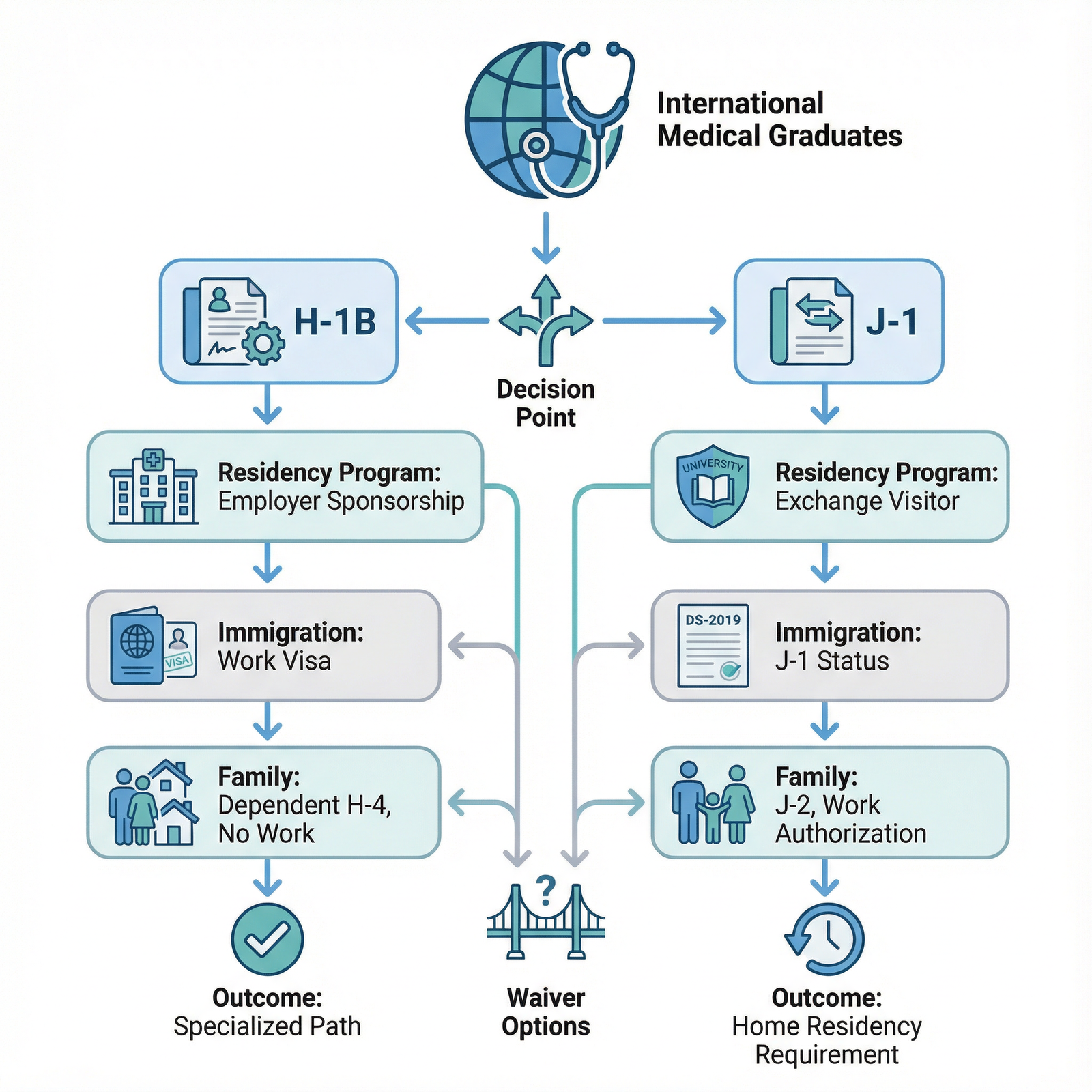
4) Timeline collisions are the silent killer
This is the one that stings because it feels administrative, but it can absolutely cost you a start date.
Your fellowship onboarding may require:
- contract execution
- credentialing
- state licensing steps
- ECFMG processing if J-1
- DS-2019 issuance
- possible consular appointment planning
- institutional HR clearance
- payroll onboarding
- hospital orientation deadlines
These do not happen in a neat sequence. They collide.
The classic failure pattern goes like this: the applicant gets the fellowship offer, celebrates, sends a few documents, and assumes HR will tell them what is next. Weeks pass. Someone finally asks for a passport renewal, updated I-94, proof of current status, or ECFMG materials. Then another office says they need more lead time. Then the start date is six weeks away and everyone is "expediting." That word should scare you. "Expediting" is what people say when the proper timeline has already been wasted.
5) Written confirmation matters more than verbal reassurance
Coordinators are helpful. Faculty are often well-meaning. Neither is your immigration guarantee.
If a program says, "We usually can do that," treat that as no answer. If they say, "Our institution sponsors H-1B," treat that as no answer. If they say, "You should be fine," that is definitely no answer.
You need specifics. In writing. For your fellowship. For your start year. Based on your current status.
Clinical and Career Consequences: How the Wrong Assumption Becomes a Real Problem
The biggest consequence is immediate: your fellowship can be delayed, complicated, or lost if you do not confirm the visa pathway early. That is the headline problem. But the deeper damage is what happens afterward.
Fellowship timing affects professional timing
If your start is delayed, even briefly, the effects can spread:
- delayed onboarding
- delayed clinical privileges
- delayed billing participation where relevant
- delayed board pathway timing in some specialties
- delayed completion date
- delayed next job start
Training is a chain. You do not miss one link without stress on the rest.
Licensing and moonlighting can get messy
Visa status and institutional policy can both influence what work is permissible. Moonlighting rules are already restrictive in many programs. Add a visa change, a new employer, a possible change in dependent status, and maybe a state license timing issue, and the result is usually less flexibility, not more.
This matters because many residents quietly build financial and career assumptions around what they think fellowship will allow. Then immigration rules cut across those plans. Hard.
The J-1 two-year home residency requirement is the long game many people ignore
This is the issue IMGs most often underappreciate.
If your fellowship requires J-1 physician status through ECFMG, you may trigger or continue the two-year home-country physical presence requirement under Section 212(e), depending on your circumstances. That requirement can affect your ability later to move into H-1B employment, permanent residence pathways, or certain status changes unless you satisfy it or obtain a waiver.
This is not a small technicality. It is a career-shaping issue.
I have seen applicants treat the switch as temporary convenience. "Fine, I will do J-1 for fellowship and sort it out later." Later arrives fast. Suddenly you are finishing subspecialty training, have a job offer, maybe in a location you want long-term, and now waiver strategy controls your options. Geography changes. Job type changes. Timing changes. Your spouse's plans change. The "later problem" becomes the main problem.
Short-term convenience versus long-term mobility
Here is my opinion, directly: if two otherwise comparable fellowship options exist and one preserves a cleaner long-term immigration path for your goals, that matters. A lot. Prestige does not erase visa consequences. Neither does a famous faculty name.
That does not mean H-1B is always better. It means you need to match the visa to the full training arc.
Examples:
- If you expect more training after fellowship, a J-1 may fit the institution's standard route but complicate later transitions.
- If you want earlier employment flexibility after training, H-1B may be strategically stronger if available.
- If your desired fellowship simply will not sponsor H-1B, then you have a real decision to make: accept J-1 with eyes open and plan waiver strategy early, or choose a different program aligned with your immigration goals.
That is not administrative trivia. That is career design.
The chart is not law. It is a strategy snapshot. The point is simple: the tradeoffs are different, and pretending they are interchangeable is how smart applicants end up cornered.
How to Protect Yourself: Questions to Ask Program Coordinators and Attorneys
This part needs to be practical. Here are the questions I would ask before ranking, not after matching.
The exact questions
Ask the fellowship program coordinator or GME office:
- Do you sponsor H-1B for this fellowship?
- Is that true for all incoming fellows, or only in certain cases?
- If not, do you require J-1 through ECFMG?
- Has this policy changed recently?
- Is the policy different by department, funding source, or subspecialty track?
- What is the latest date by which you need all immigration documents?
- Who handles immigration processing: departmental coordinator, GME office, outside counsel, or ECFMG liaison?
- Have you previously onboarded fellows transitioning from H-1B residency to J-1 fellowship?
- Is any international travel during the transition discouraged or prohibited?
- Are there internal deadlines earlier than the official start date for HR, credentialing, or visa processing?
- What dependent documentation will my spouse or children need?
Then ask immigration counsel, ideally early:
- Based on my current H-1B status, what are the realistic pathways for this fellowship?
- Is a change to J-1 required or merely preferred by the institution?
- If J-1 is required, what are the long-term consequences for waiver planning and future employment?
- Are there timing risks tied to my passport expiration, visa stamp expiration, or I-94 record?
- Would travel during this period create avoidable risk?
Verify policy by department, not just institution
This is where people get lazy. Do not ask, "Does University X sponsor H-1B?" Ask, "Does the pulmonary/critical care fellowship at University X sponsor H-1B for incoming fellows in the upcoming cycle?" That is the real question.
You also need to know whether:
- the clinical department pays legal costs
- the GME office has a blanket prohibition
- NIH or grant-funded positions are treated differently
- research-heavy tracks have different rules than clinical tracks
A clean stepwise checklist
Identify your current status clearly. H-1B dates, sponsor, I-94 validity, any amendments, dependents.
Ask each target fellowship its exact sponsorship policy early. Before rank list if possible.
Get the answer in writing. Email is fine. Verbal reassurance is not.
Map the transition timeline backward from the fellowship start date. Build buffer. Real buffer. Not optimistic buffer.
Review your case with qualified immigration counsel. Especially if J-1 conversion may trigger long-term consequences.
Check document validity now. Passport expiration, current visa documents, prior approval notices, ECFMG paperwork if relevant.
Avoid unnecessary travel during uncertain transition windows. This is not the season for casual international trips.
Coordinate family paperwork early. Do not leave dependent status issues for the last month.

Documentation details that quietly matter
These are the boring details that become expensive details if ignored:
- Passport validity: short passport validity can disrupt the whole timeline.
- I-94 accuracy: people forget to check it until there is a discrepancy.
- DS-2019 timing: if J-1 is required, late issuance is a major problem.
- Current approval notices: keep organized copies.
- Travel history and pending transitions: travel can complicate status changes.
- Name consistency across documents: tiny mismatches create big delays.
Immigration problems are often paperwork problems wearing a fancy suit.
Special Cases and Decision Scenarios: When the Answer Changes
There is no universal fellowship rule. Specialty and institution variability are real.
Some fellowships are more willing to sponsor H-1B than others. Some major academic centers almost reflexively default to J-1. Some community-affiliated programs are more flexible. Some elite places are rigid because they can be. That is the ugly truth. Policy often follows convenience and bargaining power.
Here are the common decision scenarios:
Scenario 1: Staying on H-1B is possible
This usually happens when the fellowship explicitly sponsors H-1B, the institution is prepared to handle it, your timing is clean, and your documents are current. Good scenario. Still verify every step.
Scenario 2: Changing to J-1 is unavoidable
This is common. The fellowship only accepts J-1 sponsorship. If you want that program, you accept the shift and plan the long-term consequences immediately. Not later. Immediately.
Scenario 3: Visa compatibility decides the rank list
This is the scenario people hate admitting. Two programs may be clinically comparable, but one fits your immigration strategy and one does not. That should affect your ranking. Pretending otherwise is naïve.
Scenario 4: Edge cases change everything
These include:
- expired or soon-to-expire visa stamp
- employer change complexities
- research year between residency and fellowship
- gap in training
- advanced fellowship planning after core fellowship
- mixed research/clinical appointments
- prior J-1 history or waiver-related issues
These cases are where generic advice becomes useless. You need individualized review.
My bottom line is straightforward: visa planning is part of IMG training strategy, not an afterthought. You do not wait until March or April of fellowship onboarding season to discover whether your immigration path even works. By then, you are not planning. You are scrambling.
Summary
Here is the takeaway I want burned into your decision-making: residency on H-1B does not mean fellowship will continue H-1B. Fellowship sponsorship is a separate decision, often made at the department level, and many programs default to J-1 even within institutions that have H-1B residents.
That is why IMGs need to confirm sponsorship early, specifically, and in writing. Before ranking if possible. Before signing anything definitely. The consequences touch start dates, travel, spouse and dependent planning, moonlighting assumptions, board timing, and long-term career mobility. Most of all, they touch the J-1 two-year home residency issue, which too many applicants treat casually until it starts controlling their job options.
The smart move is not complicated. Ask the blunt questions. Verify the exact policy. Build a timeline buffer. Review the case with immigration counsel. Choose programs with your full training arc in mind, not just the next title on your badge.
That is how you avoid the H-1B-to-J-1 surprise. Not by hoping the system is logical. It often is not. By planning better than everyone else.


