Cover Scenario: "I'm traveling for interviews, will that trip activate the J-1 2-year rule?"
Every September, the panic starts. I've seen it in my inbox, in forum threads, in frantic messages from applicants who should be focusing on their personal statements instead of spiraling into visa anxiety. The scenario is always the same: an IMG books flights for residency interviews, already has a J-1 visa or is planning to get one, and then someone, usually a well-meaning but underinformed classmate, drops the bomb. "Careful. If you travel on that J-1, you might trigger the 2-year rule."
Let me tell you what really happens behind closed doors. Program directors and Designated School Officials (DSOs) don't sit around debating whether your Delta flight from New Delhi to Chicago "activated" a regulatory requirement. They care about three things: your visa type, your sponsorship documentation, and the immigration basis your program uses to bring you in. That's it. The airplane ride is irrelevant to the legal determination.
Here's the promise: the 2-year rule, formally known as Section 212(e), is triggered by how you are sponsored and admitted as an exchange visitor, not by casual tourism-style movement. A boarding pass doesn't create immigration obligations. A DS-2019 does.
By the end of this article, you'll understand four things clearly: what the 2-year rule actually is, what "travel for interviews" means legally, how J-1 travel differs from J-1 application and activation, and exactly what to verify with your sponsor, DSO, and program before you book that flight.
The 2-Year Rule in plain English: what it is, and what it is not
The J-1 Exchange Visitor Two-Year Home-Country Physical Presence Requirement, Section 212(e) of the Immigration and Nationality Act, is exactly what it sounds like. If it applies to you, you must return to your home country and physically reside there for two years before you're eligible for certain US immigration benefits, including H-1B visas, L-1 visas, permanent residency, or even a change of status within the US. For IMGs entering Internal Medicine residency training, this is not a minor footnote. It's a potential career-defining constraint.
Here's the insider truth: most applicant panic comes from conflating two completely different things, "travel events" and "immigration status determinations." Applicants hear "2-year rule" and imagine a tripwire hidden at customs that springs the moment they set foot in the US. That's not how this works. That's not how any of this works.
What actually triggers 212(e)? Three main bases. First, government funding, either US government or your home government funds your exchange program. Second, your exchange program is in a field listed on your country's skills list, meaning your country requested that certain professionals return home after training. Third, you're receiving graduate medical education in the US under J-1 sponsorship through ECFMG, which historically carries 212(e) for most IMGs. The determination is baked into your DS-2019 and visa documentation before you ever board a plane.
What does not trigger it? Merely flying to the US for interviews on a visitor visa. Attending interviews while admitted as a tourist. Changing your flight schedule. Adding a city to your interview circuit. None of these "activate" anything because none of them involve exchange visitor sponsorship.
<chart-data-api config='{"type":"hbar","title":"What Triggers 212(e) vs What Usually Doesn't","labels":["DS-2019 indicates 212(e)","US government funding","Skills list country designation","Prior exchange visitor history","Tourist/visitor entry for interviews","Schedule changes","Incidental travel while status unaffected"],"datasets":[{"label":"Triggers 212(e)","values":[10,9,8,7,0,0,0]},{"label":"Doesn't Trigger","values":[0,1,2,3,10,10,10]}],"yAxisLabel":"Trigger Strength"}'>
The chart above tells you what I've seen confirmed across dozens of cases. The left side, those are your real risks. The right side? Noise. Stop losing sleep over noise.
Key distinction: J-1 travel for interviews vs being issued/activated as a J-1 Exchange Visitor
This is where applicants tie themselves in knots, so let me untangle it.
The 2-year rule is determined by your exchange program documentation, specifically your DS-2019 and the J-1 visa stamp based on it. The legal logic is straightforward: the US government looks at what your sponsor designated you as, what funding source supports your program, and whether your country's skills list covers your field. That determination appears on your DS-2019. It's either there or it isn't. Your travel doesn't add it. Your travel doesn't remove it.
Behind the scenes, here's the reality most applicants never see. Attendings and faculty discuss your clinical readiness, your USMLE scores, your letters, your communication skills. DSOs and immigration counsel discuss the status line on your paperwork. Those DSOs are the real gatekeepers. A program director might love you, but if your DS-2019 isn't right, you don't start on July 1. I've watched stellar candidates nearly lose their positions because they confused what the attending said with what the DSO required.
Now, the critical fork in the road. If you're traveling before your J-1 program start date, you need to ask yourself a hard question: What visa status am I actually using for this trip?
Are you entering on B-1/B-2? Then you're a visitor. Your DS-2019 for residency hasn't been issued yet, or if it has, you're not using it for this entry. In this case, your interview travel has zero connection to 212(e). The 2-year rule will be determined later, when your J-1 sponsorship paperwork is finalized.
Are you entering on an existing J-1 visa? Then the question shifts entirely. Does your current DS-2019 already carry a 212(e) notation? For most IMGs sponsored through ECFMG for GME, the answer is yes, it's already there, printed on the form, determined before you ever packed your suitcase. Your interview travel didn't cause it. It was already baked in.
Follow that flowchart honestly. Most applicants who get into trouble didn't ask the first question, what status am I using? and instead jumped straight to catastrophizing about the 2-year rule. Ask the first question. Everything else follows from it.
What really happens behind the scenes: DSOs, program sponsors, and how interview travel is treated
Let me pull back the curtain on what actually happens in program offices and DSO desks.
Program directors don't know visa law. I'll say it plainly because someone needs to. They know clinical medicine, they know what makes a good resident, and they know the administrative workflow their GME office requires. When a PD tells you "don't worry about the visa stuff," they're being kind, not authoritative. The person you need to listen to is the DSO or the immigration coordinator at your sponsoring institution. They're the ones who issue your DS-2019, track your SEVIS record, and flag compliance issues before they become career-ending problems.
The most common behind-the-scenes mistake I see? Applicants assuming that because they visited the US once on a tourist visa, their later J-1 application will be scrutinized differently or somehow "tainted." That's backwards. The determination of 212(e) is based on your J-1 sponsorship documents, your DS-2019, the funding source, the skills list, not your travel history as a tourist. ECFMG and your sponsoring institution evaluate your exchange program parameters. They don't care that you visited New York for three interviews in November.
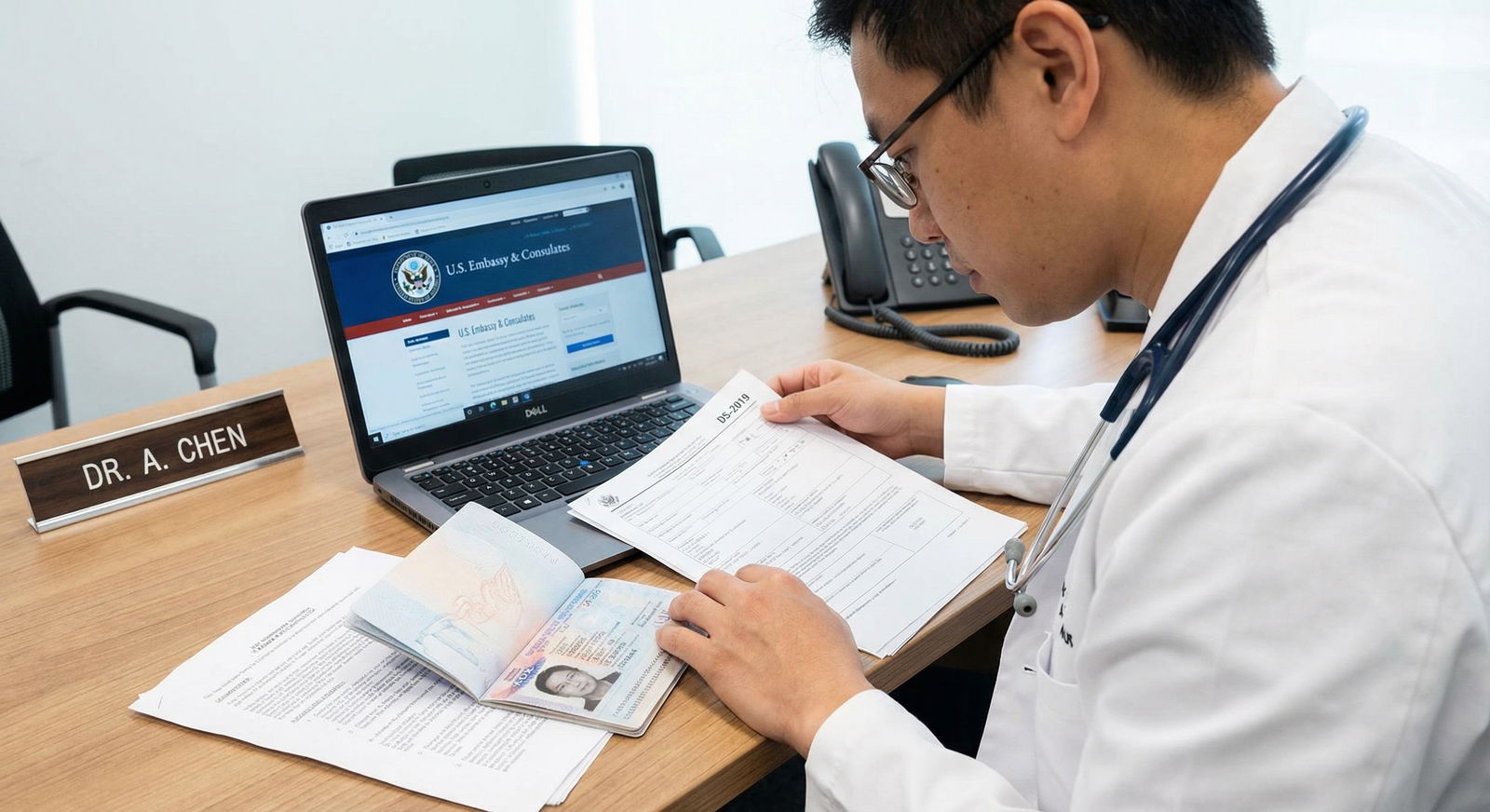
Here's how the DSO workflow actually functions. Your DS-2019 is issued by your sponsoring entity, typically ECFMG for IMG residency programs. Your entry, your SEVIS validation, and your status are all tracked against that specific DS-2019. When you enter the US as a J-1, the CBP officer validates your DS-2019. That's your activation moment, not the flight, not the airport, not the customs line. The DS-2019 validation.
On the compliance side, here's what trips people up. Interview travel must match your visa status. If you're on B-1/B-2, interviews are generally compatible with visitor status, you're not being employed, you're evaluating programs. But if you start an observership, clinical rotation, or any activity that looks like training or work without proper authorization, you've created a problem. Use the right language at customs. "I'm visiting for residency program interviews" is accurate and appropriate for a B-1/B-2 entrant. "I'm here to train" is not.
IMG-specific scenarios: mapping the most common paths applicants take
Let me walk you through the four scenarios I see most often, because your specific path determines your specific risk.
Scenario A: B-1/B-2 for interviews, then J-1 for residency. This is the most common path, and it's the cleanest. You enter as a visitor, attend your interviews, return home, match, and then your program initiates J-1 sponsorship through ECFMG. Your DS-2019 is issued after the match. At that point, 212(e) is determined based on your sponsorship, your country's skills list, any government funding, and the GME designation. Your earlier B-1/B-2 entry has nothing to do with it. I've seen this path work cleanly hundreds of times. The only risk is if you overstay your B-1/B-2 or engage in unauthorized activity during the interview trip, which is a separate compliance issue entirely.
Scenario B: You already have a J-1 or prior J-1 history. Maybe you did research on a J-1, or you were an exchange visitor in another capacity. Now you're traveling for residency interviews. Here's what matters: your prior J-1 may have already imposed 212(e), and that obligation doesn't disappear because you later travel for interviews. Check your old DS-2019s. If 212(e) was indicated, you may already be subject to the requirement, and your new J-1 for residency will add another period or compound the issue. Your interview travel doesn't change this either way, the determination was made when your first DS-2019 was issued.
Scenario C: You request a J-1 specifically to attend interviews. This is rare, and frankly, it's a bad idea in most cases. J-1 visas are for exchange programs with specific purposes, research, teaching, study, or GME. "Attending residency interviews" isn't a recognized J-1 category. If someone is arranging this, you need to scrutinize the DS-2019 basis carefully. What's the program purpose? Who's the sponsor? What category? The risk here isn't that interview travel triggers 212(e), it's that you're using a visa category that doesn't match your actual activity, which is a compliance problem regardless of 212(e).
Scenario D: Your country is on the skills list or your program includes government funding. In this case, 212(e) will likely apply to your J-1 sponsorship regardless of any travel. The skills list and funding determinations are made at the sponsorship level, not the border. Your interview trip doesn't "cause" 212(e) here, your program designation reveals it. The DS-2019 will reflect it. That's your answer, not your flight itinerary.
The pattern is clear. In every scenario, the DS-2019 and sponsorship basis are what matter. Interview travel is the sideshow. Stop treating it like the main event.
How to check quickly (and safely) whether 212(e) applies to you
Here's your action plan, concrete steps, no ambiguity.
First, read your DS-2019. The 212(e) indicator is typically printed directly on the form. Look for language about the two-year home-country physical presence requirement. If it's there, you're subject. If it's not, you may not be, but don't stop there. Some DS-2019s don't explicitly note 212(e) even when it applies, particularly when the basis is the skills list rather than funding.
Second, check your J-1 visa annotation. The visa stamp in your passport sometimes includes a 212(e) notation, though this isn't always present or reliable. Treat it as a secondary indicator, not your primary source.
Third, if you've held J-1 status before, any J-1, for any purpose, pull those old DS-2019s. Prior 212(e) obligations don't expire quietly. They follow you. I've seen applicants discover, weeks before residency start, that a J-1 research visa from three years ago carried 212(e) and nobody caught it. Don't let that be you.
Now, what to ask your DSO or sponsoring institution. Be direct. "Does my DS-2019 indicate 212(e)? What is the basis, government funding, skills list, or GME designation? Can you provide a confirmation letter or written guidance?" DSOs respond to specificity. Vague questions get vague answers. Precise questions get documentation.
Avoid the "he said/she said" trap. I'm serious about this. Forum anecdotes are worthless. Your cousin's friend who "got a waiver easily" doesn't know your DS-2019 basis. Your classmate who "heard the 2-year rule isn't enforced" is wrong, it is enforced, and it's enforced precisely when you can least afford a delay. Rely on your DS-2019, your sponsor's written confirmation, and qualified immigration counsel. That's it.
If you're unsure before interviews, request a status clarification early. I mean now, not two weeks before your first flight. Delays compress your timeline. If you discover 212(e) applies after you've already committed to a program, your waiver process, if you need one, starts from zero, and some waivers take six months or longer.
Waiver reality check (because applicants always ask): what interview travel does not decide
Every time I explain 212(e), the next question is immediate: "Can I get a waiver?" And the follow-up: "Did my interview travel affect my waiver chances?"
No. Your interview travel didn't affect your waiver eligibility. Let me be unequivocal. Waiver eligibility is determined by the 212(e) basis and your individual circumstances, not by whether you attended interviews while visiting the US on a tourist visa. A No Objection Statement waiver depends on your home country's willingness to issue a no-objection letter. An Interested Government Agency waiver depends on a US government agency's willingness to sponsor your waiver request. Exceptional hardship and persecution waivers depend on documented evidence of specific conditions. None of these categories ask whether you flew to Chicago for an interview in October.
Here's my insider caution, and I mean it: do not start waiver paperwork based on assumptions. I've seen applicants file No Objection waivers when their 212(e) basis was government funding, which makes the waiver category different and potentially unavailable. Get confirmation of the 212(e) basis first. Then discuss strategy with qualified immigration counsel. Filing the wrong waiver type wastes months, and in the residency timeline, months are everything.
On timelines: waivers are not fast. A No Objection Statement waiver can take three to six months. An IGA waiver can take longer. If you discover 212(e) applies late in the process, say, April or May after the match, you're in a compressed timeline that may threaten your July 1 start date. This is why I'm telling you to verify early. Interview travel should not be the reason you discover 212(e) late. You should know your status before you book your first flight, not after your last interview.
Compliance secrets: how to travel for interviews without accidentally creating immigration problems
The behind-the-scenes compliance truth is simple but overlooked: most visa problems come from mismatched purpose of entry, not from the number of trips you make. CBP officers are trained to ask why you're entering and whether your activity matches your visa category. They're not trying to trap you. But if your answers don't align with your status, you've created a problem that no DSO can fix retroactively.
If you use visitor status, B-1/B-2, for interviews, keep your activity within visitor bounds. Interviews are fine. You're evaluating programs, not working. But don't blur the lines. No observerships without proper authorization. No clinical activities that look like training. No receiving compensation of any kind. When CBP asks your purpose, say clearly: "I'm visiting for residency program interviews." That's honest, that's complete, and that's consistent with B-1/B-2.
If you use J-1 status for entry before your program start date, follow your sponsor's instructions to the letter. Your sponsor, ECFMG or your institution, has specific rules about what you can and cannot do before your program begins. Some sponsors allow early entry for setup and housing. Some don't. Don't assume. Ask.
Practical tips that save careers: carry your sponsor letters and documentation with you, not in checked luggage. Keep copies of your DS-2019, visa, and correspondence organized in one folder. Avoid switching between statuses on the same trip. If you enter as B-1/B-2, leave as B-1/B-2. Status switching mid-trip raises flags that invite scrutiny you don't need.
Reflection closing: what to do this week so you stop living in fear
You can keep your interview momentum without guessing about 212(e). That's the real takeaway. Fear thrives on ambiguity, and the antidote to ambiguity is documentation and timely questions. Not forum posts. Not rumors. Documentation.
Here's what to do this week. First, confirm your visa status for each interview entry. If it's B-1/B-2, make sure your activity matches. If it's J-1, verify what your sponsor permits before your start date. Second, confirm whether 212(e) applies to your J-1 sponsorship, read your DS-2019, check annotations, and ask your DSO directly. Third, if 212(e) does apply, ask about waiver strategy and timelines immediately. Don't wait until April. Don't wait until after the match. Start the conversation now.
The applicants who succeed aren't the ones who never worry about visas. They're the ones who replace worry with verified information and act on it early. Be that applicant.