

Navigating the U.S. visa system as a non-US citizen IMG who wants to match into radiation oncology residency is complex—but very manageable if you start early, understand your options, and plan strategically. This guide focuses on what foreign national medical graduates need to know about residency visas, especially IMG visa options for radiation oncology, and how those decisions can affect both your rad onc match chances and long-term career.
Understanding the Big Picture: Visas and the Radiation Oncology Pathway
Radiation oncology is a small, competitive specialty with relatively few residency spots each year. As a foreign national medical graduate, your visa status adds another layer of complexity—but it does not make matching impossible.
Why visa strategy matters more in radiation oncology
Key features of radiation oncology that interact with visa issues:
Small number of programs and spots
Many programs receive hundreds of applications for just a few positions. Some feel they cannot manage visa paperwork on top of that and simply do not sponsor visas.Academic, research-heavy specialty
Many rad onc programs are at large academic centers. Some universities have robust international offices and are comfortable with visas (especially J‑1), while others are more restrictive with H‑1B.Long-term training and practice pattern
You will complete:- 1 year of preliminary or transitional internship (often internal medicine or surgery)
- 4 years of radiation oncology residency
Visa continuity between your PGY‑1 year and your PGY‑2–PGY‑5 radiation oncology years is critical.
Post-residency career paths often include academic positions
Academic jobs can be more H‑1B–friendly but might require prior visa planning and careful attention to J‑1 two-year home residency rules if you go the J‑1 route.
Understanding J‑1 vs H‑1B and how programs think about visa sponsorship will help you target the right programs and make realistic plans.
Core Visa Options for Non-US Citizen IMGs in Radiation Oncology
Most non-US citizen IMGs in graduate medical education train on either a J‑1 or an H‑1B visa. A few will train in residency with other statuses (e.g., permanent resident, EAD under another category), but this section focuses on the main IMG visa options.
1. J‑1 Exchange Visitor Visa (ECFMG-sponsored)
For most IMGs, the J‑1 physician visa is the default and most common option.
Key features:
- Sponsor: ECFMG (Educational Commission for Foreign Medical Graduates), not the hospital directly.
- Purpose: “Exchange visitor” for graduate medical education (residency/fellowship).
- Eligibility:
- Valid ECFMG certification
- A contract or official offer from an ACGME-accredited residency program
- Passing USMLE Steps (as required for ECFMG certification and program requirements)
- English proficiency and other ECFMG documentation as required
- Duration: Typically up to 7 years total in GME (residency + fellowship), which is usually enough for:
- 1-year internship
- 4-year radiation oncology residency
- Possibly a short fellowship, depending on your total GME time
Advantages of J‑1 for radiation oncology IMGs:
- Widespread acceptance: Most academic rad onc programs that take IMGs are comfortable with J‑1; ECFMG handles most of the heavy lifting.
- Simpler for the program: Less institutional legal work compared to H‑1B, which can make programs more open to taking a J‑1 IMG.
- Large national support structure: ECFMG has detailed guidance and standardized processes.
Limitations and concerns:
Two-year home-country physical presence requirement (212(e))
After training, you are usually required to return to your home country for at least two years before you can:- Obtain an H‑1B
- Obtain an L visa
- Apply for permanent residency (“green card”)
Unless you obtain a J‑1 waiver.
J‑1 waiver challenges for rad onc
Many J‑1 waiver options (e.g., Conrad 30) strongly favor primary care and certain hospital-based specialties, not radiation oncology. It can be harder (though not impossible) to find J‑1 waiver jobs in underserved areas for a niche specialty.Limited moonlighting
J‑1 regulations restrict employment to your approved training program. Moonlighting is possible only under very specific conditions and with ECFMG approval.
When J‑1 makes sense for a non-US citizen IMG in radiation oncology:
- You primarily want to train in the U.S. but are open to:
- Returning home afterward, or
- Working in an underserved or waiver-eligible setting if available.
- You don’t have a clear, guaranteed long-term employer in the U.S. ready to sponsor H‑1B or a green card right away.
- You are applying broadly and need to maximize the number of programs that will consider your application (many are J‑1 only).
2. H‑1B Temporary Worker Visa for Residency
The H‑1B visa is a work visa that some programs use for residency training.
Key features:
- Sponsor: The individual residency program/hospital (not ECFMG).
- Purpose: Specialty occupation requiring a bachelor’s degree or higher—in this case, the physician role as structured in residency.
- Eligibility:
- USMLE Step 3 passed by the time of visa filing (important timing detail)
- A contract or letter of appointment from an ACGME-accredited program that sponsors H‑1B
- State medical licensure or training license, depending on the state
- Duration: Up to 6 years total, including all previous H‑1B time (residency + other employment).
Advantages of H‑1B for a foreign national medical graduate in rad onc:
- No automatic two-year home residency requirement like the J‑1 (though you may have other obligations depending on your background/program).
- Smoother path to long-term employment in the U.S.
After residency/fellowship, you can continue on H‑1B with an employer willing to sponsor you and eventually transition to permanent residency if eligible. - Potentially more flexibility for:
- Academic jobs in the same institution
- Certain types of moonlighting (depending on state law, contract, and visa specifics; always confirm individually)
Limitations and concerns:
Not all programs sponsor H‑1B
Many rad onc programs are J‑1 only. Some explicitly state “no H‑1B sponsorship” in their program descriptions. Your list of viable programs will shrink if you require H‑1B.USMLE Step 3 requirement
Programs usually want Step 3 completed before they file the petition, often before residency start date. This means you need to:- Plan to take Step 3 during your final year of medical school or during a research year.
- Manage scheduling around exam eligibility rules; you must be ECFMG certified or meet other requirements depending on where you took your steps.
Cap and timing issues
- Some academic institutions are cap-exempt (e.g., universities, affiliated nonprofits), simplifying H‑1B sponsorship.
- Others depend on the H‑1B cap lottery, which adds uncertainty.
- Processing time and fees can be significant; programs may perceive this as a burden.
Total time limit of 6 years
Radiation oncology training is 5 years (intern + 4 years). If you stay on H‑1B for fellowship or additional work, you must plan the 6-year limit carefully or rely on green card-based extensions.
When H‑1B makes sense in radiation oncology:
- You have a clear goal of long-term practice in the U.S. and want to avoid a J‑1 home-country requirement.
- You can realistically:
- Pass USMLE Step 3 early, and
- Target a smaller number of H‑1B-friendly programs.
- You are proactive in talking to programs about their willingness and processes to sponsor H‑1B.
3. Other Statuses: Green Card, EAD, and More
If you have or may obtain another immigration status before residency, your pathway is simpler:
Lawful permanent residents (Green Card holders)
Treated essentially like U.S. graduates from a visa standpoint. Programs do not need to sponsor a residency visa.EAD holders (e.g., asylum, certain family categories, OPT from U.S. degrees)
You may train on work authorization provided your status allows clinical employment. Programs vary in familiarity; you’ll need to provide documents and sometimes legal clarification.Canadian citizens
Still need a visa for U.S. residency (usually J‑1 or H‑1B), but some processes are slightly smoother (e.g., TN for attending-level jobs, not usually for residency).
If you fall in one of these categories, the rest of this article is still useful for understanding how programs think about visas and for planning long-term, but your immediate residency visa hurdles may be lower.

J‑1 vs H‑1B: Strategic Pros and Cons for Radiation Oncology IMGs
Choosing between J‑1 vs H‑1B is not just a paperwork decision—it affects:
- Which programs you can apply to
- The structure of your 5+ years of training
- Your first job options and long-term career flexibility
How radiation oncology programs typically view J‑1 and H‑1B
Patterns you may see when researching programs:
J‑1 only:
- Many academic rad onc programs fall into this category.
- They are comfortable with ECFMG sponsorship.
- They prefer J‑1 due to standardized processes and fewer legal/financial obligations.
J‑1 or H‑1B (case-by-case):
- Some large academic centers with established international offices.
- More open to H‑1B if:
- You already passed Step 3.
- The department strongly supports your candidacy.
No visa sponsorship:
- Some smaller community programs or certain institutions explicitly do not sponsor any visa.
- As a non-US citizen IMG, you should generally exclude these from your primary list, unless you will have your own independent status (e.g., green card).
Career planning implications
If you choose a J‑1:
Training:
- Usually easier to match into a program that is J‑1 friendly.
- Easier continuity from PGY‑1 to PGY‑5, as ECFMG covers all GME years.
Post-training challenges:
- You need a J‑1 waiver job to stay in the U.S. immediately after residency.
- Waiver positions for radiation oncology may be:
- Geographically limited
- Less common than in primary care specialties
- You might need to:
- Be open to rural or underserved locations, or
- Return home for 2 years and then come back on H‑1B or other visa.
If you choose an H‑1B:
Training:
- You must ensure:
- Your intern year and radiation oncology residency both can sponsor H‑1B.
- Or be prepared for a transition (e.g., J‑1 for intern, then H‑1B for rad onc), which gets more complex.
- Step 3 timing becomes crucial.
- You must ensure:
Post-training advantages:
- You can proceed directly to an H‑1B job without needing a waiver or returning home.
- Academic institutions often have cap-exempt H‑1B slots, making academic careers more accessible.
Practical decision-making framework
Ask yourself:
What is my primary goal?
- Train in the U.S. for a few years, then return home → J‑1 is usually fine.
- Build a long-term career in the U.S., including possible permanent residency → H‑1B may be preferable if accessible.
Can I realistically pass Step 3 early?
- If yes, doors to H‑1B open.
- If no, pursuing J‑1 may be more realistic.
How flexible am I with location and program type?
- Willing to apply widely and to programs that are J‑1‑only? J‑1 works.
- Focused on a subset of institutions that explicitly sponsor H‑1B? Possible, but more competitive.
Do I have personal/family immigration plans (e.g., spouse, children, other pending petitions)?
- Some family situations make H‑1B or non-J‑1 paths more attractive due to timing and long-term stability.
No choice is perfect; it’s a balance of short-term match probability and long-term immigration strategy.
Application Strategy: Integrating Visa Planning into Your Rad Onc Match
Your rad onc match strategy as a non-US citizen IMG should integrate visa planning from the very beginning of your application cycle.
Step 1: Clarify your visa preferences and constraints
Decide whether you:
- Are open to J‑1 and H‑1B, or
- Need H‑1B only, or
- Will have independent status (e.g., green card).
Consider early Step 3:
- If you want H‑1B, plan a detailed schedule to meet eligibility and testing deadlines.
- Build a study plan around your clinical and research commitments.
Step 2: Build a targeted program list
Create a spreadsheet with columns for:
- Program name
- Location
- Type (university, university-affiliated, community)
- Visa policy (J‑1, H‑1B, both, or none)
- Historical IMG intake (if known)
- Personal fit factors (research, location, specific faculty)
Research visa policies:
- Program websites: Look under “Eligibility & Requirements”, “FAQ”, or “International Applicants”.
- FREIDA and program directories (but always verify with the program’s own website).
- Email or call coordinators if the policy is unclear (brief, professional message).
Sample email template to clarify visa sponsorship:
Dear [Program Coordinator/Dr. X],
I am an international medical graduate and a non-US citizen applying to radiation oncology residency this cycle. I am writing to ask whether your program sponsors [J‑1 and/or H‑1B] visas for residents.
Thank you very much for your time and clarification.
Sincerely,
[Your Name], MD
[Medical School, Country]Prioritize programs that:
- Match your visa needs (J‑1 only vs J‑1/H‑1B).
- Historically interview or match IMGs.
- Align with your academic & research interests in radiation oncology.
Step 3: Address visa status thoughtfully in your application
ERAS application:
- Indicate your current citizenship and visa needs accurately.
- Do not hide or misrepresent status; programs will verify and it can harm your credibility.
Personal statement:
- You do not need to focus heavily on visa issues.
- If relevant (e.g., returning to serve cancer patients in your home country after training), describe your long-term goals in a way that aligns with your likely visa path (J‑1 return vs H‑1B long-term stay).
CV and experiences:
- Highlight any prior U.S. clinical experience, observerships, or research.
- Emphasize reliability, adaptability, and strong communication skills—qualities that reassure programs about the investment in an IMG requiring visa sponsorship.
Step 4: Interviewing as a non-US citizen IMG
During interviews:
Be ready for visa questions, such as:
- “Will you need visa sponsorship?”
- “Are you able to take Step 3 before starting residency?” (if program sponsors H‑1B)
- “Are you open to a J‑1 visa?”
How to respond:
- Be honest, concise, and confident.
- Example response for dual openness:
“I am a non-US citizen IMG and will require visa sponsorship. I am open to both J‑1 and H‑1B visas. I have already taken/passed Step 3 [or] I plan to take it on [approximate timeline] in case H‑1B is an option.”
Clarify details politely:
- If the program seems uncertain about their own policy, it’s appropriate to ask:
“Does your institution typically sponsor J‑1, H‑1B, or both for residents?”
- If the program seems uncertain about their own policy, it’s appropriate to ask:
Maintain a professional tone; visa questions should not dominate the interview, but you should ensure there is no misunderstanding.
Step 5: Ranking programs with visa in mind
When finalizing your rank list:
- Place programs that match both your training goals and visa needs at the top.
- If you have programs that:
- You love academically but
- Cannot meet your visa preference
Think carefully: - Are you willing to accept a J‑1 with a 2-year home requirement if your long-term goal is U.S. practice?
- Or conversely, are you willing to give up a top-ranked research environment to secure H‑1B and long-term immigration flexibility?
There is no universally right decision; align your rank list with your personal and family priorities.
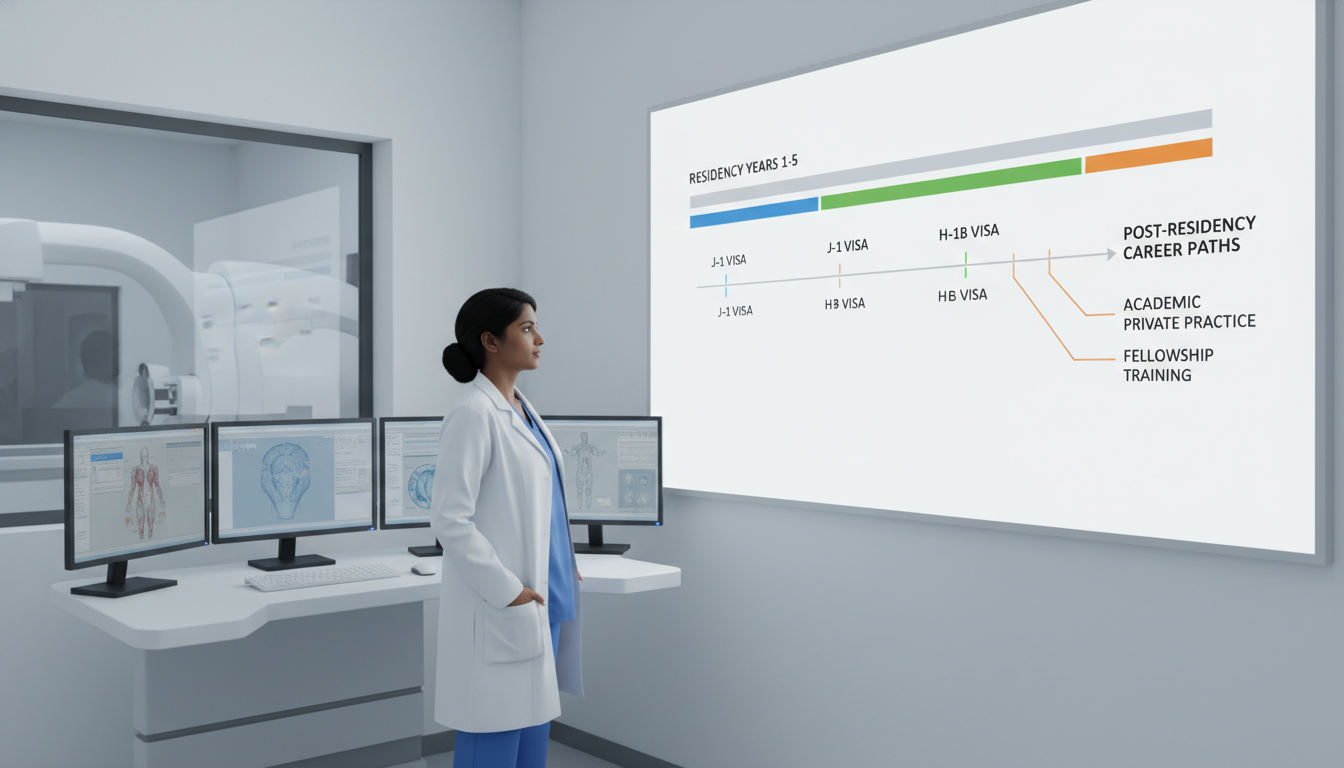
Post-Residency Paths and Long-Term Visa Considerations for Rad Onc IMGs
Your visa choices during residency affect your options immediately after graduation and beyond.
If you trained on a J‑1 visa
You typically must either:
Return to your home country for 2 years
- You can:
- Work clinically
- Build academic collaborations with your U.S. mentors
- Plan a later return to the U.S. for fellowships or jobs via H‑1B or other visas
- You can:
Secure a J‑1 waiver job in the U.S.
- Common waiver routes:
- Conrad 30 (state-based, primary-care-heavy, but some states may consider specialists)
- Federal agencies (e.g., VA, HHS), though rad onc slots are rare.
- Challenges in radiation oncology:
- Fewer positions in medically underserved areas compared to primary care or general internal medicine.
- You may need to be geographically very flexible.
- Common waiver routes:
Pursue additional training in another country
- Some IMGs complete further training in Canada, the UK, or other jurisdictions while waiting out or satisfying home-country requirements.
If your long-term plan is U.S. practice in radiation oncology, start exploring potential waiver possibilities by PGY‑3–PGY‑4 so you are not rushed in your final year.
If you trained on an H‑1B visa
After finishing residency (and any fellowship), you can:
- Transition directly to an attending-level H‑1B job.
- Begin a green card (permanent residency) process with your employer’s support.
Consider:
- Total time on H‑1B (6-year limit without green card progress).
- Whether your future employer is cap-exempt or cap-subject.
- Timing your green card process so you don’t run out of H‑1B time.
Long-term academic vs private practice considerations
Academic careers:
- Often at cap-exempt institutions.
- May be more open to complex immigration histories.
- Strong fit with rad onc’s research orientation.
Private practice:
- Can sponsor H‑1B but are usually cap-subject unless partnered with certain nonprofit entities.
- Immigration strategy may revolve more around green card sponsorship.
For both, your track record in residency—research, clinical performance, professionalism—matters more than your visa alone; but your visa groundwork will determine how easily you can accept offers.
Practical Tips, Common Pitfalls, and Action Plan
Practical tips for non-US citizen IMGs targeting rad onc
Start visa planning early—ideally at least 1–2 years before you apply.
Take Step 3 early if H‑1B is important to you, building a realistic study schedule.
Keep communication with programs professional and concise regarding visas.
Use mentors:
- Ask your rad onc and IMG mentors for introductions to residents or alumni who navigated J‑1 or H‑1B.
- Learn from their real experiences and institutional nuances.
Stay informed of policy changes:
- Immigration rules can shift.
- Check:
- ECFMG and AAMC for updated J‑1 guidance.
- Institutional GME office resources.
- Official USCIS site for H‑1B rules (or get legal advice).
Common pitfalls to avoid
Assuming all programs sponsor your preferred visa
Always verify; many excellent rad onc programs are J‑1 only or offer no H‑1B.Delaying Step 3 if you aim for H‑1B
Without Step 3, H‑1B is off the table for residency.Ignoring the J‑1 2-year home residency requirement
Do not treat it as a minor technicality; it shapes your early-career options.Over-focusing on visa at the expense of overall application quality
Even if a program can sponsor your visa, they will not rank you if your application is weak academically or clinically.
Sample 12–18 month action plan
12–18 months before ERAS opens:
- Decide your preferred visa strategy (J‑1 only vs J‑1/H‑1B).
- Map out USMLE Step 3 plan if needed.
- Strengthen your radiation oncology CV (research, rotations, observerships).
6–12 months before ERAS:
- Take Step 3 (if aiming for H‑1B).
- Begin program list and visa policy research.
- Draft personal statement and refine your CV.
Application season:
- Submit ERAS with accurate visa information.
- Email programs (if necessary) to clarify visa sponsorship.
- Prepare for interviews, including clear, calm talking points about your visa status and flexibility.
Match to residency start:
- Work with your matched program’s GME office early to submit visa paperwork (J‑1 or H‑1B petitions).
- Track all deadlines closely and respond promptly to requests for documentation.
FAQs: Visa Navigation for Non-US Citizen IMGs in Radiation Oncology
1. As a non-US citizen IMG, will needing a visa significantly hurt my chances in the rad onc match?
Visa needs do add complexity, but they are not an automatic disqualifier. What matters most is your overall profile: USMLE scores, research, clinical performance, letters, communication skills, and genuine interest in radiation oncology. However, some programs do not sponsor visas at all, and many may prefer J‑1 over H‑1B. By targeting visa-friendly programs and planning early, you can remain competitive.
2. Should I delay applying for radiation oncology until I pass Step 3 so I can pursue H‑1B?
Not necessarily. If you have a strong application and are open to J‑1 programs, you can apply without Step 3. Delaying solely for H‑1B might mean missing strong J‑1 opportunities. A balanced approach for many IMGs is:
- Apply on time.
- Take Step 3 as early as is reasonable.
- Indicate openness to both J‑1 and H‑1B if that’s true for you.
If H‑1B is absolutely critical for your long-term plans, then planning your application around early Step 3 may be appropriate—but recognize that this narrows your options.
3. Can I switch from J‑1 to H‑1B during or right after residency to avoid the 2-year home requirement?
In most cases, no. If you are subject to the J‑1 two-year home residency requirement, you cannot change status to H‑1B or obtain an H‑1B visa until you either:
- Fulfill the 2 years in your home country, or
- Obtain a J‑1 waiver.
Some people complete J‑1 training and later return under H‑1B after meeting these conditions, but you should not count on an easy in-training switch as your main strategy.
4. How can I find radiation oncology residency programs that are IMG- and visa-friendly?
Use a multi-step approach:
- Check program websites for statements about international applicants and visa sponsorship.
- Review FREIDA and other residency directories.
- Look at programs’ resident lists to see if they currently or historically have IMGs.
- Reach out by email to coordinators when policies are unclear.
Create a database and prioritize programs that: - Explicitly sponsor J‑1 and/or H‑1B
- Have a track record of matching IMGs
- Align with your research and clinical interests in radiation oncology.
By understanding IMG visa options, the differences between J‑1 vs H‑1B, and how they intersect with the rad onc match, you can create a realistic and strategic plan for both your training and your long-term career as a radiation oncologist.


