Understanding H-1B and J-1 Visas for International Medical Graduates
International Medical Graduates (IMGs) are vital to the U.S. healthcare system, especially in underserved and rural areas. Every year, thousands of IMGs navigate the complex combination of exams, applications, and immigration rules to enter U.S. residency and fellowship programs. Two visa categories dominate this process: the H-1B Visa and the J-1 Visa.
For IMGs, the choice between these visas affects not only the residency application process, but also long-term career options, potential paths to permanent residency, and the ability to stay in the U.S. after training. This guide expands on the most important FAQs about H-1B and J-1 visas, clarifying eligibility, the visa application process, practical pros and cons, and strategic considerations for residency and beyond.
H-1B Visa for IMGs: Key Features and Eligibility
What is the H-1B Visa for International Medical Graduates?
The H-1B Visa is a non-immigrant, employment-based visa that allows U.S. employers to temporarily hire foreign workers in “specialty occupations.” Medicine clearly qualifies as a specialty occupation because it requires advanced, highly specialized education and licensure.
In the context of IMGs, H-1B is most commonly used for:
- ACGME-accredited residency and fellowship positions (when the institution sponsors H-1Bs)
- Attending physician roles after completion of training
- Academic or research-based clinical positions
The H-1B visa is employer-specific and position-specific. You cannot simply “hold an H-1B” and work anywhere; your visa is tied to one sponsoring employer and one specific job description unless a new petition is approved.
Who Qualifies for the H-1B Visa as an IMG?
To qualify for an H-1B Visa as an International Medical Graduate, you typically must satisfy all of the following:
Job Offer
- A formal offer of employment from a U.S. employer (e.g., teaching hospital, health system, university hospital, or clinic).
- For residents/fellows: an official contract or Match agreement from an ACGME-accredited program that is willing to sponsor H-1B.
Specialty Occupation
- The offered role must require at least a bachelor’s degree or higher in a specialized field. In medicine, this is effectively your medical degree (MD/MBBS/DO or equivalent) plus relevant specialization for fellowship or attending roles.
Education and Credentials
- A medical degree that is equivalent to a U.S. MD or DO (verified through agencies such as ECFMG).
- Passing relevant USMLE exams (most programs require Steps 1, 2 CK, and often Step 3 for H-1B sponsorship; Step 3 in particular is frequently a requirement for H-1B residency sponsorship).
- An ECFMG certificate (or proof you will have it before the start of training).
- State medical licensure or eligibility for a training license, depending on state requirements.
Visa-Specific Requirements
- The employer must pay at least the prevailing wage determined for that position and region.
- The position must be full-time (or near full-time) and meet Department of Labor standards.
Practical Considerations for H-1B in Residency
- Many residency programs do not sponsor H-1B visas because of cost, complexity, and administrative burden.
- Programs that do sponsor H-1Bs often require:
- USMLE Step 3 passed before Match ranking or before issuing contracts.
- Strong documentation that you meet state licensing requirements.
If you prefer H-1B, you should proactively research and filter programs in ERAS that explicitly accept and sponsor H-1B visas.
J-1 Visa for IMGs: Key Features and Eligibility
What is the J-1 Visa for Medical Training?
The J-1 Visa is a non-immigrant visa category designed primarily for educational and cultural exchange. For physicians, it is used for graduate medical education and training, including:
- ACGME-accredited residency programs
- ACGME-accredited or recognized fellowship programs
- Certain non-standard fellowships with special approvals
Most physicians on J-1 are sponsored not directly by the hospital, but by the Educational Commission for Foreign Medical Graduates (ECFMG) acting as the official Exchange Visitor Program sponsor for foreign physicians.
Who Qualifies for the J-1 Visa as a Physician?
For IMGs seeking a J-1 Visa for residency or fellowship, typical requirements include:
Acceptance into an ACGME-Accredited Program
- You must match into or be accepted by a U.S. residency or fellowship program that meets accreditation criteria.
- The program’s GME office must agree to support your J-1 sponsorship through ECFMG.
Sponsorship by ECFMG
- ECFMG issues the Form DS-2019, which is the certificate of eligibility for J-1 status for physicians.
- You must meet ECFMG’s requirements, which generally include:
- Valid ECFMG certification (medical degree verification + exams).
- Sufficient English language proficiency (typically demonstrated through exams and training).
- Appropriate contract/offer letter from the training program.
Funding/Compensation
- You must receive a salary or stipend sufficient to support yourself and (if applicable) dependents.
- The funding usually comes directly from the training institution, not an external sponsor.
Intent to Return Home
- The J-1 is theoretically a temporary, exchange-focused visa. Many J-1 physicians are subject to the two-year home-country physical presence requirement, which significantly affects future immigration options (discussed below).
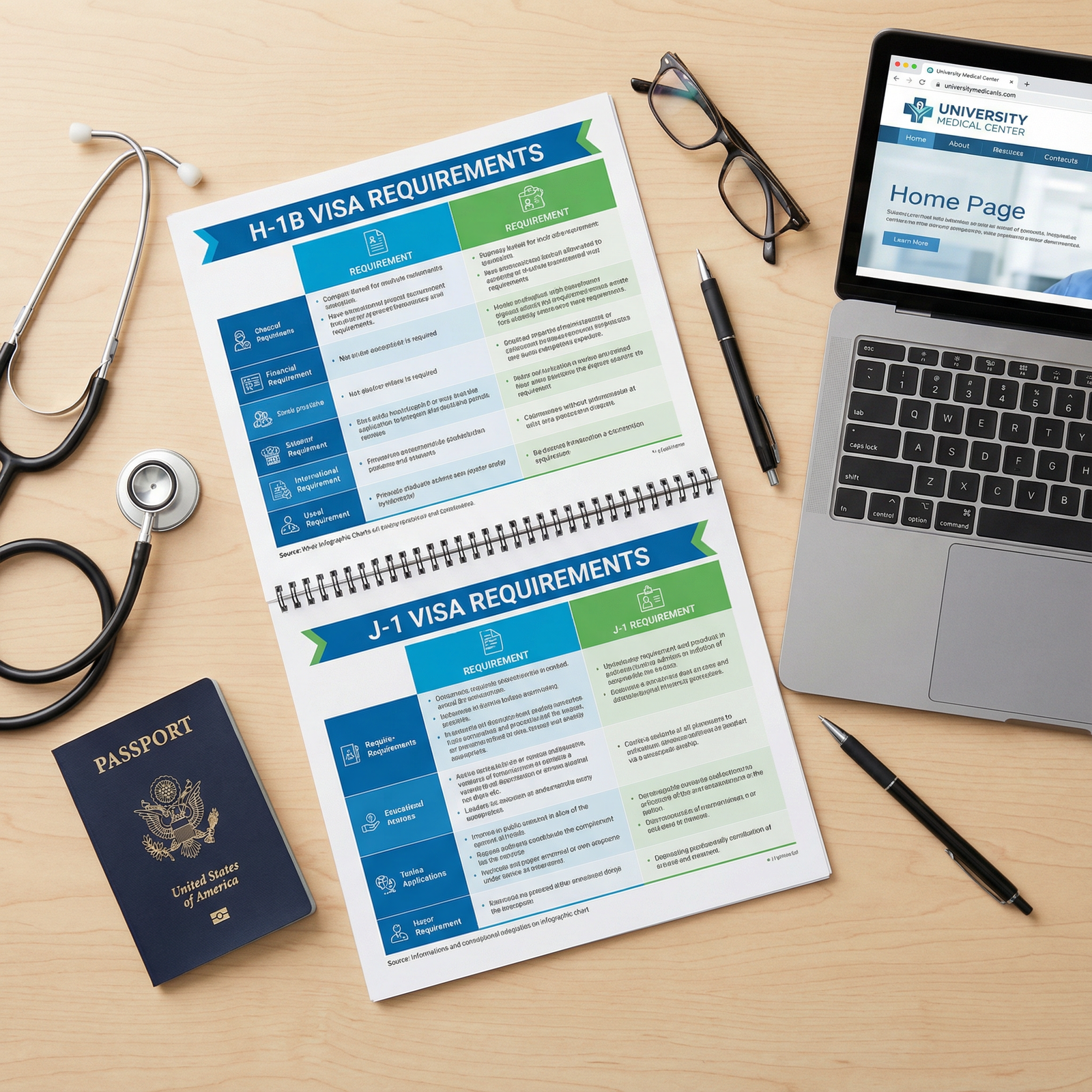
Side-by-Side: Key Differences Between H-1B and J-1 Visas for IMGs
1. Purpose and Sponsorship Structure
H-1B Visa
- Purpose: Temporary employment in a specialty occupation.
- Sponsorship: Directly by the employer (hospital, health system, university).
- Focus: Employment relationship and labor standards.
J-1 Visa
- Purpose: Educational and cultural exchange, specifically for graduate medical training.
- Sponsorship: For physicians, primarily by ECFMG as the designated sponsor, with support from the training program.
- Focus: Training and return-home requirement to promote global knowledge exchange.
2. Two-Year Home Residency Requirement (J-1 Specific)
A major distinction is the two-year home-country physical presence requirement (INA §212(e)):
- Many J-1 physicians must, after completing training, either:
- Return to their home country (or country of last permanent residence) for a total of two years, or
- Obtain a J-1 waiver before changing to certain other U.S. statuses (e.g., H-1B, immigrant status/Green Card).
You may be subject to this requirement if:
- Your home country or specialty appears on the U.S. skills list, or
- Your training is government-funded, or
- You are participating in a program specifically designated with this condition.
In contrast:
- H-1B Visa holders generally do not have any home residency requirement.
- They can pursue permanent residency (Green Card) from within the U.S. if they meet the criteria.
3. Flexibility to Change Employers or Training Programs
H-1B Visa
- You can change employers if a new employer files and receives approval for a new H-1B petition (known as a transfer).
- In residency: changing programs on H-1B is possible but practically difficult and uncommon because:
- Not all programs sponsor H-1Bs.
- Timing, credentialing, and state licensing can complicate transitions.
- For attending roles: H-1B porting between employers is more common.
J-1 Visa
- Changing residency programs or specialties is more restricted and requires ECFMG’s approval.
- Transfers are possible in limited circumstances (e.g., program closure, academic necessity) but are not as flexible as H-1B employment changes.
- The primary expectation is continuous, full-time participation in the specific training program listed on your DS-2019.
4. Duration and Extensions
H-1B Visa Duration
- Initial approval: typically up to 3 years.
- Maximum standard duration: 6 years total in H-1B status.
- Possible extensions beyond 6 years if:
- You are in the process of obtaining an employment-based Green Card (e.g., I-140 approved and certain conditions met).
J-1 Visa Duration
- Usually granted for the full length of the ACGME-accredited training program, plus short grace periods.
- Residency: often 3–5 years depending on specialty.
- Fellowship: additional years with separate DS-2019 forms.
- Extensions are possible within the maximum permitted time for training, if supported by your program and ECFMG.
5. Pathways to Permanent Residency (Green Card)
H-1B Visa Holders
- More straightforward route to U.S. permanent residency through:
- Employer-sponsored EB-2 or EB-3 Green Card.
- Academic or research positions may qualify for EB-1 categories in some cases.
- You are allowed “dual intent”: you can hold a non-immigrant H-1B and still lawfully apply for a Green Card.
- More straightforward route to U.S. permanent residency through:
J-1 Visa Holders
- If you are subject to the two-year home residency requirement, you typically must:
- Fulfill the two years abroad, or
- Obtain a J-1 waiver (commonly through:
- Conrad 30/J-1 waiver jobs in underserved areas,
- Federal government agency waivers,
- Exceptional hardship or persecution-based waivers).
- Only after completing or waiving the requirement can you usually change to H-1B or apply for permanent residency.
- J-1 itself does not permit dual intent; your official intent is to return home after training.
- If you are subject to the two-year home residency requirement, you typically must:
Visa Application Process for H-1B and J-1: Step-by-Step
The H-1B Visa Application Process for IMGs
For an IMG entering residency or fellowship with an H-1B:
Secure a Job Offer or Match Position
- Match into a residency/fellowship program that sponsors H-1B, or receive an attending offer from a U.S. employer.
- Clarify early with the program whether H-1B is supported and what their internal deadlines are.
Employer Files a Labor Condition Application (LCA)
- The employer submits an LCA to the U.S. Department of Labor (DOL).
- They attest to paying you at least the prevailing wage and maintaining proper working conditions.
- LCA approval is typically a prerequisite to filing the H-1B petition.
Employer Files Form I-129 (H-1B Petition) with USCIS
- This includes:
- Approved LCA
- Detailed job description
- Evidence of your qualifications (education, ECFMG certificate, USMLE scores)
- Proof of licensure or eligibility for a training license.
- Optional premium processing can expedite adjudication (for an additional fee).
- This includes:
USCIS Adjudication
- USCIS may approve, deny, or issue a Request for Evidence (RFE).
- Once approved, you receive a Notice of Approval (Form I-797).
Consular Processing or Change of Status
- If you are outside the U.S.:
- Schedule a visa interview at a U.S. consulate/embassy.
- Present your approval notice, supporting documents, and complete the DS-160.
- If you are inside the U.S. in another valid status:
- You might request a change of status to H-1B without leaving the country (subject to timing and eligibility).
- If you are outside the U.S.:
The J-1 Visa Application Process for IMGs
For an IMG entering residency or fellowship with a J-1:
Match into or Secure a Position in an ACGME-Accredited Program
- The program must be approved for ECFMG-sponsored J-1 training.
- You sign your contract or Match agreement.
Apply for ECFMG Sponsorship
- Through ECFMG’s online system, you submit:
- Personal information and documents.
- Program details and contract.
- Proof of funding/salary and health insurance coverage.
- The GME office usually coordinates with ECFMG to validate program details.
- Through ECFMG’s online system, you submit:
Receive Form DS-2019
- If approved, ECFMG issues the DS-2019, your Certificate of Eligibility for J-1 status.
- The DS-2019 specifies the training program, dates, and category.
Complete SEVIS and Visa Application Requirements
- Pay the SEVIS I-901 fee.
- Complete the DS-160 (non-immigrant visa application).
- Prepare required documentation (passport, DS-2019, photos, financial evidence, etc.).
Schedule and Attend Consular Interview
- Attend your J-1 visa interview at the U.S. embassy/consulate.
- If approved, the J-1 visa is placed in your passport, and you can enter the U.S. to begin training.
Advantages and Challenges of Each Visa for IMGs
Advantages of the H-1B Visa for IMGs
More Direct Path to Permanent Residency
- Recognized “dual intent” allows you to pursue a Green Card while on H-1B.
- No inherent two-year home residency requirement.
Greater Long-Term Flexibility
- Easier to transition into attending roles within the U.S.
- More straightforward to change employers (with new H-1B petitions).
Perception by Some Employers
- Some employers prefer H-1B due to long-term stability and easier transitions to permanent roles.
Challenges of the H-1B Visa
Limited Sponsorship in Residency
- Many residency programs do not sponsor H-1Bs for trainees.
- Fewer programs to choose from can affect competitiveness and specialty choice.
H-1B Cap (for Certain Employers)
- Many teaching hospitals are “cap-exempt,” but some employers are not.
- If you transition to a non-exempt employer, you may face the annual H-1B cap and lottery.
Higher Administrative Burden
- More complex wage, LCA, and documentation requirements.
- Often requires consultation with immigration attorneys, adding cost and time.
Advantages of the J-1 Visa for IMGs
Widely Accepted for Residency and Fellowship
- The majority of U.S. residency and fellowship programs are familiar and comfortable with J-1 sponsorship.
- This can open more program options in the U.S. residency application process.
Purpose-Built for Training
- Designed specifically for education and clinical training.
- ECFMG provides structured guidance, standardized forms, and processes.
Consistency Across Institutions
- Because ECFMG is the primary sponsor, there is more uniformity in requirements and documentation for training programs nationwide.
Challenges of the J-1 Visa
Two-Year Home Residency Requirement
- Limits your ability to immediately transition to H-1B or permanent residency.
- Often requires a J-1 waiver, commonly via:
- Conrad 30 Waiver Programs (state-level underserved area employment),
- Federal agencies (e.g., VA, HHS, etc.),
- Exceptional hardship or persecution claims.
- The waiver process adds 1–2 years or more of additional steps after training.
Less Flexibility During Training
- Changing specialties or moving between programs is more difficult.
- Must maintain continuous, full-time participation in the approved training program.
No Dual Intent
- Formally, J-1 assumes your intent is to return home after training, which can complicate future immigration strategies if not carefully planned.
Impact of External Factors (e.g., COVID-19) on Visa Processing
Global events, including the COVID-19 pandemic, demonstrated how quickly visa processes can change:
Consular Delays and Closures
- Reduced appointment availability for visa interviews.
- Backlogs leading to late arrivals or delayed start dates for residency.
Policy Changes and Travel Restrictions
- Periodic suspensions or additional screenings for certain visa categories or countries.
- Requirements for negative tests, quarantines, or vaccination documentation.
Virtual Adaptations
- Increased use of virtual interviews for both residency programs and consular processing.
- More frequent updates to consular procedures and documentation requirements.
Because policy and processing times can shift rapidly, IMGs should:
- Monitor consular websites and ECFMG updates regularly.
- Stay in close communication with their program’s GME office.
- Consider building time buffers into travel and start-date planning.
Should IMGs Work with an Immigration Attorney?
While it is possible to navigate the visa application process without legal representation, many IMGs and institutions benefit from involving an experienced immigration attorney—especially for H-1B petitions and long-term planning.
An immigration attorney can help:
- Evaluate whether H-1B or J-1 is strategically better for your goals.
- Identify timing risks (e.g., licensure, Step 3, cap issues).
- Prepare and review petitions to minimize RFEs and denials.
- Plan a stepwise path to permanent residency (if desired), including J-1 waiver strategies and Green Card planning.
For J-1 residency sponsorship alone, your program’s GME office and ECFMG often provide enough structure. However, if you anticipate seeking a J-1 waiver, Green Card, or complex status changes, legal guidance can be extremely valuable.
Expanded FAQs: H-1B and J-1 Visas for International Medical Graduates
1. What kind of financial support do IMGs receive on J-1 or H-1B visas?
J-1 Visa Holders
- Receive a stipend or salary from the residency or fellowship program.
- Amounts are typically standardized by PGY level and set by the institution.
- Must be sufficient to meet ECFMG’s minimum funding requirements for you and your dependents.
- Funding must be clearly documented in your contract or institutional letter.
H-1B Visa Holders
- Are employees under U.S. labor law and must be paid at least the prevailing wage for their role and location.
- For residents/fellows, salaries are usually similar to those of U.S. trainees at the same level.
- For attendings, compensation must meet or exceed Department of Labor prevailing wage determinations.
In both cases, you should review your contract to confirm salary, benefits, and any additional allowances (e.g., relocation support, educational funds).
2. Can dependents accompany H-1B or J-1 visa holders, and can they work?
H-1B Dependents (H-4 Status)
- Spouses and unmarried children under 21 can apply for H-4 visas.
- They can live and study in the U.S.
- Work authorization for H-4 spouses is limited and generally tied to the principal H-1B holder being on a path to permanent residency (e.g., approved I-140 in specific circumstances).
J-1 Dependents (J-2 Status)
- Spouses and unmarried children under 21 can obtain J-2 visas.
- They may apply for work authorization (EAD) and, if approved, can work for any employer.
- They can also study in the U.S. without a separate student visa.
Always check the latest USCIS and Department of State guidelines, as dependent work rules can change.
3. What employment options are available after completing training on a J-1 visa?
After J-1 training, your options depend on whether you are subject to and whether you have satisfied or waived the two-year home residency requirement:
If you complete the two-year home-country requirement:
- You may then apply for H-1B positions in the U.S.
- You may be eligible for permanent residency sponsorship (EB-2/EB-3, etc.).
If you obtain a J-1 waiver (common pathways):
- Conrad 30 Waiver Programs:
- You agree to work for 3 years full-time in a federally designated underserved area (usually on an H-1B visa).
- After fulfilling the service obligation, you may pursue permanent roles and Green Card sponsorship.
- Federal Agency Waivers:
- Employment in certain public or research institutions that request your waiver.
- Hardship or Persecution Waivers:
- Based on showing that you or your U.S. citizen/permanent resident family members would suffer exceptional hardship or face persecution if you return home.
- Conrad 30 Waiver Programs:
Plan for your post-training pathway early—ideally by mid-residency—so you can align your fellowship plans, location preferences, and visa strategy.
4. How should IMGs choose between H-1B and J-1 for U.S. residency?
Consider the following factors:
Program Availability
- Are there enough programs in your specialty and desired locations that sponsor H-1B?
- Would insisting on H-1B significantly limit your Match options?
Long-Term Career Goals
- Do you aim to stay and practice long-term in the U.S.?
- Are you open to working in underserved or rural areas (Conrad 30) if you choose J-1?
Timeline and Credentials
- Have you passed USMLE Step 3 (often required for H-1B sponsorship)?
- Will you have all documentation ready by the program’s deadlines?
Family and Mobility Considerations
- Is dependent work authorization important for your spouse?
- How risk-tolerant are you regarding J-1 waivers or home-country stays?
Many IMGs accept a J-1 visa for residency to maximize Match opportunities, then plan strategically for a waiver and H-1B or Green Card afterward. Others target H-1B from the outset, especially if they already have Step 3 and a clear pathway to a sponsoring program.
5. Can I switch from J-1 to H-1B during or after residency?
During Residency
- Switching from J-1 to H-1B during training is complex and usually not recommended.
- You would generally need:
- A program willing to re-sponsor you under H-1B,
- ECFMG and consular approval for status change, and
- Resolution of the two-year home residency requirement (or an approved waiver).
- Most programs and IMGs avoid this mid-training switch due to logistical and regulatory hurdles.
After Residency
- Common route: complete residency/fellowship on J-1, obtain a J-1 waiver, then transition to H-1B for waiver-obligated employment (e.g., Conrad 30 job).
- Once in H-1B status and after fulfilling waiver requirements, you can pursue broader job opportunities and permanent residency.
By understanding how the H-1B Visa and J-1 Visa work for International Medical Graduates, you can better align your immigration strategy with your training plans and long-term career goals. Research your target programs’ visa policies early, maintain strong communication with GME offices, and consider professional legal advice for complex cases or long-term planning. Thoughtful preparation now will help you navigate U.S. residency, fellowship, and beyond with greater confidence and flexibility.