

International Medical Graduates (IMGs) are a vital part of the U.S. healthcare workforce, especially in underserved and rural communities. Yet the path from medical school abroad to practicing physician in the United States is tightly linked to immigration status. Two visa categories dominate this journey: the H-1B Visa and the J-1 Visa.
Understanding visa compliance is not just about avoiding problems with U.S. immigration authorities—it directly affects your ability to match into residency, complete training on time, pursue fellowships, and build long-term U.S. healthcare careers. A single misstep can delay or even derail your professional plans.
This enhanced guide explains the key features of H-1B and J-1 visas for IMGs, outlines compliance obligations, and offers practical strategies to stay in good standing throughout residency and beyond.
Understanding H-1B and J-1 Visas for International Medical Graduates
Both H-1B and J-1 visas can be used by IMGs to participate in U.S. residency and fellowship training, but they differ significantly in purpose, flexibility, and long-term impact on your career and immigration options.
H-1B Visa Overview for IMGs
The H-1B Visa is a non-immigrant category for “specialty occupations” that require at least a bachelor’s degree in a specific field. For IMGs, this typically means:
- A residency or fellowship position
- Occasionally an attending physician role after training
Key features for IMGs:
Specialty Occupation Requirement
You must be filling a position that requires highly specialized knowledge. In practice, ACGME-accredited residency and fellowship positions qualify as specialty occupations because they require:- An MD/DO (or foreign equivalent)
- Passing USMLE Steps (or COMLEX)
- ECFMG certification (for international graduates)
Employer Sponsorship Required
IMGs cannot self-petition for an H-1B. A U.S. employer—typically:- A teaching hospital
- A university-affiliated program
- A healthcare system
—must file the petition on your behalf. You cannot begin working in H-1B status until USCIS approves this petition.
Duration and Extensions
- Initial approval is usually up to 3 years.
- Extensions are permitted up to a usual maximum of 6 years in H-1B status.
- Certain physicians pursuing permanent residency (Green Card) may extend beyond six years under specific conditions (e.g., pending or approved immigrant petition).
Cap-Exempt vs. Cap-Subject H-1B
Many residency and fellowship positions are cap-exempt because they are:- At nonprofit or governmental research institutions
- At university-affiliated teaching hospitals
This means you may not be subject to the annual H-1B lottery. Later, transitioning to a non–cap-exempt job may require entering the H-1B lottery.
Dual Intent Advantage
One of H-1B’s biggest benefits is dual intent:- You may pursue permanent residency (Green Card) while in H-1B status.
- Applying for a Green Card does not usually jeopardize H-1B status or renewals.
J-1 Visa Overview for IMGs in Graduate Medical Education
The J-1 Visa for IMGs is usually the J-1 “Exchange Visitor” physician category, administered through the Educational Commission for Foreign Medical Graduates (ECFMG), which acts as the program sponsor.
Key features for IMGs:
Program and Sponsor Requirement
- You must have a position in an ACGME-accredited program (residency or fellowship).
- ECFMG must agree to sponsor your J-1 status.
- J-1 sponsorship is strictly for education and training, not for long-term employment.
Duration of Stay
- Typically granted for one year at a time, renewable annually for the length of the training program.
- Maximum total duration for clinical training is generally 7 years, though exceptions exist in specific circumstances (e.g., for certain subspecialties).
Two-Year Home Residency Requirement (INA 212(e))
Many J-1 physician participants are subject to a two-year home-country physical presence requirement after completing training:- You must return to your country of last legal permanent residence for two years.
- Until this is satisfied or waived, you are generally not eligible for:
- H-1B Visa
- L-1 Visa
- Permanent residency (Green Card)
This requirement significantly shapes long-term planning for J-1 IMGs.
Single Intent
Technically, the J-1 is not a dual-intent visa:- It is meant for temporary educational exchange.
- Showing clear long-term immigrant intent can complicate visa renewals or consular processing.
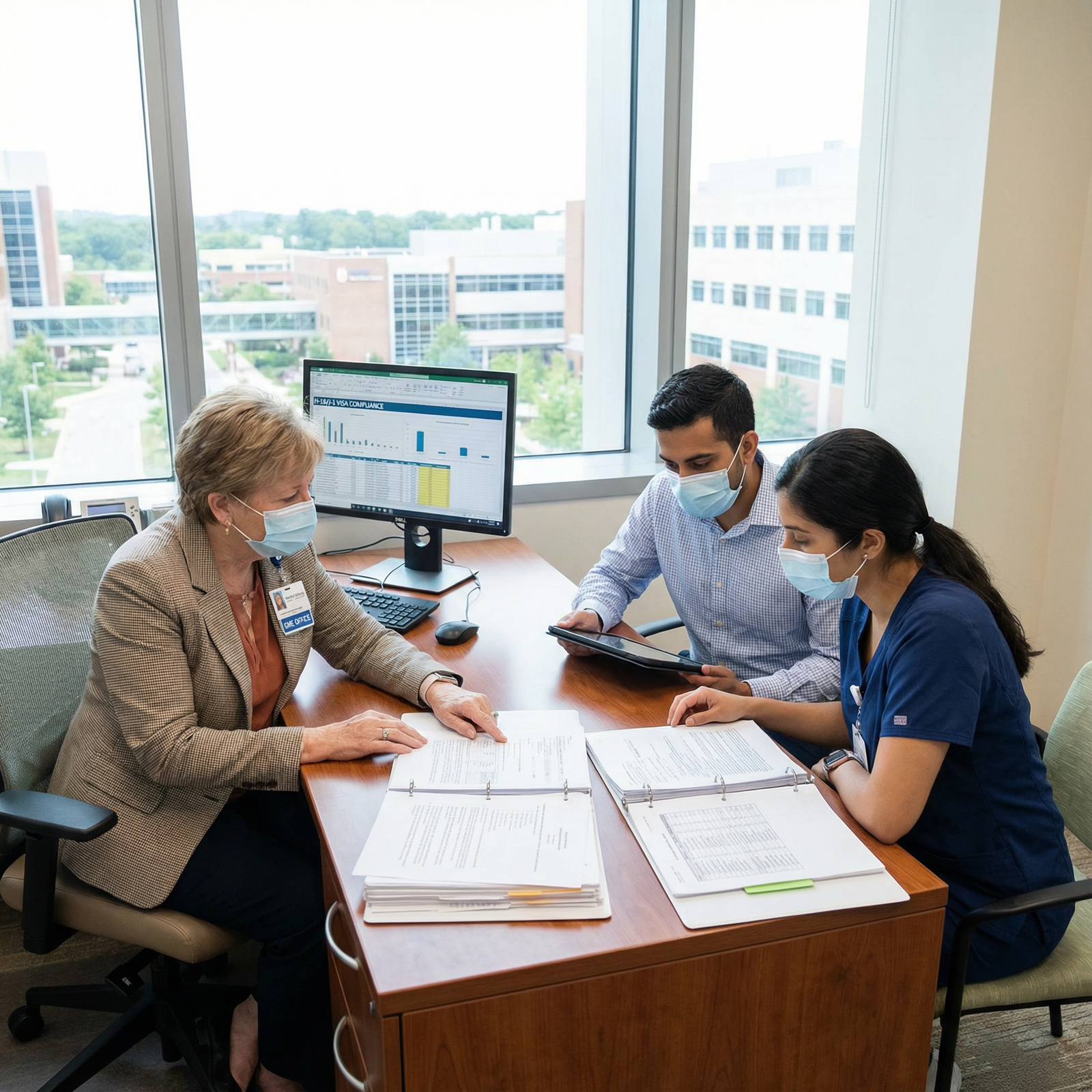
Compliance Obligations for H-1B Visa Holders in Residency and Fellowship
Staying in status on an H-1B Visa requires ongoing coordination between you, your employer, and sometimes legal counsel. Compliance is not a one-time event at approval; it continues throughout your training and employment.
Application Process and Core Documentation
While the employer leads the petition process, IMGs should understand what is being filed on their behalf:
Labor Condition Application (LCA)
Before filing Form I-129, the employer must:- File an LCA with the Department of Labor (DOL).
- Attest to paying at least the prevailing wage for the position.
- Confirm that employment will not adversely affect U.S. workers.
Form I-129 Petition to USCIS
The employer files an H-1B petition that includes:- Your medical degree and transcripts (and verified foreign equivalency if applicable).
- ECFMG certification and USMLE scores.
- A detailed employment contract or offer letter spelling out:
- Job title (e.g., PGY-1 Internal Medicine Resident)
- Salary and benefits
- Worksite locations
- Number of hours per week
- Evidence of the institution’s ability to pay the offered wage.
- The certified LCA.
Your Role in the Process
IMGs should:- Provide accurate, complete personal and academic documentation.
- Disclose any prior visa denials, immigration violations, or status changes.
- Review the employment terms with the GME office or legal team before signing.
Maintaining H-1B Status During Training
Once your H-1B Visa is approved, maintaining status is largely about consistency and communication.
Key compliance expectations include:
Work Only for the Petitioning Employer and Approved Worksites
- You are authorized only to work for the institution listed in the petition (and any properly added concurrent sponsors).
- Moonlighting at an external private clinic or unaffiliated hospital is not permitted unless:
- A separate H-1B petition (or concurrent H-1B) is filed and approved for that employment.
- Internal moonlighting within the same institution may be possible if:
- It is clearly allowed by the program.
- It fits within visa and licensing regulations.
- It is included or consistent with the H-1B petition details.
Adhere to the Job Duties and Hours in the Petition
- Major changes in duties (e.g., moving from training to attending role) or significant hours changes may require an amended petition.
- Rotations at new sites not listed in the petition may trigger a need to update the LCA and file an amendment.
Maintain Full-Time Status
- Most residency/fellowship H-1B positions are full-time.
- Extended unpaid leave (e.g., medical, family) beyond typical program policy can impact status. Always:
- Discuss planned leaves with your program director and GME office.
- Confirm immigration implications before taking prolonged leave.
Address Changes and Personal Updates
- You must report address changes to USCIS (typically via Form AR-11) within the required timeframe.
- Keep HR/GME offices updated on any change in name (e.g., after marriage), contact information, or immigration document renewals.
When Amendments or New Filings Are Required
Certain changes require your employer to re-file or amend your H-1B:
- Transfer to a different hospital or employer (e.g., moving from residency to a fellowship at another institution).
- Significant change in job duties or position level (e.g., from resident to attending).
- New primary work location in a different geographic area from what was originally filed.
- Material changes in salary that may affect wage compliance.
Never assume a change is minor. Whenever your job, location, or role shifts, confirm with:
- The institution’s international office or GME office
- The hospital’s or university’s immigration attorney
Compliance Obligations for J-1 Visa Holders Sponsored for Medical Training
For IMGs on a J-1 Visa, ECFMG is not just a certifying body; it is also your J-1 program sponsor and the primary authority overseeing your visa compliance during training.
Application, Sponsorship, and the DS-2019 Form
J-1 program participation involves multiple stakeholders:
Program Sponsorship by ECFMG
Before a U.S. consulate issues your J-1 Visa:- ECFMG must agree to sponsor you as a J-1 physician.
- You must meet eligibility requirements, including:
- Valid ECFMG certification (for clinical training).
- Appropriate USMLE scores.
- A contract or offer letter from an ACGME-accredited program.
The DS-2019 Certificate of Eligibility
- Once sponsorship is approved, ECFMG issues Form DS-2019, specifying:
- Program category (e.g., “Alien Physician”)
- Start and end dates for the training year
- Program site(s) and sponsor information
- You use DS-2019 to apply for the J-1 Visa at a U.S. embassy or consulate.
- You must keep DS-2019 valid and updated during your entire training.
- Once sponsorship is approved, ECFMG issues Form DS-2019, specifying:
SEVIS and Reporting Requirements
Your information is recorded in the Student and Exchange Visitor Information System (SEVIS).- ECFMG and your program must report changes (e.g., early completion, withdrawal, termination).
- You may need to confirm physical presence and participation each year.
Staying Compliant as a J-1 Visa Physician
J-1 compliance is highly structured and time-bound. Key expectations include:
Full-Time Participation in the Approved Training Program
- You must remain in good standing with your residency or fellowship.
- Repeated remediation, probation, or risk of dismissal may affect your visa.
On-Time Renewal of DS-2019 Each Academic Year
- Programs typically coordinate renewal paperwork with ECFMG.
- Missing renewal deadlines can lead to status lapse; be proactive about deadlines.
Restrictions on Moonlighting and Additional Work
- J-1 physician regulations are stricter than H-1B for outside employment.
- Clinical activities are usually limited to:
- Those required for your approved training program.
- Sites listed on your DS-2019 and training documents.
- Unauthorized moonlighting (especially for pay) is a serious violation and can quickly lead to loss of status.
Travel and Re-entry
- For international travel, ensure:
- Valid passport
- Valid J-1 Visa
- Current DS-2019 with a valid travel signature (from ECFMG)
- Check with ECFMG and your international office before traveling, especially if your visa stamp is expired or near expiration.
- For international travel, ensure:
Navigating the Two-Year Home Residency Requirement
The two-year home residency requirement is one of the most consequential aspects of the J-1 Visa for IMGs.
When the Requirement Applies
You are typically subject to the requirement if:
- Your J-1 program is funded by your home government or the U.S. government, or
- Your field of training appears on your home country’s Exchange Visitor Skills List, or
- You participate in clinical medical training as a J-1 physician sponsored by ECFMG.
Most J-1 clinical physician trainees are subject to this rule.
Options for Waiving the Requirement
While the requirement is strict, waivers are sometimes possible in specific cases:
Conrad 30 Program (State Health Department Waiver)
- For physicians who agree to work in a federally designated underserved area in the U.S. on an H-1B Visa after training.
- Each U.S. state can sponsor up to 30 physicians per fiscal year.
- Typically requires:
- A job offer from an eligible employer in a shortage area.
- A commitment to work full-time for 3 years.
- This is one of the most common waiver routes for IMGs entering community practice.
Interested Government Agency (IGA) Waiver
- A U.S. federal agency (e.g., VA, HHS) requests a waiver if your continued work is in the public interest.
- Often linked to research or service in critical need areas.
Persecution Waiver
- For physicians who would face persecution in their home country due to race, religion, political opinion, etc.
Hardship Waiver
- If your departure would cause exceptional hardship to a U.S. citizen or permanent resident spouse or child.
Each pathway has complex documentation and strict timelines. You should talk to an experienced immigration attorney well before the end of your training if you plan to stay in the U.S.
Common Compliance Pitfalls and How to Avoid Them
Even diligent IMGs can unintentionally violate H-1B or J-1 regulations. Understanding high-risk areas can help you proactively protect your status and career.
Miscommunication or Lack of Communication
Not informing your GME or HR office about:
- Changes in personal information (address, legal name).
- Planned leaves of absence (medical, family, research).
- Opportunities for outside clinical work or moonlighting.
Solution:
- Treat your GME office and visa sponsor as key partners.
- When in doubt, ask before you act.
- Keep copies of:
- Contracts
- DS-2019 forms
- H-1B approval notices (I-797)
- All correspondence about your status
Unauthorized Employment
This is one of the most serious and common issues:
Examples of unauthorized work:
- Moonlighting without clear written approval and proper visa coverage.
- Working at a clinic that is not included in your H-1B LCA or your J-1 training documents.
- Doing telemedicine from the U.S. for foreign entities without checking visa rules.
Potential consequences:
- Immediate loss of status.
- Future visa denials.
- Difficulty adjusting status to permanent residency.
Prevention:
- Never accept paid clinical work without confirming that:
- Your current visa category allows it.
- The worksite and role are properly documented and approved.
- For J-1s, assume most outside employment is not allowed unless explicitly authorized.
- Never accept paid clinical work without confirming that:
Unreported Changes in Training or Employment
Changes that may require immediate visa action include:
- Transferring to another residency or fellowship program.
- Shortening or extending training beyond the originally planned completion date.
- Switching specialties (e.g., leaving Internal Medicine for Anesthesiology).
- Being placed on extended leave or dismissed from the program.
If you ignore these changes or fail to report them:
- Your SEVIS record (J-1) or H-1B petition may become inaccurate.
- You could unknowingly be considered “out of status.”

Key Resources and Support Systems for IMGs Managing Visa Compliance
You do not have to navigate H-1B and J-1 Visa compliance alone. Multiple organizations and professionals can help you stay on track.
Professional and Regulatory Organizations
Educational Commission for Foreign Medical Graduates (ECFMG)
- Oversees J-1 sponsorship for IMGs in clinical training.
- Provides detailed online guidance, FAQs, and policy updates.
- Manages the DS-2019 and SEVIS records for J-1 physicians.
Association of American Medical Colleges (AAMC)
- Offers resources about the residency application process, including for International Medical Graduates.
- Provides data, webinars, and guidance on matching and program selection.
Specialty Societies and State Medical Boards
- Sometimes publish guidance on licensing and visa intersections.
- Helpful for understanding post-residency options on H-1B or following a J-1 waiver.
Institutional Support: GME and International Offices
Most teaching hospitals and universities have:
Graduate Medical Education (GME) Offices
- Oversee residency and fellowship programs.
- Coordinate with immigration attorneys and HR about trainee visas.
- Help with:
- Timely filing of extensions
- Documentation for DS-2019 renewals
- Letters for waiver programs (e.g., Conrad 30)
International Services or Immigration Offices
- Provide immigration-specific guidance.
- Track compliance deadlines and help you understand travel and renewal requirements.
Legal Assistance: Immigration Attorneys
Given the complexity and high stakes, many IMGs benefit from consulting a qualified immigration attorney, especially when:
- Transitioning from J-1 to H-1B with a waiver.
- Applying for a Conrad 30 or other J-1 waiver program.
- Moving from H-1B to permanent residency.
- Dealing with unusual situations (prior visa denials, status violations, complex travel history).
An attorney can:
- Evaluate your long-term strategy (training → waiver → employment → Green Card).
- Help you avoid technical errors in timing and documentation.
- Advocate for you if complications arise.
Conclusion: Building a Stable U.S. Healthcare Career Through Visa Compliance
For International Medical Graduates, visas are not just paperwork—they are the backbone of your ability to train, practice, and advance your U.S. healthcare career.
Understanding the H-1B Visa and J-1 Visa systems, and carefully complying with their rules, allows you to:
- Match into residency and complete training without interruption.
- Pursue fellowships or subspecialty education.
- Position yourself for long-term options, including waiver programs and permanent residency.
Key takeaways:
- Learn the core features and limitations of your visa category early in your journey.
- Communicate regularly with sponsors, GME offices, and HR teams.
- Avoid unauthorized employment and unreported changes at all costs.
- Use institutional resources and immigration counsel for planning complex transitions like J-1 waivers or H-1B extensions.
Being proactive, informed, and meticulous about visa compliance is one of the most effective ways to protect your investment in training and secure a sustainable future in U.S. medicine.
FAQs About H-1B and J-1 Visa Compliance for IMGs
1. Which visa is “better” for IMGs: H-1B or J-1?
There is no universal “better” option—it depends on your goals and situation:
H-1B Visa is often preferable if:
- You plan to pursue permanent residency in the U.S.
- Your program is willing and able to sponsor H-1B.
- You want more flexibility around long-term employment and dual intent.
J-1 Visa may be more common when:
- Programs primarily use J-1 sponsorship through ECFMG.
- H-1B sponsorship is not available or feasible.
- You are open to returning home or using a waiver program after training.
Always discuss visa options with each program before ranking them for the Match.
2. Can an IMG switch from a J-1 Visa to an H-1B Visa?
Yes, but with important conditions:
If you are subject to the two-year home residency requirement, you must either:
- Complete the two years abroad, or
- Obtain a formal waiver (e.g., Conrad 30, hardship, persecution).
Only after the requirement is satisfied or waived can you typically:
- Change to H-1B status inside the U.S., or
- Apply for an H-1B Visa at a U.S. consulate abroad.
Because the timing and documentation are complex, work closely with:
- Your future employer
- An immigration attorney
- ECFMG (for J-1-related procedures)
3. What happens if an IMG violates visa terms (e.g., unauthorized work or status lapse)?
Consequences can be severe and long-lasting:
- You may be considered out of status, which can lead to:
- Termination of your current visa classification.
- Denial of future visas or change of status applications.
- In some cases, accrual of unlawful presence and bars on re-entry.
If you suspect a potential violation:
- Immediately contact:
- Your GME/international office
- An experienced immigration attorney
- Do not try to “fix it quietly” on your own—early, transparent action is usually better than delay.
4. How long can an IMG stay in the U.S. on an H-1B Visa, and can they extend beyond six years?
Typically:
- H-1B status is granted for an initial 3 years, renewable up to a usual 6-year maximum.
- Physicians pursuing permanent residency may obtain extensions beyond six years in some situations, for example:
- If an employment-based immigrant petition (I-140) or labor certification has been pending for a certain period.
- If an immigrant petition is approved but no visa number is yet available.
These scenarios are nuanced; you should seek specialized legal advice once you near the end of your initial H-1B period.
5. Are there realistic exemptions or waivers for the J-1 two-year home residency requirement?
Yes, but they are specific and competitive:
Conrad 30 Waiver:
- Requires working full-time in an underserved area on H-1B status for 3 years.
- Limited to 30 waivers per state per year.
Interested Government Agency (IGA) Waivers:
- Based on a U.S. federal agency’s determination that your continued presence is in the national interest.
Hardship and Persecution Waivers:
- Based on documented extreme hardship to qualifying U.S. family or fear of persecution.
Each category requires:
- Detailed evidence
- Strong legal preparation
- Early planning (often 12–24 months before completing training)
By proactively learning the rules and using available support, you can turn a complex visa landscape into a manageable pathway toward a stable and successful medical career in the United States.


