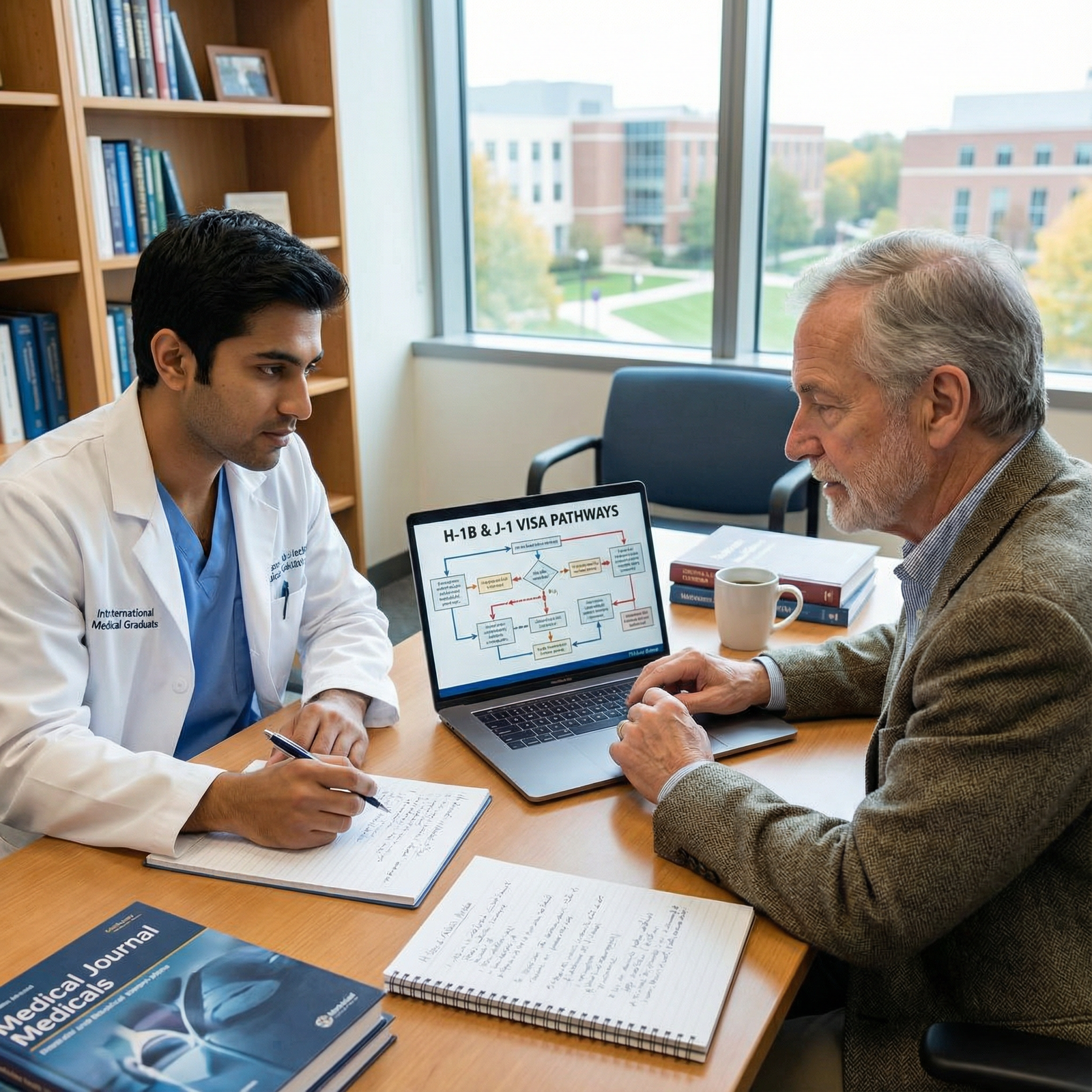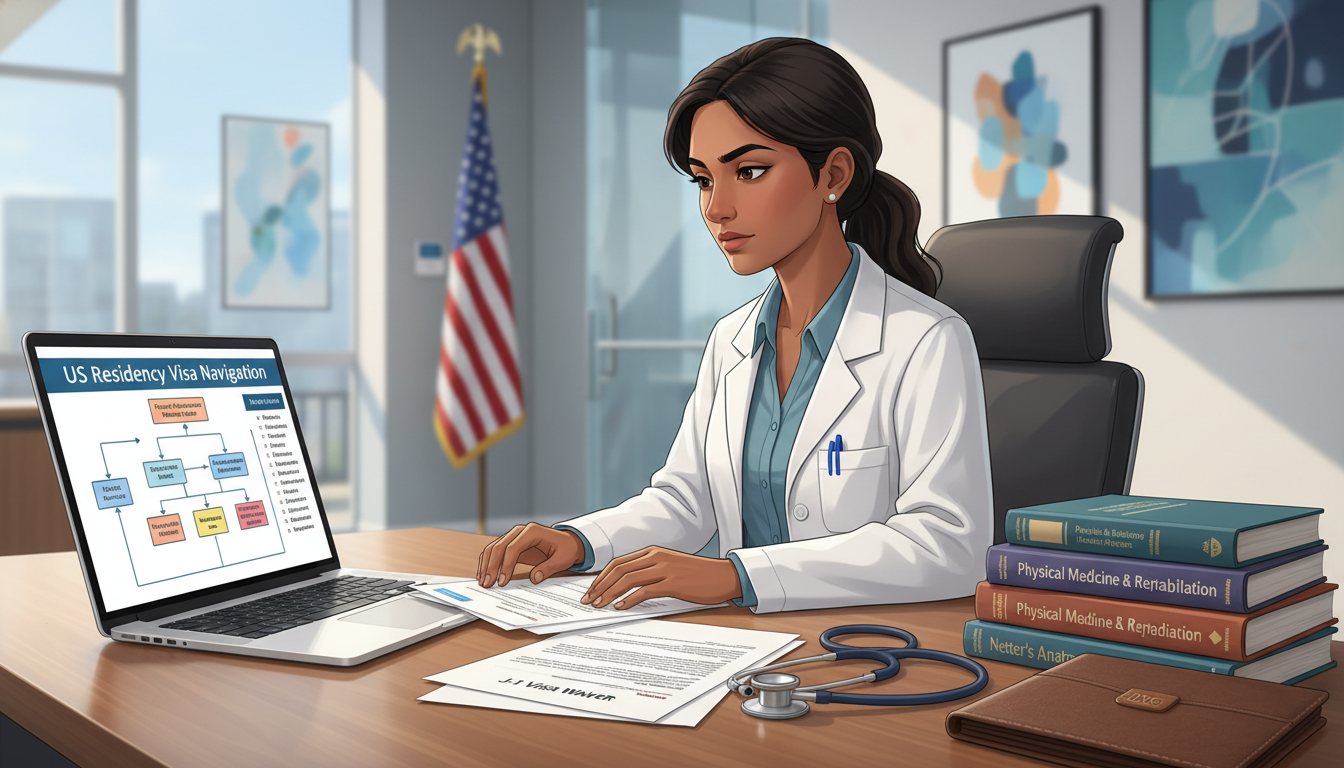
International medical graduates (IMGs) in pediatrics face a unique mix of opportunity and uncertainty when it comes to staying in the United States after residency. You’ve invested years into pediatrics residency training, navigated the peds match, and now you’re trying to understand how a J-1 waiver, Conrad 30 position, or other underserved area waiver can fit into your long-term career plans.
This guide breaks down the major J-1 waiver pathways that pediatric residents and fellows most commonly use, how they work in practice, and concrete strategies to position yourself for success—starting as early as intern year.
Understanding the J‑1 Visa and Why a Waiver Matters
The Two-Year Home Residency Requirement
Most IMGs in ACGME-accredited pediatrics residency programs train on an Educational Commission for Foreign Medical Graduates (ECFMG)-sponsored J-1 visa. This status comes with a key condition: the two-year home residency requirement (also known as the 212(e) requirement).
Unless you obtain a waiver or change status via another qualifying path, you must:
- Return to your home country (or last country of residence) for a cumulative two years, and
- Satisfy this requirement before you can obtain an H-1B, L-1, or immigrant visa, or adjust status to permanent residency.
For most pediatricians who want to pursue fellowship, academic positions, or long-term practice in the U.S., a J-1 waiver is the main pathway to bridge from training to an employment-based status.
Basic Structure of a J‑1 Waiver Job
Most clinically based J-1 waivers for pediatricians share some core elements:
- Full-time clinical employment (usually at least 40 hours/week)
- Three-year service commitment in a designated area or approved facility
- Employer support for your J-1 waiver application
- Transition from J-1 to H-1B status once the waiver is approved
During and after that three-year period, you may also start or continue a green card process (such as an EB-2 NIW or employer-sponsored PERM), but the timing and strategy require careful planning.
Overview of Major J‑1 Waiver Options for Pediatricians
Several J-1 waiver categories are especially relevant to pediatrics. The right choice depends on your goals (academic vs. community practice, urban vs. rural, general vs. subspecialty), timing, and personal situation.
1. Conrad 30 Waiver (State Program)
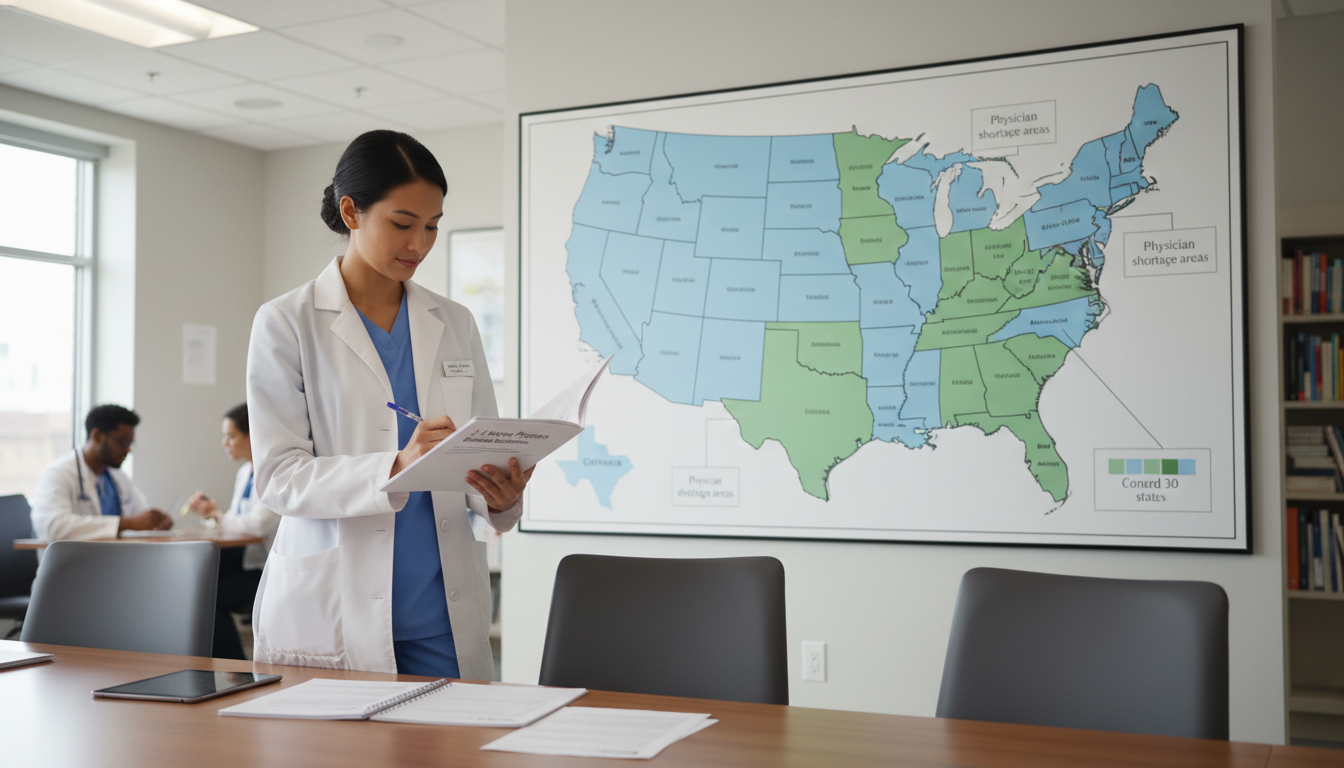
The most widely used route for pediatricians is the Conrad 30 J-1 waiver program. Each state and some U.S. territories can sponsor up to 30 J-1 physicians per fiscal year to work in shortage areas, often in primary care and certain specialties.
Key features:
- Administered by individual states, each with its own guidelines and priorities
- Requires a 3-year full-time commitment in the sponsoring state
- Typically requires work in a Health Professional Shortage Area (HPSA), Medically Underserved Area (MUA), or facility serving an underserved population
- Often used for general pediatrics and some pediatric subspecialties in underserved communities
2. Federal Underserved Area Waivers Beyond Conrad 30
In addition to Conrad 30, several federal agencies can sponsor J-1 waivers. These are especially relevant if you are interested in research, public health, or specific institutional settings.
Key examples:
- U.S. Department of Health and Human Services (HHS) – Primarily for clinical research and certain direct clinical care positions addressing public health needs
- Veterans Affairs (VA) – Positions in VA hospitals (limited relevance to pediatrics but worth awareness if you have dual training or family medicine/peds angles)
- Appalachian Regional Commission (ARC) and Delta Regional Authority (DRA) – Regional options for certain underserved states, historically more adult-primary-care focused but occasionally open to pediatrics
These programs typically:
- Have narrower eligibility criteria than Conrad 30
- May favor academic or research-intensive roles (e.g., HHS research waivers)
- Can be useful if you miss a Conrad 30 cycle or need a non-state based solution
3. Interested Government Agency (IGA) Waivers
Some federal agencies can act as “Interested Government Agencies” for J-1 waivers. For pediatricians, the most realistic options include:
- HHS clinical research waivers – For positions where you dedicate a substantial proportion of time to biomedical or public health research, often at major academic centers
- Other IGAs – Occasionally provide waivers for highly specialized roles that address critical public health needs (e.g., pediatric infectious diseases research)
These positions are highly competitive and generally favor physicians with strong research track records, publications, and clear alignment with the agency’s mission.
Conrad 30 in Pediatrics: How It Really Works
For most IMGs in pediatrics residency, Conrad 30 is the backbone strategy for staying in the U.S. after training. Understanding its nuances early in residency can dramatically improve your options.
State Variability: 50 Programs, 50 Rulebooks
Conrad 30 is not one uniform program; it’s 50+ mini-programs, each with its own:
- Application deadlines and cycles
- Priority specialties (e.g., some states explicitly favor primary care pediatrics)
- Requirements regarding:
- HPSA/MUA scores
- Hospital vs. clinic-based work
- Moonlighting or outside employment
- Employer eligibility (FQHCs, rural health clinics, private groups, hospitals)
Some states fill all 30 slots annually (California, New York, Texas often do), while others routinely underutilize their allotment, which can be advantageous for pediatricians willing to be geographically flexible.
Action step:
During PGY-2, shortlist 5–10 states based on your preferences (geography, family, lifestyle) and review each state’s Conrad 30 guidelines. Many states update policies yearly—bookmark and re-check them regularly.
Primary Care vs. Subspecialty Pediatrics
Historically, many states have treated pediatrics as primary care, but not all. Some trends:
- General pediatrics: Typically viewed as primary care and highly eligible
- Pediatric subspecialties (cardiology, endocrinology, GI, etc.):
- Some states explicitly accept them if they serve Medicaid/uninsured and underserved communities
- Others categorize all subspecialties as lower priority or only accept them for “flex” slots (see below)
If you are planning a pediatric fellowship, build your strategy around:
- States that clearly state they sponsor pediatric subspecialists
- Employer settings (children’s hospitals, tertiary centers) that have a history of successful J-1 waiver hires
Flex Slots: Working Outside a HPSA but Serving Underserved
Many states use “flex” positions, which allow Conrad 30 waivers at facilities outside designated shortage areas as long as:
- The facility can demonstrate that at least 30–40% of patients come from underserved areas (threshold varies by state), and
- They meet the state’s additional criteria
Flex slots are crucial for pediatricians who want to work at:
- Children’s hospitals in major cities
- Large academic centers that draw patients from rural or underserved regions
These slots are often more competitive and may have:
- Earlier application deadlines
- Additional documentation requirements (patient origin data, payer mix, public need statements)
Example: A Typical Conrad 30 Pathway in Pediatrics
Dr. A, an IMG in a U.S. pediatrics residency, wants to stay in the U.S. after training:
PGY-2 year:
- Identifies interest in general outpatient pediatrics, open to Midwest or Southeast
- Researches Conrad 30 programs in 7 states that typically do not fill all 30 slots
- Connects with IMGs 2–3 years ahead who secured waivers in those states
Early PGY-3:
- Applies to pediatric clinics and community hospitals in HPSA/MUA areas of those states
- Receives an offer from a community health center in a rural county serving a high Medicaid population
- Negotiates contract language that includes: J-1 waiver support, H-1B sponsorship, and potential green card sponsorship
Fall of PGY-3:
- Employer prepares and submits Conrad 30 application to the state
- Once state recommends the waiver, the case moves to the U.S. Department of State and then USCIS for final approval
- H-1B petition is filed, allowing a smooth transition when residency ends
Post-residency:
- Dr. A works for three years in the underserved community on H-1B status
- During year 2, the employer files an EB-2 PERM-based green card process
This is a classic, reliable pathway for general pediatricians.
Beyond Conrad 30: HHS and Other Federal Waiver Options
Conrad 30 is powerful, but it’s not your only option—especially if you are aiming for a research-focused career in academic pediatrics.
HHS Clinical Care Waivers (Evolving but Limited)
The U.S. Department of Health and Human Services has periodically offered waivers for clinical care in underserved settings, but its policies have changed over time. For pediatrics, these waivers:
- Historically focused more on primary care, including pediatrics, in HPSA or MUA settings
- Often required safety-net facilities, FQHCs, or similar mission-driven organizations
- Have been less predictable than Conrad 30 due to shifting program priorities
If your employer has prior experience with HHS waivers, this path may be an alternative or complement, particularly if your preferred state’s Conrad 30 slots are routinely oversubscribed.
HHS Research Waivers: Academic Pediatrics Focus
For pediatricians with a strong academic and research track record, HHS research waivers can be powerful:
Key features:
- Typically require a position at a public or nonprofit U.S. institution involved in biomedical or public health research
- You usually must dedicate a significant proportion of time (e.g., 50%) to research
- The institution must show your work is in the U.S. public interest and difficult to fill otherwise
This pathway is often used by:
- Pediatric subspecialists with NIH-funded or similar grants
- Physician-scientists with substantial publication records and clear alignment with public health priorities (e.g., pediatric oncology, infectious disease, neonatology)
Other Federal IGAs and Regional Programs
Programs like ARC and DRA occasionally open doors for J-1 waivers in designated rural, economically distressed regions. While more common for adult primary care, some pediatric positions in these regions may be waiver-eligible.
These programs typically require:
- Employment in a specific region covered by the commission/authority
- Strong documentation of regional physician shortages
- Employer familiarity with the program’s rules

Timing, Strategy, and Contracting: Practical Steps During Residency
When to Start Planning
Your J-1 waiver strategy should start early, even if it evolves:
PGY-1:
- Learn the basics about J-1, Conrad 30, and H-1B
- Talk to senior residents and recent grads about their experiences
Early PGY-2:
- Begin identifying preferred geographic regions
- Explore Conrad 30 guidelines in those states
- Clarify whether you’re leaning toward general pediatrics or fellowship
Late PGY-2 to early PGY-3:
- Start active job applications and networking
- Engage an experienced immigration attorney (often paid by your future employer, but you should budget initial consultation fees)
If you’re pursuing a pediatric fellowship, shift this timeline so you begin serious planning during your first fellowship year.
Choosing Between General Pediatrics and Fellowship
Pursuing a pediatric subspecialty adds complexity:
- J-1 fellowship will extend your J-1 stay, but the 2-year home requirement remains
- You will still eventually need a waiver position
- Some subspecialists find fewer underserved positions aligned with their expertise, especially in highly urban or tertiary-only fields
Practical tips:
If you are strongly committed to fellowship, seek specialties with:
- Clear clinical demand in underserved regions (e.g., pediatric cardiology, pulmonology, endocrinology in regional children’s hospitals)
- A history of hiring J-1 waiver physicians
If your primary goal is to remain in the U.S. and you’re flexible on scope, general pediatrics is typically more straightforward for waiver jobs, especially in community or rural settings.
Evaluating and Negotiating Job Offers
When you receive offers, evaluate them not just as jobs but as immigration pathways. Key questions:
- Does the employer have prior experience sponsoring J-1 waivers and H-1Bs for pediatricians or other IMGs?
- Will the employer:
- Support a Conrad 30 (or other) waiver application?
- Cover legal fees and government filing fees?
- Sponsor H-1B promptly and file on time?
- Potentially support a green card after you start?
Essential contract items for a J-1 waiver position:
- Clear statement that the employer will:
- Sponsor your J-1 waiver under a named program (e.g., State X Conrad 30)
- File and support your H-1B petition
- Location(s) where you’ll practice (must match waiver application)
- Schedule (must satisfy full-time definition – usually 40 hours/week)
- Non-compete clauses: Try to minimize or remove them; they can limit options after your three-year term
- Remedies if the waiver is not approved (e.g., contract automatically terminates without penalty)
Always have an experienced attorney review your contract—employment law and immigration need to be aligned.
Long-Term Planning: After the Three-Year Waiver Commitment
Transitioning to Stability: Green Cards and Beyond
Most pediatricians on J-1 waivers eventually want permanent residence. Common strategies:
Employer-Sponsored Green Card (EB-2 or EB-3 via PERM):
- Employer conducts labor certification process
- Once approved, they file immigrant petition (I-140)
- You complete your three-year waiver obligation while your green card process is pending (timelines vary by country of birth)
EB-2 National Interest Waiver (NIW):
- For pediatricians offering significant benefit to the U.S., especially in underserved or public health-critical areas
- Can be self-petitioned, but your work record (clinical, research, leadership) must support the case
- Often paired with academic or research-heavy pediatric careers
Coordinate timing carefully so that:
- H-1B validity covers your full waiver service and
- You avoid gaps in status while your green card application is pending
Career Mobility After the Waiver
After your three-year J-1 waiver obligation:
- You can generally change employers within the U.S., assuming:
- You maintain valid immigration status (e.g., new H-1B, pending green card with work authorization)
- You have completed your contractual obligations (beware of repayment clauses for bonuses or relocation expenses)
Think ahead:
If you want to eventually move to academia or a large children’s hospital in a major city, consider:
- Building a strong clinical reputation and referral network during your waiver years
- Maintaining research collaborations, telemedicine teaching, or quality improvement projects that keep you connected to academic pediatrics
If you love community and rural pediatrics, your waiver job may naturally evolve into a long-term leadership role—medical director, clinic chief, or program builder.
FAQs: J‑1 Waivers in Pediatrics
1. Is it harder for pediatricians to get a J‑1 waiver than for adult primary care doctors?
Not necessarily. In many states, pediatrics is considered primary care, and there is high demand for pediatricians in underserved communities. However:
- In some states, adult internal medicine and family medicine are prioritized
- Pediatric subspecialists may face more limited options compared to general pediatrics
Research state preferences early and target states that explicitly value pediatric access.
2. Can I do a pediatric fellowship on J‑1 and still get a Conrad 30 waiver later?
Yes. Many pediatric subspecialists complete fellowship on J‑1 and then secure a Conrad 30 or other underserved area waiver. The key challenges are:
- Finding a job that both:
- Fits your subspecialty skill set, and
- Meets waiver program requirements (HPSA/MUA, underserved population, etc.)
- Aligning your timeline so you search for jobs during your fellowship, typically starting in the first year
Work closely with mentors and an immigration attorney to map a realistic strategy for your specific subspecialty.
3. Can I switch jobs during my three-year J‑1 waiver commitment?
Switching jobs is possible but risky and complex:
- You must:
- Obtain a new H-1B approval for the new employer
- Ensure the new job also meets J‑1 waiver requirements
- Sometimes obtain state/federal program consent for the change
Frequent job changes are strongly discouraged; plan to stay for the full three years unless there are exceptional circumstances (e.g., clinic closure, unsafe environment).
4. Do I need a lawyer, or can my program or employer handle the waiver on their own?
Residency programs and employers may have experience, but immigration law is specialized and constantly changing. You should:
- Have an independent immigration attorney involved in your planning, especially for:
- Choice of waiver program (Conrad 30 vs. HHS vs. IGA)
- Reviewing job contracts
- Coordinating waiver, H‑1B, and green card timelines
Many employers will cover these legal fees; if not, view it as an investment in your long-term career and stability.
Navigating J‑1 waiver options as a pediatrics resident or fellow can feel overwhelming, but with early planning, strategic state selection, and sound legal guidance, you can convert your training into a sustainable career in the U.S. pediatrics workforce—often while making a profound impact in underserved communities that need pediatric care the most.