
Understanding the Visa Landscape as a Non‑US Citizen IMG
If you are a non-US citizen IMG aiming for an Emergency Medicine–Internal Medicine (EM IM combined) residency in the United States, you are navigating two complex systems at once: US immigration and graduate medical education. Success depends on understanding which visas are realistic, how programs think about sponsorship, and what you can do now to keep as many doors open as possible.
Because EM-IM combined programs are few and highly selective, a foreign national medical graduate must be particularly strategic about visa planning. Many programs prefer J-1 sponsorship; a smaller subset offers H-1B. Knowing the trade-offs between J-1 vs H-1B, and how they intersect with your long-term goals, is essential.
This guide focuses specifically on residency visa navigation for non-US citizen IMGs applying to Emergency Medicine–Internal Medicine combined programs, but much of the information also applies to categorical EM or IM.
Core Visa Options for EM–IM Residency
1. Overview of Common Residency Visas
For clinical residency training, the realistic visa options for a non-US citizen IMG are:
- J-1 Exchange Visitor (ECFMG-sponsored physician category)
- H-1B Temporary Worker (specialty occupation)
- Less commonly relevant or unsuitable:
- F-1 (student) with Optional Practical Training: rarely used for residency
- O-1 (extraordinary ability): occasionally used post-residency or for specific academic roles
- TN (for Canadians/Mexicans): rarely aligns with standard GME structures
Most IMG visa options for residency boil down to J-1 vs H-1B, with J-1 being far more common.
2. J-1 Exchange Visitor Visa for Residency
The J-1 physician visa, sponsored by ECFMG, is the predominant pathway for foreign national medical graduates in residency and fellowship.
Key characteristics:
- Sponsor: ECFMG, not the hospital/program directly
- Duration: Typically up to 7 years total of clinical training
- Employment: You are not directly “employed” under ECFMG; the program is the host institution. ECFMG controls your DS-2019 and maintains your status.
- USMLE Requirements: Must have passed USMLE Step 1 & Step 2 CK and hold ECFMG certification by the time of J-1 sponsorship.
- Remuneration: You receive a resident salary from the hospital; ECFMG does not pay you.
Pros of the J-1 for EM IM combined applicants:
- Widely accepted: A large majority of EM and IM programs (including many combined EM IM programs) are open to J-1 sponsorship.
- Predictable process: ECFMG has a standardized system; GME offices are familiar with it.
- Sufficient length for EM–IM: EM–IM combined residency is typically 5 years, which fits under the 7-year cap (leaving room for some future fellowship training).
- Quicker onboarding: Often easier for institutions administratively compared to H-1B, especially for July 1 start dates.
Cons / limitations:
- Two-year home-country physical presence requirement (212(e)):
- After completing training, you must either:
- Return to your home country or country of last residence for 2 years, or
- Obtain a J-1 waiver (e.g., Conrad 30, federal waiver) before you can change to most other US non-immigrant statuses or apply for permanent residency.
- After completing training, you must either:
- Limited flexibility for moonlighting: Many J-1 holders are restricted in moonlighting and working outside the sponsoring site.
- Immigrant intent: J-1 is nominally for exchange and education, not permanent immigration, which can complicate consular interviews if long-term US stay is clearly your goal.
Relevance to EM–IM combined programs:
- EM–IM programs are time-intense and dual-accredited. They are often conservative about administrative complexity; J-1 is administratively easier.
- Many combined programs specifically state “J-1 only” or “J-1 preferred.” So being open to J-1 significantly broadens your options as a non-US citizen IMG.
3. H-1B Visa for Residency
The H-1B is a temporary work visa for “specialty occupations.” In GME, it allows you to work as a resident physician as a professional employee of the hospital.
Key features:
- Employer sponsor: The teaching hospital or health system, not ECFMG.
- Dual intent: You can pursue permanent residency (green card) while on H-1B without the same constraints as J-1.
- Duration: Up to 6 years total, often in 3-year increments.
Minimum requirements for residency H-1B:
- USMLE Step 3 must be passed before H-1B filing in most states/programs.
- Valid ECFMG certification.
- State-specific licensing or training permit requirements vary; some states require Step 3 as well.
Pros for an EM–IM bound non-US citizen IMG:
- No J-1 two-year home requirement: You avoid the 212(e) issue, which can be particularly important if you want:
- Competitive fellowships after EM–IM (critical care, cardiology, etc.)
- Academic positions in urban centers rather than underserved areas
- A straightforward path to a green card
- Dual intent: Enables smoother progression to permanent residency, including employer-sponsored green card during or after training.
- Flexibility post-residency: You can move into hospitalist work, EM attending positions, academic jobs, or fellowships without needing a J-1 waiver.
Cons / limitations:
- Fewer programs offer H-1B: Many EM and IM departments avoid H-1B due to higher legal cost and administrative complexity.
- Timing pressure with Step 3: As a non-US citizen IMG, you must pass Step 3 early, often by the time of ranking or at least by spring before July 1 start, to allow for H-1B processing.
- Cap and timing issues:
- Some teaching hospitals are cap-exempt (affiliated with universities or research institutions), which simplifies H-1B.
- Others are cap-subject, potentially limiting availability and requiring coordination with the federal fiscal year (October 1 start date).
- Shorter total time than J-1 for long training pathways: EM–IM is 5 years, leaving only 1 year for fellowship if you stay within the 6-year H-1B limit—though cap-exempt and extensions may mitigate this.
Specific challenge for combined EM–IM residency:
Because EM IM combined training is 5 years, plus potential fellowship afterward, an H-1B strategy requires more nuanced long-term planning. You must consider how you will:
- Stay within the 6-year H-1B limit, or
- Secure cap-exempt H-1B status that may allow for additional time, or
- Transition to a green card relatively early in your attending career.
Selecting Between J-1 vs H-1B for EM–IM: Strategic Considerations
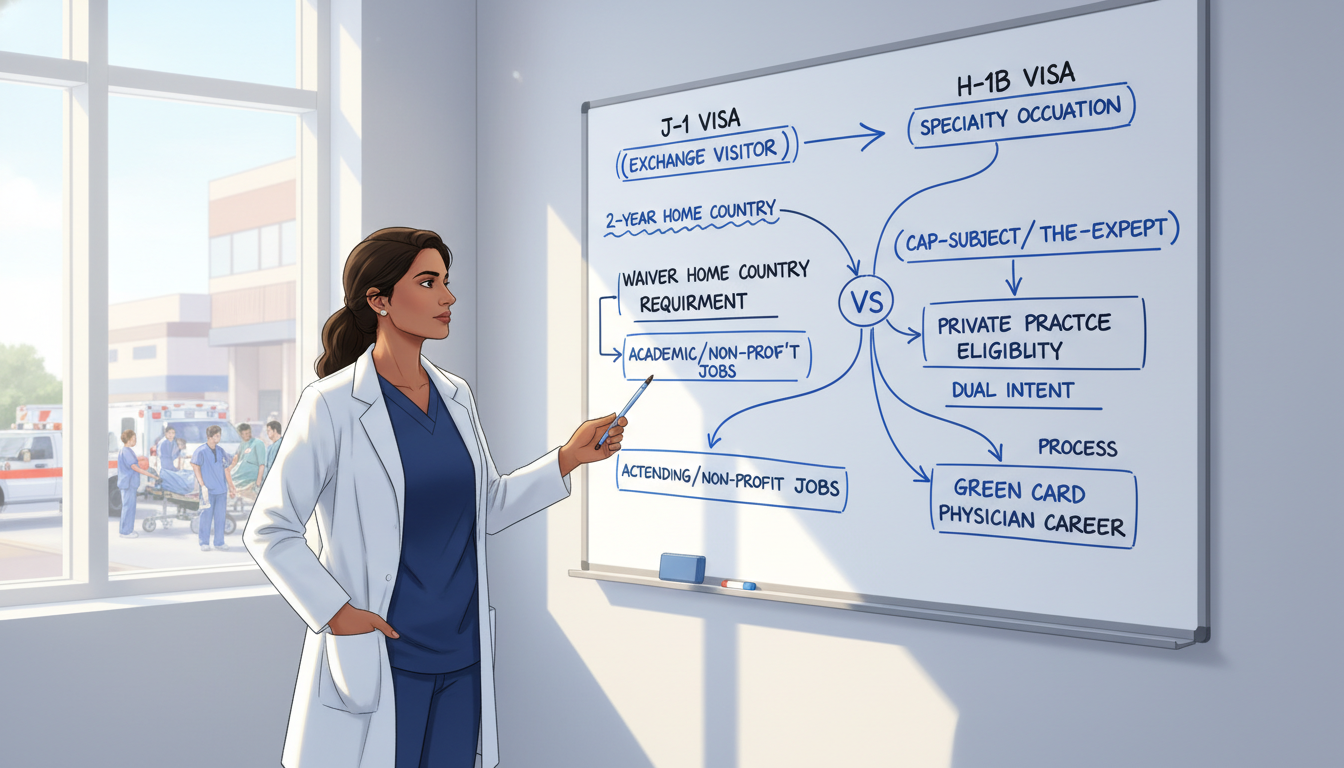
1. Clarify Your Long-Term Career Goals
Before deciding which IMG visa options to prioritize, define your goals:
- Do you want to stay in the US long term?
- Are you strongly interested in subspecialty fellowship after EM–IM (e.g., critical care, cardiology, nephrology, palliative care)?
- Would you be willing to work in rural/underserved or J-1 waiver-eligible locations after training?
- Do you have a strong connection to your home country and could see yourself returning for 2 years?
When J-1 may be better aligned:
- You are open to working in underserved areas for several years post-training (common for J-1 waiver jobs, especially in EM and IM hospitalist roles).
- You want to maximize your residency match chances in EM–IM by considering programs that sponsor J-1 only.
- You are not certain about staying in the US permanently, or you are comfortable with the possibility of returning home for 2 years if needed.
When H-1B may be preferred:
- You have a strong intention to remain in the US long term.
- You are aiming for competitive fellowships where J-1 waiver limitations might be constraining later.
- You want the flexibility to live and work in major metropolitan areas rather than waiver-eligible locations after training.
2. Realities of EM–IM Combined Programs and Visa Sponsorship
EM–IM combined programs are:
- Fewer in number than categorical EM or IM programs
- Often at large academic centers
- Highly competitive and selective about both qualifications and logistics
Many EM–IM programs state their policies clearly:
- “We sponsor J-1 visas only”
- “We sponsor J-1 and may sponsor H-1B for exceptional candidates”
- “No visa sponsorship”
Action step:
Create a spreadsheet of EM–IM programs and:
- Note each program’s visa policy (J-1 only, J-1 + H-1B, no sponsorship)
- Identify which are currently sponsoring H-1B for other residents/fellows
- Track application deadlines, Step 3 expectations, and contact information
This targeted preparation is crucial for a non-US citizen IMG because your pool of viable EM–IM combined options may shrink significantly if you are limited to H-1B or if you apply without awareness of each program’s stance.
3. Timeline and Exam Strategy for Visa Flexibility
To keep both J-1 and H-1B paths open:
USMLE Step 1 & Step 2 CK:
- Aim for competitive scores, especially as an IMG in a high-demand specialty combination.
- Complete them early enough to secure ECFMG certification before ERAS opens (ideally before September of the application year).
USMLE Step 3:
If you are seriously considering H-1B, plan to take Step 3 before the Match or at least before early spring of your PGY-1 start year.
This might mean:
- Completing Step 3 during a US clinical observership/research year
- Or taking Step 3 during an early post-graduation phase if you are not in training yet
Some states require training in the US before Step 3 eligibility; research state-specific rules early.
ERAS Personal Statement and Interviews:
- Be honest but strategic when discussing visa preference.
- If a program only sponsors J-1, emphasize your comfort with J-1 and your understanding of its requirements.
- If a program offers H-1B, show you are proactive (Step 3 passed, aware of timing, long-term plans).
Practical example:
- A non-US citizen IMG applying to EM–IM has:
- Step 1: 240, Step 2 CK: 248, ECFMG certified
- Step 3: Not yet taken
- They aim to match in 2026. For maximum options:
- They schedule Step 3 for early 2025 and target a pass before ERAS opens.
- They apply broadly to EM–IM programs, including both J-1 and H-1B supporting programs, but can showcase Step 3 when available.
If Step 3 timing doesn’t work out, they still retain J-1 eligibility, which remains the main path for many foreign national medical graduates.
J-1 Two-Year Home Requirement and Waiver Pathways
1. Understanding the 212(e) Home-Country Requirement
If you complete residency on a J-1 physician visa, you are typically subject to the two-year home-country physical presence requirement under INA 212(e). This means:
- You must spend an aggregate of 2 years in your home country (or country of last legal permanent residence) after finishing your training, before:
- Applying for an H-1B or L visa
- Changing to many other non-immigrant statuses in the US
- Applying for permanent residence (green card)
However, you can often avoid the 2-year return by obtaining a J-1 waiver.
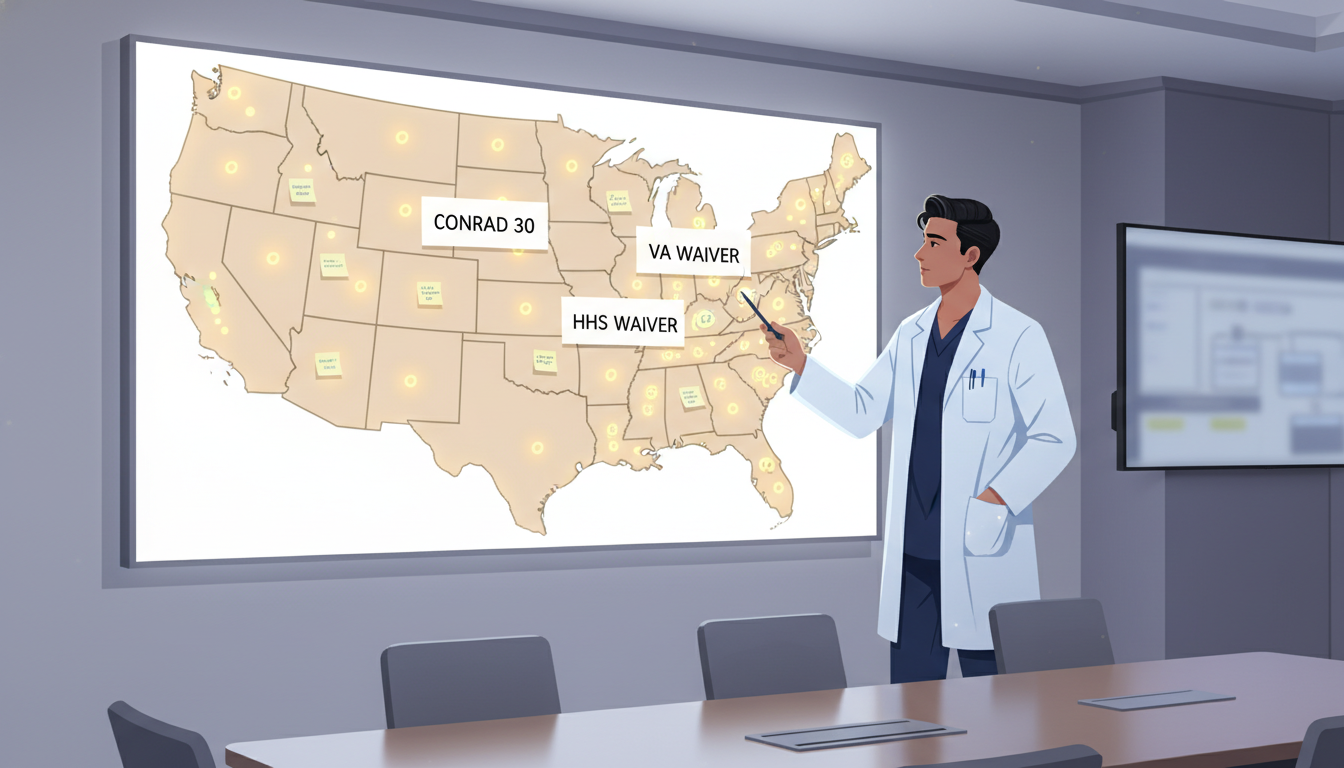
2. Common J-1 Waiver Options for EM–IM Graduates
For someone completing an EM IM combined residency, typical waiver paths are:
Conrad 30 Waiver (State Health Department Waiver):
- Each US state can sponsor up to 30 J-1 physicians per year.
- Typically requires working in a Health Professional Shortage Area (HPSA) or Medically Underserved Area (MUA).
- Particularly common for:
- Emergency physicians in rural/underserved emergency departments
- Internal medicine physicians as primary care or hospitalists
- Service obligation: Usually 3 years full-time in the designated location on an H-1B visa.
Federal agency waivers:
- Examples: Department of Veterans Affairs (VA), Department of Health and Human Services (HHS), Appalachian Regional Commission, etc.
- Requirements differ: often also focus on underserved communities or special populations.
Hardship or persecution waivers:
- More complex and less common.
- Based on demonstrating that your return to your home country would cause:
- Exceptional hardship to a US citizen or permanent resident spouse/child, or
- Likely persecution based on race, religion, or political opinion.
Relevance for EM–IM physicians:
- Your dual training in emergency medicine and internal medicine makes you highly desirable in many underserved areas:
- Rural hospitals needing EM coverage plus inpatient medicine
- Community systems wanting flexibility in staffing
- This can improve your competitiveness for Conrad 30 positions and other waiver jobs.
3. Planning Ahead for Waiver Jobs
Even while you are an EM–IM resident, you should:
- Attend talks from immigration or career development offices at your institution.
- Network with alumni who pursued J-1 waivers in EM or IM.
- Understand state-by-state Conrad 30 practices:
- Some states fill all 30 slots quickly with primary care/internal medicine.
- Others actively recruit emergency physicians or hospitalists.
- Some states reserve slots for subspecialties or academic positions.
By PGY-3–4 in an EM–IM combined program, you should have at least a preliminary plan:
- J-1 + Conrad 30 waiver in a specific region, or
- Transition to H-1B (if possible) and aim for a green card, or
- Return to your home country for the 2-year requirement and potentially return later.
Application Strategy for Non-US Citizen IMGs Targeting EM–IM
1. Researching Programs and Visa Sponsorship Status
Because EM–IM combined programs are limited, thorough research is crucial:
- Use official program websites, FREIDA, and EM/IM specialty society resources.
- Directly email program coordinators if the residency visa policy is unclear.
- Ask specifically:
- “Do you sponsor J-1 visas for non-US citizen IMGs?”
- “Do you sponsor H-1B visas for EM–IM residents?”
- “Are there any recent changes in visa policy due to institutional or state-level shifts?”
Create categories in your list:
- J-1 only programs
- J-1 and H-1B supportive programs
- No visa sponsorship
Apply as broadly as is financially and logistically feasible, especially if you have no US citizenship/green card.
2. Strengthening Your Application as a Foreign National Medical Graduate
For a non-US citizen IMG in a competitive combined specialty:
- US clinical experience (USCE) in both EM and IM is extremely valuable:
- Observerships, externships, or research with clinical exposure.
- Strong letters from US EM and IM faculty.
- Demonstrate clear interest in dual training:
- Research or quality improvement that spans emergency care and longitudinal medicine.
- Personal statement explaining how EM–IM fits your goals (rural ED + inpatient care, global health, academic EM and IM, etc.).
- Highlight visa awareness and professionalism:
- Show you understand the responsibilities and regulations of training on J-1 or H-1B.
- Do not appear uninformed or avoidant when the topic comes up.
3. Communicating About Visa During Interviews
During interviews:
- Be honest and concise about your status:
- “I am a non-US citizen IMG, currently on [X status] and will require [J-1/H-1B] sponsorship for residency.”
- If a program is J-1 only:
- Express comfort: “I am fully open to a J-1 visa and understand the two-year home requirement and waiver options.”
- If a program sponsors H-1B:
- Briefly note your preparation: “I have passed Step 3 and understand the process and timing for H-1B filing.”
Avoid lengthy immigration lectures—programs want reassurance, not a full legal discussion—but do show you’re informed and proactive.
Practical Scenarios and Outcomes
Scenario 1: J-1 EM–IM with Conrad 30 Waiver
- A non-US citizen IMG matches into an EM–IM combined program on a J-1.
- Completes 5 years of dual training.
- Applies for Conrad 30 waiver in a Midwestern state:
- Position: Hybrid ED + inpatient IM in a community hospital in a HPSA region.
- Receives waiver and transitions to H-1B for 3-year service commitment.
- During the waiver job, employer sponsors them for a green card.
Outcome:
They ultimately secure permanent residency, having used both J-1 and H-1B, and fulfilled service in an underserved area.
Scenario 2: H-1B EM–IM with Early Green Card Strategy
- Another non-US citizen IMG passes Step 3 before matching.
- Matches to an EM–IM program that sponsors H-1B, at a cap-exempt university hospital.
- Completes 5 years on H-1B (cap-exempt).
- Joins the academic faculty as an EM–IM attending, still in cap-exempt H-1B status.
- The university begins EB-2 or EB-1 green card sponsorship during their attending years.
Outcome:
No J-1 home requirement; smooth transition to permanent residency via academic route.
Scenario 3: J-1 EM–IM and Return to Home Country
- A non-US citizen IMG trains on J-1 in an EM–IM combined program.
- After residency, they return to their home country and become a leader in emergency and internal medicine development, with occasional short-term educational visits to the US.
- After fulfilling the 2-year home-country requirement, they later return to the US for a fellowship or attending job, now eligible for an H-1B or other immigration pathway.
Outcome:
J-1 functions as a training bridge with long-term international benefits, even if permanent US residency is not pursued.
Frequently Asked Questions (FAQ)
1. As a non-US citizen IMG, is it realistic to secure an H-1B for an EM–IM combined residency?
It is possible but less common than J-1. Many EM–IM combined programs choose J-1 only due to administrative simplicity. To maximize your chances for an H-1B:
- Pass USMLE Step 3 early (ideally before ranking).
- Target programs that explicitly state H-1B sponsorship.
- Demonstrate strong academic and clinical credentials to justify the additional administrative effort.
Still, you should be prepared to accept a J-1 if you want the broadest range of programs.
2. Will doing my residency on a J-1 prevent me from staying in the US long term?
Not necessarily. While the J-1 physician visa comes with the two-year home-country requirement, many physicians remain in the US long term by obtaining a J-1 waiver (e.g., Conrad 30) followed by an H-1B and eventually a green card. However, this route typically requires:
- Working in an underserved area or a qualifying federal agency.
- Careful timing and coordination with immigration counsel.
If your goal is a straightforward urban academic career with minimal geographic limitation, the H-1B pathway is often more flexible—but less readily available.
3. Does EM–IM combined training complicate visa issues compared to categorical EM or IM?
The main complication is the length of training (5 years instead of 3–4):
- On J-1, this is generally not a problem, as the 7-year limit covers 5-year EM–IM training plus potential short fellowship.
- On H-1B, you must consider the 6-year limit, especially if planning additional fellowship training afterward.
It does not necessarily make you ineligible for any visa category, but it demands more forward planning, especially if you want to pursue subspecialty fellowships or extended academic roles on H-1B.
4. How early should I start planning my visa strategy as a foreign national medical graduate targeting EM–IM?
Ideally:
- 1–2 years before your intended ERAS application cycle:
- Clarify your long-term goals (stay in US vs return home vs flexible).
- Plan your USMLE sequence with Step 3 timing in mind if considering H-1B.
- Gather information on EM–IM programs’ visa policies.
- By the time you submit ERAS:
- Have ECFMG certification.
- Know which programs support J-1, which support H-1B, and which support both.
- Be ready to discuss your visa needs confidently during interviews.
Early planning is especially important for a non-US citizen IMG in a narrow, competitive field like emergency medicine–internal medicine combined training.
By understanding how J-1 vs H-1B interact with your EM–IM aspirations, and by aligning exams, applications, and career planning with realistic IMG visa options, you can navigate the residency visa landscape strategically rather than reactively.