

The biggest mistake IMGs make about fellowship visas is thinking “I’ll figure it out in residency.” You will not. By the time you care, you’ll already be boxed in by visa rules you agreed to three years earlier.
If you want a US fellowship as an IMG, every single training year has a visa milestone. Miss one, and your options shrink. Sometimes to zero.
I’m going to walk you year by year—from MS4/Pre‑Match through PGY‑3+—and spell out what you should be doing that year to keep fellowship and long‑term US options open.
Big Picture: How Fellowship Depends on Your Visa Path
Before we go year‑by‑year, you need the map.
| Visa Path | Typical Holder | Fellowship Impact |
|---|---|---|
| J‑1 | Most IMGs in university programs | Requires 2‑year home return or waiver before long‑term work; most fellowships ok, jobs harder |
| H‑1B (residency) | Some IMGs with high‑demand skills/specialties | Can go directly into fellowship on H‑1B, no 2‑year rule |
| H‑1B (fellowship) | J‑1 waiver completers or direct H‑1B from residency | Strong path toward long‑term practice & green card |
| O‑1 | High‑achieving researchers/academics | Flexible but hard to qualify; can bridge to green card |
| J‑2 EAD / Dependent | Spouse of J‑1 holder | Can complicate independent career planning |
If you don’t consciously choose which column you want to land in by the end of residency, the system will choose for you.
MS4 / Pre‑Match Year: Decide Your Visa Strategy Before You Rank
At this point you should be:
- Choosing between J‑1 and H‑1B on purpose, not by inertia.
- Filtering programs based on their actual visa behavior, not what the website vaguely promises.
Fall–Winter (Before Rank List)
You need to be ruthlessly honest about three questions:
Do you ultimately want:
- US fellowship + then return home?
- Or US fellowship + long‑term US practice/green card?
Is your Step performance and CV strong enough that any realistic program will sponsor H‑1B?
Are you willing to do a J‑1 waiver in an underserved area after fellowship if needed?
Now, concrete moves:
1. Sort programs by visa reality, not brochure language
At this point you should:
Email program coordinators with very specific questions:
- “How many of your current IMGs are on H‑1B vs J‑1?”
- “Have you sponsored new H‑1Bs in the last 2–3 years?”
- “Do you convert J‑1 residents to H‑1B for fellowship at your institution?”
Ask current residents on Zoom/WhatsApp:
- “If you were starting over, would you still choose this program given the visa situation?”
- “Any co‑residents blocked from fellowship or jobs because of visa issues?”
Red flags I’ve seen repeatedly:
- “We support all visa types” → Then 100% of their IMGs are on J‑1.
- “Case‑by‑case” → Means “almost never.”
2. Make a conscious J‑1 vs H‑1B choice
If you accept J‑1, you are accepting:
- 2‑year home‑country requirement unless you do a waiver job.
- Most likely needing a J‑1 waiver after fellowship before private/long‑term work.
If you push for H‑1B, you must:
- Confirm they will file H‑1B for PGY‑1, not convert later “if possible.”
- Check your USMLE Steps are high enough and all passed on first attempt (some institutions have hard cutoffs for H‑1B).
At this point, your rank list is your visa decision. Treat it that way.
Match Year Spring–Summer (Pre‑PGY‑1): Lock the Paperwork Right
Once you’ve matched, the clock is brutal and unforgiving.
At this point you should:
- Know exactly which DS‑2019 or H‑1B petition you’re going to hold.
- Eliminate surprises that will blow up fellowship options later.
March–April (Immediately After Match)
- Confirm visa type in writing
Reply to your GME or program coordinator with explicit language:
- “To confirm, my residency visa status will be: [J‑1 sponsored by ECFMG] / [H‑1B filed by the institution for PGY‑1 start].”
If they hesitate or try to “discuss later,” push now. Not in July. I’ve watched people show up expecting H‑1B and find a DS‑2019 waiting for them.
- If J‑1: Check the 2‑year rule details
- Your DS‑2019 and J‑1 stamp will almost certainly trigger 212(e) (2‑year home requirement).
- Accept that your long‑term path is now: Residency → Fellowship(s) → J‑1 waiver job → then maybe green card.
That’s not a bad path. But it’s a path. Stop fantasizing about skipping the waiver unless you have a 212(e) exemption scenario (rare).
- If H‑1B: Nail the logistics
Make sure:
- The position is cap‑exempt (university/teaching hospital).
- Petition includes full duration of residency (or a clear plan to extend).
- You understand H‑1B time limits: 6 years total across residency + fellowship.
If you plan a long fellowship track (e.g., IM → Cards → EP), you can easily bump into that 6‑year cap. Better to know now.
PGY‑1: Set Up Your Fellowship and Waiver Options Early
PGY‑1 feels like drowning. But this is when smart people quietly put the foundation in place.
At this point you should:
- Choose specialty and early subspecialty interest.
- Align your visa reality with that specialty’s competitiveness and job market.
First 3–6 Months of PGY‑1
- Decide if your chosen specialty + visa path actually fits
Concrete examples:
J‑1 + ultra‑competitive fellowship (e.g., Derm, Plastics via GS, Ortho) = brutal path. Not impossible, but don’t lie to yourself.
J‑1 + IM → Cards / GI = doable, but you’ll often need:
- Strong research.
- Good US mentors.
- Eventually, a waiver‑friendly geography.
H‑1B + any fellowship = much more flexible, but you must watch your 6‑year clock.
- Start targeting institutions that are friendly to your visa type
Make a running list (Excel, Notion, whatever) of:
- Programs in your specialty that:
- Take J‑1 fellows.
- OR sponsor H‑1B for fellowship.
- OR historically hire waiver candidates after fellowship.
Stop pretending “I’ll apply everywhere.” Visa rules will cut your list in half anyway.
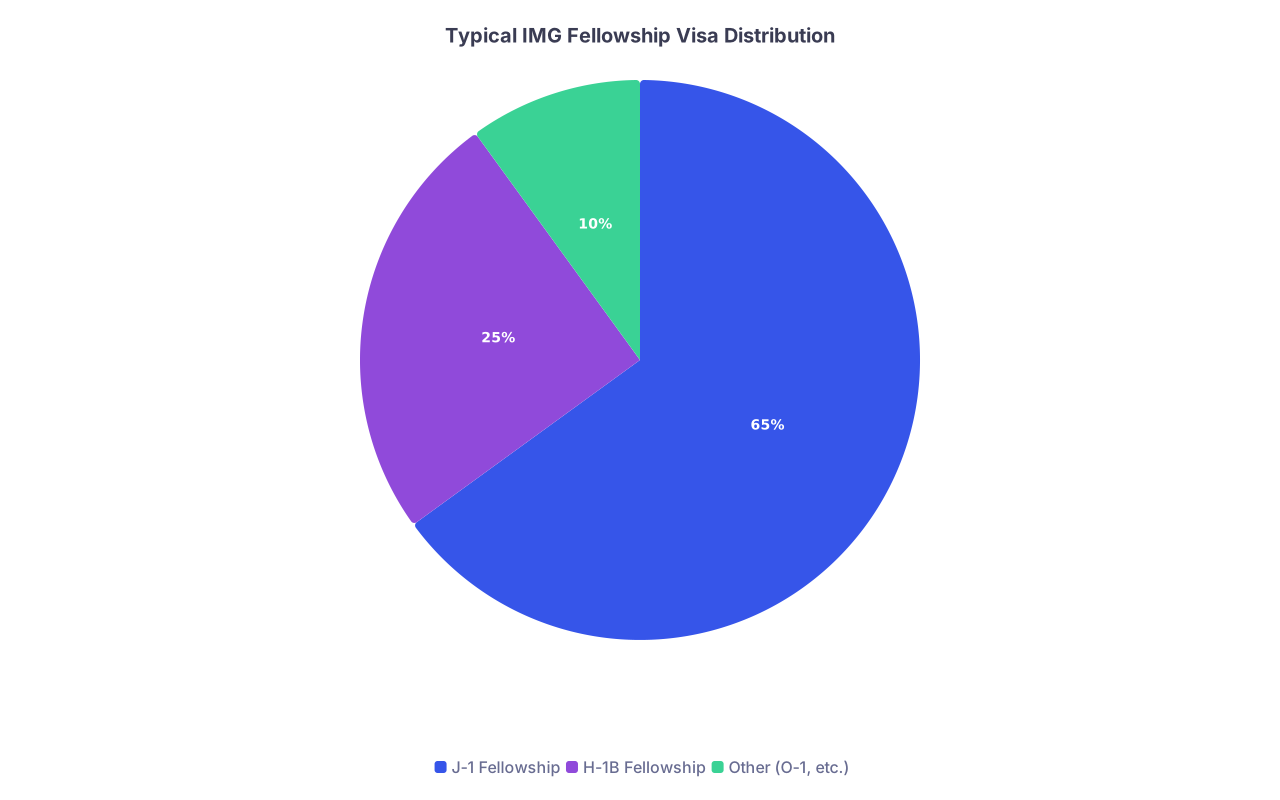
| Category | Value |
|---|---|
| J-1 Fellowship | 65 |
| H-1B Fellowship | 25 |
| Other (O-1, etc.) | 10 |
- PGY‑1 End: Have a draft fellowship CV
By June of PGY‑1 you should already have:
- 1–2 mentors who know your name and career goals.
- At least one research project started.
- Your visa type clearly stated on your CV (yes, put it there for fellowship programs later).
PGY‑2: The Critical Fellowship Application Year (Most Specialties)
For core specialties (IM, Peds, Neuro, Psych, etc.), fellowship applications often start in late PGY‑2. That means PGY‑2 is your pivotal visa‑planning year.
At this point you should:
- Decide where you’ll sit during fellowship: still J‑1, or switch to H‑1B (if possible).
- Map the post‑fellowship waiver or green card steps.
Early PGY‑2 (July–December)
- Clarify fellowship application cycles and visa policies
You need exact info for your target subspecialty:
- When does ERAS open?
- Do top programs in your field accept J‑1 only or J‑1 + H‑1B?
- Are there programs that historically help fellows transition to H‑1B for attending jobs?
Check actual websites and ask current fellows. Don’t trust generic “visa sponsorship available.”
- If you’re on J‑1 residency: know your switch options
Reality:
- Most people stay J‑1 for fellowship. Clean, predictable, ECFMG‑sponsored.
- Switching to H‑1B for fellowship from J‑1 residency is possible only if:
- You’re not subject to 212(e) (rare).
- Or you’ve obtained a waiver of 212(e) before fellowship (hard, unusual timing).
- Or you never triggered 212(e) in the first place (specific country categories, etc.).
If your DS‑2019 says you’re subject to 212(e), stop planning magical H‑1B fellowships that ignore that.
Mid‑PGY‑2 (January–March)
- Build a realistic post‑fellowship path
You’re not just applying to fellowship; you’re choosing where you’ll be allowed to work after.
Two sample paths:
Path A: J‑1 Residency → J‑1 Fellowship → J‑1 Waiver Job → H‑1B → Green card
- Target: institutions in states with strong J‑1 waiver programs (TX, NY, FL, rural Midwest).
- During fellowship, you’ll apply for Conrad 30 or federal waivers.
Path B: H‑1B Residency → H‑1B Fellowship → Employer‑sponsored green card
- Target: academic centers that sponsor both H‑1B and PERM/I‑140 for physicians.
- During fellowship, you negotiate green card timing with your future employer.
At this point you should pick one primary path and stop collecting theoretical backup ideas that you’ll never execute.
Late PGY‑2 (Fellowship Application Season)
Your application strategy must match your visa.
If J‑1:
- Explicitly state “J‑1 visa, ECFMG‑sponsored” on your applications.
- Target programs that historically have J‑1 fellows. Look at current roster photos.
If H‑1B:
- Confirm programs will file cap‑exempt H‑1B for fellows (not all do).
- Calculate remaining H‑1B years you’ll have after residency ends.
PGY‑3 (and PGY‑4 for Some): Lock in Fellowship and Prepare Next Visa Step
By PGY‑3, fellowship interviews/offers are happening or done. This is where many IMGs relax. That’s the wrong move.
At this point you should:
- Use the time between fellowship match and fellowship start to prepare the next visa stage, not just celebrate.
Early PGY‑3: During Fellowship Interviews
During interviews, ask sharp, specific visa questions:
- “What visa types do your current fellows have?”
- “Have you sponsored H‑1B for fellows in the last 3 years?”
- “Where do your J‑1 fellows usually go after finishing here—waiver jobs, back home, or another visa?”
If they’re vague, assume:
- They don’t pay attention.
- They don’t help much.
Post‑Match PGY‑3: Between Fellowship Offer and Start
Your timeline:
Within 1–2 months of signing fellowship contract:
- Clarify your fellowship visa type in writing.
- Make sure the program knows whether you’re J‑1 subject to 212(e) or currently on H‑1B.
If going J‑1 again:
- Keep all DS‑2019 forms organized; you’ll need them for waiver and green card later.
- Confirm ECFMG sponsorship transfer process and dates so there’s no gap between residency and fellowship.
If going H‑1B for fellowship:
- Confirm:
- That the fellowship institution is cap‑exempt.
- They’ll file H‑1B early enough to avoid gaps.
- You won’t exceed the 6‑year limit with residency + fellowship.
- Confirm:
Here’s what that 6‑year constraint often looks like:
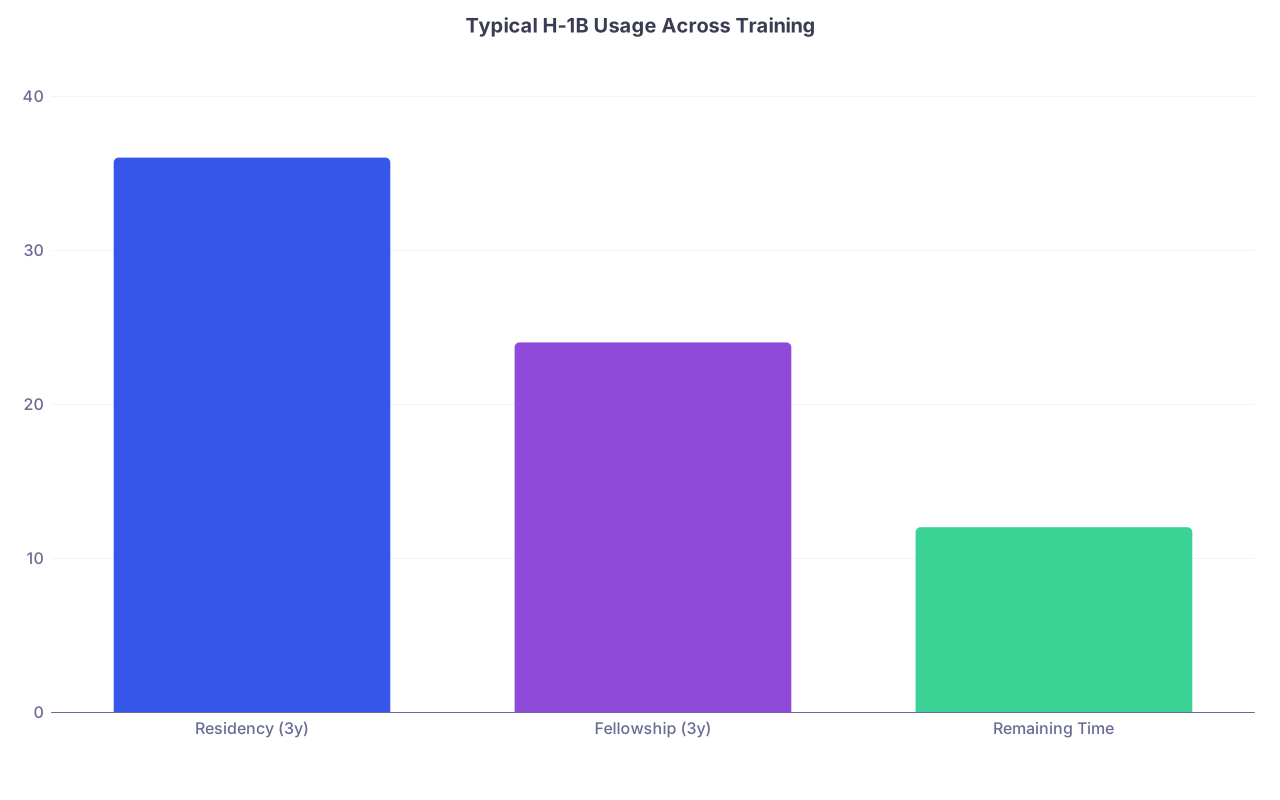
| Category | Value |
|---|---|
| Residency (3y) | 36 |
| Fellowship (3y) | 24 |
| Remaining Time | 12 |
(Values are in months. You don’t want to find out you’re out of H‑1B time in the last year of fellowship.)
Fellowship Years: The Visa Work You Do Here Determines Your Long‑Term Career
Once you’re actually in fellowship, the focus shifts from “How do I train?” to “How do I stay and work where I want?”
At this point you should:
- Start your post‑fellowship visa and green card moves in the first fellowship year, not the last.
Fellowship Year 1
If you’re on J‑1 (most IMGs):
Your priority is the J‑1 waiver:
Identify waiver‑friendly regions and employers early
- Look at Conrad 30 programs by state.
- Track which states filled all 30 slots last cycle and which had leftover.
By mid‑Year 1 of fellowship:
- Start talking (quietly) with potential employers in waiver‑friendly areas.
- Clarify whether they’ve successfully done J‑1 waivers for subspecialists before.
Late Year 1:
- Narrow down 2–3 serious options.
- Make sure those employers:
- Will file your waiver on time.
- Can support you from J‑1 → H‑1B → green card.
If you’re on H‑1B for fellowship:
You’re playing the green card game now.
By mid‑Year 1:
- Decide if you want academic vs private practice vs hospital employment.
- Start targeting employers who will sponsor PERM/I‑140 quickly, not “after a few years.”
Ask future employers:
- “When do you typically start green card paperwork for physicians?”
- “Have any of your H‑1B physicians had to leave because green card wasn’t done in time?”
You want the ones who start during Year 1 of employment, not Year 4.
Special Case: O‑1 as a Bridge for Academic IMGs
O‑1 gets thrown around as a magical solution. It isn’t. But in some careers it’s the right move.
At this point (usually late residency or fellowship) you should consider O‑1 if:
- You have substantial research output:
- Multiple first‑author publications.
- National conference presentations.
- Strong letters from recognized experts.
- You’re headed into a fairly academic field or niche.
O‑1 can:
- Let you work when H‑1B time is exhausted.
- Bypass some J‑1 waiver constraints if used strategically.
- Strengthen later EB‑1 green card cases.
Do not chase O‑1 if you have a thin CV and no interest in academic output. It’ll just waste time and money.
Visualizing the Overall Timeline
Sometimes it helps to see the whole thing in one shot.
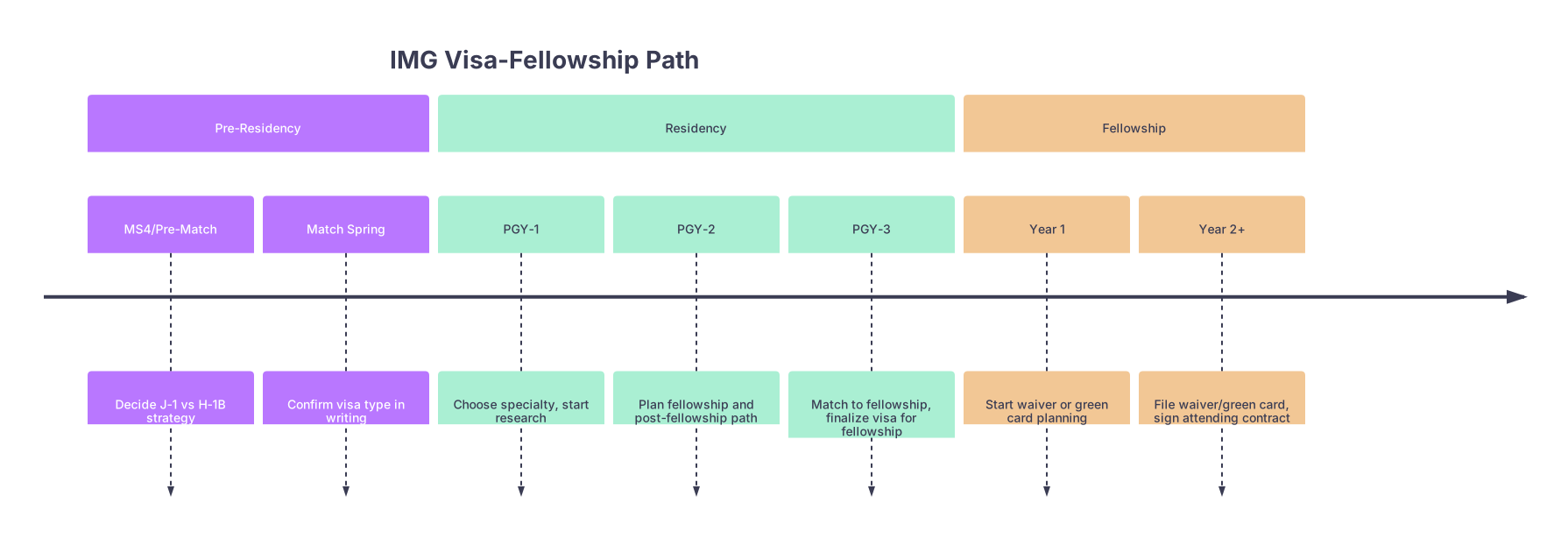
| Period | Event |
|---|---|
| Pre-Residency - MS4/Pre-Match | Decide J-1 vs H-1B strategy |
| Pre-Residency - Match Spring | Confirm visa type in writing |
| Residency - PGY-1 | Choose specialty, start research |
| Residency - PGY-2 | Plan fellowship and post-fellowship path |
| Residency - PGY-3 | Match to fellowship, finalize visa for fellowship |
| Fellowship - Year 1 | Start waiver or green card planning |
| Fellowship - Year 2+ | File waiver/green card, sign attending contract |
Quick Year‑By‑Year Checklist
To make this brutally practical, here’s what you should be doing each year.

MS4 / Pre‑Match
- Decide: J‑1 vs H‑1B long‑term preference.
- Rank programs based on real visa patterns.
- Ask current residents direct visa questions.
Match Year (Before PGY‑1)
- Get visa type confirmed in writing.
- For J‑1: accept the 2‑year rule reality.
- For H‑1B: confirm cap‑exempt status and years needed.
PGY‑1
- Choose specialty and tentative fellowship.
- Identify specialties compatible with your visa.
- Start research and mentorship with your visa in mind.
PGY‑2
- Research fellowship programs’ visa habits.
- Clarify if you’ll stay J‑1 vs aim for H‑1B in fellowship (if even possible).
- Map your post‑fellowship path: waiver vs green card.
PGY‑3
- Ask explicit visa questions during fellowship interviews.
- Lock in fellowship visa details right after matching.
- Line up documents for J‑1 waiver or H‑1B/green card planning.
Fellowship
- Year 1: Start employer talks for waiver or green card.
- Confirm timelines for filing J‑1 waiver or PERM/I‑140.
- Make sure your attending job matches your visa route (rural/underserved vs academic center, etc.).
Three Things I Want You to Remember
- Your rank list and PGY‑1 visa are not paperwork details; they’re the first big fork in your entire US career path.
- PGY‑2 is when you either build a coherent residency → fellowship → waiver/green‑card story, or you end up scrambling with fewer options.
- By the first year of fellowship, you’re already late if you haven’t started planning your post‑fellowship visa and job—do that early, not as a last‑minute emergency.


