
The biggest visa mistakes IMGs make do not happen at the embassy. They happen in the three chaotic months after Match Day.
You are exhausted from interviews, drowning in emails from your new program, and everyone keeps saying “it will work out.” That is how people end up missing orientation or scrambling for emergency appointments.
I am not going to tell you “it will work out.” I will tell you exactly what to do, month by month, week by week, from Match Day until orientation so it actually works out.
This guide assumes a standard US residency start of July 1. Adjust by a couple of weeks if your program starts late June or mid-July.
Big Picture: Your 3-Month Visa Timeline
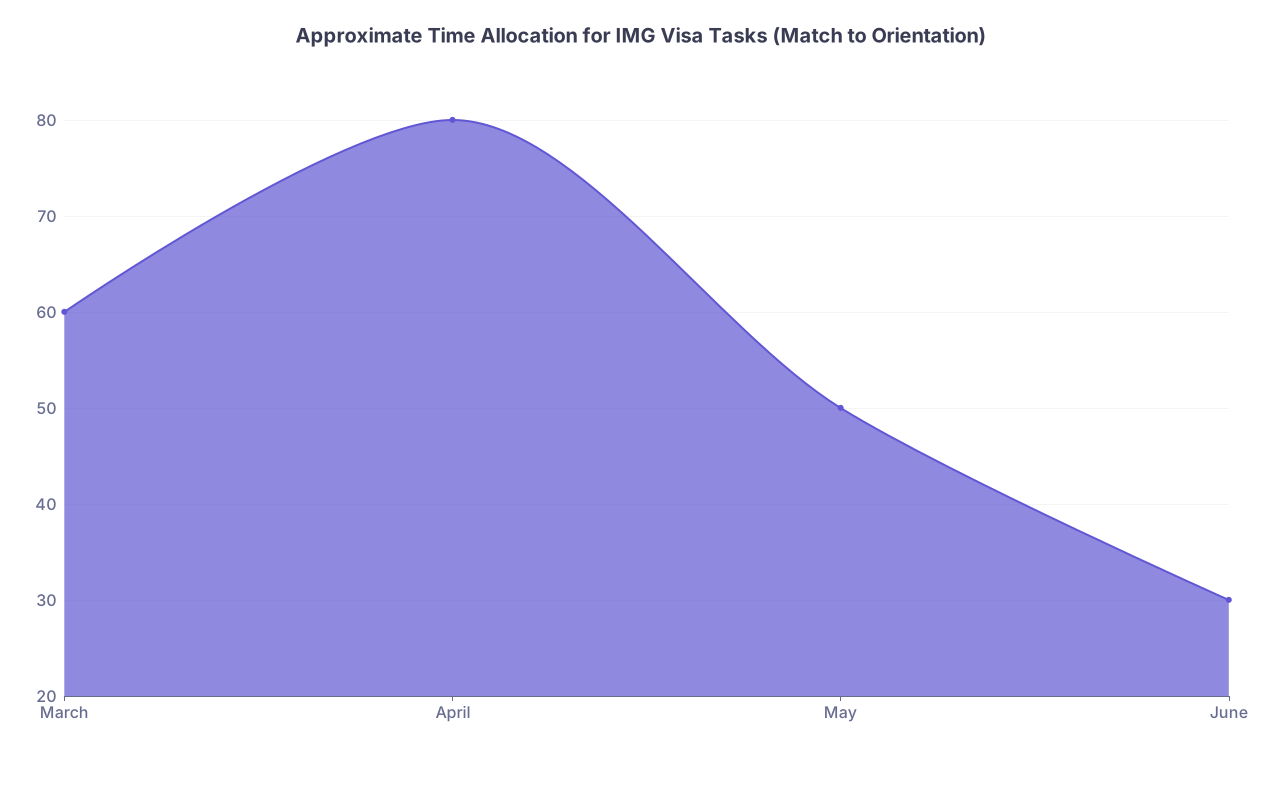
Before we zoom in, you need the overview. Visa work for IMGs is front-loaded and unforgiving. There are three critical phases:
| Category | Value |
|---|---|
| March | 60 |
| April | 80 |
| May | 50 |
| June | 30 |
- March (Match Month): Decision and paperwork. No visa appointment yet. You are locking in your visa category and chasing documents.
- April–May: DS-2019 or petition processing + visa interview. This is where delays hit.
- June: Travel, SSN, and final hospital onboarding steps.
If you are starting from scratch on June 1, you are already in trouble. By June you should be tying loose ends, not starting the process.
Step 1: Match Month (March) – Decide and Declare Your Visa Path
At this point you should be:
- Confirming your visa type with your program.
- Sending every document they need for sponsorship.
- Clearing any red-flag issues that can block your visa.
Think in weeks.
Match Week (Mid-March)
Day of Match / Match +1–3 days
You are on an emotional high. Enjoy it—for 24 hours. Then:
Confirm the visa category with your program.
Typical options:- J-1 (ECFMG-sponsored exchange visitor) – most common.
- H-1B (employment-based) – only if the program supports it and you meet strict criteria.
Ask your GME office or program coordinator directly, in writing:
- “Do you sponsor J-1, H-1B, or both for incoming residents?”
- “Which category will you be using for me?”
- “Who is my contact for visa processing (GME vs international office)?”
If J-1 is possible, assume J-1 unless clearly told otherwise.
H-1B is:- More expensive and paperwork-heavy for the program.
- Impossible without:
- Passed USMLE Step 3 (often with score report already in hand).
- Immediate eligibility for state licensure or training license. If they are “still deciding” in late March, that is a problem. Push for clarity.
Register on OASIS/ECFMG (if J-1) and verify your status.
By Match Week you should:- Have your ECFMG certificate or know exactly what is missing.
- Confirm your name, date of birth, and passport number on file match your current passport.
Any mismatch = delay. Fix it now.
Week After Match (Mid to Late March)
At this point you should be sending documents, not asking what to send.
If You Will Be on a J-1 Visa (ECFMG-Sponsored)
Your main goal: get your DS-2019 processed by ECFMG early. Programs cannot do this for you.
Complete the ECFMG “J-1 Sponsorship” or “EVSP” application steps.
Your program must submit:- Appointment Form (AF) with your training dates and salary.
- Statement of Need (for some countries, you obtain this; others, the embassy does).
You must:
- Upload passport biographic page.
- Confirm permanent address.
- Confirm medical school and ECFMG certification details.
Start the Statement of Need process immediately.
This is where I have watched people lose 3–4 weeks.Typical patterns:
- Some ministries of health (India, Pakistan, Saudi Arabia, UAE, Nigeria, etc.) have rigid processes and only issue Statements of Need on certain timelines.
- Some require in-person visits, notarization, or embassy visits.
- Some take “10 business days” that magically becomes 5 weeks.
Do not wait for your program to remind you. You email your country’s embassy/consulate and ministry of health this week and ask:
- “What is the current processing time for a Statement of Need for US residency?”
- “What documents and fees are required?”
- “Can I submit scans or do you need originals?”
Make sure your passport is valid through at least the end of PGY-1.
If your passport expires in less than 18–24 months:- Start renewal immediately.
- Use a second valid passport number only after you know your ECFMG file is updated. Wrong passport number on DS-2019 = appointment problems.
If You May Be on an H-1B Visa
Your main goal: confirm you actually qualify and the program is willing to file this cycle.
Confirm Step 3 status.
- If Step 3 is not passed with an official report, genuine H-1B sponsorship for July 1 is effectively dead.
- Some states allow exceptions. Most do not. Your program knows which applies.
Ask for a written H-1B timeline from the program’s legal/HR office.
You want answers to:- When will they file the LCA (Labor Condition Application)?
- When will they file the H-1B petition?
- Will they use premium processing?
Have a J-1 backup plan in your head.
Programs occasionally switch you from H-1B to J-1 in April or May when something breaks (state license delay, Step 3 report delay, or HR pushback).
You do not want that conversation in late May. Have your ECFMG-side documentation ready anyway.
Step 2: Late March to April – Get Your DS-2019 or Petition Approved
This phase is about one thing: getting actual visa-sponsoring documents in your hand.
At this point you should be:
- Finalizing all ECFMG and program paperwork.
- Tracking processing times like a hawk.
- Preparing for the consular interview before the document even arrives.
Late March – Document Chase
Your checklists differ by visa type.
| Task Category | J-1 (ECFMG) – Mostly Your Responsibility | H-1B – Mostly Program Responsibility |
|---|---|---|
| Sponsoring Entity | ECFMG | Hospital/University |
| Core Form | DS-2019 | I-129 + I-797 Approval |
| Key Exam Requirement | ECFMG Certification | USMLE Step 3 + license eligibility |
| Typical Processing | 2–6 weeks after complete file | 2–4+ months without premium |
For J-1 Applicants
Submit a complete EVSP packet before April 1 if possible.
Real talk: I see smoother cases when everything is in by early April.- DS-2019 issuance often takes:
- 2–3 weeks when things are clean.
- 4–6 weeks with Statement of Need or document issues.
- DS-2019 issuance often takes:
Double-check funding details.
ECFMG will want:- Salary confirmation that meets minimum thresholds.
- Any supplemental funding documented (scholarships, government sponsorships, etc.).
Monitor ECFMG portal weekly.
Do not assume silence means progress.
If you see no status movement after 2 weeks:- Email EVSP with your application number.
- Confirm what, if anything, is missing.
For H-1B Applicants
Push for early petition filing.
Programs that start H-1B work in late April are playing with fire.Confirm whether they will use premium processing.
- Premium = 15-day USCIS processing (for a fee).
- Without premium, petitions can drag 2–4 months. That collides with July 1.
Ask for copies of the LCA filing and petition once available.
You are not managing this process, but you are the one who will be stranded if it slips into June.
Step 3: April – Schedule Your Visa Interview Strategically
At this point you should be:
- Tracking when your DS-2019 or I-797 will arrive.
- Watching visa appointment wait times weekly.
- Pre-building your DS-160 and document file.
This is where smart IMGs pull ahead. They do not wait for the DS-2019 to start anything.
Early to Mid-April
Check US consulate visa appointment wait times for your country/city.
Use the official US Department of State wait time tool and check:- Nonimmigrant (J or H) appointment wait.
- Typical administrative processing times for your region (your friends will know; so will old Reddit threads).
Start filling out the DS-160 online form early.
You do not submit without your SEVIS or petition details, but you can:- Create a DS-160 application.
- Fill 90% of it (personal info, travel plans, family, education, work history).
- Save the application ID and security questions somewhere secure.
Organize your supporting documents binder.
You should already be collecting:- Valid passport(s) with sufficient validity.
- Passport-sized photos meeting US specs.
- Medical school diploma + transcript.
- ECFMG certificate (or current status letter if allowed).
- Match letter / contract from your program.
- Proof of ties to home country (for J-1): family, property documents, job letters, etc.
- Bank statements or funding letters if required by your consulate.
Put them in a physical folder. You will not have time to hunt for this stuff in May.

Mid to Late April – Document Arrival and Booking
For J-1: DS-2019 Arrival
Once your DS-2019 is issued and shipped:
Immediately update or finalize your DS-160.
- Enter your SEVIS number from the DS-2019.
- Confirm program start date (usually June 24–July 1 type range).
Schedule the visa interview as soon as SEVIS fee and DS-160 are ready.
Sequence:- Pay SEVIS I-901 fee (for J-1).
- Complete DS-160 and print confirmation page.
- Create a profile on your consulate’s visa appointment site.
- Pay MRV fee (visa application fee).
- Book the earliest reasonable appointment.
If your consulate has long wait times, look at:
- Neighboring cities or countries where you are allowed to apply.
- “Emergency appointment” criteria (some consulates consider fixed training start dates as valid grounds, some do not).
For H-1B: I-797 Approval
Once your H-1B is approved:
Use the petition details to complete DS-160.
- Petitioner information.
- Receipt numbers where requested.
Book the H-1B visa interview immediately using the same appointment infrastructure as J-1 (different category selection, same core mechanics).
Step 4: May – Interview, Administrative Processing, and Contingency Plans
May is execution month. At this point you should be:
- Attending your visa interview.
- Responding instantly to any follow-up or administrative processing (AP).
- Updating your program on realistic arrival dates.
Early to Mid-May – Visa Interview
Your target: interview no later than the third week of May if you start July 1. Earlier is better.
Prepare your story for the consular officer.
They are not only verifying documents. They are testing coherence.Be ready to answer crisply:
- Why this specialty? Why this program?
- What are your plans after training? (For J-1, you must show intent to return home, at least on paper.)
- Who is funding your stay?
- What family do you have in the US vs home country?
Bring over-complete documentation.
Under-prepared candidates get delayed. I have watched this repeatedly.Extra items that often help:
- Previous US visas and I-20/DS-2019 forms if you studied in the US.
- Any research or employment letters that show continuity of your CV.
- Translations for any non-English official documents, stamped and signed.
Be honest about any prior visa denials, overstay, or status issues.
The officer already has access to your history. If you try to hide something, you just converted a solvable problem into a likely denial.
Mid-May – If Your Visa Is Approved Quickly
Perfect world scenario:
- Visa approved within days.
- Passport returned with visa stamp.
- You are good to plan travel, housing, and arrival.
At this point you should:
Book flights for a safe arrival window.
Aim to arrive:- 10–14 days before orientation if you are new to the US.
- At least 7 days before hospital onboarding.
Coordinate with your program on housing, onboarding, and I-9 (work eligibility) steps.
Ask for:- Official orientation date(s).
- Any required in-person pre-orientation tasks (fit testing, drug screen, etc.).
Mid to Late May – If You Hit Administrative Processing (AP)
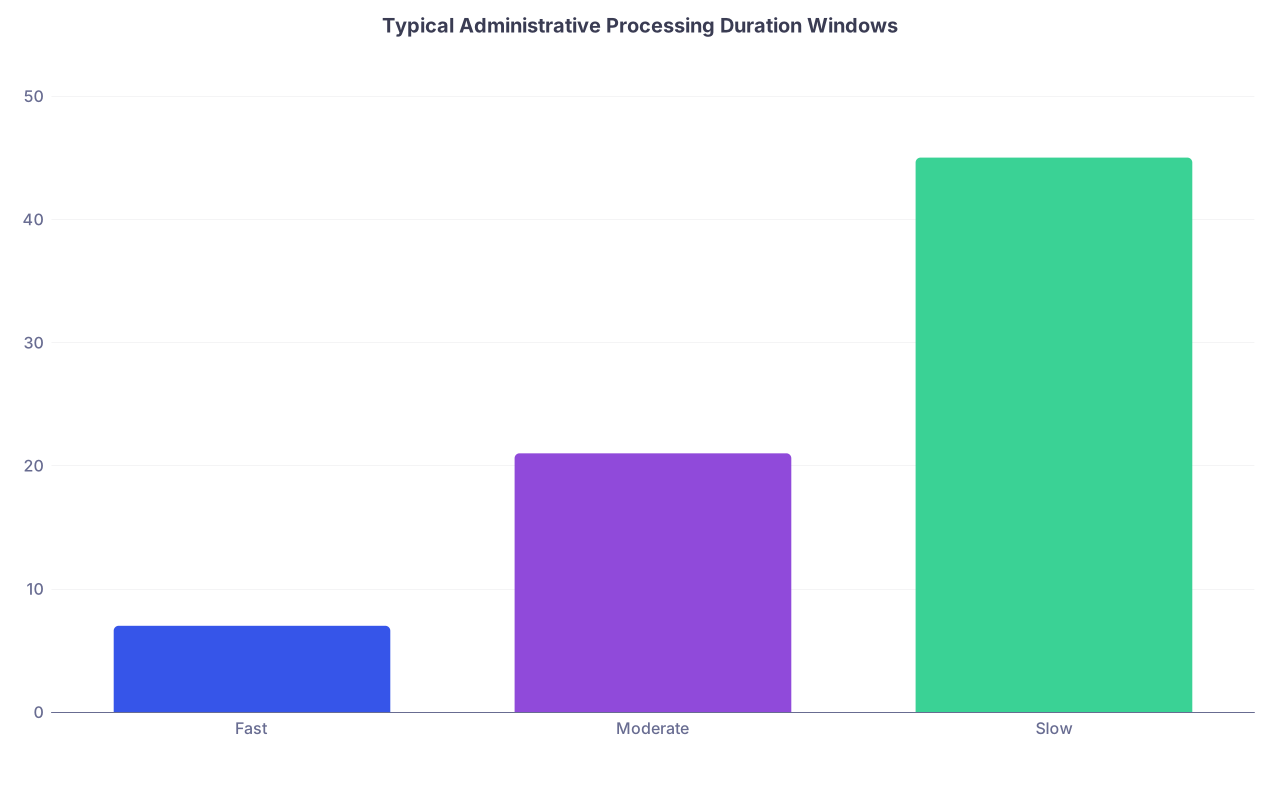
This is where the anxiety spikes. Many IMGs from certain countries experience 221(g) or “administrative processing.”
| Category | Value |
|---|---|
| Fast | 7 |
| Moderate | 21 |
| Slow | 45 |
You cannot force them to finish faster, but you can avoid making it worse.
Respond immediately to any document requests.
If the consulate asks for:- CV in full detail.
- List of publications.
- Travel history explanation.
- Police certificates.
You send them within 24–48 hours. Every day you wait is a day added to your problem.
Keep your program informed every 7–10 days.
Do not disappear. Send short updates:- Date of interview.
- Type of processing or 221(g).
- Any estimated timelines they gave (usually they do not, but if they did, share it).
Ask your program if they have had residents from your country/region with AP before.
Sometimes:- They know typical durations.
- Their international office has a contact or template for letters to consulates clarifying your training start date and funding.
Do not promise arrival by July 1 if you have no basis. Give ranges. Programs can sometimes flex orientation dates or initial scheduling if they know early.
Step 5: June – Travel, SSN, and Final Onboarding
If everything went well, June should not be frantic. If things were delayed, June becomes triage month.
At this point you should be:
- Getting into the US.
- Getting your Social Security Number (SSN).
- Completing every HR and hospital requirement before you touch a patient.
Early June – Arrival in the US
Carry all critical documents in your hand luggage.
For both J-1 and H-1B:- Passport with valid visa.
- DS-2019 (for J-1) or I-797 copy (for H-1B).
- Offer letter or contract.
- Contact info for your GME office.
Answer CBP questions cleanly at the port of entry.
They may ask:- Where are you going?
- What will you be doing?
- Who is paying you and how much?
Your answers should match your documents and DS-160.
Check your I-94 record online within 24–48 hours of entry.
Make sure:- Status is J-1 or H-1B as expected.
- Admit until date is:
- “D/S” for J-1.
- A clear date through the end of petition validity for H-1B. Save a PDF. HR will need it.

| Step | Description |
|---|---|
| Step 1 | Arrive in US |
| Step 2 | Check I-94 Online |
| Step 3 | Attend GME Onboarding |
| Step 4 | Apply for SSN |
| Step 5 | Complete Occupational Health |
| Step 6 | Hospital Credentialing Complete |
| Step 7 | Start Orientation/Clinical Duties |
Mid-June – SSN, HR, and Hospital Requirements
Apply for your SSN as soon as you are allowed.
Some SSA offices ask you to wait 3–10 days after entry so their systems update. Bring:- Passport and visa.
- I-94 printout.
- DS-2019 or I-797.
- Offer letter / proof of employment.
Complete I-9 and HR paperwork.
Your program will not pay you until:- Work authorization verified (via I-94 and visa docs).
- I-9 completed.
Finish all occupational health tasks. Typical items:
- TB testing.
- Immunization titers.
- Drug screen.
- Mask fit testing.
Do these early. You do not want to be pulled from clinical duties in week one because your varicella titer result is missing.
Late June – Orientation and “What If I Am Late?” Scenarios
If you arrive late June with visa issues resolved, your focus is simple: show up where they tell you, on time, every day.
But let us talk about the uncomfortable scenario.
If Your Visa Is Still Pending in Late June
Stay in constant, calm contact with your program.
You should be emailing:- GME office.
- Program director or coordinator.
- International office (if they have one).
Ask explicitly about:
- Latest possible start date without losing your spot.
- Whether they can delay your start into a later block.
- Whether they have had a delayed-start resident before, and how they handled it.
Keep every consulate communication documented.
If you finally get clearance mid-July, your program may need:- Proof of administrative processing dates.
- Confirmation that you did not cause the delay.
Key Differences by Visa Type – What Changes Your Timeline
| Factor | J-1 (ECFMG) Focus | H-1B Focus |
|---|---|---|
| Critical Month | March–April (DS-2019 + SoN) | January–April (Step 3 + petition) |
| Biggest Delay Risk | Statement of Need, DS-2019 | Petition approval, license eligibility |
| Interview Booking Trigger | DS-2019 + SEVIS fee receipt | I-797 Approval Notice |
| Post-Arrival Concern | Maintaining SEVIS, renewals | Extension of petition, cap issues |
J-1 delays are often on your side (documents, Statement of Need, ECFMG file).
H-1B delays are often on the employer side (HR, attorneys, state licensing).
You cannot control everything. But you can control how early you start and how aggressively you follow up.
Final 60-Second Summary
- The month after Match Day is not for celebrating. It is for locking your visa category, launching J-1 sponsorship or H-1B petitions, and starting Statement of Need and passport cleanup.
- By late April you should have your DS-2019 or be close to H-1B approval, your DS-160 mostly filled, and a clear strategy for booking a May visa interview.
- June is for arrival, SSN, and hospital onboarding—not for starting your visa process. If you are still waiting on a stamp by then, your only job is tight communication with your program and instant responses to the consulate.
Follow the calendar, not your anxiety. The clock is less forgiving than your optimism.