
You know the feeling. It's 1:17 a.m., your ERAS spreadsheet is open, your rank list is half-built, and your brain has decided that one decision will ruin your life forever. Prelim year or categorical backup. Temporary bridge or full safety net. Dream preservation or career protection. And because this is the Match, your brain doesn't ask the question calmly. It asks it like this: What if I choose wrong, slip through the cracks, and end up with no specialty, no plan, and no way to explain any of it next March?
That's not irrational. This choice really is high-stakes.
Here's the cleanest way to think about it. A prelim year is usually a one-year position, often medicine or surgery, meant to pair with or bridge to advanced training. It's not built to guarantee your future by itself. A categorical backup is different. It's a full residency track. If you match, you have ongoing training, a defined pathway, and much less chaos hanging over your head the next year.
And that's the whole emotional center of this question, honestly. Security versus optionality. Stability versus another gamble. The terror isn't really about semantics. It's about whether you'll still have a coherent life plan if your first-choice specialty doesn't work out.
So let's do this the useful way. Not with fantasy. Not with prestige-poisoned advice from people who matched ten years ago into a completely different market. With data, broad match patterns, and the ugly real-world consequences that applicants hate to say out loud. The goal isn't to erase risk. You can't. The goal is to make the risk visible enough that you stop making decisions in a panic.
Why This Choice Feels So High-Stakes
MD applicants often get pushed into false confidence. People say, "You'll be fine," as if reassurance is a strategy. It's not. If you're deciding between ranking a prelim year and ranking a categorical backup, you're not being dramatic by taking it seriously. You're responding to the structure of the system. One path gives you temporary training and then asks you to keep proving yourself. The other gives you a residency home.
That's why this choice feels so loaded. With a prelim year, you're often betting that one year of solid performance, networking, and reapplication effort will carry you into the advanced specialty you wanted in the first place. Sometimes that works beautifully. I've seen applicants use a medicine prelim year to strengthen a radiology or anesthesia path, get stronger letters, and match the next cycle. But I've also seen the opposite: good people finishing intern year while quietly panicking in call rooms because they still don't know where they'll be in July.
A categorical backup changes the emotional math. You may not love that it wasn't your original plan, but you're not job-hunting from inside residency. You're not trying to rebrand yourself while surviving wards. You're moving forward.
The real fear here is blunt: what if I pick wrong and trap myself? That's why this comparison matters. Data won't make the anxiety vanish. It will at least tell you where the cliff edges are.
What the Match and Residency Data Suggest
The broad pattern is pretty consistent. Applicants who pursue advanced specialties often use prelim years as a strategic bridge. That part is real. Anesthesiology, dermatology, radiology, PM&R, and similar pathways have long made prelim or transitional planning part of the conversation. So the existence of prelim positions doesn't mean they're bad. It means they're built for a specific kind of applicant and a specific kind of risk.
But if we're being honest, categorical backup plans are safer. Full stop.
Why? Because the biggest danger of a prelim year isn't the year itself. It's the year after. If you don't secure the advanced position you need, you're back in the market carrying fresh stress, possible geographic restrictions, and often a brutal schedule that makes reapplying harder than you imagined. Residents always underestimate that part. Everyone thinks they'll "just reapply." Sure. Between ICU nights, Step 3, moving costs, ERAS updates, begging for letters, and trying not to look distracted at your current program. It's miserable.
A categorical backup reduces that exposure. Matching into a categorical program means you are training continuously toward board eligibility in an actual specialty. You're not standing on a one-year platform hoping the next train comes.
That said, competitiveness changes the calculus. If your dream field is an advanced specialty where prelim training is normal and your application is strong, a prelim year may be a rational extension of an already viable strategy. Strong board scores. Solid letters. No interview drought. Good geographic flexibility. That's different from using prelim as a desperate patch because your cycle underperformed and you don't want to face what that means.
And that's where people get themselves in trouble. They confuse "common" with "safe." Prelim years are common in certain pathways. They are not automatically safe for you.
The data also never exists in a vacuum. Outcomes depend on your actual application strength, how many interviews you had, whether your advisors are giving honest feedback, and whether you're willing to move basically anywhere. A highly competitive applicant with broad flexibility can tolerate more uncertainty. A borderline applicant with partner constraints and six interviews cannot pretend this is just an adventure.
When a Prelim Year Makes Sense — and When It Doesn't
A prelim year makes sense when you are truly committed to an advanced specialty and your commitment is backed by something stronger than vibes. I mean real evidence. You interviewed well enough to believe you're close. Your mentors in the field aren't giving you pity encouragement; they're telling you your candidacy is workable. You understand the logistics of reapplying if needed. And you can tolerate a year where the future may still feel unfinished.
That's a reasonable use of a prelim year.
It also makes sense if the alternative categorical backup is a field you genuinely do not want and would likely try to leave anyway. Matching into a categorical program you resent can create its own mess. Bitter residents are not mythical. They exist. They drag themselves through orientation already planning an exit.
But here's when prelim is a bad idea. Not "suboptimal." Bad.
It's bad when you don't have a realistic next-step plan. Bad when your advanced specialty interview count was weak and everyone is pretending not to notice. Bad when your geographic flexibility is tiny because of a spouse's job, custody issues, visas, or family needs. Bad when your finances are already stretched and the idea of another relocation or another application cycle makes you nauseous. And especially bad when your anxiety is so high that a one-year uncertainty loop will wreck your functioning.
People love to underplay the hidden costs of prelim years. They shouldn't. Reapplying while interning is exhausting. The emotional toll is real. You watch co-interns settle into futures they can name while you're still refreshing email and trying not to catastrophize over every delayed response from a program coordinator. Burnout hits harder when uncertainty is layered on top of service-heavy training. Financial strain matters too. Another cycle means more fees, more travel or virtual prep burdens, more moving, more instability. None of that is glamorous. None of that gets fixed by saying, "At least I'm still in the game."
Use a tougher decision framework. Ask three things.
First: what are my actual odds, not my hoped-for odds? Look at interview volume, advisor feedback, specialty competitiveness, and how many signals you got back from the market. The market is rude, but it's usually informative.
Second: how much backup tolerance do I have? If next March goes badly again, can you withstand another pivot? Emotionally, financially, practically?
Third: what career would still let me build a life I don't hate? That's the question applicants avoid because they think answering it betrays the dream. It doesn't. It makes you an adult.
Prestige should not be driving this. Fear shouldn't either. The right answer is the path that still works if life gets ugly.
How to Evaluate a Categorical Backup Without Feeling Like You've “Settled”
Let's say this plainly because applicants get poisoned by Match culture: a categorical backup is not failure. It is not evidence that you lacked courage. And it is definitely not "lesser" just because it wasn't the first fantasy you built around yourself during third year.
A categorical backup is a real residency path. It offers continuous training, board eligibility, attending-level career momentum, and a much lower chance that you'll be left dangling after one year. That's not settling. That's protection.
I've watched applicants sneer at backup specialties in October and thank God for them in March. The swagger disappears fast once the possibility of going unmatched gets real.
The smart way to evaluate a backup specialty is by fit, not prestige theater. Can you tolerate the day-to-day work? Do the patient population and workflow make sense for you? What does the lifestyle look like in training and after? How competitive is it, really? Could you build a satisfying career there if the original advanced specialty never opens up?
That last question matters most. A good backup preserves optionality by being a specialty you can actually live inside. Maybe that means internal medicine because it gives broad training and multiple fellowships. Maybe it's neurology, pediatrics, family medicine, or pathology depending on your interests and profile. The point isn't to choose the easiest thing you can get. That's dumb. The point is to choose a field with enough genuine fit that matching there still leads somewhere coherent.
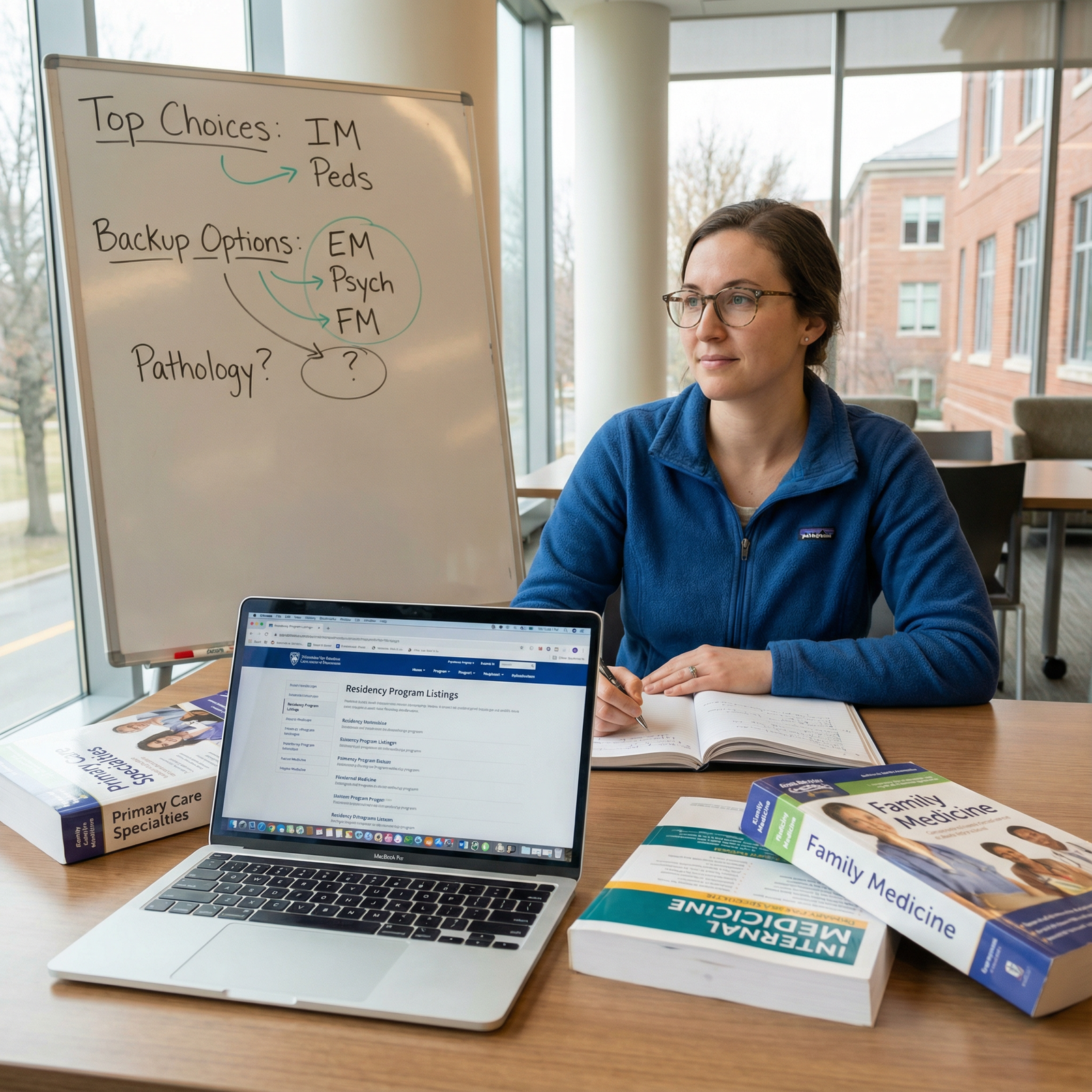
And no, choosing a backup doesn't mean you've given up on your dream. It means you're refusing to let one dream hold your entire future hostage. That's wisdom. Applicants who plan backups well aren't less ambitious. They're less reckless.
Practical Questions to Ask Before You Decide
Before you lock anything in, force yourself to answer the questions you've probably been trying to dodge.
If I don't match my advanced specialty, what exactly happens next? Not vaguely. Exactly. Do you have mentors who will help you reapply? Can you secure new letters? Are there open PGY-2 pathways that realistically fit your field? Would you be okay doing another prelim year if it came to that? Because yes, that happens, and no, it is not a cute plot twist.
Would you be okay starting and finishing a categorical backup if the door never reopens to the original plan? If the answer is absolutely not, you need to be honest about the risk of resentment. But if the answer is, "I could make a real career there," that's a powerful signal.
Then ask the unromantic questions. Do you need guaranteed training now because of loans, dependents, partner constraints, or sheer emotional survival? How geographically flexible are you, really? Not what you wish were true. What's true.
Talk to mentors, program directors, and recent graduates. Not just the superstar who matched perfectly. Talk to the person who had to SOAP, the resident who did a prelim year and re-entered the Match, the advisor who has watched five cycles of the same specialty. That's where the honest information lives.
You do not need the perfect decision. You need the decision that matches both your long-term goals and your tolerance for uncertainty. If you're deeply committed, genuinely competitive, and psychologically prepared for a bridge year, prelim can be smart. If what you need most is a stable training path and a way to keep your career moving, categorical backup is usually the better bet.
And if you're scared? Of course you are. This process scares almost everyone. The goal isn't to become fearless. It's to choose a path that still protects you even on your worst day.