
Understanding Why Backup Specialty Planning Matters for IMGs in Diagnostic Radiology
For an international medical graduate (IMG) targeting diagnostic radiology, backup specialty planning is not optional—it is risk management.
Diagnostic radiology is consistently one of the more competitive specialties. As an IMG, you often face additional barriers: visa needs, fewer “IMG-friendly” programs, limited U.S. clinical experience (USCE), and less access to home-program advocacy. A thoughtful backup strategy protects you from going unmatched while still prioritizing your radiology dream.
This IMG residency guide focuses on how to design a rational, data-driven backup plan for a diagnostic radiology applicant—especially if you are considering dual applying to a Plan B specialty. You will learn:
- How competitive radiology is specifically for IMGs
- How to objectively assess your own profile and risk
- Which specialties make logical backups for radiology and why
- How to structure a dual applying residency strategy without sabotaging your main application
- Practical timelines, examples, and action steps
Throughout, we will emphasize balance: maximizing your chances in radiology while maintaining a realistic, dignified safety net.
Step 1: Grasp the Competitiveness of Diagnostic Radiology for IMGs
Before deciding on a backup, understand the landscape you are walking into. This frames whether dual applying is highly recommended, advisable, or optional.
Diagnostic Radiology and the Match: The Big Picture
In recent match cycles (through 2024 data trends):
- Diagnostic radiology tends to have:
- High average USMLE scores among matched applicants
- Strong emphasis on U.S. letters of recommendation (LORs) and USCE
- Preference for applicants with demonstrated academic curiosity (research, presentations)
- U.S. MD seniors have relatively high match rates into radiology compared to its perceived difficulty, but:
- IMGs—especially non–U.S. citizen IMGs—consistently have lower match rates
- Visa dependence can significantly narrow program lists
While exact numbers change yearly, the pattern is stable:
For IMGs, diagnostic radiology is competitive enough that a backup specialty should be seriously considered unless your profile is exceptionally strong.
Unique Challenges for International Medical Graduates
Common IMG-specific barriers in the diagnostic radiology match include:
Limited USCE in radiology
Observerships are often unpaid and harder to obtain; true radiology electives with meaningful evaluation can be rare.Fewer IMG-friendly radiology programs
Many academic radiology departments prefer U.S. graduates; community programs may be more open, but they are fewer in number.Visa issues
Some programs do not sponsor visas or only sponsor J-1; H-1B programs are even more limited, concentrating competition.Perception issues
Program directors may have limited familiarity with your home school, grading system, or clinical environment.
These realities amplify the importance of an intelligent Plan B specialty, especially if:
- Your USMLE scores are average or below average for radiology
- You lack strong U.S.-based radiology mentors or letters
- You are applying late (e.g., graduation >5 years ago)
- You need an H-1B visa
Step 2: Assessing Your Personal Risk Profile
Your backup specialty strategy should be tailored to your risk level, not generic advice. Use the following self-assessment framework.
Key Factors to Evaluate
USMLE / Step Performance
- Step 1 (if numeric): Is your score at or above typical radiology matches?
- Step 2 CK: Often weighted heavily; > high 240s or 250+ strengthens radiology competitiveness.
- Any Step failures make radiology much riskier for an IMG.
Clinical Experience and Letters
- Do you have at least:
- 1–2 strong letters from U.S. radiologists?
- 1–2 additional solid letters from U.S. clinicians in internal medicine, surgery, or other relevant fields?
- Have you done hands-on USCE (sub-internship, externship) or mainly observerships?
- Do you have at least:
Research and Academic Profile
- Any radiology-related research, case reports, QI projects, or conference posters?
- Any U.S.-based academic involvement (even small projects) can distinguish you.
Visa and Year of Graduation
- Visa-dependent + older YOG + limited USCE = higher risk in radiology.
- No visa requirement + recent graduate + strong scores = lower risk, though a backup can still be wise.
Program List Size and Breadth
- Are you applying to:
- Broad range of IMG-friendly radiology programs?
- Including community and mid-tier academic centers?
- Can you afford to apply widely (application fees, interviews)?
- Are you applying to:
Rough Risk Categories (for Radiology as an IMG)
Lower-Risk Radiology Applicant
- High Step 2 CK (e.g., 250+)
- No exam failures
- Multiple strong U.S. letters (including radiology)
- Recent graduate (<3 years)
- Either permanent resident/U.S. citizen or flexible with J‑1
- Radiology research or meaningful exposure
Moderate-Risk Radiology Applicant
- Step 2 CK in mid-230s–240s
- Limited but some U.S. experience and one strong radiology LOR
- YOG 3–7 years ago
- Needs visa support
- Minimal research but good clinical evaluations
High-Risk Radiology Applicant
- Step failures or low Step 2 CK
- Sparse/no U.S. radiology experience
- YOG >7 years ago
- Visa-dependent and/or narrow program list
- Little or no research, few strong LORs
Implication:
- Lower-risk IMGs might consider a light dual applying strategy, with radiology clearly primary.
- Moderate-risk IMGs should strongly consider a robust dual applying residency approach.
- High-risk IMGs should treat the backup specialty almost as a co-primary focus.

Step 3: Choosing a Rational Backup (Plan B) Specialty for a Radiology Applicant
Not all backups are created equal. Your Plan B specialty should:
- Be more attainable than radiology given your profile
- Still align with your strengths and interests
- Leverage some overlapping skills or experiences (e.g., imaging-heavy fields, internal medicine base)
- Offer reasonable long-term satisfaction and career growth
Common Backup Options for Diagnostic Radiology IMGs
Below are frequently chosen backup specialties and how they align with a radiology profile.
1. Internal Medicine (IM)
Why it works as a backup:
- Typically more IMG-friendly with a high number of positions
- Many programs sponsor J-1; a reasonable number support H-1B
- You can still incorporate imaging into your career:
- Hospitalist consulting radiology frequently
- Subspecialties like cardiology, pulmonary, oncology heavily use imaging
- Academic IM often encourages imaging-related quality improvement or research.
Best for:
- IMGs with strong clinical skills, strong internal medicine rotations, and a willingness to maintain broad clinical practice.
Key strategy points:
- Obtain robust IM-focused LORs from U.S. attendings.
- Highlight both clinical performance and communication skills.
- Personal statement for IM should not sound like “I really want radiology but need a job.”
2. Transitional Year (TY) / Preliminary Medicine or Surgery
Why it can be helpful:
- Sometimes used as a bridge if you can’t match radiology advanced position but might strengthen your profile for the next cycle.
- Gives you U.S. hospital experience and opportunities for new LORs, research, networking.
Limitations:
- Not a long-term specialty solution; it’s only one year.
- You must have a plan for how to leverage that year—e.g., reapplying to radiology or pivoting to another categorical specialty.
Best for:
- Applicants who are relatively strong but just short of matching, and who can afford the uncertainty of needing to reapply.
3. Family Medicine (FM)
Why it’s a viable Plan B specialty:
- Generally more open to IMGs and visa sponsorship.
- Many community-based programs, often in underserved areas.
- You can include point-of-care ultrasound and basic imaging interpretation into your practice in some settings.
Considerations:
- Very different day-to-day from diagnostic radiology: more primary care, longitudinal outpatient relationships.
- Must genuinely appreciate patient contact and chronic disease management.
Best for:
- IMGs who enjoy broad-spectrum medicine and are open to outpatient-focused careers, including rural or underserved areas.
4. Psychiatry
Why some radiology applicants choose it:
- Often more IMG-friendly than radiology; many positions, wide geographic distribution.
- Less emphasis on procedural skills, more on communication and empathy.
- Offers good lifestyle and growing need in the U.S.
Considerations:
- Farther from radiology in content, but still an intellectually rich specialty.
- You must be truly interested; forced psychiatry applicants can appear inauthentic during interviews.
Best for:
- Candidates with evident interest in mental health, psychiatry electives, or related research.
5. Pathology (Caution)
Pathology is image-heavy and sometimes attracts radiology enthusiasts. However, for IMGs, pathology can itself be competitive in certain cycles and is not always a safer alternative, especially without pathology exposure or LORs. Additionally, job markets in some regions are tightening.
Best only if:
- You have genuine, sustained interest and experience in pathology, and you have done your homework on job prospects.
How to Pick Your Plan B Specialty Strategically
When choosing your Plan B specialty, consider:
Your Clinical Personality
- Do you like prolonged patient interactions (FM, IM) or limited patient contact (pathology, psychiatry)?
- Do you prefer inpatient complexities (IM) or outpatient continuity (FM, psych)?
Your Academic & Career Goals
- Want research and academic centers? IM and psychiatry may offer rich academic pathways.
- Open to rural/underserved practice? FM might be especially suitable.
Competitiveness vs. Radiology
- Your backup specialty must be truly less competitive for IMGs than diagnostic radiology—not just different.
Geographic and Visa Considerations
- Some specialties have more IMG-friendly options in certain regions.
- Check whether many programs in your chosen backup field sponsor visas.
Step 4: Executing a Dual Applying Residency Strategy Without Diluting Your Radiology Application
Once you’ve chosen your Plan B specialty, you must design a dual applying residency plan that:
- Presents you as genuinely committed to each field when appropriate
- Uses your experiences efficiently across both fields
- Minimizes contradictory messaging in your materials
Separate but Harmonized Application Materials
Personal Statements
- Radiology PS: Focus on your fascination with imaging, pattern recognition, analytic thinking, and prior radiology exposure.
- Backup PS (e.g., IM, FM, psych): Emphasize the aspects of your training and personality that align with that specialty.
They should:
- Be clearly distinct yet truthful.
- Avoid language that portrays the backup as “second choice” or temporary.
Letters of Recommendation
- Aim for:
- 2–3 radiology-focused LORs
- 2–3 backup-specialty-focused LORs (IM, FM, etc.)
Use ERAS to assign appropriate letters to each program:
- Radiology programs: Majority radiology LORs, maybe one strong IM/clinical LOR.
- Backup specialty programs: Majority specialty-appropriate LORs plus one strong general clinical letter.
- Aim for:
Experiences and Activities
- Research and volunteering entries can be listed once, but highlight different aspects in your personal statements and interviews.
- If you have overlapping research (e.g., QI projects using imaging in an IM department), mention:
- Radiology angle in radiology PS
- Patient-care or system-improvement angle in IM PS
Building a Coherent Narrative for Both Specialties
You need to be able to explain, in interviews:
- Why radiology is meaningful to you
- Why your backup specialty is also a strong fit, not just a fallback
Example narrative structure for an IMG dual applying to radiology and internal medicine:
- “My initial exposure to radiology came during ___, where I was drawn to the diagnostic challenges and image-based reasoning.”
- “At the same time, my rotations in internal medicine showed me the satisfaction of synthesizing complex clinical histories and managing comprehensive patient care.”
- “I see both as ways of solving diagnostic problems, one with more direct patient interaction and one with a focus on imaging. I’ve pursued experiences in both fields, and I would be honored to grow in either path.”
This feels authentic and thoughtful rather than opportunistic.
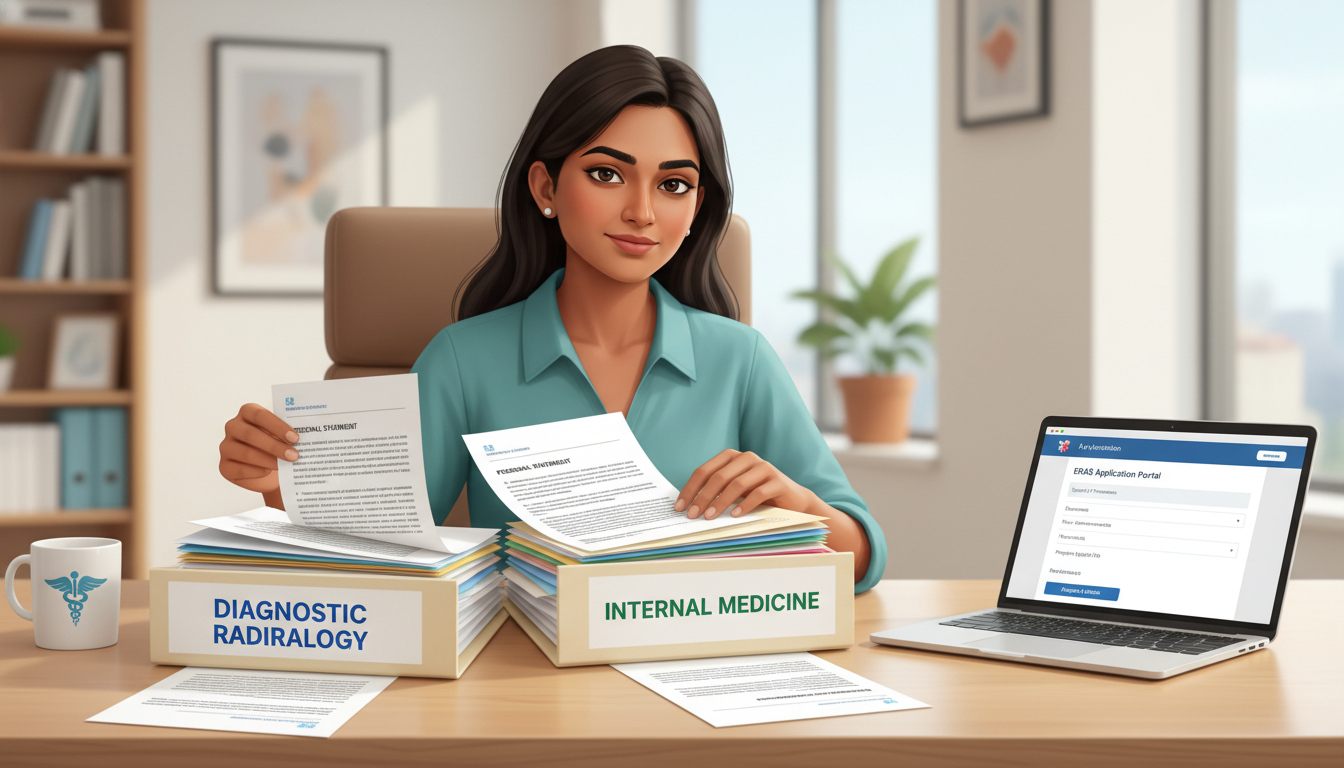
Step 5: Tactical Planning – Timeline, Program Lists, and Interview Strategy
Planning your application cycle systematically reduces stress and helps you maximize both options.
Pre-ERAS Timeline (6–12 Months Before Applying)
Clarify Your Primary and Backup Targets
- Decide early if you are dual applying (ideally 9–12 months in advance).
- Choose your Plan B specialty based on genuine interest and realistic match prospects.
Secure Appropriate Clinical Experiences
- For radiology:
- Aim for at least one rotation/observership in a U.S. radiology department.
- For backup:
- Do at least one hands-on rotation (sub‑I, externship) in IM/FM/psych, etc., to earn strong letters.
- For radiology:
Seek Diverse Mentorship
- Radiologist mentor for specialty-specific guidance.
- Backup specialty mentor for realistic appraisal of your competitiveness and help with letters.
Plan Research Strategically
- Radiology-related projects: case reports, audits, QI in imaging.
- Backup-related projects (if time allows): chart reviews, case paperwork, QI.
- Even small projects can show initiative and academic curiosity.
ERAS Season: Building Radiology and Backup Program Lists
Program Selection for Radiology
- Prioritize IMG-friendly radiology programs:
- Check past residents on program websites.
- Note visa policies.
- Include:
- Community programs
- Mid-tier academic centers
- Geographic regions more open to IMGs (often Midwest, South, certain Northeast areas)
- Prioritize IMG-friendly radiology programs:
Program Selection for Backup Specialty
- Build a broad list of programs in your Plan B field:
- Check if they routinely match IMGs.
- Confirm visa sponsorship where needed.
- Don’t limit yourself to “dream cities” here; flexibility helps you match.
- Build a broad list of programs in your Plan B field:
Balancing Applications
- Many dual applicants apply to:
- 30–80 radiology programs (or more) depending on risk profile and budget
- 30–60 backup specialty programs for moderate/high-risk applicants
The exact numbers vary, but your backup list should be substantial enough to be a real safety net.
- Many dual applicants apply to:
Managing Interviews and Rank Lists
Interview Season
- Accept nearly all radiology interview invitations; the field is competitive and interviews are limited.
- For backup specialty interviews:
- Try to accept broadly, prioritizing IMG-friendly, visa-supporting programs.
- Avoid burning bridges—each interview is valuable.
Interview Behavior
- In radiology interviews: Present yourself as genuinely radiology-focused; don’t bring up your backup plan unless directly asked.
- In backup specialty interviews: Be fully present and sincere about your interest in that field; avoid implying it is just a placeholder for radiology.
Rank List Strategy
- Rank all radiology programs where you would be happy to train above backup programs if radiology is truly your priority.
- Then rank backup programs in order of overall fit (location, program culture, visa, training quality).
- Never rank a program in any specialty that you would be truly miserable attending.
Common Pitfalls and How to Avoid Them
1. Unconvincing Commitment to Either Specialty
If your materials make you look half-hearted in both radiology and your backup specialty, both sets of program directors may pass.
Solution:
Craft specialty-specific narratives, LORs, and talking points. Show depth and insight, not generic enthusiasm.
2. Overly Narrow Program Lists
Focusing only on top-tier or big-city programs drastically increases your unmatched risk.
Solution:
Be pragmatic. Especially as an IMG, broaden geographically and include community and mid-tier academic centers.
3. Late Decision to Dual Apply
If you decide to dual apply only weeks before ERAS submission, your backup application may be weak and rushed.
Solution:
Start backup planning 6–12 months in advance so you can secure targeted rotations and letters.
4. Ignoring Visa Reality
Applying heavily to programs that do not sponsor your required visa wastes time and money.
Solution:
Filter programs carefully by their most recent stated visa policies and check resident rosters for patterns.
Putting It All Together: Example Profiles and Backup Plans
Example 1: Moderately Strong IMG, Some Radiology Exposure
- Step 2 CK: 245
- Recent graduate, J‑1 acceptable
- 1 U.S. radiology observership with good LOR
- 1 U.S. IM rotation with strong LOR
- Minor radiology research (case report)
Plan:
- Primary goal: Diagnostic radiology match
- Backup: Internal medicine
- Applications:
- Radiology: ~60–70 programs, IMG-friendly focus
- IM: ~40–50 programs
- Materials:
- Radiology PS + 2 radiology LORs + 1 IM LOR
- IM PS + 2 IM LORs + 1 general/radiology LOR (if appropriate)
Example 2: High-Risk IMG, Very Limited Radiology Exposure
- Step 2 CK: 228, one previous Step failure
- YOG: 8 years ago
- Mostly non–U.S. experience, one short radiology observership
- Needs H‑1B visa
Plan:
- Radiology remains a stretch; apply, but expect low probability.
- Co-primary focus on Family Medicine or Psychiatry, depending on interest.
- Applications:
- Radiology: ~40 programs (realistic but not excessive)
- FM or Psych: 60+ programs, heavily IMG-friendly
- Strategy:
- Heavily invest in backup specialty rotations and letters.
- Treat backup as a serious, long-term path, not “temporary.”
Final Thoughts: Building a Future-Proof Career, Not Just a Match
Backup specialty planning for an international medical graduate in diagnostic radiology is ultimately about creating options. The goal is not only to avoid going unmatched but also to:
- Enter a specialty where you can grow, contribute, and be fulfilled
- Maintain adaptability—perhaps leveraging imaging skills within IM, FM, or psych roles
- Protect your mental health and self-worth during a stressful residency match and applications period
A thoughtful dual-applying residency strategy—grounded in realistic self-assessment, careful specialty selection, and coherent storytelling—turns Plan B from a symbol of “failure” into a powerful, dignified alternative path.
FAQ: Backup Specialty Planning for IMGs in Diagnostic Radiology
1. As an IMG, do I have to dual apply if I want diagnostic radiology?
Not always, but it is strongly recommended for most IMGs. If you have very high scores, strong radiology LORs, recent graduation, U.S. citizenship/green card, and radiology research, you might apply radiology-only. However, for most IMGs—even relatively strong ones—dual applying to a more IMG-friendly specialty (such as internal medicine or family medicine) significantly reduces the risk of going unmatched.
2. Will program directors know that I applied to another specialty as a backup?
Generally, programs do not see your entire application portfolio or where else you applied. However, they might infer it from your experiences or if colleagues in other departments mention you. This is why your materials must be consistent and convincing for each specialty. During interviews, answer honestly but tactfully if asked about other specialties you considered.
3. How do I explain dual applying in interviews without sounding unsure?
Focus on your genuine interests in each field rather than presenting one as “fallback.” For radiology interviews, discuss your imaging passion and analytic strengths. For your backup specialty interviews, emphasize what attracts you to that specialty (patient interaction, breadth of disease, mental health, etc.). If directly asked, you can say you explored multiple specialties that fit your skills, but in this interview, you are seriously considering the specialty in front of you.
4. If I match my backup specialty, can I later switch to radiology?
Transitions are possible but not guaranteed and depend on open spots, program policies, and visa status. Many residents who start in IM or FM decide to stay once they build relationships and see career options. If you’re truly committed to eventually moving into radiology, you would need to:
- Excel in your current program
- Build strong U.S. credentials and relationships
- Monitor for open radiology positions or reapply through the match
This path is uncertain, so choose a backup specialty you would be willing to pursue as a long-term career if switching is not possible.