Educational disclaimer: This article is for educational purposes only and is not financial, legal, or tax advice. For guidance on compensation, contracts, benefits, or visa matters, consult qualified professionals.

Match week can go from adrenaline to free fall in about three minutes.
You open the email. Or the portal. Or your phone starts buzzing before you've even had coffee. You didn't match. Then SOAP starts moving fast, people are talking over each other, mentors are texting half-helpful advice, and suddenly you're expected to make a career decision while your brain is still trying to catch up. I've seen applicants spend the first six hours panicking and the next six pretending they have all the time in the world. Both are mistakes.
The two most common serious alternatives are straightforward:
- Take a prelim year
- Take a research year
Both can work. Both can also waste a year if you choose for the wrong reason.
At this point, you should think in layers of time:
Same day
- Stabilize emotionally.
- Review SOAP options if still available.
- Call the people who actually know your application well.
- Figure out why you likely didn't match. Not the flattering version. The real version.
First week
- Decide whether your biggest gap is clinical credibility or academic signaling.
- Secure a position, mentor, or structured plan.
- Stop doom-scrolling spreadsheets and start making decisions.
First month
- Build the next cycle on purpose.
- Set deliverables.
- Put deadlines on your calendar now, not "later."
That's the whole game after a no-match: not staying busy, but getting stronger in the exact place your application broke.
Here's the cleanest read of the landscape: prelim years tend to help when your application needs proof that you can function and impress in a U.S. clinical environment. Research years tend to help when your specialty values academic output and insider mentorship enough to materially change how programs see you.
That's not ideology. That's how programs behave.
- Recent clinical work
- Fresh evaluations
- New letters from physicians who've actually watched you perform
- Networking inside a hospital system
- A paycheck and benefits
- Publications, posters, abstracts, and presentations
- Closer access to faculty in competitive fields
- A cleaner specialty narrative if your application looked thin or unfocused
- Better signaling for specialties where scholarly output really matters
The trap is thinking either option is automatically "strong." It isn't. A weak prelim year is just exhausting service work with no advocacy attached. A weak research year is even worse: twelve months of "helping on projects" with nothing accepted, nothing submitted, and no mentor willing to make calls for you.
What usually happens by pathway?
If you choose a prelim year
You improve your odds most when:
- Your original application had decent fundamentals but weak recent U.S. clinical proof
- You need stronger letters
- You need to show maturity, reliability, and readiness
- You may want to pivot into categorical medicine, neurology, anesthesia, radiology, or another field where clinical endorsement matters a lot
If you choose a research year
You improve your odds most when:
- You are targeting highly competitive specialties
- Your publication record was light
- You lacked specialty-specific mentors
- You need a stronger "why this field" story backed by actual output
But data never lives in a vacuum. Outcomes vary heavily by:
- Specialty competitiveness
- Geographic ties
- Mentor quality
- Access to publishable work
- How strong your original board scores, grades, and letters were
- Visa limitations
- Whether your reapplication is genuinely improved or just repackaged
My blunt take: if you reapply with the same file plus one extra line on your CV, don't expect a different result. Programs notice.
Prelim Year Pathway: Month-by-Month Planning for Clinical Momentum
A prelim year is best for applicants who need to prove they belong in residency-level clinical work right now. If your issue was weak letters, limited U.S. clinical momentum, concerns about readiness, or a need for a stable bridge year, prelim can be the smart move.
At this point, you should move fast.
First 2 weeks
Your job is to secure the right spot, not just any spot.
Checklist:
- Confirm whether the prelim program has residents who successfully reapply
- Ask who can write strong letters there
- Find out whether the schedule allows elective exposure in your target field
- Clarify visa, contract, compensation, benefits, and start logistics immediately
Some prelim years are helpful. Some are just labor extraction with a badge. Know the difference.
Months 1-3
Now your goal shifts from survival to reputation.
At this point, you should:
- Show up early
- Be relentlessly reliable
- Ask for feedback before anyone has to chase you down
- Identify 2-3 faculty who actually notice your work
- Keep a running file of meaningful patient care moments and evaluations
You are building your next application in real time.
Months 4-6
This is where many applicants get lazy. Bad idea.
Now you should:
- Ask directly for mentorship
- Tell attendings you plan to reapply
- Request letters early from people who know you well
- Meet with your program leadership about strategy
- If possible, add one targeted scholarly or QI project
Months 7-10
Turn performance into application leverage.
You should be:
- Updating ERAS early
- Rewriting your personal statement around growth and proof
- Explaining your no-match year clearly, without self-pity
- Preparing for interviews with concrete examples from your prelim experience
If your prelim year ends with vague compliments and no advocate willing to call programs for you, you underused it. Simple as that.
Research Year Pathway: Week-by-Week Planning for Signal Building
A research year works best when your target specialty cares deeply about scholarly output and insider sponsorship. Think fields where publications aren't decoration; they're currency. If your file lacked specialty-specific commitment, this path can change your story fast, if you produce.
The key word is produce.
Week 1
Secure a mentor, lab, department, or research group with a track record of turning applicants into stronger applicants.
At this point, you should ask:
- How many manuscripts can I realistically touch this year?
- Will I be first author on anything?
- Who meets with me regularly?
- Have prior students from this group matched?
If they can't answer clearly, walk away.
Weeks 2-4
Define deliverables. On paper.
You should leave the first month with:
- A list of active projects
- Submission deadlines
- Authorship expectations
- Conference targets
- A recurring mentor meeting on the calendar
Passive research is a scam people tell themselves is productivity.
Months 2-6
This is output season.
At this point, you should be stacking:
- Case reports
- Retrospective studies
- Posters
- Abstract submissions
- Manuscript drafts
- Department presentations
Not every project has to be glamorous. A finished case report beats an imaginary landmark paper every time.
Late year
Now convert activity into interview fuel.
You should:
- Ask mentors for strong, specific letters
- Make sure your CV reflects accepted, submitted, and presented work accurately
- Build a coherent narrative linking your research to your specialty choice
- Practice talking about your projects like someone who did them, not someone who watched

A research year without deadlines, authorship clarity, and visible products is one of the easiest ways to lose a cycle. I've seen it happen. Smart people. Good intentions. No output. Then September arrives and the application still looks thin.
How to Choose: Decision Criteria, Risk Factors, and a Practical Comparison
Choose the option that fixes the reason you didn't match. Not the option that feels more respectable. Not the one other applicants hype online. The one that closes your gap.
Use this framework.
Choose a prelim year if you need:
- Fresh clinical letters
- Demonstrated U.S. residency performance
- Income and benefits
- Clinical skill retention
- A more credible reapplication in a less research-driven specialty
Choose a research year if you need:
- Publications
- Specialty-specific mentorship
- A stronger academic identity
- Better signaling for a competitive field
- Time to rebuild your narrative without clinical overload
Risk factors that should influence the decision:
- Burnout: if you're cooked, a brutal prelim may make you worse, not better
- Finances: a research year with weak funding can create ugly pressure fast
- Visa status: this can narrow your realistic options immediately
- Mentorship access: no mentor, no plan
- Specialty flexibility: prelim often preserves broader clinical optionality
My rule is simple: pick the path that directly repairs your weakest application variable. Anything else is just motion.
Action Plan After the Decision: 30-Day Checklist and Next-Cycle Preparation
Once you choose, stop revisiting the decision every night. Commit and build.
Days 1-7
- Finalize position, mentor, or project structure
- Notify your key recommenders and advisors
- Build a master calendar through ERAS season
- Review finances, housing, insurance, and any contract terms that affect your timeline
- Write down exactly why you didn't match
Days 8-14
- Set 3-5 measurable goals for the year
- Schedule recurring mentor check-ins
- Draft your reapplication improvement plan
- Start a document for experiences, feedback, and accomplishments
Days 15-30
- Update your CV
- Map your future letter writers
- Identify target programs and geographic strategy
- Start revising your personal statement early
- Build an interview practice plan, not just an application plan
Before the next ERAS cycle, you should have:
- A deliberate letter strategy
- A sharper personal statement
- Specialty-specific targeting
- A clear explanation of growth after no match
- Real evidence that this year changed your candidacy
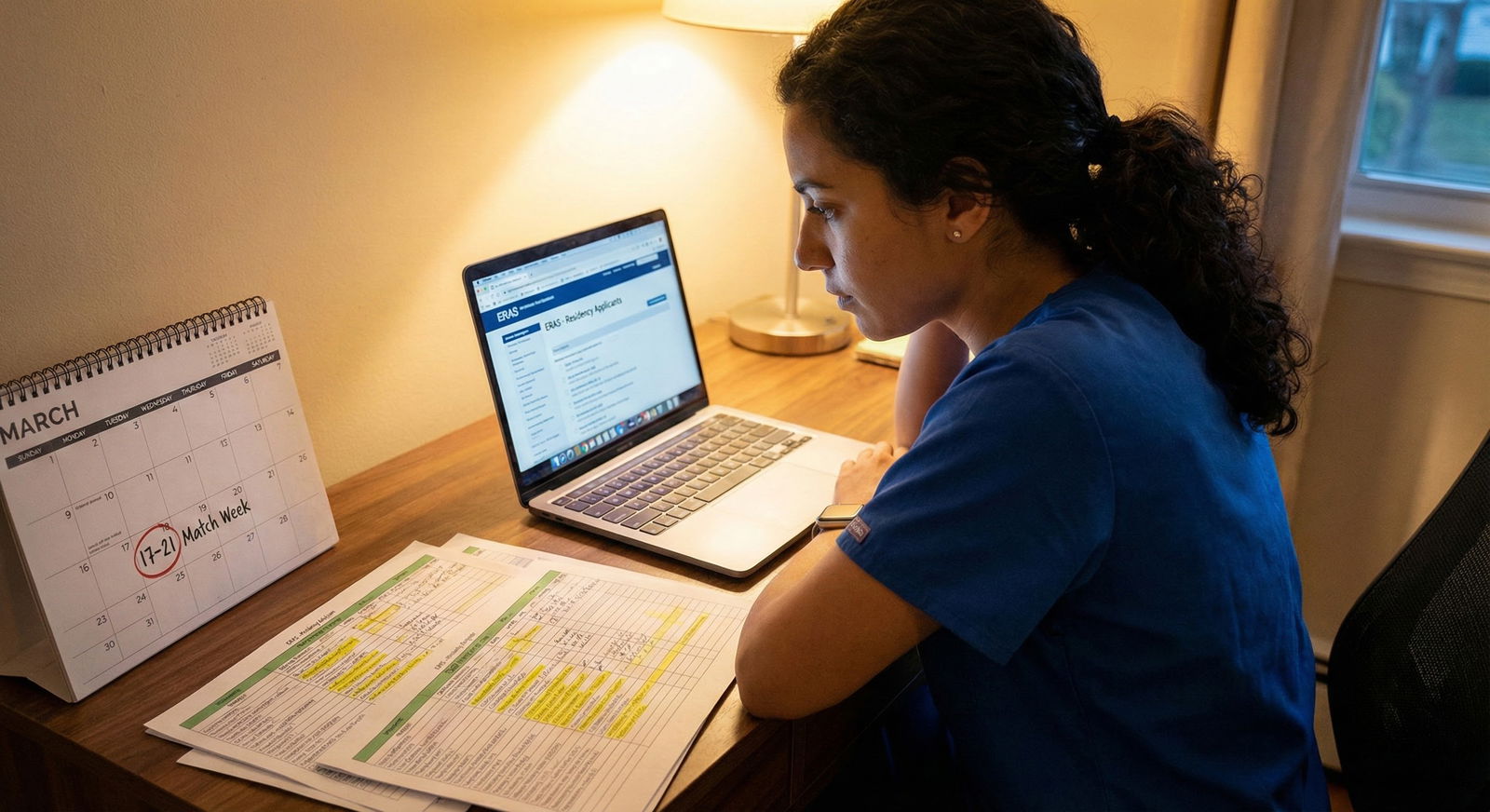
Here's the summary that matters: after a no-match, the best next step is the one that creates the strongest story by application season. Prelim year is usually the right bridge when you need clinical proof, fresh letters, and visible readiness. Research year is usually the right bridge when you need publications, mentorship, and a stronger specialty signal.
At this point, you should be asking one question only: what would make a program believe I'm a safer, stronger, more obvious yes next time?
Answer that honestly, and the right path usually stops being mysterious.