
You did not match categorical. That hurts. But the bigger mistake is to treat a prelim year like a consolation prize instead of a weapon.
Used correctly, a preliminary year can massively upgrade your chances the next cycle. Used badly, it can trap you in limbo: exhausted, with no categorical spot, weak letters, and a reputation for being “average but hard‑working.”
You do not want that label.
Let’s go step by step so you use a prelim year strategically—not emotionally.
1. First, Be Clear On What a Preliminary Year Actually Is (And Is Not)
A lot of residents I talk to cannot define “prelim” beyond “one year and then figure it out.” That vagueness is how people waste the year.
What is a prelim year?
A preliminary year is a one‑year residency position in a core specialty (most commonly Internal Medicine, General Surgery, or Transitional Year) that:
- Satisfies the PGY‑1 requirement for advanced specialties (e.g., Neurology, Anesthesiology, Radiology, Derm, PM&R).
- Can provide US clinical experience, letters, and evaluations for reapplying to the Match.
- Does not guarantee continuation in that same program as a categorical resident.
Think of it as:
“One year on the inside of the hospital system, paid, evaluated, and watched.”
That “watched” part is either your curse or your biggest asset.
Prelim vs categorical vs transitional
| Type | Length | Goal | Guarantees Continuation? |
|---|---|---|---|
| Preliminary IM/Surg | 1 year | PGY-1 for advanced or reapply | No |
| Categorical IM/Surg | 3+ yrs | Full training to board-elig. | Yes |
| Transitional Year | 1 year | Broad PGY-1, usually cushier | No |
Key point: A prelim year is a tool, not a destination. You must decide what you want that tool to do.
2. Decide Right Now: What Is Your Actual Target?
If you do not choose an explicit target, you will drift. Busy, tired, and directionless. And then it will be December, and your application will look like you just “worked hard.”
Your prelim year strategy depends on one key decision:
Are you trying to (1) get into the same specialty, (2) pivot to a different specialty, or (3) secure an advanced spot that requires a prelim?
Break it down.
Path A: You still want the same specialty
Examples:
- You applied categorical IM, did not match, now have a prelim IM spot.
- You applied categorical General Surgery, did not match, now have a prelim Surgery spot.
Your goals:
- Prove that you can function as a strong categorical resident in that field.
- Generate killer letters from people whose names programs recognize.
- Fix whatever sank you last cycle: scores, lack of research, weak narrative, poor interviewing.
Path B: You are pivoting specialties
Examples:
- Did not match categorical Emergency Medicine; now have a prelim IM.
- Did not match categorical Surgery; thinking about Anesthesia, PM&R, FM.
Your goals:
- Show you can succeed clinically in a core year.
- Build relationships and letters in the new target specialty.
- Demonstrate a coherent, believable story for the switch.
Path C: You need the prelim year for an advanced position
Examples:
- Matched into Radiology or Anesthesiology advanced, but this question is more often: you are re‑applying to those because you did not match this year.
Your goals:
- Keep your record clean—no professionalism issues, no “barely passing” evaluations.
- Get letters that say, “I would trust this resident in any specialty.”
- Align your schedule and experiences with your target field (e.g., ICU, OR time, radiology‑heavy rotations).
3. Before July 1: Set Up The Chessboard
You have a window between Match Week and the start of residency. Use it. This is prep time.
Step 1: Autopsy your failed match
Brutally honest. No sugar‑coating.
Make a simple table and fill it in:
| Area | Last Cycle Reality | Needed for Competitiveness |
|---|---|---|
| Step scores | e.g., Step 1 pass, Step 2 220 | Many programs 240+ |
| Grades/MSPE | e.g., Mostly High Pass | Honors or strong narrative |
| Letters | Generic, 2 from non‑academic faculty | Strong, detailed, from known names |
| Research | None | 1–2 pubs preferred for specialty |
| Interviews | 3 interviews, no offers | 10–12 for decent shot |
Ask at least one honest mentor or advisor to look at your prior ERAS and tell you what was weak. If they give you vague feedback (“just keep trying”), push:
“What would make my application clearly stronger one year from now?”
Step 2: Clarify your one‑year goals on paper
Your prelim year plan must be written, not just in your head.
Example for someone reapplying to IM:
- Letters: 3 new IM letters from faculty who supervised me directly, at least 1 from program leadership.
- Clinical: “Exceeds expectations” or top 1/3 evaluations on all core rotations.
- Research: 1 retrospective chart review or QI project submitted by February.
- Application: ERAS updated with concrete evidence of growth, including specific cases, leadership roles, and feedback.
You are not “hoping” to get these. You are planning toward them.
Step 3: Before orientation, email your PD and chief residents
Not a 10‑paragraph saga. A concise, professional message.
Something like:
Dear Dr. X,
I am very grateful for the opportunity to join the program as a preliminary intern this year. My long‑term goal is to pursue categorical training in Internal Medicine, and I hope to make the most of this year to grow clinically and contribute meaningfully to the residency.
I would appreciate any guidance on:
- Rotations or teams where I can learn the most and work closely with faculty known for teaching and mentorship.
- Opportunities for QI or research that would be feasible to complete within the year.
Thank you again for this opportunity.
Sincerely,
[Name]
Why this works: you mark yourself early as intentional, not just a body to plug call holes.
4. Month‑by‑Month Game Plan: How To Use Your Prelim Year Strategically
Now the part you actually need: a concrete timeline.
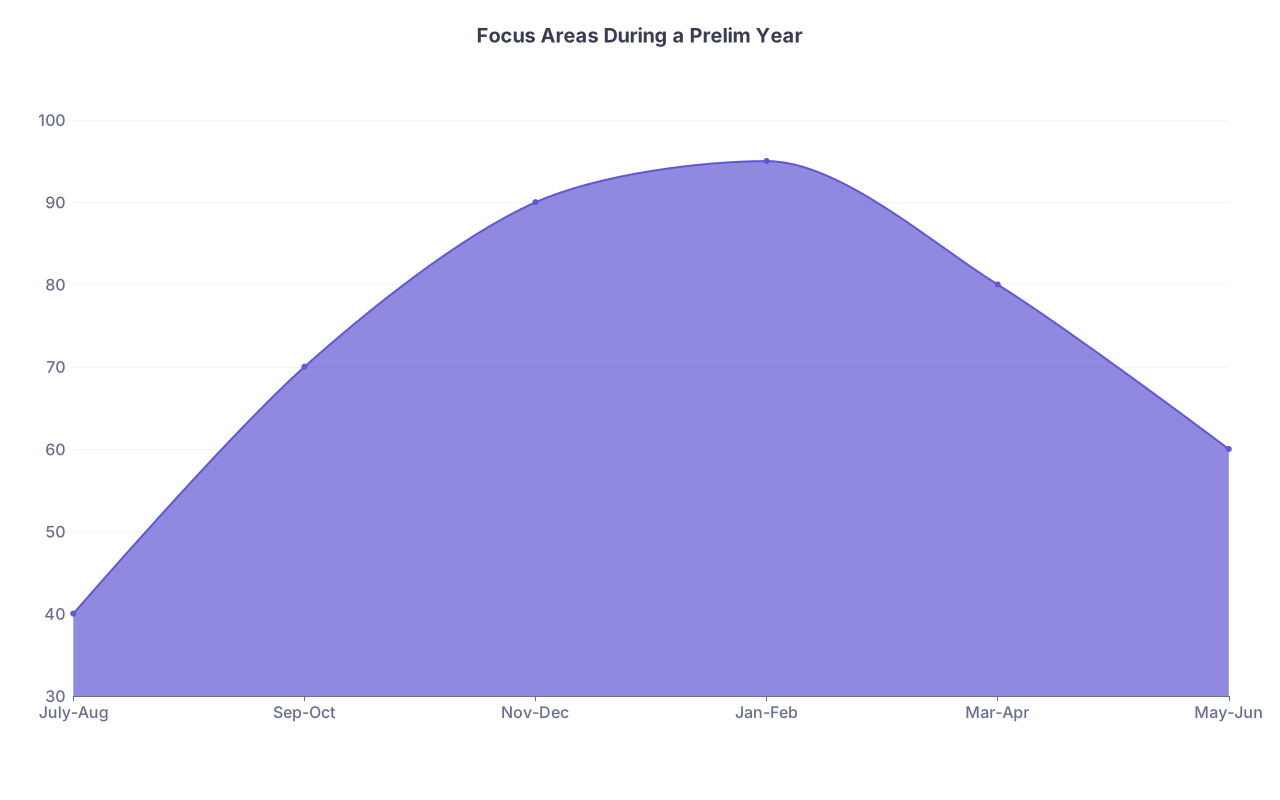
| Category | Value |
|---|---|
| July-Aug | 40 |
| Sep-Oct | 70 |
| Nov-Dec | 90 |
| Jan-Feb | 95 |
| Mar-Apr | 80 |
| May-Jun | 60 |
Think of this as your default blueprint. You will adjust for your specific schedule.
July–August: Prove you are safe and reliable
Your only job for the first 2 months: be the intern no one has to worry about.
Focus:
- Show up early. Know your patients better than anyone else.
- Learn the EMR fast. Become the person who can get orders, notes, and discharges done without drama.
- Ask seniors, explicitly: “What do you expect from a strong intern on this team?” Then actually do that.
Strategic moves:
- Identify 2–3 attendings per month who seem fair, engaged, and respected. These are future letter writers.
- End each rotation with: “Do you have any feedback on how I can be stronger as a resident?” and write down what they say. Then fix it on the next block.
Red flag here: if you get called out for lateness, sloppy notes, or missing tasks in July–August, you have dug a hole you will spend the rest of the year climbing out of.
September–October: Quietly line up advocates and projects
You are still working hard clinically, but now you start playing the long game.
- Ask for mentorship meetings
Target: a PD, APD, or respected faculty member in your specialty of interest.
You say something like:
“I am a preliminary intern planning to reapply to [specialty]. I would appreciate 20–30 minutes of your time to get your advice on how to make the most of this year so that I can be a strong candidate next cycle.”
At that meeting, you:
- Briefly outline your previous application and where you fell short.
- Present your specific goals for the year.
- Ask: “What would you focus on if you were in my position?”
It does not need to be glamorous. But it must be:
- Achievable within 6–9 months.
- Supervised by someone who can speak to your work ethic.
- Concrete: QI, chart review, case series, curriculum project.
Examples:
- A QI project on decreasing 30‑day readmissions in CHF patients on your IM service.
- A chart review on outcomes after a common procedure in Surgery.
- A protocol improvement project in the ICU or ED.
You do not need to be first author in NEJM. You need to be able to write in your ERAS:
“Led QI project that reduced XYZ by 15%; presented at regional meeting; manuscript in preparation.” That reads as growth.
November–December: Build your new application while you are still in the trenches
This is where many prelims blow it. They assume they can work full time, do calls, and then magically assemble ERAS in their “free time.”
You cannot. You must schedule this like another rotation.
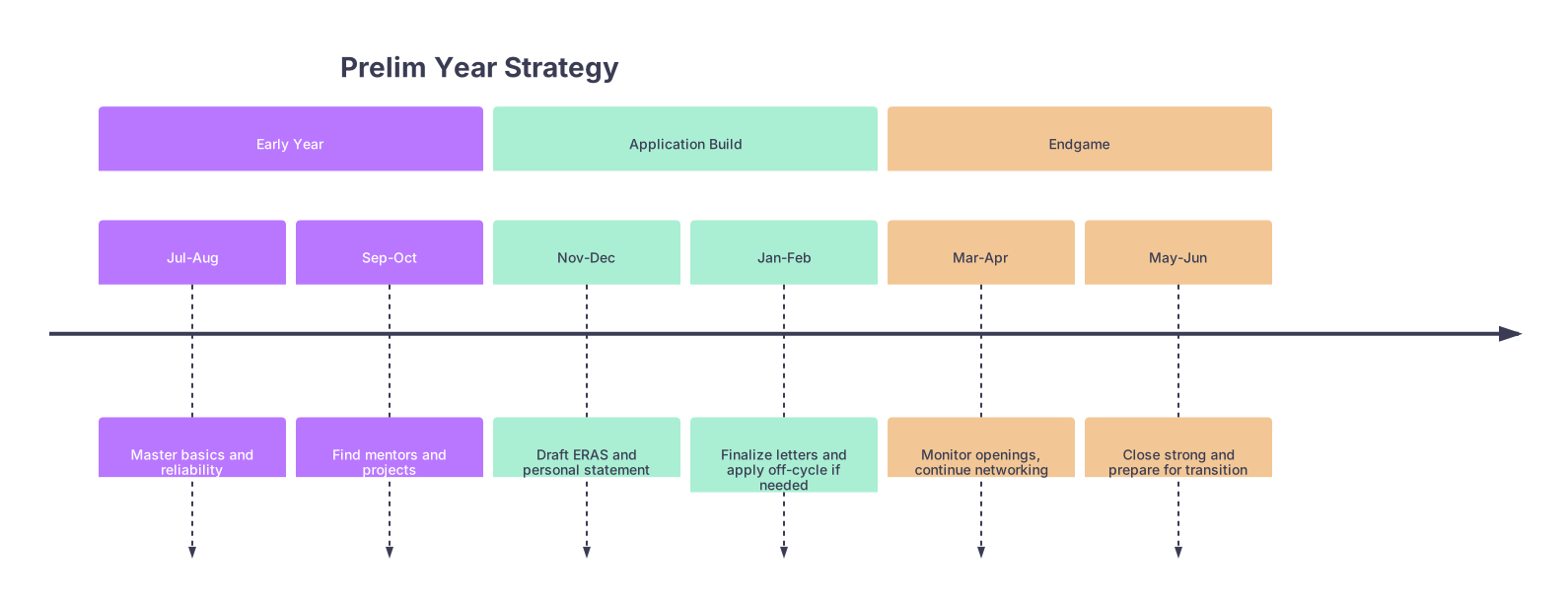
| Period | Event |
|---|---|
| Early Year - Jul-Aug | Master basics and reliability |
| Early Year - Sep-Oct | Find mentors and projects |
| Application Build - Nov-Dec | Draft ERAS and personal statement |
| Application Build - Jan-Feb | Finalize letters and apply off-cycle if needed |
| Endgame - Mar-Apr | Monitor openings, continue networking |
| Endgame - May-Jun | Close strong and prepare for transition |
Key tasks in this period:
- Rewrite your personal statement
Your new statement cannot be a recycled version of last year’s. It must:
- Reflect what you learned as an intern.
- Show specific patient encounters that shaped your understanding.
- If changing specialties, give a tight explanation that does not sound like “I just want a better lifestyle.”
- Update your CV and ERAS activities
Add:
- Concrete clinical responsibilities.
- Any teaching roles (e.g., teaching students on service).
- Early outputs from your project (even if “abstract submitted” or “manuscript in progress”).
- Identify your letter writers and ask early
By December, you should know who your top 3–4 attendings will be.
You ask them directly:
“Would you feel comfortable writing me a strong letter of recommendation for [specialty] based on our work together this year?”
If they hesitate, you do NOT use them. You find someone else. A lukewarm letter will quietly kill your application.
January–February: Start acting like an applicant again
If you are reapplying in the same cycle (for PGY‑2, PGY‑1 again, or advanced spots), this is heavy lifting time.
Your focus:
- Get letter writers all materials they need: CV, draft personal statement, and bullet points of things you did with them.
- Meet with your PD / APD again. Explicitly say:
“I am planning to apply to [categorical/advanced X]. I would value your honest opinion on where I am competitive and how best to represent our program.”
Depending on your field, January–February may also be crucial for:
- Off‑cycle openings (more on this soon).
- Networking with other programs via email, conferences, or virtual meetings.
March–June: Keep doors open and finish strong
Two traps here:
- Some interns mentally “check out” after ERAS is in. Their evaluations drop. Their attitude sours. Programs notice.
- Others burn out and start making clinical mistakes.
Your priorities:
- Maintain or improve your evaluation trend. Programs look for consistency.
- If you are staying in the same institution (e.g., converting to categorical), these last few months are when PDs decide how badly they want to keep you.
- If you are leaving, you still need clean final evaluations. No last‑minute professionalism headaches.
5. Off‑Cycle Spots, SOAP, and In‑House Conversion: How To Actually Land the Categorical Position
Prelim years open a few doors that you did not have as a student. But only if you push them.
A. Converting to categorical in your own program
This happens more than programs admit.
Scenarios:
- A categorical resident drops out, transfers, or fails.
- The program receives funding to expand by a spot.
- Leadership decides they want to “upgrade” a strong prelim into categorical.
- Make it clear to leadership (PD, APDs) by mid‑year that you want to stay categorical if a spot opens.
- Back that up with top‑tier evaluations and visible professionalism.
- Avoid social drama. If your name shows up in gossip, you are less likely to be “the safe choice” for that open spot.
What you do not do:
- Harass the PD monthly asking, “Is there a spot yet?”
- Bad‑mouth other residents or programs. That always comes back.
B. Off‑cycle PGY‑2 and PGY‑1 openings
Not everything goes through the main Match or SOAP. Programs post unexpected vacancies.
Common sources:
- A resident resigns or is dismissed.
- New funding lines.
- Program expansion.
You watch for these on:
- ACGME or NRMP vacancy listings.
- Specialty‑specific listservs and social media (for example, EMRA, APDIM, SOAP‑specific forums).
- Word of mouth from your attendings and chiefs.
When you see a relevant opening:
- Have a ready‑to‑go packet: CV, personal statement, 2–3 letters, score reports.
- Ask your PD if they are comfortable making a phone call or sending a brief endorsement. A PD‑to‑PD email carries much more weight than your cold email.
C. SOAP: If you still do not have a categorical by Match Week
SOAP as a prelim is tricky but not hopeless.
Key SOAP rules for prelims:
- You must meet NRMP SOAP eligibility (registered, unmatched or partially matched, etc.).
- Programs know you are already functioning as an intern. That is an advantage.
- But they also know if your own PD did not fight to keep you. That raises questions.
How to approach SOAP strategically:
Talk to your PD early (Jan/Feb):
- “If I remain unmatched in categorical by Match Week, would you be willing to advocate for me during SOAP?”
- If they hesitate, you have some work to do.
Target a mix of realistic programs
Not just big‑name places. SOAP is about getting a seat at the table, not prestige shopping.Have your narrative ready
Programs will ask: “Why prelim? Why no categorical yet?”
Your answer cannot be, “The Match is random.”
You say something like:“I applied broadly last year but had weaknesses in [X]. This year I focused on [specific improvements]. As a preliminary intern I have demonstrated [list concrete performance outcomes]. I am looking for a program where I can continue to grow and contribute at a categorical level.”
6. How To Behave As a Prelim So People Actually Want To Keep You
This is where I have seen people crash.
You need to thread a needle:
- Work hard without martyrdom.
- Be ambitious without stepping on people.
- Be visible without being annoying.
Here is the behavioral checklist.
Do these consistently
Own your patients
Know every lab, imaging, med change. When an attending asks, “Why is Mr. X on this anticoagulant?” you have an answer, not a guess.Communicate clearly and early
If something is delayed or complicated, tell your senior or attending before they hear it from nursing.Accept feedback like an adult
No eye‑rolling. No defensiveness. “Thank you, I will work on that,” followed by you actually fixing it.Help co‑interns when you can
Be the person who stays 15 minutes to help with a discharge so someone else can get home. People remember that when a spot opens.
Avoid these career‑suicide moves
- Complaining constantly about being a prelim.
- Saying things like, “I am just here for the year” or “I am really a [other specialty] person.”
- Gossiping about residents or faculty.
- Picking open fights with nursing or consultants.
One unprofessional incident documented in your file can hurt you more than a 220 Step 2.
7. Special Situations: Low Scores, IMG Status, or Major Red Flags
Some of you are not starting from a neutral playing field. You know it. Programs know it. You cannot pretend otherwise.
If your test scores are low
You cannot magically fix them if you already graduated and used your attempts. So your strategy shifts.
You must:
- Show extremely strong clinical performance.
- Gather letters that explicitly state: “Despite modest standardized test scores, this resident performs at or above the level of their peers clinically, with excellent judgment and work ethic.”
If you still have an exam left (e.g., Step 3):
- Do not take it casually during an ICU month.
- Take it during a lighter rotation, prepare properly, and aim to outperform your prior pattern. A significantly stronger Step 3 can soften earlier numbers.
If you are an IMG or non‑US grad
Your prelim year is your US credibility year. Everything you do is either confirming or disproving stereotypes about IMGs in the minds of program leadership.
Tactics:
- Impress not just faculty, but also nursing, case management, pharmacists. Word spreads.
- Be proactive in asking: “Am I on track for a strong letter from you?”
- Target community and university‑affiliated programs that historically take IMGs.
If you have a professionalism or failure red flag
You must face it directly.
Concrete moves:
- Ask your PD directly: “Is there anything in my record you believe I need to address explicitly in my application?”
- Get at least one letter that explicitly says something like:
“There were initial concerns regarding X, which the resident has addressed by [specific behavior change]. Over the year, I have seen consistent professionalism and reliability.”
Programs hate unexplained smoke. Either show the fire is out, or they assume it is still burning.
8. Quick Reality Check: When A Prelim Year Is Not Enough
Sometimes, even using a prelim year perfectly will not get you into certain hyper‑competitive specialties. Dermatology. Plastic surgery. Ortho. ENT.
You need to be honest with yourself:
- If you struck out once with multiple red flags, and you are now prelim IM with zero research in that field, the odds of flipping into Derm are microscopic.
- You may need to rethink your target: consider a different specialty where your prelim year is a direct asset (IM, FM, Anesthesia, PM&R, etc.).
This is not failure. It is adaptation. The real failure is wasting 2–3 more years chasing a door that is bolted shut while ignoring open doors right next to you.
FAQs
1. Should I reapply during my prelim year or wait until after I finish it?
If you already graduated from medical school, you almost always apply during your prelim year for the next available cycle. Waiting an extra year just creates an unexplained gap unless you have a high‑yield reason (extensive research year, serious personal circumstance). The key is to have your ERAS draft, letters, and strategy started by late fall of your prelim year, not scrambling in July.
2. Is a Transitional Year better than a prelim IM or Surgery year?
Transitional Years are typically cushier and broad, which can be great for lifestyle and Step 3 prep. However, for many core specialties (Internal Medicine, Surgery) and some advanced ones, a Prelim IM or Surgery year carries more clinical weight. If your main goal is to prove you are a strong inpatient clinician and secure categorical IM or Surgery, a Prelim IM/Surg year is usually more strategic than a cushy TY.
3. Can strong letters from my prelim year overcome a low Step score?
They can help a lot, but they are not magic. For moderately low scores (e.g., Step 2 CK in the 220s for IM), consistently excellent clinical evaluations and powerful, detailed letters can absolutely get you interviews and matches at many programs. For truly low or multiple‑attempt scores, letters are necessary but may not be sufficient for highly competitive or academic programs. You will need to be realistic about where you apply and possibly broaden your specialty targets.
4. What should I do if my prelim program is toxic or unsupportive?
You still need to protect your record. That means: remain professional, avoid emotional blow‑ups, document serious issues appropriately, and find at least 1–2 faculty who can vouch for you. Meanwhile, aggressively look for openings elsewhere (PGY‑2, new prelim, or categorical positions) and build connections outside your current program—through conferences, virtual events, and networking via mentors from medical school. Leaving a toxic environment is reasonable, but you must leave with clean evaluations and at least a couple of solid letters if you want other programs to take a chance on you.
Key points to carry forward:
- A prelim year is not a consolation prize; it is a one‑year audition that can radically improve or permanently stall your career.
- You need a written, specific plan for letters, projects, evaluations, and reapplication tasks starting before Day 1.
- How you behave—as a reliable, teachable, professional intern—matters more than any speech you give about “how badly you want this.” Programs believe what you do, not what you say.