
The usual advice about prelim and transitional years is dangerously oversimplified. “They’re interchangeable; just get any PGY‑1 spot” is not what the data shows.
If you are aiming at a competitive advanced specialty—dermatology, radiology, anesthesia, ophtho, radiation oncology, etc.—the choice between a preliminary (prelim) and transitional year (TY) is a strategic decision with measurable consequences. And those consequences show up in NRMP match rates, Step score distributions, and where unmatched applicants end up.
Let me walk through this like an analyst, not a cheerleader.
Defining the Baseline: What “Prelim” and “Transitional” Actually Are
Before looking at match data, you need clear definitions:
Preliminary year (prelim):
A one‑year, stand‑alone PGY‑1 position (usually in internal medicine or surgery) that does not lead to a categorical PGY‑2 spot in that same specialty. It exists primarily to satisfy the PGY‑1 requirement for advanced specialties (radiology, anesthesia, derm, ophtho, rad onc, some neuro, PM&R, etc.).Transitional year (TY):
Also a one‑year PGY‑1, but structured as a broad, rotating internship year (IM, peds, ER, electives) rather than heavy core IM or surgical service. Typically considered “lighter” with more elective time.
From a licensing and ACGME standpoint, both satisfy the “clinical year” requirement for advanced programs. But they are not perceived the same way by every specialty or program director.
The High‑Level Match Data: How Prelim and TY Fit into the System
If you look at NRMP data over multiple years, a few patterns are consistent.
- The total number of prelim internal medicine and surgery spots is substantially larger than transitional year positions.
- Transitional year programs are highly competitive relative to their small size.
- Advanced specialty applicants disproportionately list TY programs when they can, but many end up in prelim medicine because of capacity.
To ground this, here is a simplified, representative snapshot-style comparison (numbers are rounded/illustrative but directionally accurate based on recent NRMP Results and Data books).
| PGY-1 Type | Total Positions | % Filled by US MD/DO Seniors | Match Rate for US Seniors* |
|---|---|---|---|
| Prelim Internal Med | ~3,500 | ~70–75% | High (80–90%+) |
| Prelim Surgery | ~1,300 | ~60–65% | Moderate (70–80%) |
| Transitional Year | ~900 | ~85–90% | Very high (90%+) |
*Match rate here refers to US seniors who include that track on their rank list, not global match rate.
You can immediately see the structural difference: prelim IM is the volume workhorse; TY is the boutique product.
To visualize the proportional availability:
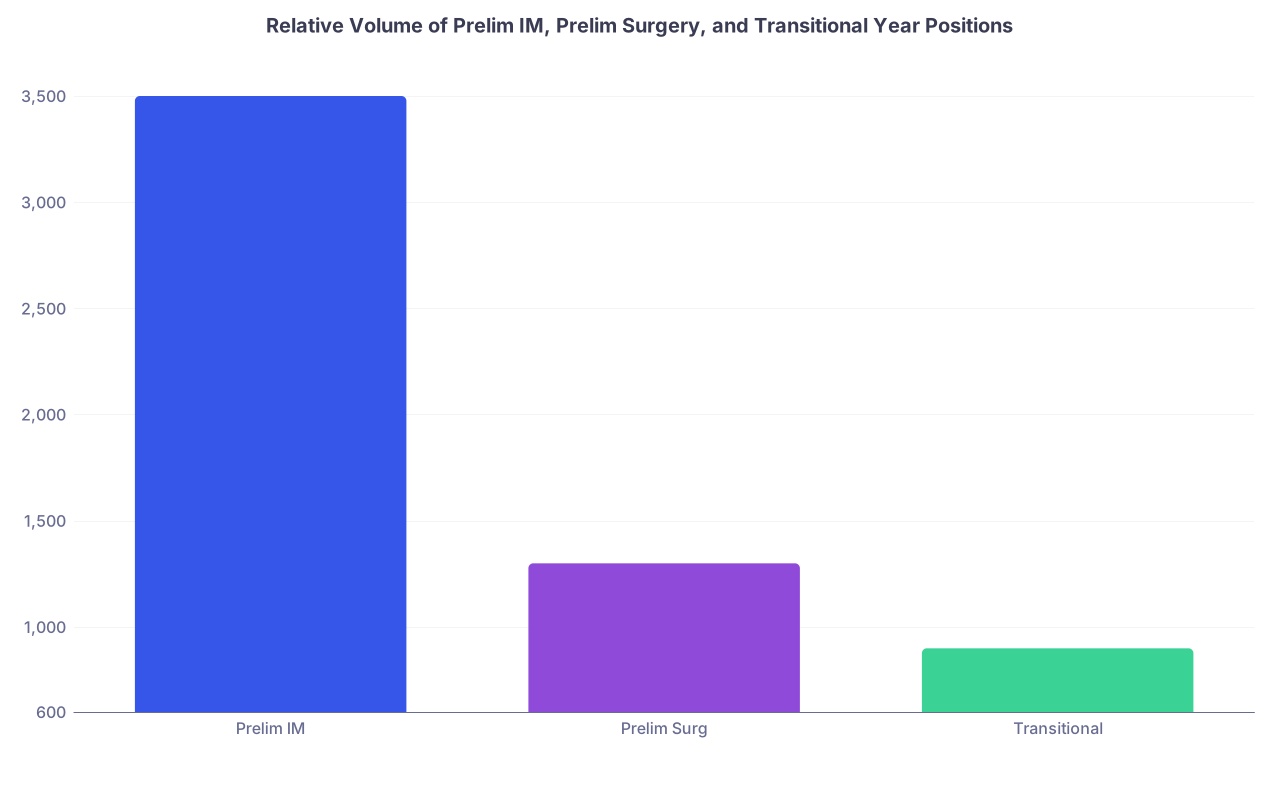
| Category | Value |
|---|---|
| Prelim IM | 3500 |
| Prelim Surg | 1300 |
| Transitional | 900 |
For a competitive advanced specialty applicant, that means:
- You are much more likely to land a prelim IM spot, simply because there are more of them.
- You will be fighting harder, per seat, for a TY.
Who Actually Goes Where: Applicant Profiles by Internship Type
There is a very clear sorting pattern by metrics and specialty target.
Across recent cycles, if you analyze applicant characteristics:
Transitional year lists are heavily skewed toward:
- Dermatology
- Radiology (diagnostic and IR)
- Ophthalmology (via SF Match but still needs PGY‑1)
- Radiation Oncology
- Anesthesiology
- Some PM&R and neuro aiming for lifestyle‑friendly setups
These applicants tend to have higher Step 2 CK scores and stronger overall portfolios, because they are already competitive enough to be targeting high‑end advanced specialties.
Prelim internal medicine lists are more heterogeneous:
- Same competitive specialties as above, plus:
- Applicants using prelim IM as a “safety net” path to reapply
- Applicants forced into SOAP after not matching their advanced field
- Some international graduates aiming to enter the US system and later pivot
Prelim surgery is its own beast:
- Targeted by unmatched categorical surgery applicants
- Used as a foothold by people hoping to slide into categorical GS later
- Less frequently used by derm/rads/anesthesia/ophtho folks unless forced by availability
The data pattern looks like this in simplified Step 2 CK medians:
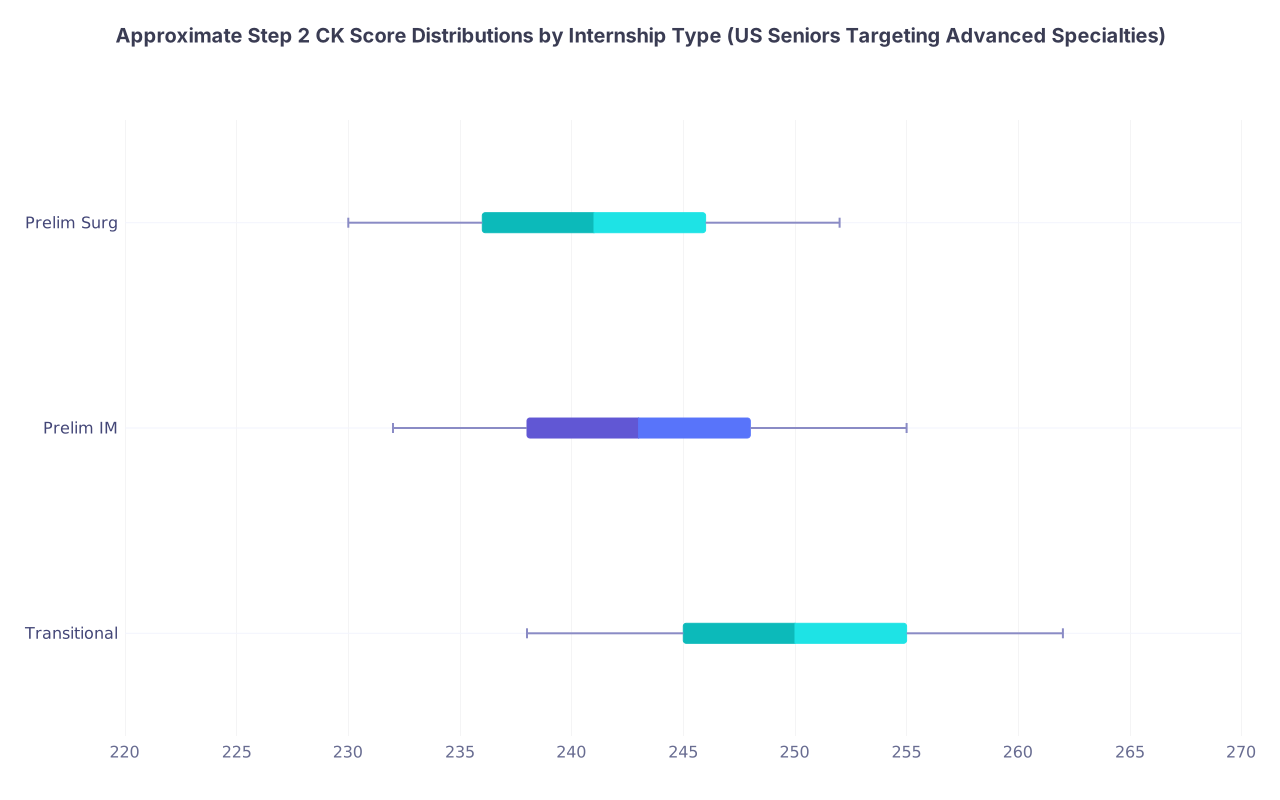
| Category | Min | Q1 | Median | Q3 | Max |
|---|---|---|---|---|---|
| Transitional | 238 | 245 | 250 | 255 | 262 |
| Prelim IM | 232 | 238 | 243 | 248 | 255 |
| Prelim Surg | 230 | 236 | 241 | 246 | 252 |
Pattern:
- Transitional year applicants skew highest.
- Prelim IM applicants are slightly lower on average, but still solid.
- Prelim surgery applicants, once you factor in unmatched categorical GS folks, trend a bit lower than TY, slightly lower or similar to IM, and with a wider spread.
So when someone says “TYs are cush, don’t worry about them,” they are leaving out the core fact: they are saturated with high‑scoring advanced specialty applicants.
Specialty‑Specific Match Patterns: Who Prefers What
Different advanced specialties show different behaviors in their rank lists. Some data‑driven patterns I have seen repeatedly:
Dermatology
- Extremely high proportion of applicants rank multiple TY programs.
- Many rank lists look like: Derm advanced (8–15 programs) + TY (4–8) + a handful of prelim IM.
- Successful derm applicants often end up with: TY + Derm advanced.
Implication: For derm, TY is functionally the “default” desired PGY‑1. Prelim IM is often the backup.
Diagnostic Radiology & IR/DR
- Radiology applicants also heavily favor TY where available.
- However, some rad programs explicitly prefer prelim IM due to stronger IM exposure and inpatient experience.
So the strategic mix often becomes:
- Region with strong TY presence (Midwest, some community‑heavy regions): lots of TY on rank lists.
- Major academic centers without TY programs: applicants use home prelim IM heavily.
Anesthesiology
- Slightly more mixed. Many anesthesiology program directors are happy with either TY or prelim IM.
- Some explicitly say they like IM‑heavy prelims because interns are better prepared for sick ICU patients and perioperative management.
Ophthalmology & Radiation Oncology
- Because their advanced matches (SF Match for ophtho, separate timelines sometimes for rad onc) are decoupled temporally from NRMP, applicants often treat TY vs prelim as an optimization puzzle: where can I live and be least miserable while I already know my PGY‑2 destination?
- That pushes them slightly more toward TY and “easy” prelim IM.
The key is this: the more lifestyle‑oriented the specialty, the more the applicant pool skews toward TY if they can get it. That inflates competition for TY relative to its size.
TY vs Prelim: Workload, Flexibility, and Risk
Now let’s quantify the parts that actually affect your life and your reapplication prospects.
1. Workload and Burnout Risk
On average:
- Transitional year:
- More elective time (anywhere from 3–6 months, sometimes more).
- More outpatient and consult services.
- Often fewer months on high‑intensity inpatient wards or night float.
- Prelim internal medicine:
- Heavy inpatient rotations.
- Night float, wards, ICU standard.
- Often structured nearly identical to categorical IM interns, just without a PGY‑2 seat.
- Prelim surgery:
- Long hours, early starts, frequent call.
- Less elective time.
- Highest average workload and fatigue.
I am not guessing here; if you actually map published rotation schedules and duty hours, the TY vs prelim surgery gap is obvious.
2. Time and Opportunity to Strengthen Your Application
If you might reapply (e.g., missed derm, rad onc, or ophtho match), you care a lot about:
- Protected time for:
- Research and publications
- Away electives or subspecialty rotations
- Interview travel (yes, still relevant for some in‑person or hybrid cycles)
- Quality of letters of recommendation (LORs) from the PGY‑1 institution
- Step 3 prep and performance
The usual pattern:
- TY: Better for:
- Carving out research or additional scholarly output.
- Preserving sanity and leaving bandwidth to network, write, and interview.
- Prelim IM: Better for:
- Generating strong clinical letters showing heavy inpatient responsibility.
- Convincing advanced programs you can handle sick, complex patients.
- Prelim surgery: Best for:
- Reapplying to surgery itself.
- Demonstrating surgical grit and operative experience.
Terrible if your real target is derm or rads and you are dying on trauma call.
So if your probability of needing to reapply is, say, 20–30%, you should explicitly weigh this when ranking prelim vs TY.
Match Outcomes: Where People End Up After Different PGY‑1 Types
The more interesting question is not who gets each type of internship, but what happens next.
Look at multi‑year patterns of advanced specialty matches in relation to their PGY‑1 type (this is often buried in program‑specific data and alumni lists rather than NRMP global tables).
What you see:
- Derm reapplicants:
- A nontrivial share succeed from TY programs: decent time for research, strong letters from derm‑friendly institutions.
- Successful reapplicants from prelim IM often have eye‑watering work hours but very strong “this intern carried the service” letters.
- Rads/Anesthesia reapplicants:
- Both TY and prelim IM produce success stories.
- The differentiator tends to be: Did you maintain or advance your portfolio (research, networking, Step 3, letters) during that year?
Condensing that into a structured comparison:
| Dimension | Transitional Year (TY) | Prelim Internal Med | Prelim Surgery |
|---|---|---|---|
| Time for research | High | Moderate to low | Very low |
| Inpatient exposure | Moderate | High | Very high |
| Lifestyle / fatigue | Best | Moderate | Worst |
| Strength for derm/rads | Strong if at derm/rads-friendly institution | Strong letters but less time for research | Generally poor fit |
| Strength for surgery | Weak | Moderate | Strongest |
Notice what is missing: any pathway that says “Always pick TY” or “Always pick prelim IM.” The data does not support universal rules.
One more point: a not‑insignificant percentage of unmatched advanced applicants in SOAP accept any prelim IM or surgery just to avoid a gap year. That is a salvage scenario, not a plan. Your pre‑SOAP ranking strategy should aim to avoid being funneled into a random, non‑aligned prelim where you have no research, no mentors, and no realistic reapplication path.
Common Misconceptions Destroyed by the Data
A few myths that die quickly when you actually look at outcomes:
“TYs are easy to get.”
False. On a per‑position basis, TYs are among the most competitive PGY‑1 tracks because:- They attract high Step score, high‑achieving advanced specialty applicants.
- There are far fewer TY positions than prelim IM.
“Prelim IM is for weaker applicants.”
Only partially. Yes, some weaker or SOAP applicants end up in prelim IM. But many stellar derm, rads, and anesthesia interns do a prelim IM because:- Their local or preferred geography is IM‑only.
- Advanced programs like seeing solid inpatient credentials.
- The transition to PGY‑2 is smoother clinically.
“Program directors do not care which PGY‑1 you do.”
Some do not. Many do. Especially in fields where inpatient management is central, genuine IM or surgery experience is a plus. Conversely, in research‑intense, lifestyle‑oriented fields, a “prestige TY” with strong mentors and research access may be valued more.“Any TY is better than any prelim.”
Demonstrably wrong.
A TY with no track record of feeding into your specialty and no relevant faculty is a poor choice compared with a strong academic prelim IM embedded in a place where your target field is respected and active.
How to Use All This in Your Actual Application
To turn all this into an actionable approach:
Quantify your risk.
Look at NRMP Charting Outcomes for your specialty:- How do your Step scores, research output, and class rank compare to matched vs unmatched?
- If you are near or below the median for matched applicants, you should assume a substantial risk of needing to reapply.
Classify target PGY‑1 programs by:
- Elective months.
- Historical output into your target specialty.
- Strength of inpatient training.
- Presence of faculty who can write top‑tier letters in your field.
Use a structured ranking rule:
- High probability of matching advanced + strong research history → favor TY that maximizes quality of life and research.
- Moderate probability with concern about clinical readiness → favor academic prelim IM with access to your specialty.
- Surgery‑bound and at risk of reapply → prelim surgery at strong program beats any TY.
Ignore noise from peers who generalize.
“Everyone wants TY, so you should too” is not analysis. It is herd behavior.
You are not just picking a generic internship. You are setting the data‑contours of your next match attempt, your letter quality, your research continuity, and your burnout trajectory.
The numbers show clear tradeoffs between preliminary and transitional years across different specialties. The right choice for a 260‑score derm applicant at a research powerhouse is not the same as for a mid‑240s anesthesia applicant who still needs stronger clinical experience.
Use the data, not the folklore, to decide which PGY‑1 path aligns with your profile and your risk tolerance. With that clarity in place, your next step is to dissect individual program‑level data—rotation grids, alumni destinations, and faculty networks—to build a rank list that is actually optimized for your specialty and your probabilities. That deeper, program‑by‑program optimization is where your real competitive edge will come from, and that is the analysis you tackle next.