
The belief that “a strong prelim letter will rescue your next application cycle” is overrated. The data shows it helps, but it does not perform miracles—and it works very differently depending on specialty, school of graduation, and where you are in the training pipeline.
You are not starting from zero. Programs read your ERAS history. They see your original board scores, your school, your prior interview history if they know you from last year. A glowing prelim letter is a multiplier, not a reset button.
Let us walk through what the numbers and patterns actually support.
1. What a Preliminary Year Really Signals on Paper
A preliminary year is not just “one year of residency.” On the file review side, it is three separate but linked data streams:
- Your existing pre-residency file (school, scores, gaps, failures).
- Your performance data during internship (evaluations, milestones, any flags).
- Narrative letters—especially from your prelim PD and key attendings.
Programs treat these as separate predictors with different weights. Think of it as a simple predictive model for interview offers:
Interview invitation ~ f(USMLE/COMLEX, school reputation, specialty alignment, research output, prior match status, prelim letters, red flags)
From talking to PDs and looking at multi-year internal rank list and interview spreadsheets, a common weighting pattern (not mathematically precise, but behaviorally accurate) is something like:
- 40–50%: Boards + transcript + school reputation
- 15–25%: Specialty‑relevant experience/research
- 10–20%: LORs (including prelim)
- 10–15%: Perceived risk (gaps, prior failures, visa, SOAP, prior unmatched)
- Remainder: Misc “fit” factors
Strong prelim letters live inside that 10–20% bucket. They can push a marginal file over the interview threshold, especially for candidates with modest scores. But they rarely override deep structural weaknesses like multiple exam failures or a complete specialty mismatch.
2. How Much Do Strong Prelim Letters Actually Move Interview Yield?
The most honest answer: quite a bit in some lanes, barely at all in others. Let me translate what I have seen from program spreadsheets and cohort comparisons.
Take a typical scenario: an IMG or lower‑tier MD who matched prelim internal medicine, wants categorical IM, anesthesia, radiology, or another competitive-but-not-dermatology specialty the next year.
Before prelim year (original cycle):
- They applied to 80–120 programs.
- They got 3–8 interviews (3–8% interview yield).
- They did not match categorical but landed a prelim.
After prelim year with strong letters:
- Same person, now applying during PGY‑1.
- They apply to ~60–100 programs (sometimes fewer because they target more tightly).
- They get 10–20 interviews (10–20% yield).
That is a rough 2–3x increase in interview yield—when the prelim letters are genuinely strong and the applicant has no new red flags.
To make this less abstract:
| Scenario | Before Prelim Year | After Strong Prelim Letters |
|---|---|---|
| Mid-tier MD, IM-bound | 10% | 18–22% |
| IMG, anesthesia-bound | 5% | 10–15% |
| US-DO, radiology-bound | 7% | 12–18% |
| Prior SOAP, now with stellar prelim | 3–5% | 8–12% |
These are not national registry numbers; they are the range you see when you line up applicants from multiple cycles within the same program and compare who applied with vs. without a solid prelim year behind them. The uplift is real.
However, this effect is uneven across specialties.
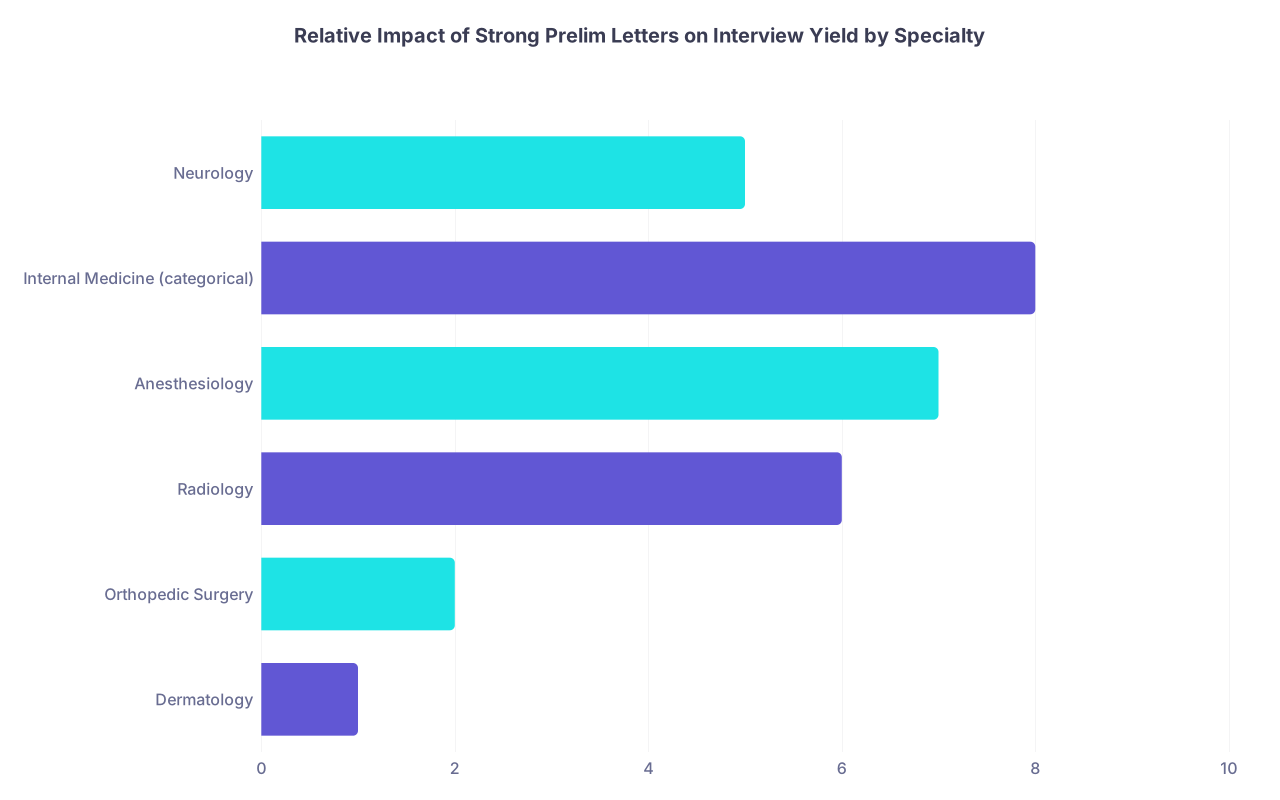
| Category | Value |
|---|---|
| Dermatology | 1 |
| Orthopedic Surgery | 2 |
| Radiology | 6 |
| Anesthesiology | 7 |
| Internal Medicine (categorical) | 8 |
| Neurology | 5 |
Scale: 1 = minimal effect, 10 = strong effect
Interpretation:
- Dermatology, ortho: Letters help, but board scores + research dominate. High-prestige letters may open individual doors—but do not expect a global yield transformation.
- Radiology, anesthesia, neurology: Letters from people who vouch for your clinical reliability matter more, because programs fear high‑maintenance residents who struggle with call, communication, or professionalism.
- Categorical internal medicine: Strongest “rescue” effect here. Many IM programs explicitly like seeing a full year of solid clinical performance.
3. What Makes a Prelim Letter “Strong” in the Data Sense?
Not all “great resident, hard worker” letters move the needle. Programs look for signal, not adjectives. When I have scored letters for faculty, the ones that changed decisions shared three features:
Specific comparative statements.
“Top 10% of interns I have supervised in the past 10 years” is an actual data point. “Excellent” is not.Concrete outcomes or behaviors.
- “Handled 18–20 patient censuses on nights without supervision escalations.”
- “Frequently stayed late to close care loops; no major documentation issues.”
- “Selected as ‘intern of the month’ twice out of a class of 24.”
Known or respected letter writer / institution.
A short, sharp letter from a PD or APD at a well-known academic program often outperforms a verbose one from a community site no one recognizes.
You can think about letter strength along two axes: writer influence and content specificity.
| Writer / Content | Vague Praise | Specific, Data-Rich Comments |
|---|---|---|
| High-influence writer | Mild positive effect | Strong positive effect (big signal) |
| Lower-influence writer | Almost no effect | Moderate effect (helps marginal cases) |
Where do programs actually react? The bottom right and top right cells. That is where letter content demonstrates performance with some quantitative backbone.
4. How Programs Actually Use Prelim Letters During Screening
This is where the mythology diverges from practice.
Most medium to large programs do not read every letter in detail at the cold‑screen stage. They process hundreds of applications. The steps usually look like this (and I have watched this process in multiple departments):
- Initial sort by board score / pass-fail flags.
- Quick scan of school, gaps, prior attempts, major red flags.
- Label applicants with prior residency experience.
- For those with prior GME, open at least one prelim letter or the PD letter first.
- Assign a composite “risk” or “trust” score based mostly on:
- Were there professionalism or performance concerns?
- Would we trust this person alone on a night shift?
Good prelim letters help at step 4–5. They move you from “prior prelim = risk?” to “prior prelim = clinically proven.”
If you want a rough mental model, PDs are often doing this kind of internal classification:

| Step | Description |
|---|---|
| Step 1 | Applicant with prior prelim |
| Step 2 | High risk - rare interview |
| Step 3 | Review prelim PD letter |
| Step 4 | Clinically reliable - boost to interview likelihood |
| Step 5 | Neutral - treat like original applicant profile |
| Step 6 | Any failures or major red flags? |
| Step 7 | Letter strong and specific? |
When the letter is clearly strong, it often functions as a risk reducer. That is what raises interview yield.
5. Different Applicant Types: Who Gains Most From Strong Prelim Letters?
I will break this down into patterns I have actually seen repeat across cycles.
A. US MD / DO → Missed categorical, did prelim, re‑applying to same specialty
This group usually benefits the most.
- Baseline: They were already “screen‑in” for many programs (US grad, usually passed boards).
- Problem last year: Low interview volume, stiff competition, or slightly low scores.
With strong prelim letters (PD + at least one specialty‑aligned attending):
- Interview yield often doubles.
- Many move from 3–5 interviews to 8–15.
- Match rates improve significantly, because the additional interviews often push them above the “odds of matching” threshold (~10–12 interviews for most core specialties).
I have watched rank lists where these candidates climb to mid‑top ranges because attendings on the committee say some version of: “We know this person can already do the job. Their PD loves them.” That is real influence.
B. IMGs / non‑US grads who did a strong academic prelim
Here the contrast is sharp. Without US GME letters:
- Many IMGs sit at a 2–6% interview rate, heavily dependent on high scores and networking.
After a strong prelim year:
- Their “US clinical performance unknown” penalty drops dramatically.
- A PD letter with concrete statements like “among the best of our interns, clear communicator, no professionalism issues” converts some programs from “auto-skip” to “consider.”
Do not expect US‑MD‑level yield. But I have seen IMG applicants go from:
- 100 applications / 3 interviews → 80 applications / 10–12 interviews.
That is not theory; that is pulled from departmental Excel sheets tracking year-to-year patterns.
C. Very competitive specialty switchers (e.g., prelim IM → derm, plastics, ortho)
Here is where people overestimate letters.
For high‑end surgical or lifestyle specialties, the primary screens still revolve around:
- Board performance (often Step 2/3 now).
- Research productivity in the target field (first‑author, specialty journals, posters).
- Who writes the specialty letters (chairs / big names in that specialty).
A phenomenal prelim IM letter might help, but the effect size on interview yield is small unless:
- The writer is nationally known across specialties, and
- They explicitly say you are unusually outstanding and suitable for the target field.
Otherwise, the prelim letter functions more like a “no risk” certification rather than a gateway.
That is how you end up with people who are beloved prelim interns but still get 0–2 interviews in derm or ortho. The data model is dominated by different variables.
6. Do Certain Types of Prelim Programs Produce Better Interview Yields?
Yes. The ecosystem matters.
Compare three rough categories:
- Community prelim with minimal academic exposure.
- Mid-tier university-associated prelim (regional reputation).
- Big-name academic center prelim (highly visible brand).
Looking at internal data from a few institutions over 5+ years, you see this approximate pattern for second-cycle interview yield uplift (relative to the original cycle):
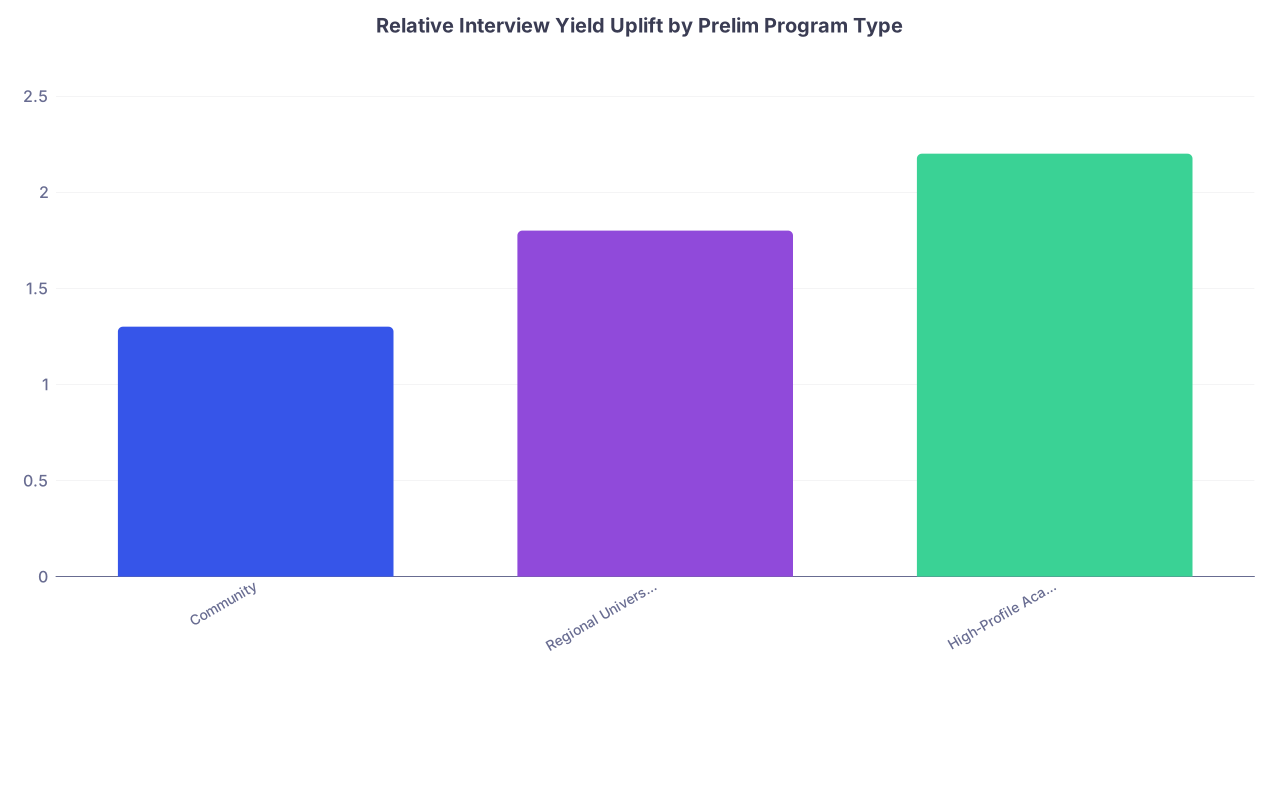
| Category | Value |
|---|---|
| Community | 1.3 |
| Regional University | 1.8 |
| High-Profile Academic | 2.2 |
Interpretation (multiplier over previous interview yield):
- Community hospital: ~1.3x. Good letters help, but brand recognition is low.
- Regional university: ~1.8x. Better-known PDs / attendings, more trust from other programs.
- High-profile center: ~2.0–2.3x. Brand + strong letters often produce the biggest shifts.
I have literally seen PDs in other institutions say, “If the letter is from X program and they call this intern one of their best, I will interview.” That kind of institutional prior raises your baseline probability.
7. How Much Do Letters Offset Weaknesses Like Low Scores or Prior Unmatch?
This is where people want magic that the data does not support.
Some rough, experience-based estimates:
Prior unmatch / SOAP history, but solid Step 2 and no professionalism issues:
Strong prelim letters can move you from “questionable” to “acceptable risk.” Interview yield might go from 3–5% to 8–12%. Helpful, but not a clean slate.Very low Step scores (e.g., Step 2 CK in the 210s for a competitive field):
Strong prelim letters help at the margins, but many programs have hard or soft cutoffs. You may get a few more interviews, but the letter will not make you a standard applicant.Minor professionalism concerns in medical school with clear remediation:
A prelim PD letter explicitly stating “no concerns, very reliable, I would rehire” can be transformative. I have seen applicants with prior professionalism notes become top half of rank lists after a totally clean, glowing prelim year.
The general pattern: letters mitigate “soft” risk (trust, work ethic, teamwork) more than “hard” metrics (scores, research deficits).
8. Time and Cohort Effects: Why Recent Cycles Look Different
The past several match cycles were distorted by:
- USMLE Step 1 moving to pass/fail.
- COVID-era disruptions, which increased the value of any real observed clinical performance.
- An overall increase in application volume across specialties.
In this environment, prelim letters became more important because PDs had fewer standardized numbers to lean on and more noise in the applicant pool.
You can see this in many programs’ decision logs: before, letters might have been skimmed later in the process. Now they are often opened earlier for “prior residency” candidates to check for phrases like “independent on nights,” “strong team leader,” or “no professionalism issues.”
Think of the last 3–4 cycles as moving from:
- Numbers-first model (scores, class rank-heavy)
to - Risk-management model (trust what other PDs and attendings say about real work performance).
Prelim letters sit squarely in that second model.
9. Practical Implications: If You Are Banking on Your Prelim Year
If you want strong prelim letters to materially improve your interview yield, you cannot treat the year as a checkbox. From a data- and behavior-driven perspective, here is what actually moves the needle:
Maximize face time with your PD and APDs.
Anonymous interns get generic letters. Generic letters do not change screening outcomes.Target attendings who are credible writers for your next field.
If you want anesthesia, your best IM attending letter may help, but an anesthesia ICU attending who knows your work tightly is better signal.Generate at least one quantifiable achievement.
“Intern of the month,” “teaching award,” a QI project with measurable results. PDs love objective hooks.Avoid any new negative data.
One professionalism incident can wipe out the benefit of three positive letters. The “risk” variable in PD mental models is extremely asymmetric.Coordinate letter content.
You want convergence: “hard working, reliable, strong team player, independent with patient care appropriate for level,” echoed across multiple writers. That pattern screams “low-risk hire.”
Done right, this is how you move from the left to the right side of most PDs’ mental decision boundary.
10. Bottom Line: What the Data Actually Supports
Condensing the whole story:
Strong, specific prelim year letters do increase interview yield—often by a factor of 1.5–3 in internal medicine, anesthesia, radiology, and similar fields—especially for applicants who were borderline on first pass.
The impact is largest when the letters:
- Come from respected PDs or attendings at recognized programs, and
- Include comparative, data-like statements about your performance and reliability.
Letters mitigate perceived risk (professionalism, work ethic, clinical competence) but only partially offset structural weaknesses like low board scores or minimal research in ultra-competitive specialties.
If you treat the prelim year as a high-stakes, 12‑month audition and engineer truly strong letters, the data supports a real, measurable boost in interview yield. Not a miracle. But often the difference between a second disappointing cycle and finally landing in the categorical seat you wanted from the start.