
Last January, a prelim medicine intern sat in my office, still in scrubs, pager going off every five minutes. He’d just matched into his dream anesthesia program… and looked absolutely wrecked. “If I’d understood the deal I was making with this prelim year,” he told me, “I’d have negotiated my life very differently.”
Let’s talk about that deal. Because there is a deal, and nobody spells it out clearly for you. Program directors talk around it, advisors romanticize it, and students only figure it out halfway through an 80‑hour week in January when it’s already too late to change anything.
You’re about to find out what you’re really trading in a preliminary medicine year.
First: What a Preliminary Medicine Year Actually Is (Not the Brochure Version)
On paper, a preliminary internal medicine year is simple: a 1‑year internal medicine internship that doesn’t lead to categorical IM board eligibility, typically used as a required clinical year before specialties like:
- Neurology
- Anesthesiology
- Radiology
- PM&R
- Dermatology (occasionally)
- Radiation Oncology
- Ophthalmology
You know that part already. Here’s what most students don’t fully get before they sign those rank lists:
A prelim medicine year is not designed around your future specialty. It’s designed around the needs of the medicine department. Full stop.
Categorical IM interns are “investments.” The program is grooming them for 3 years, sometimes chief year, maybe fellowship, research projects that boost the department’s reputation. Prelim interns? You’re labor. Necessary, helpful, but transient. They know you’re gone in 12 months, often to another institution.
Does that mean they’ll treat you badly? Not necessarily. Many prelim years are perfectly humane. But it does mean the structure of your year is not optimized for you. It’s optimized for coverage, throughput, and service.
Let me spell out the unspoken deal.
The Real Trade: What You Give vs What You Get
You think you're just choosing between “prelim vs transitional year” or “this IM prelim vs that IM prelim.” That’s too superficial. The real variables are harsher and more specific.
You are trading:
- Your time
- Your physical and mental bandwidth
- Your PGY‑1 learning environment
- Your relationships with attendings and seniors
for:
- A required clinical year box checked
- Some real-world medicine skills
- A reputation (good or bad) going into PGY‑2
- Networking and letters you may or may not use
Let’s break those down like a program director does behind closed doors.
| Category | What You Trade | What You Get |
|---|---|---|
| Time & Schedule | Nights, weekends, heavy wards | Required clinical year, experience |
| Learning Focus | Broad IM, not your future field | Clinical judgment, patient management |
| Status in Program | Short-term worker, less investment | Variable support, some mentorship |
| Career Trajectory | Limited continuity at institution | Possibly strong letters, reputation |
| Personal Bandwidth | Fatigue, burnout risk | Resilience, confidence (if supported) |
Time: The Hours Are Not Equal
Here’s a fact your med school probably glossed over:
Many IM prelim years are harder than the subsequent advanced specialty years in terms of hours, call, and scut. Neurology PDs, anesthesia PDs, rad onc PDs — they all quietly rely on IM prelim years to “toughen you up” and teach you to handle sick patients in the middle of the night. They do not build that heavy ground floor themselves.
Some programs are honest and tell you: “Our prelims work like categoricals.” What they usually mean is:
- Similar ICU time
- Similar ward time
- Similar call schedule
But here’s the catch. When push comes to shove — someone has to cover an extra night, a new admit shift, a swing rotation that nobody wants — the “short‑timer” prelim is the path of least resistance.
I’ve literally heard this in a scheduling meeting:
“Categoricals need their clinic time protected; prelims are leaving anyway. Just slide the extra nights there.”
That’s part of the deal, whether anyone admits it during interview day or not.
The Hidden Hierarchy: Categorical vs Prelim
Let me tell you a truth most IM programs won’t say on a Zoom interview: there’s a two‑tier system.
Categoricals:
- Long‑term investment
- Tracked for fellowship placements, quality metrics, academic output
- Given continuity clinic, mentorship, conferences targeted to their career path
Prelims:
- One‑year helpers
- No continuity clinic long game
- Less tailored education for a 3‑year medicine path (because you’re not staying)
Some programs truly try to integrate prelims and categs as equally as possible. I’ve seen places where prelims were treated well, had sick patients, and got excellent teaching. They existed. But the instinct of the system is always to prioritize those who will be around for 3 years.
Where this shows up:
Rotations
Categorical interns often get first dibs on prime electives, subspecialties, and lighter rotations. Prelims fill gaps: extra wards blocks, more nights, “float” roles.Advocacy
When the rotation is overloaded and someone needs to be pulled, the chief resident is more likely to protect the categ developing into a future senior. The prelim? The logic goes: “they’re leaving, and neurology/anesthesia/rads will take over their career development.”Letters and Mentoring
Categs get naturally scooped up into research with subspecialty attendings, fellowship mentors, and multi‑year projects. Prelims have to hustle hard and fast to get anyone to invest in them — because by the time an attending really knows you, your year is almost done.
What You Actually Learn in a Prelim Medicine Year
Now the upside. Because there is one, and it’s not small.
A strong prelim medicine year gives you five things that matter no matter what specialty you go into:
Pattern recognition of sick vs not sick
You learn very quickly who will crash at 2 a.m. and who will be fine until morning. That’s gold in anesthesia, neurology, radiology, anything.Fluent inpatient medicine
You become competent at:- Starting basic management for DKA, CHF exacerbations, COPD flares
- Handling sepsis bundles in your sleep
- Managing electrolytes without looking everything up
Owning decisions
That moment at 3 a.m. when you’re the only doc on the floor and a nurse calls about a hypotensive patient — that’s when you actually become a physician. Not reading UWorld. Not in OSCE. In that room, with that patient.System navigation
You’ll know exactly how to move a sick patient from the floor to the unit, who to call, how to get CT at 2 a.m., how disposition actually works, how to push back when something’s unsafe.Credibility with other specialties
A neurologist, anesthesiologist, or radiologist who can still walk onto a medicine floor and not look lost earns instant respect. Everyone knows which subspecialists “get it” and which ones never did real inpatient grind.
If your prelim year is decently run and not malignant, you walk out of it dangerous in the right way: clinically sharp, not easily rattled, able to triage reality from noise.
The Costs: What You’re Giving Up (That No One Talks About)
Now the ugly side of the ledger.
1. Bandwidth for Your Actual Future Specialty
You match into, say, anesthesia at Hospital X with a prelim year at Hospital Y. During your prelim year:
- You’re exhausted
- You’ve moved, you’re adjusting to a new system
- You’re covering nights and wards every other week
Where in that do you have energy to:
- Read core anesthesia texts
- Practice ultrasound
- Scrub in regularly in the OR
- Attend your advanced program’s welcome events
You don’t. Not consistently. Most prelims “planning to read their future specialty on days off” end up sleeping, doing laundry, and trying to remember their own name. By the time July 1 of your PGY‑2 rolls around, you’re starting anesthesia fresh — with less pre‑reading than you told yourself you’d do.
Is this survivable? Sure. But the fantasy that your prelim year will be an academically aligned ramp‑up to your advanced specialty is… optimistic.
2. A Clean Start with Your Advanced Program
Here’s a nasty little secret: how you finish prelim year influences how you show up to your advanced program.
I’ve seen two patterns:
- The prelim survivor: confident, efficient, calm, but a little fried and cynical.
- The prelim casualty: burned out, behind on board studying, resentful, starting PGY‑2 already running on fumes.
Your advanced program doesn’t see the full story. They see whoever walks in on July 1. If your prelim year was brutal and unsupported, you might be starting your “dream specialty” at 60% capacity.
Some PDs quietly prefer applicants coming from cushier transitional years for exactly that reason — they show up fresher. Not necessarily better clinically, but they’ve still got gas in the tank for subspecialty training.
3. Personal Life and Relationships
Intern year always hits personal life hard. A service-heavy prelim year amplifies that.
You’re often in a new city for just one year. Strange hospital. Minimal roots. Many people think, “It’s just a year, I’ll push through and reset next July.” Then the isolation, rotating nights, and constant pager pressure stack up faster than they expected.
I’ve watched marriages get stressed badly during a prelim year. Long‑distance relationships fall apart. People drift away from hobbies, friend groups, marriages, even their own sense of self.
Again: not unique to prelim IM — but more likely when the year is built for service over sustainability.
A Hard Truth: Some Programs Use Prelims as Shielding
Let me be extremely clear here: not every program does this. But enough do that you should be aware of the pattern.
In some medicine departments, prelims are a pressure release valve.
When volume is too high, staffing is tight, or ACGME caps are close, the “flex” pool is often the prelim cohort. They:
- Cover more nights or short‑staffed ward teams
- Lose electives or swaps more easily
- Get stuck on notoriously painful rotations the categs quietly avoid
I’ve seen scheduling conversations where the categorical interns were treated as protected assets — “We can’t load them up too much; we need them functional as PGY‑2/3” — and the prelims… less so.
You won’t hear this on interview day. You might get small hints in how the chiefs talk when residents aren’t in the room. Listen closely when they describe schedule differences between categoricals, prelims, and TYs.
How Program Directors Actually View Prelim Years
Let’s widen the lens. There are really three groups of PDs you’re dealing with:
The Internal Medicine PD (prelim program)
Their fundamental priority is to staff a functioning inpatient system and train competent internists. You, the prelim going into radiology or PM&R, are helpful, but you’re not their legacy. Their primary output is categorical grads and fellowship matches.Your Future Specialty PD (advanced program)
They want a PGY‑1 that won’t break you. They don’t need you to be a mini‑hospitalist. They want:- Reliability
- Basic inpatient competence
- Enough resilience to handle a rough call night
I’ve sat in meetings where advanced PDs admitted they prefer a solid, not‑insane TY over a brutal IM prelim, because their PGY‑2s were showing up toasted.
The Hospital System
They don’t “care” what you become. They care that the wards and ICU have enough warm bodies who can write notes, field pages, and keep admissions moving. Prelims help plug that system for cheap compared to midlevel hires.
Once you see the incentives, the structure of your year makes a lot more sense.
What You Should Be Asking on Interview Day (But Most Don’t)
If you’re going to sign this deal, at least read the fine print.
Here are the questions I’ve heard make attendings shift in their seats — which means they’re the right ones:
- How many wards months do prelims do compared to categoricals?
- Do prelims have the same number of ICU rotations as categoricals?
- Are prelims ever used to cover for short staffing or schedule gaps more than categoricals?
- Do prelims get elective time tailored to their advanced specialty?
- How many prelims from the last 2–3 years would be willing to talk candidly by phone or email?
And then you don’t just listen to the words. You watch the body language.
If they say, “Our prelims work just like our categoricals,” ask specifically, “So identical ward, ICU, and call distributions?” Most of the time, the answer is “mostly, but…” and that “but” is your deal breaker or not.
How to Survive — and Actually Benefit From — a Prelim Medicine Year
Let me be blunt. If you rank a prelim medicine year, you are accepting some loss of control over your time and bandwidth. So your strategy is not to make that untrue. It’s to minimize the damage and maximize the gains.
A few practical things I’ve watched successful prelims do:
Choose your prelim site like it’s a real residency, not an afterthought.
You’re not just “filling the PGY‑1 requirement.” You’re choosing who will own your life next year, and how you’ll show up to your advanced program. Treat this as seriously as your main specialty.Lock in at least one rotation close to your future field.
For anesthesia, a MICU or CCU month with procedures. For neuro, stroke or neuro ICU time. For rads, an ED month where you live in imaging results and think in differential terms. You can usually negotiate one or two rotations with an understanding schedule chief.Get 1–2 attendings who truly know you by name and story.
Even if you never use their letters, those are the people who go to bat for you if you run into trouble, who will adjust evaluations, and who will quietly say, “Give them a break, they’re solid.”Protect a small, non‑negotiable piece of your life.
One weekly ritual. Gym session, call with a partner, religious service, whatever. If you treat all of your personal life as optional, the system will take 100% of it. The residents who come out decent from brutal years are the ones who drew at least one hard line.Use the year to become clinically efficient, not just busy.
Learn to structure your notes so you can pre‑chart fast. Learn which pages need a sprint and which can be batched. Efficiency is what keeps you from drowning, not heroism.
A Quick Reality Check: When a Prelim Year Makes Sense — And When It’s a Bad Trade
There are scenarios where a prelim IM year is absolutely worth it:
- You’re entering a specialty that deeply values strong inpatient medicine (neuro, anesthesia, ICU‑heavy fields).
- You’ve matched a stellar advanced spot and the prelim is simply the required price of admission.
- You want to feel like a “real doctor” managing full inpatient complexity before subspecializing.
And there are scenarios where it’s often a bad deal:
- You had significant burnout in med school and are already near your limit.
- Your advanced specialty is lifestyle‑friendly and you don’t need intense inpatient grind.
- The prelim programs on your list have reputations for malignant culture or over‑service.
That last one is non‑negotiable for me: if multiple people independently describe a prelim program as “toxic” or “abusive,” don’t rationalize it as “only 12 months.” Twelve malignant months can sour your career for a decade.
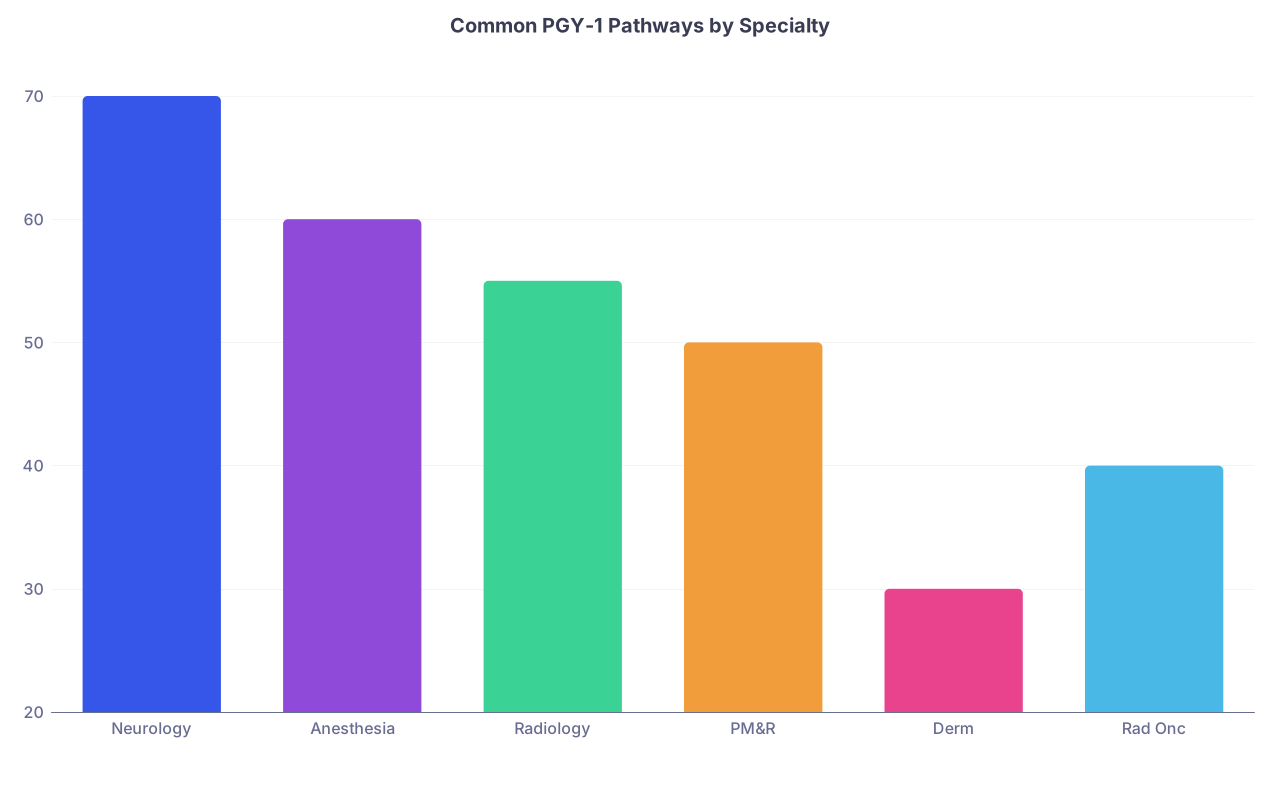
| Category | Value |
|---|---|
| Neurology | 70 |
| Anesthesia | 60 |
| Radiology | 55 |
| PM&R | 50 |
| Derm | 30 |
| Rad Onc | 40 |

| Step | Description |
|---|---|
| Step 1 | Match Day |
| Step 2 | Prelim Medicine Start |
| Step 3 | Heavy Wards and Nights |
| Step 4 | ICU and Step Up in Responsibility |
| Step 5 | Electives and Specialty Exposure |
| Step 6 | Prelim Year Ends |
| Step 7 | Start Advanced Specialty |
The Unspoken Deal, Plainly
So here it is, without the glossy brochure language.
When you sign up for a preliminary medicine year, you are saying:
“I accept a year where the medicine department’s needs will usually come before my own long‑term specialty development. In exchange, I will get intense, sometimes painful, but often invaluable training in being a real inpatient doctor — which I’ll carry for the rest of my career.”
Sometimes that’s a fair trade. Sometimes it’s a rip‑off.
Your job is not to pretend you can avoid the trade. Your job is to choose where you make it, with your eyes open, and to refuse the programs where the balance is so skewed you come out broken instead of built.
If you remember nothing else, remember this:
- Prelim medicine years are structurally designed around service, not you.
- A well‑chosen prelim can make you clinically sharp and respected in your future field; a bad one can drain you before you even start.
- Ask the hard questions, read between the lines, and rank like this year actually matters — because it does.
FAQ (Exactly 5 Questions)
1. Is a preliminary medicine year looked down on compared to a transitional year?
No, not inherently. Some advanced PDs actually respect a solid IM prelim more because they know you’ve seen sick patients and survived a tough year. What they don’t want is a prelim that leaves you clinically decent but psychologically wrecked. Between a malignant IM prelim and a humane TY, most PDs quietly prefer the TY.
2. Can I switch into categorical internal medicine from a prelim spot?
Sometimes, but do not count on it. A few prelims convert to categorical when spots open from attrition, but programs will always prioritize applicants they selected as categorical from the start. If you’re thinking “I’ll backdoor myself into IM residency through a prelim,” that’s a weak plan. Treat any promise of “maybe we can find a spot later” as unreliable unless it’s in writing and very specific.
3. Will my prelim medicine evaluations matter to my advanced program?
They matter more than you think. Many advanced PDs request your intern year evaluations before or shortly after you start. If your prelim PD flags professionalism issues, unreliability, or major performance concerns, that follows you. On the flip side, a strong prelim letter saying “handles sick patients well and is reliable at 3 a.m.” carries real weight in anesthesia, neuro, EM‑adjacent fields.
4. How much should I prioritize location when ranking prelim programs?
Less than you think if the program is malignant, more than you think if options are comparable. A brutal prelim in your dream city is still a brutal prelim. A solid, humane prelim in a less desirable city often leaves you in much better shape for the rest of your career. If two programs are roughly similar in workload and culture, then use location and support system as a tiebreaker.
5. What’s the biggest red flag when hearing residents talk about a prelim program?
When prelims use phrases like “we’re just workhorses,” “they don’t care, we’re gone next year,” or “I wouldn’t do this again,” you should pay attention. One or two bitter people you can discount. But if multiple prelims independently describe feeling disposable, overused, or unprotected when things get unsafe, that’s not noise — that’s the system revealing its true deal.