
The dirty secret about preliminary years is this: they exist as much for hospital service coverage as they do for your training. Sometimes more.
Everyone tells you a prelim year is “good clinical exposure” and “broad foundational training.” Program leadership calls it “indispensable to the team.” What they say inside the conference room, when you are not there, is a lot blunter:
“We need twelve prelims to keep this service running.”
And they build schedules, budgets, and rank lists around that sentence.
Let me walk you through how that actually works.
Why Preliminary Positions Exist In The First Place
You already know the textbook version: a preliminary (prelim) year is a 1‑year residency—usually in internal medicine, surgery, or transitional year—often used by applicants going into advanced specialties like anesthesia, radiology, neurology, dermatology, PM&R, ophtho, or radiation oncology.
That’s the brochure story.
Behind the scenes, here’s the real driver: hospitals need bodies. Inpatient services, ICUs, night float, ED holds, post‑op floors—those patients don’t magically take care of themselves. Hospitals can’t staff all of that with attendings and NPs alone without bleeding money. So program leadership negotiates with the hospital and GME office:
“We can staff X services if we have Y categorical residents and Z prelims.”
Prelim spots are the variable lever. They’re cheaper than adding more faculty and often easier to justify politically than expanding categorical classes.
So when you see a program with, say, 20 categorical IM residents per year and 15 prelims, do the math. They didn’t randomly pick those numbers. They backed into them starting from the service grid.
| Role Type | Approx Number / Year | Main Purpose |
|---|---|---|
| Categorical IM PGY-1 | 20 | Long-term training, continuity |
| Prelim IM PGY-1 | 12–18 | Service coverage, gap filling |
| PGY-2/3 Seniors | 30–36 total | Supervision, higher level tasks |
| NPs/PAs | 6–10 | Daytime continuity, discharge help |
Those prelim numbers are not an afterthought. They’re the service engine.
How Leadership Actually Plans With Prelim Residents
Program directors won’t say this to you on interview day, but this is roughly how their thought process goes at the annual “staffing retreat,” when they project the next academic year.
They pull up a big spreadsheet: rows are rotations, columns are months, cells are “intern FTEs needed.” Then someone says:
“Okay, gen med needs four interns every month, cardiology two, night float two, ICU two, ED one, and we’ve got vacations, jeopardy, and sick call to cover. How many categorical interns do we have? How many slots do prelims plug?”
Categorical interns have constraints. They need continuity clinic, required rotations, elective time, vacation protections, and a coherent three‑year progression. There’s an ACGME structure to honor.
Prelims? They need one year of accredited training and a minimum set of experiences. But the leash is longer. So leadership does this:
- They assign categorical interns to the rotations that “matter” for their long‑term development and ACGME requirements.
- Whatever is left—overflow ward coverage, “SCU” (step‑down units), float, night blocks, some ED shifts—that’s where prelims get inserted.
They all swear they “treat prelims and categoricals the same.” On paper. In the grid, they absolutely do not.
You can see it in how they talk.
I’ve sat in a room where a clerkship director said, “We can’t put categoricals on that night‑float‑heavy block; they’ll hate it. Just put two prelims there and call it a day.” Nobody objected. Because the unspoken rule is: prelims are more expendable, schedule‑wise.
That doesn’t mean every prelim is abused. But it does mean you’re often the pressure valve for service needs.
The Rotations Prelims Get Pushed Into
Let’s be concrete. Here’s how the “service need” reality shapes your year.
1. Heavy Floor Months
Prelim medicine interns at big academic centers are often stacked onto:
- General medicine ward teams with high census caps and brutal turnover
- “Off‑service” floor teams (e.g., oncology or transplant) where patients are complicated and the hours are long
Categoricals will also do these rotations—but the ratio of heavy months is usually worse for prelims. You might do 7–8 months of hard inpatient vs. a categorical’s 5–6 in their first year, because categoricals also need clinic and elective time.
For prelims, “electives” often quietly shrink when the service is short. More than once I’ve seen an “elective” become, overnight:
“Hey, we’re short two on gen med. You’re now on gen med. We’ll call it a ward elective.”
Sure.
2. Night Float and Cross‑Coverage
If a program has any flexibility at all, they will protect categoricals from excessive night float, because those residents will be there three years and will remember how they were treated when they become chiefs or faculty.
Prelims leave.
So if someone has to eat more nights, prelims are the easy answer. I’ve seen schedules like:
- Categorical IM intern: 1–2 months of nights across PGY‑1
- Prelim IM intern: 3–4 months of nights, sometimes split into multiple short blocks so it “doesn’t look as bad” on paper
On interview day you’ll hear, “Everyone shares nights equitably.” Look at the actual rotation list if you can. Or ask politely, “How many weeks of nights do your prelims typically do?” Watch for the micro‑pause before they answer.
3. ICU and Step‑Down Units
ICU is valuable training, and some prelims want as much as they can get, especially anesthesia and critical care bound folks. So there’s a legitimate educational argument for prelims spending real time there.
But hospitals also need fixed headcount in ICUs around the clock. Prelims are a convenient pool.
If a surgery program has 10 categorial interns and 8 prelims, and they need 4 interns in SICU every month, someone is doing a lot of ICU. Guess who.
4. Transitional Year vs Medicine/Surgery Prelim
Transitional years (TY) are the exception where service use isn’t always as heavy. Why? Because many TY programs are built more as educational products to attract competitive applicants (derm, rad onc, ophtho) and are sometimes less entangled with the big tertiary care hospital grind.
Traditional prelim medicine and surgery programs at large academic centers are where the service‑need mentality is most obvious.
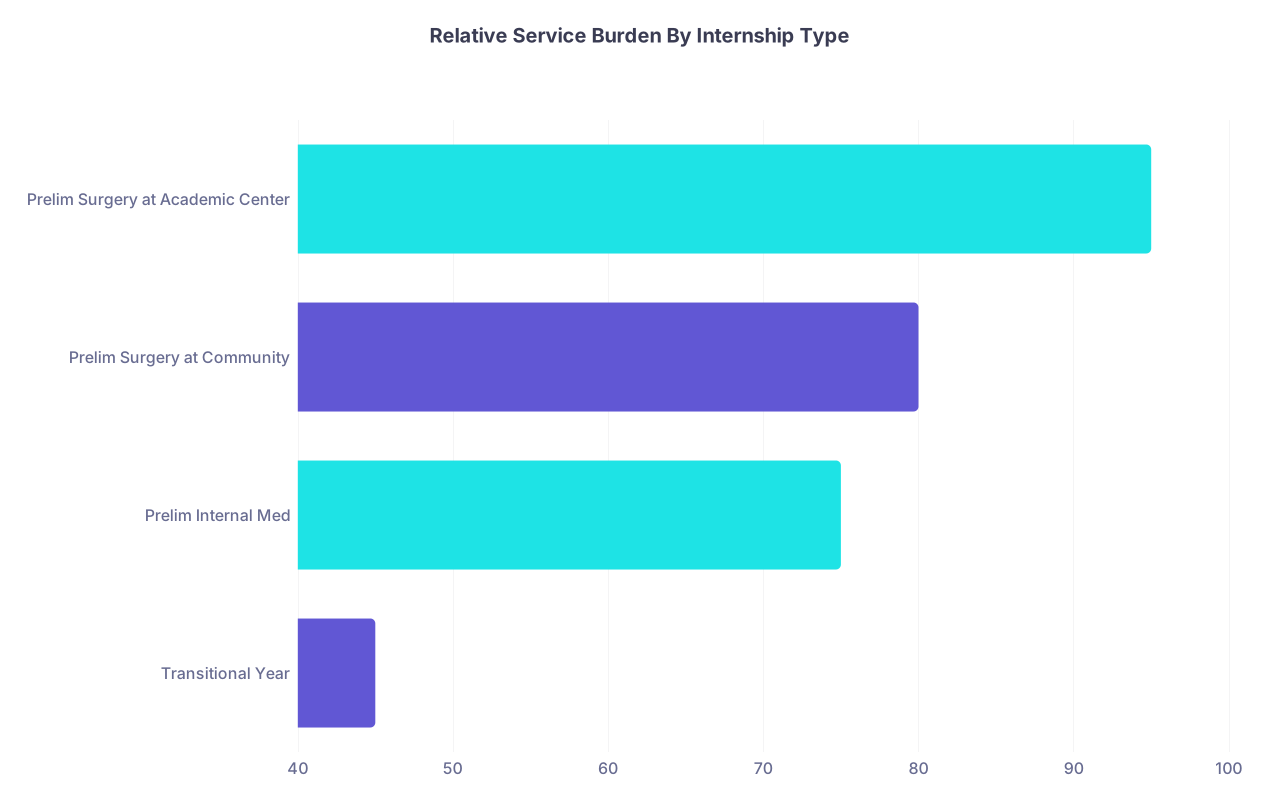
| Category | Value |
|---|---|
| Transitional Year | 45 |
| Prelim Internal Med | 75 |
| Prelim Surgery at Community | 80 |
| Prelim Surgery at Academic Center | 95 |
Think of that chart as “percentage of your year spent in pure service-heavy roles” out of 100. Not scientific, but painfully close to how it feels.
How This Affects Your Training (And Your Life)
When leadership uses prelims to fill service needs, it changes the character of your year in several predictable ways.
You Get Lots Of Reps… Of Some Things
On the plus side, prelims often become competent workhorses very quickly:
- You’ll learn to admit and dispo a patient fast.
- You’ll get efficient with notes, orders, and cross‑cover calls.
- You’ll understand hospital systems better than many PGY‑2s in cushier programs.
I’ve watched prelims finish their year and walk into anesthesia or radiology knowing the hospital flow better than senior residents in those fields. There is real value in that.
But the skill set is biased. You get very good at throughput and survival. Less time for:
- Sitting down with attendings to go through evidence and subtle clinical reasoning
- Longitudinal follow‑up of patients
- Tailored electives in your future field
Program directors will swear up and down that “education is our priority.” Then they’ll quietly cancel the noon lecture because the census exploded and “we just need everyone to keep working through lunch.”
Guess which residents are most likely still on the floor at 12:15? The prelims.
You Become The Default “Extra”
Because leadership sees prelims as the flexible buffer, you become the answer to every coverage problem:
- Extra code coverage on days when census spikes
- “Can we float you to the other tower? They’re drowning over there.”
- “We’re short a body for the night cross‑cover. You’re on.”
They justify it as “great learning opportunity.” Sometimes it is. Often it’s just patching a staffing hole.
The psychological effect is real: many prelims feel like second‑class citizens, even when attendings are nice and seniors are supportive. The schedule itself sends a message about who is indispensable and who is portable.
Letters, Mentorship, And Being Remembered
Here’s the bad part that doesn’t get talked about: when you are always on the busiest, least controlled rotations, you have less protected time to build relationships and secure strong letters for your advanced specialty (or a categorical switch if you need one).
Attendings on high‑volume wards often barely keep their heads above water. They see you busting it, they’re grateful—but they don’t have time to sit with you for an hour to talk about career paths or help you edit a personal statement.
This is where well‑run programs distinguish themselves. The best PDs deliberately protect at least some time for:
- A continuity attending who follows you through the year
- A “prelim mentor” who is not just lip service
- One or two truly lighter rotations where you can go to clinic, meet people in your advanced field, and breathe
The worst programs just keep you on the hamster wheel and then act surprised when your letters are generic.
What Program Directors Say Behind Closed Doors
Let me give you some verbatim snippets I’ve heard in standing PD/chief meetings. These are from multiple institutions, different regions, all ACGME‑accredited, all “solid” on paper.
- “We can’t cut prelim spots unless the hospital gives us mid‑levels to replace them. And that’s not happening.”
- “The OR and SICU are screaming for more interns. Can we shift a couple of prelims from gen surg to SICU months?”
- “We can’t protect all the prelims’ electives. Service needs come first.”
Program leadership lives in a constant tension between education and service. Good leaders actually wrestle with it. Mediocre ones let the hospital CFO and service chiefs decide and then back‑justify the schedule as “educational.”
Your experience will depend heavily on which group runs your program.
Another hard truth: prelims are easier to sacrifice politically. If the hospital demands more coverage and there are two options—
- Add another categorical resident (with 3‑year cost and educational implications), or
- Increase prelim spots, who are around for one year and won’t be voting with their feet in the next match cycle at that same program
—guess which option wins the internal negotiations.
How To Spot A Program That Overuses Prelims
You cannot rely on glossy websites or PowerPoints. Everyone claims “strong educational focus” and “supportive environment.” Look at the structure and the slip‑ups.
Here’s what I tell applicants behind the scenes.
1. Rotation Composition
Ask for a sample prelim schedule. Not a fictional “representative” block diagram. A real anonymized schedule from last year.
Look for:
- Total number of inpatient months
- Number of night blocks
- Presence (or absence) of true electives with your future field
- Differences between the prelim and categorical intern schedules
If prelims clearly have more nights, more wards, fewer electives, and no continuity clinic substitute, you’re looking at a service product, not a developmental year.
2. Ratios Of Prelims To Categoricals
If a general medicine program has 15 categoricals and 14 prelims, that’s a red flag. That means half their intern‑level headcount is disposable after one year.
Same for surgery: a program with 8 categorical PGY‑1s and 18 prelims is telling you exactly how they keep the call schedule afloat.
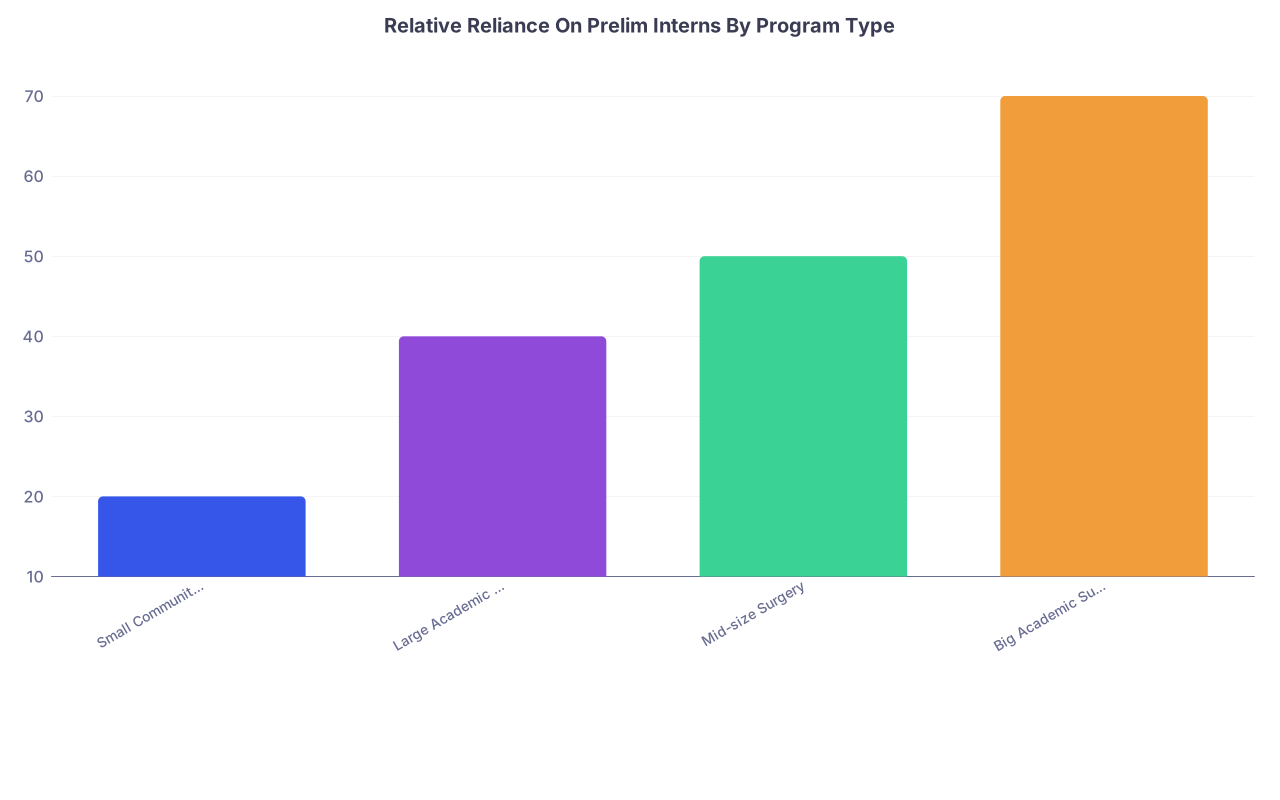
| Category | Value |
|---|---|
| Small Community IM | 20 |
| Large Academic IM | 40 |
| Mid-size Surgery | 50 |
| Big Academic Surgery | 70 |
Those percentages are “proportion of total interns who are prelims.” When that number climbs, your risk of being treated like a coverage tool increases.
3. How They Talk About You
On interview day, listen carefully to the language.
Good sign: “Our prelims go into anesthesia, rads, derm, ophtho. We meet with each of them individually to align their schedules with their specialty. We had one prelim do a month with cardiology because he was undecided, and we made it happen.”
Bad sign: “Our prelims are integrated into all of our services and help us keep the hospital running.” That sounds nice. It’s also code for “service backbone.”
Even worse is when they barely talk about prelims at all. I’ve watched programs present 15 minutes on categorical curriculum and then say, “Oh, prelims basically do the same thing but just for a year.” That’s often false. It tells you they don’t actually think about the prelim experience as a distinct educational product.
If You’re Applying For A Prelim: How To Protect Yourself
You cannot fully escape the service‑coverage dynamic. It’s baked into these positions. But you can be smart about how you enter the game.
A few concrete moves:
Aim for transitional year if at all possible. They tend to be less tied to hardcore hospital service needs than straight IM or surgery prelims, and they often cater to highly competitive specialties. More electives. More daylight.
Prioritize programs with smaller prelim cohorts. If they have 4 prelims and 20 categorial interns, there’s a realistic chance they treat prelims more like actual interns and less like a disposable platoon.
Ask direct schedule questions. “How many months of nights? How many ICU? How many true elective blocks, and can prelims use them in their advanced specialty department?” You’re not being difficult. You’re doing due diligence.
Find out where last year’s prelims matched. A PD who truly cares will gladly brag: “Six went into anesthesia, three into rads, one into derm.” If their answer is vague—“Oh, all over the place, I think?”—that tells you how much they track and advocate for prelims.
Watch the interns’ faces. When you talk to current prelims on interview day, ask: “Is the schedule what you expected? Do you get time to explore your advanced specialty?” Body language will tell you more than any official answer.
How This Plays Out During The Match
One last insider angle: the way programs rank prelim applicants is also influenced by service needs.
Programs with heavy service requirements will happily rank:
- Applicants with strong Step scores who want anesthesia/rads/ophtho—you’ll be competent and independent quickly, which they like
- Applicants who signal they’re “okay with hard work” or have prior hospital experience
They are, however, wary of:
- People clearly using prelim as a backup to re‑apply for a different specialty (especially something like categorical IM or gen surg)—because if you end up staying, they now have pressure to convert you to a categorical spot they don’t necessarily have
- Applicants they fear might burn out or quit mid‑year, because that blows up their service coverage grid
So they look for reliability. Stamina. Less concern about your long‑term fit in their program, because you’re gone in 12 months.
Again, not every program is this transactional. But many are, to some degree. It’s how they protect their service lines.
The Bottom Line: What You’re Actually Signing Up For
A prelim year is not some random detour. It is a very deliberate staffing solution for hospitals and departments that also, as a side effect, gives you a year of clinical exposure.
Is that inherently bad? No. For some people, it’s the making of their career. They become efficient, confident, and deeply comfortable with sick inpatients. Advanced specialties appreciate that.
But you need to walk into it with open eyes:
Most programs use prelims as flexible service coverage to keep wards, ICUs, and nights staffed. That shapes your schedule more than any “educational objectives” document.
The degree of exploitation varies wildly. Programs that treat prelims as real trainees—with protected electives, mentorship, and realistic night loads—exist. Programs that treat prelims as warm bodies definitely exist.
Your job as an applicant is to tell the difference, and to choose a program where the service you provide still leaves room for growth, letters, and sanity. Because one year can feel very long if you are only seen as coverage.