
The myth that you “cannot do research during prelim year” is wrong. You can. But only if you treat it like a second job with a system, not a hobby you squeeze in “when things slow down.”
You are in the worst possible position for research productivity:
- No control over your schedule
- High-call, high-floor time
- Constant pages and scut
- New environment, new EMR, new expectations
So you need structure, not vibes.
Below is a concrete, step‑by‑step blueprint to maximize research time during a demanding preliminary year (TY or prelim medicine/surgery), without burning yourself out or tanking your clinical performance.
1. Get Your Reality Straight: What a Prelim Year Actually Allows
Stop fantasizing about what “an ideal research year” would look like. You do not have a research year. You have:
- 60–80 hours/week of clinical work
- 1–4 golden weekends a month, if you are lucky
- Random lighter rotations that show up like rare animals
So the right question is not “How do I do a big RCT during prelim?”
It is: “What type of research fits inside a prelim year without wrecking me?”
Here is the hard truth: during a demanding prelim, the most realistic and high-yield projects are:
- Case reports and case series
- Retrospective chart reviews (with an existing database or simple extraction plan)
- Secondary analyses with mentors who already have IRB + data
- Quality improvement projects with well‑defined metrics
- Short reviews / methodological papers / letters to the editor
What is usually too big unless the infrastructure is already in place and you are plugging into a team:
- Prospective clinical trials
- Anything needing you to recruit and consent patients yourself on busy services
- Standalone basic science bench work that requires you physically in lab 20 hours/week
You are not in a position to build a lab or a dataset from scratch. You are in a position to be the engine that moves existing or simple projects across the finish line.
So step one: accept the constraint. Choose project types that match reality.
2. Front‑Load the Setup Before Day 1
If you start your prelim year and only then begin “looking for research,” you already lost 3–4 months.
You want to start residency on Day 1 with:
- At least one active, clearly scoped project
- A mentor who knows your schedule will be bad
- Defined deliverables you can work on in small time blocks
2.1. Identify mentors aligned with your advanced field
If you are:
- Prelim medicine → aiming for derm, rads, gas, neuro, ophtho
- Transitional year → same idea
- Prelim surgery → aiming for radiology, anesthesia, etc.
You want mentors in your future specialty, not necessarily your prelim department.
Concrete steps:
- Email faculty in your advanced specialty at your advanced program (or target programs) 3–6 months before prelim starts.
- Use a blunt, focused email:
- Who you are
- Your goal specialty
- What you’ve done so far
- Exactly what you’re asking for: “small, well-defined project I can work on during a demanding prelim year.”
- Ideally, get on a Zoom and ask:
- “Do you have any projects where data are already collected?”
- “Any ongoing chart reviews or QI projects I could plug into?”
You are looking for projects in late-middle or final phases:
- Data collected → you help clean/analyze/write
- IRB approved, clear variable list → you help extract
Avoid mentors who say, “We can think of something once you get here.” That is code for “Nothing structured exists.”
3. Choose Project Types That Survive a Terrible Schedule
Let me be very specific about which project types actually work during a brutal prelim and why.
| Project Type | Feasibility | Main Work You Do |
|---|---|---|
| Case reports/series | High | Chart review, writing |
| Retro chart review | High | Data extraction, stats |
| Secondary data analysis | High | Cleaning, analysis, write |
| QI project | Medium | Workflow, metrics, write |
| Prospective study | Low | Consenting, follow-ups |
3.1. Case reports and series
Perfect for:
- ICU months with weird pathology
- Night float with unusual admissions
- Subspecialty rotations (onc, cards, ID)
Protocol:
- Tell your seniors/attendings on Day 1: “If you see any unusual or rare cases, I am very interested in helping with case reports.”
- When such a case appears:
- Write down MRN, attending name, key diagnosis, and labs right away.
- Ask attending: “Would you be okay with me working on a case report for this patient?”
- Same day or next day off:
- Check if your institution has a case report IRB exemption policy.
- Start a basic outline: background, case description, discussion, conclusion.
- Use templates from journals like BMJ Case Reports, Cureus, or specialty-specific case journals.
You can draft a publishable case report in 2–3 focused half-days if your mentor is responsive.
3.2. Retrospective chart reviews
Most powerful option if:
- IRB is already approved
- Clear inclusion/exclusion criteria
- Data dictionary exists
Your job is to:
- Pull charts from EMR
- Abstract variables into RedCap or Excel
- Help run basic stats (or hand clean data to statistician)
- Draft methods/results
This is ideal because:
- You can do it at 10 pm in the call room
- You can work 30 minutes at a time
- No patient interaction needed once IRB is in place
4. Build a Ruthless Time Strategy (Hour-by-Hour, Not Vague “Some Time”)
You will not “find time.” You will assign time. If it is not on a calendar, it will lose to admissions, signouts, and your bed.
Let us talk structure.
4.1. Identify your “research windows” per block
At the start of each rotation, ask:
- Is this a 6+ admission/day kind of month (e.g., wards, ICU)?
- Is this consults, electives, or float with some breathing room?
Then decide on your minimum research commitment per week:
Brutal block (q4 call, nights, ICU):
- Goal: 2–3 hours/week of low‑cognitive tasks
- Activities: simple chart abstraction, lit search, formatting references
Moderate block (wards with good seniors, day float):
- Goal: 4–6 hours/week
- Activities: targeted writing sections, drafting case reports
Easy block (ambulatory, electives, consult with calm attending):
- Goal: 8–10 hours/week
- Activities: full manuscript drafts, analysis sessions, re-writes
Now schedule it like this:

| Step | Description |
|---|---|
| Step 1 | Start of Week |
| Step 2 | Schedule 2-3 hrs |
| Step 3 | Schedule 4-6 hrs |
| Step 4 | Schedule 8-10 hrs |
| Step 5 | Pick 2-3 late evenings or post-call |
| Step 6 | Add 1 weekend block |
| Step 7 | 2 evenings + 1 long weekend session |
| Step 8 | Block Intensity |
You literally block these on your calendar:
- Tuesday 20:30–22:00 – “Chart abstraction – 20 patients”
- Thursday 21:00–22:30 – “Write discussion – 2 pages”
- Sunday 13:00–16:00 – “Revise manuscript + respond to mentor edits”
If you treat research time like optional, it will be eaten alive by your phone, Netflix, or doom‑scrolling.
4.2. Use micro‑blocks on call days
You will never get 3 uninterrupted hours on a heavy floor day. But you will get:
- 15 minutes waiting for CT read
- 10 minutes between admissions
- 20 minutes when your senior is finishing signouts
You must have tasks ready that fit in 10–20 minute chunks:
- Cleaning 10 rows of data
- Fixing references for 1 section
- Drafting 2–3 sentences in the introduction
- Making 1 figure or table skeleton
This is how projects inch forward even on terrible rotations.
5. Turn Every Rotation into a Research Engine
A demanding prelim year is not just a time sink. It is a case factory and a QI factory.
5.1. Wards / ICU: Mine your clinical work
On the very first days:
- Tell attendings and seniors you are interested in research.
- Ask: “Are there any ongoing QI projects on this unit? Any registries for sepsis, heart failure, etc.?”
You are looking for:
- People already collecting data (e.g., sepsis bundles, CLABSI rates)
- Recurring issues: handoff errors, code status documentation, readmission patterns
Possible projects:
- QI: “Improving telemetry discontinuation rates”
- QI: “Increasing documentation of goals of care in ICU admissions”
- Retrospective: outcomes of patients with X condition over Y years
Your tactical move:
- Offer to do the grunt work (chart pulls, data cleaning, literature review) in exchange for authorship and mentorship.
5.2. Consult services: Target niche questions
On nephro, cards, ID consults, etc., you see patterns:
- Same complication repeatedly
- Same therapy being used off‑label
These rotations are ideal because:
- Slightly more predictable days
- Fewer cross-cover patients
When you notice a pattern, ask:
“Do we have any internal data on X? I would love to look at outcomes if someone has an IRB or is interested.”
Again: your value is time + data extraction, theirs is content knowledge, IRB, and senior authorship.
6. Use Tools and Systems that Remove Friction
If your research workflow is clunky, you will avoid it when you are tired. You want zero friction.
6.1. Set up your core tools once
Minimum tech stack:
- Reference manager (Zotero, Mendeley, EndNote)
- Cloud files (Google Drive, Dropbox, OneDrive)
- Simple task manager (Todoist, Notion, even Notes app)
Do this in one evening before or early in prelim:
- Create a single “Residency Research” folder
- Subfolders: “Case Reports”, “Chart Review Project 1”, “QI – Telemetry”, etc.
- Install citation plugin in Word or Google Docs
- One shared spreadsheet (or RedCap) per project
The point: when your pager is quiet at 21:30 and you have 20 minutes, you can open laptop and start immediately. No hunting for files.
6.2. Work with checklists, not vague goals
For each project, make a concrete step list, not “work on paper.”
Example for a case report:
- Confirm attending coauthor and patient consent requirement
- Pull full hospitalization record and key labs/imaging
- Draft case timeline table
- Write 1–2 paragraph background with 5–7 references
- Write case description (2–3 pages)
- Write discussion with 10–15 references
- Format to journal guidelines
- Send to mentor for edits
Each small step is micr0‑scheduleable. “Work on paper” is not.
7. Protect Yourself from the Big Three Productivity Killers
You are not just fighting time. You are fighting three bigger enemies: exhaustion, perfectionism, and chaos.
7.1. Exhaustion: Adjust expectations per block
On your worst rotations:
- Accept that you might only do low‑effort tasks: formatting, simple chart work, easy reading.
- Do not expect deep, creative writing after 28‑hour calls. That is how people burn out and quit.
On lighter rotations:
- Push harder. Block 3–4 hour deep work sessions.
- Tackle introduction/discussion sections or harder analysis.
Research productivity across the year will be lumpy. That is fine. The key is that it never goes to zero for more than 2–3 weeks.
7.2. Perfectionism: Aim for “good enough, then revise”
I have watched residents “work on an introduction” for 3 months and never send a draft because it is “not ready.” That is death.
Better approach:
- Draft something ugly in one night.
- Email mentor: “Here is a very rough draft of the introduction. I know it needs work, but I wanted to get a version down so we can revise direction.”
Once something exists, mentors will edit. They cannot edit the inside of your head.
7.3. Chaos: Communicate early and often with mentors
You must manage expectations. Otherwise they assume you have a research year and get annoyed when you disappear.
At the start of the relationship:
- “I am in a very demanding prelim medicine year. My schedule fluctuates. On my hardest months, I may only have 1–2 hours a week; on lighter months, more like 6–8. I am committed to finishing this project, but I want you to understand the time variation.”
Then:
- Send a freakishly simple update email every 3–4 weeks:
- What you completed
- What you will do next
- Any barriers
This keeps you on their radar without long essays.
8. Leverage Nights, Post‑Call, and Weekends Intelligently
This is where most prelim residents either gain or lose their edge.
8.1. Nights
On night float:
- First priority: patient care and not making dangerous mistakes.
- When it is quiet and your senior is fine with it, you can:
- Pull charts
- Do low‑complexity data abstraction
- Read background papers
Do not attempt heavy writing at 3 am. It will be garbage and you will feel awful.
8.2. Post‑call
Rule: sleep first. Non‑negotiable.
After a reasonable nap:
- Consider a strict 60–90 minute cap on research:
- Quick email replies
- Cleaning up data
- Polishing a table
Do not try to turn post‑call day into a heroic 6‑hour research marathon. That is fantasy and will blow up within two weeks.
8.3. Weekends
On free weekends:
- Choose one of the two days for life: groceries, laundry, gym, friends, doing nothing.
- On the other day, schedule 2–4 hours of uninterrupted work, max.
Pro tip:
- Use a public location (library, coffee shop) for those 2–4 hours. Phone on DND. One project only.
9. Keep Your Eyes on Deliverables that Matter for Future Applications
You are not doing research for fun. You are angling for:
- Strong letters from people in your future field
- PubMed‑indexed papers and abstracts
- Evidence that you can finish what you start
So think tactically.
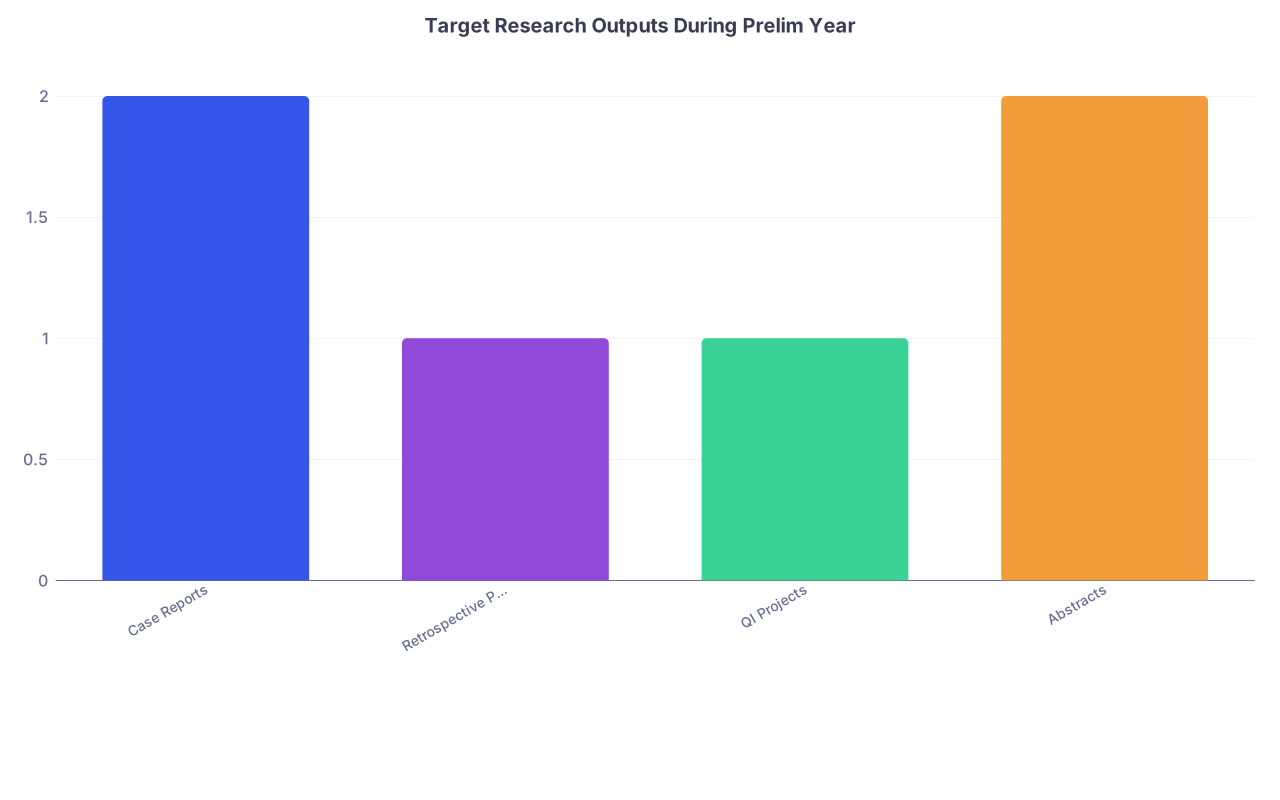
| Category | Value |
|---|---|
| Case Reports | 2 |
| Retrospective Papers | 1 |
| QI Projects | 1 |
| Abstracts | 2 |
Reasonable, ambitious but realistic target for a heavy prelim year:
- 1–2 case reports submitted
- 1 retrospective or QI paper where you are 1st, 2nd, or 3rd author
- 1 QI project that you can present locally or regionally
- 1–2 abstracts or posters at a regional/national meeting
Not all will publish before you apply, and that is fine. “Submitted” and “in preparation” matter more than people admit, if the mentor writing your letter can vouch you did real work.
Also: prioritize projects tied to someone who will write you a strong letter. A mediocre paper with a great letter is worth more than a higher‑impact paper with a stranger who barely knows you.
10. Example Weekly Schedules That Actually Work
Let me spell out two sample weeks, because vague advice does not survive real call schedules.
10.1. Brutal wards week (q4 call, intern on busy service)
- Monday: Call, 6:00–21:00 → zero research
- Tuesday: Post‑call, sleep 12:00–17:00 → 20:30–21:30: clean up 10 data rows
- Wednesday: Short call, 6:00–19:00 → 21:00–21:30: add 3 references to intro
- Thursday: Regular day, 6:00–18:00 → no research, you are destroyed
- Friday: Pre‑call, 6:00–17:00 → 20:00–21:00: outline case report discussion
- Saturday: Call → nothing
- Sunday: Post‑call, sleep → 1 hour max: minor edits or reading
Total: 3–4 hours of very light but real progress.
10.2. Ambulatory week (clinic 8–17, no call)
- Monday: 19:30–21:30 – Draft case report results
- Tuesday: Gym, no research
- Wednesday: 20:00–22:00 – Revise introduction to retrospective paper
- Thursday: Free evening
- Friday: 19:30–21:00 – Create RedCap codebook for new project
- Saturday: 10:00–13:00 – Deep work: write discussion, respond to mentor track‑changes
- Sunday: Off
Total: 7–8 hours of high‑quality effort. This is where the real advances happen.
11. How to Rescue a “Wasted” First Half of the Year
If you are halfway through prelim and have done nothing, you are not doomed. You just need to compress the steps.

| Step | Description |
|---|---|
| Step 1 | Week 1 - Find Mentor |
| Step 2 | Week 2 - Pick Project |
| Step 3 | Week 3 - IRB or Data Access |
| Step 4 | Week 4 - Data Pull or Case Draft |
| Step 5 | Week 5 - Write Results |
| Step 6 | Week 6 - Draft Full Manuscript |
Six‑week salvage plan:
- Week 1: Email 3–5 potential mentors. Take the first serious one with a realistic project.
- Week 2: Lock in 1 primary project. No dabbling in 5 things.
- Week 3: Get IRB access or confirm existing approval. Get logins and data plan.
- Week 4: Pull at least a sample of data or draft the case report core.
- Week 5: Convert data to basic results (tables, summary statistics).
- Week 6: Draft a crude full manuscript and send to mentor.
Is it ideal? No. Is it better than “I meant to do research but prelim was too busy”? Absolutely.
12. Mental Framing: You Are Building a Reputation, Not Just a CV
The point of squeezing research into a prelim year is not just a line on ERAS.
You are training people to think:
- “This resident follows through.”
- “Even with a brutal schedule, they finished the project.”
- “If I bring them to my advanced program, they will be productive.”
That perception is gold.
You do that by:
- Keeping promises about small tasks.
- Responding to emails within a few days even when you are slammed (a one‑line update counts).
- Being honest about time constraints while still moving projects forward.
Most residents do not fail at research because they are not smart enough. They fail because they never build a boring, repeatable system for inching projects forward in bad conditions.
You are in bad conditions. So build the system.
FAQ (Exactly 2 Questions)
1. How many research projects should I realistically take on during a demanding prelim year?
Two primary projects is usually the upper limit if your year is truly heavy:
- One “anchor” project (retrospective/QI) where you aim for a full manuscript.
- One or two smaller case reports / abstracts that can be slotted in quickly.
If you take on 5–6 projects, you will end with 5 half‑finished things and a reputation for flakiness. Better to fully complete 1–2 solid projects with good mentors than scatter across 10 “in progress” ideas.
2. Will programs judge me harshly if my publications are mostly case reports or small projects from prelim year?
No. Programs know a prelim year, especially in medicine or surgery, is brutal. Selection committees care much more about:
- That you did something scholarly in a tough environment.
- That you have at least one mentor who can write a strong, specific letter about your work ethic and reliability.
- That your output makes sense for your stage (case reports + retrospective is perfectly reasonable).
They do not expect R01‑level work in a prelim year. They expect evidence that, when given limited time and rough conditions, you still produce and follow through.
Open your calendar for the next four weeks right now and block out your first three research sessions—specific days and times—with a one‑line task for each. Then email one mentor today with a concrete update or a direct ask for a well‑defined project.