
The residency advice you’re hearing about “just rank advanced and prelim together, it’ll work out” is dangerously incomplete.
If your prelim and advanced programs end up in different cities, your real job for the next two years is not just doctoring—it’s logistics.
You’re not alone, and you’re not doomed. But you do need a plan. A real one. With dates, money, and backup options—not just vibes and hope.
Let’s walk through exactly how to handle life when your PGY-1 and PGY-2+ are in different cities.
1. First, Accept What You Actually Signed Up For
A prelim + advanced split city situation is basically:
- Two jobs
- Two cities
- One long, exhausting transition in the middle
That transition is not a side quest. It is its own beast.
You might be in:
- Prelim in City A – large community hospital
- Advanced in City B – big academic center 4–6 hours away
- Gap of 2–6 weeks between PGY-1 end and PGY-2 start
Or worse: 1 week. Or overlapping orientations.
Your life for the next ~18 months is defined by:
- Housing decisions that straddle two cities
- Moving while working 60–80 hours/week
- Licensing/credentialing in two different states (possibly)
- Brand new social/professional network twice in two years
You can either:
- Drift through that and hope it works out.
- Or treat this like a small military deployment with a concrete ops plan.
If you want to keep your sanity, you choose the second.
2. Timeline: What Needs to Happen and When
Before we talk housing, money, or travel, you need a spine to hang it all on: time.
Here’s the rough framework you should be working on.
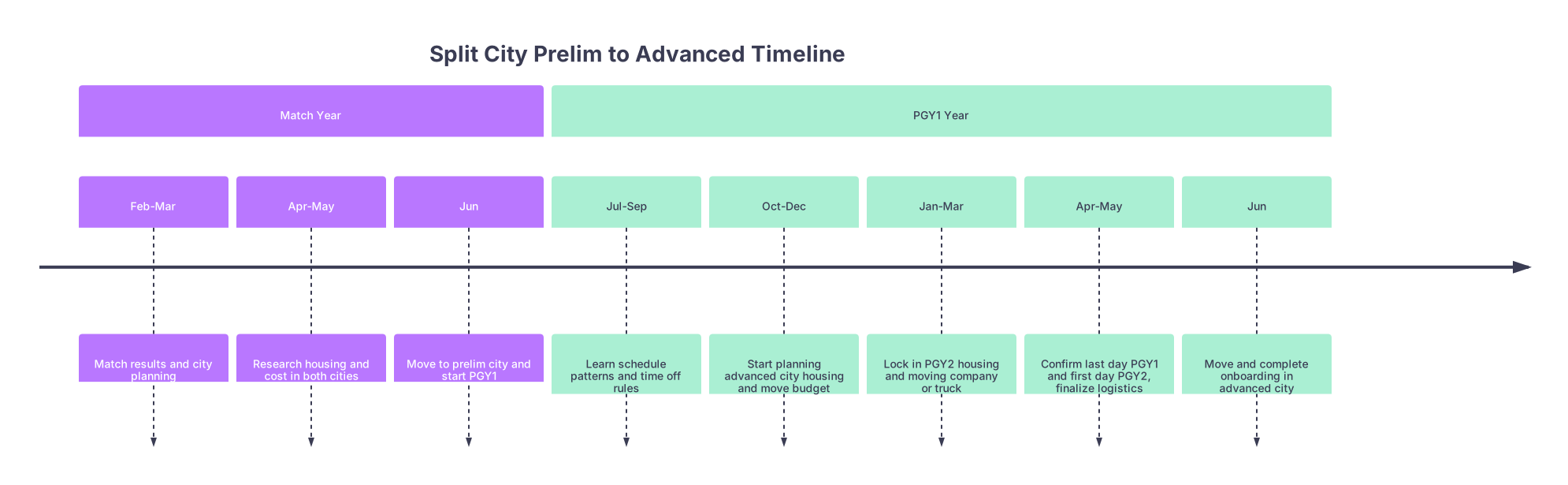
| Period | Event |
|---|---|
| Match Year - Feb-Mar | Match results and city planning |
| Match Year - Apr-May | Research housing and cost in both cities |
| Match Year - Jun | Move to prelim city and start PGY1 |
| PGY1 Year - Jul-Sep | Learn schedule patterns and time off rules |
| PGY1 Year - Oct-Dec | Start planning advanced city housing and move budget |
| PGY1 Year - Jan-Mar | Lock in PGY2 housing and moving company or truck |
| PGY1 Year - Apr-May | Confirm last day PGY1 and first day PGY2, finalize logistics |
| PGY1 Year - Jun | Move and complete onboarding in advanced city |
Now let’s layer details.
Match week – month 1 after Match
You must:
- Confirm your start dates and exact locations for both programs
- Clarify orientation dates (they’re sometimes earlier than July 1)
- Ask each program:
- “What’s the earliest I’d need to be physically here?”
- “Do you provide any PGY-1 or PGY-2 specific housing resources?”
- Start rough mapping:
- Distance between the two cities
- Typical rent in both places
- Cost to break a lease early in the prelim city
First 3 months of PGY-1
You’re dying on wards. But minimum planning still has to happen:
Learn your program’s:
- Vacation policy
- Rules for switching weeks with co-residents
- How rigid they are about time off at the end of the year
Start a simple doc (Google Doc/Notion/whatever) with:
- “PGY-2 Start Date / Orientation Date / City”
- “Deadline for health clearance, HR docs, license, etc.”
- “Expected move week window”
You do not need all the answers yet. You need a place where all partial answers accumulate.
6–9 months before starting PGY-2
This is commit time.
You should be:
Deciding whether you’ll:
- Keep overlapping housing
- Move fully once
- Or do something hybrid (sublet / family / co-living)
Locking in:
- Your PGY-2 city housing
- A realistic moving budget
- A rough move date range
If you’re reading this and you’re inside that 6–9 month window and nothing is decided, that’s your immediate project for the next week.
3. Housing Strategy: One City at a Time (But Thinking About Both)
Housing is where people screw this up and lose thousands of dollars or their sanity.
Here’s the core problem: you’re committing to City A (prelim) for 12 months, knowing you must be in City B almost exactly 12 months later. And you don’t fully control your PGY-1 schedule at the end of the year.
Step 1: Prelim Year Housing Rules
When you choose PGY-1 housing, you need to optimize for three things, in this order:
- Flexibility
- Commute
- Price
The trap: signing a cheap 12-month lease with harsh break fees, thinking “I’ll figure it out later.”
Ask landlords or complexes very directly:
- “What is the penalty for breaking a lease early?”
- “Do you allow subletting?”
- “What happens if I need to leave 1–2 months before the lease ends?”
Then choose one of these lanes:
| Option | Pros | Cons |
|---|---|---|
| 12-month lease, flexible terms | Usually cheaper monthly | Need proof terms are truly flexible |
| Month-to-month / short term | Maximum flexibility | Higher rent, less selection |
| Room in shared house | Can be informal/flexible | Less control, roommates risk |
If you can find:
- A roommate situation with another resident
- A complex known for transient professionals
- Or a landlord who’s expressed, on email, flexibility if you match elsewhere
…that’s gold.
Step 2: PGY-2 City Housing
This one is different. You’ll be there for 3–6 years.
You can and should:
Ask your advanced program for:
- Resident group chats
- Incoming class email list
- People looking for roommates
Target:
- A lease start date 1–2 weeks before you absolutely must be there
- Something you do not have to move out of mid-ICU block in PGY-3
Your decision tree here is simple:
Got a short gap between PGY-1 end and PGY-2 start (≤1 week)?
→ You may need some overlap (paying rent in two places briefly).Got 2–4 weeks between?
→ Ideal. You move once, stay with friends/family/cheap Airbnb in the interim if needed.
And remember: if you must overpay anywhere, overpay for flexibility at the prelim site, not for luxury at either.
4. The Actual Move: Treat It Like a Procedure
Residents try to move like college kids: last minute, DIY, chaotic. That works when you’re 20 and on summer break. You are not that person anymore.
You’ll be working full-time, often with a brutal schedule.
Break it into phases.
A. 3–6 months before moving
- Decide: professional movers vs. U-Haul vs. “I own 6 things and a mattress”
- Make a written list (yes, written) of:
- Furniture you’re actually taking
- Stuff you’re donating/selling
- What can be replaced cheaply rather than moved
If your cities are far apart (flight distance), heavily consider:
- Selling bulky, cheap furniture
- Moving only essentials + personal items
- Re-buying basics in City B (IKEA, Facebook Marketplace, etc.)
B. 2–3 months before
Book:
- Movers or truck
- Storage unit if there’s a gap between leases
- Any flights if needed
Submit:
- Vacation request or schedule adjustment for your intended move week
- HR paperwork and occupational health for PGY-2
You want your move falling on an actual off stretch, not between nights and wards.
C. 1 month before
Start packing non-essentials in small bursts (1–2 boxes per off day).
Forward mail from prelim address to:
- Either a stable friend/family address
- Or directly to your PGY-2 address if timing fits
Confirm:
- Orientation dates in City B
- Last working day in City A
D. Move week(s)
You are doing:
- A “survival kit” bag:
- 7–10 days of clothes
- Badges, stethoscope, electronics, chargers
- Important documents (IDs, vaccination records, license, etc.)
Do not pack those into boxes. Keep them in a backpack/roller that stays with you.
5. Money: Build a One-Time Transition Budget
Residents constantly underestimate how expensive this split-city setup is.
You’re essentially doing:
- Two “start-up” costs
- One major relocation
- Double deposits, double furniture gaps, double everything
Build a basic one-time budget:
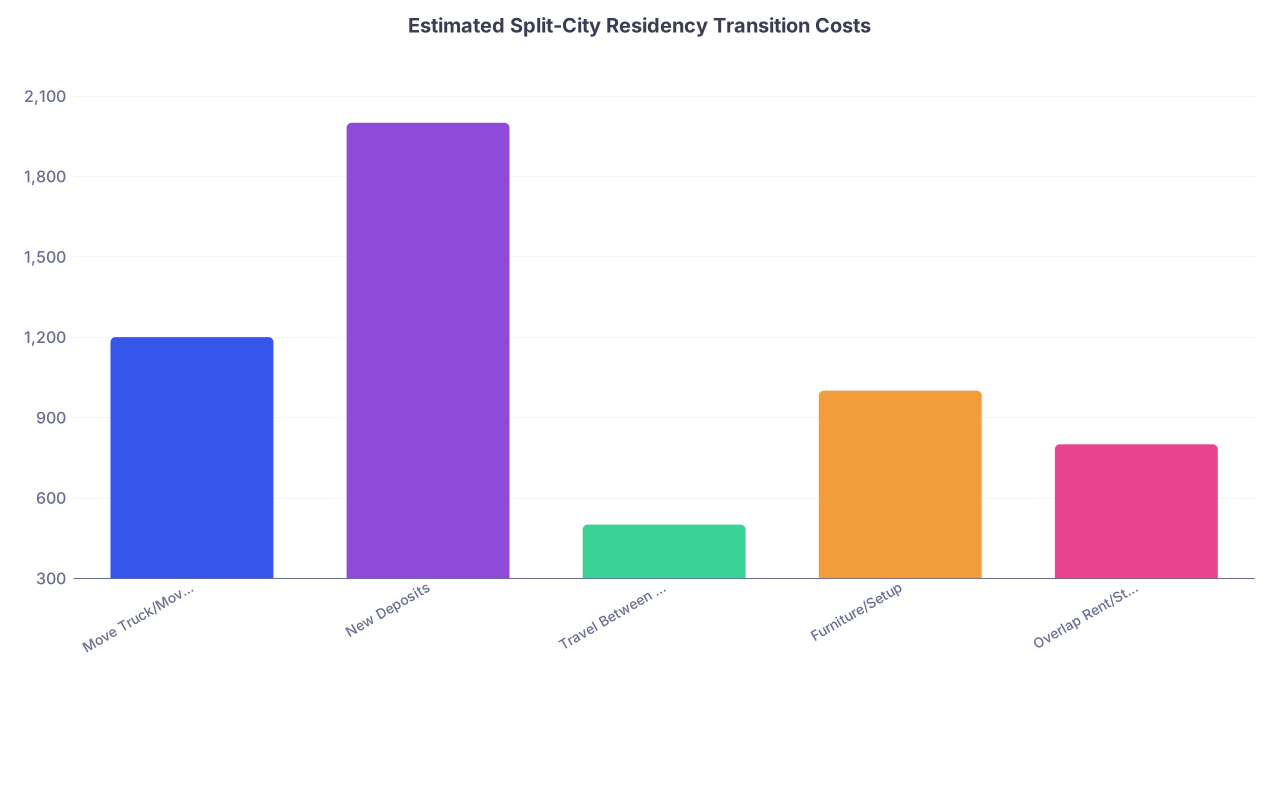
| Category | Value |
|---|---|
| Move Truck/Movers | 1200 |
| New Deposits | 2000 |
| Travel Between Cities | 500 |
| Furniture/Setup | 1000 |
| Overlap Rent/Storage | 800 |
Then:
- Add 20–30% buffer. Because something will go wrong.
- Start setting aside a small amount every month during PGY-1.
Even $150–200/month for 10 months gives you $1,500–2,000. That’s the difference between controlled chaos and “I put this all on a credit card and now I’m underwater.”
Look for:
- Relocation stipend from either program (ask explicitly)
- Sign-on bonus (rare but exists in some specialties)
- Family/friend help in the form of temporary housing, not just cash
6. Scheduling: Orientations, Last Rotations, and Not Burning Bridges
The single most stressful part is often those last 4–6 weeks of PGY-1.
Here’s what YOU need to do early:
Ask your prelim program:
- “Are there any restrictions on when I can use my last vacation?”
- “Have prior residents left early for PGY-2 orientation? How was that handled?”
Ask your advanced program:
- “What are the non-negotiable dates I must be physically present?”
- “Do prior incoming PGY-2s ever arrive a few days late due to prelim commitments?”
Then, at least 4–6 months out:
- Tell your chief residents and program coordinator at the prelim:
- Rough PGY-2 start/orientation date
- Your desire to have your last off-block or easier rotation close to that time
You’re not asking for special treatment. You’re asking with enough lead time that they can actually accommodate you.
Do not:
- Spring this on them in May.
- Vanish emotionally because “I’m leaving anyway.” People remember.
7. Life, Relationships, and Not Losing Your Mind
The logistical stuff is only half of it. Your actual life matters.
You might be:
- Leaving a partner behind after prelim
- Moving back to a partner/family in the advanced city
- Moving twice completely alone
So be intentional.
If you’re in a relationship
You need a brutally honest talk about:
- Where each person will live during prelim and advanced
- Whether anyone is willing to move twice
- How often you can realistically see each other
Do not promise weekly visits if you’re on Q4 call and 3 hours apart. You’ll just stack guilt on top of fatigue.
If you’re solo
Your biggest risks are:
- Social isolation x 2 years
- Not building roots because “I’m leaving soon”
In prelim city:
- Let yourself be “temporary,” but still:
- Make 1–2 good resident friends
- Learn where you like to decompress (park, coffeeshop, gym)
In advanced city:
- Plan to arrive at least a few days early if possible
- Use that time to:
- Walk your neighborhood
- Find a grocery store, pharmacy, coffee spot, gym, etc.
Tiny things like already knowing where to park on day 1 make a big psychological difference.
8. Paperwork: Two States, Two Systems
Boring but critical.
You may need:
- State license #1 for prelim (if required in that state)
- State license #2 for advanced (or training license)
- Two sets of:
- HR onboarding
- Immunization verification
- Employee health visits
So:
Create a digital “residency docs” folder:
- Vaccination records
- PPD/Quantiferon results
- Mask fit documentation
- Certifications (ACLS, BLS, etc.)
Store:
- PDFs in the cloud
- A physical copy in a labeled folder that moves with you
If you think this is overkill, talk to anyone who had their EMTALA or immunization documentation lost 3 days before orientation and had to scramble.
9. Social & Professional Integration—Twice
The hidden cost of split cities is that you start over socially and professionally right when you finally “get comfortable.”
PGY-1:
- Your “brand” is: “the new intern who doesn’t know anything”
- You finally figure out the EMR, the culture, the attendings’ personalities
And then you leave.
PGY-2:
- You are an “experienced” resident clinically
- But socially? You’re the new person again
You can speed this up:
Ask your advanced program:
- “Can I be added to resident GroupMe/WhatsApp before I arrive?”
- “Is there a co-resident from my medical school region or prelim program who I can reach out to?”
At both places:
- Show up to at least some optional things (welcome dinners, happy hours)
- Volunteer for one small committee or project mid-year (not 10)
You don’t need to become social chair. You need 3–5 people who know your name and will answer: “How do you actually get a CT approved here at 3 a.m.?”
10. Contingency Plans: When Things Don’t Line Up Perfectly
Last piece: assume something won’t go to script.
Common failure modes:
- Your prelim program schedules you on nights up to June 30
- Your advanced program insists on in-person orientation starting June 25
- Your landlord refuses to let you end your lease 2 weeks early
- Your moving truck window doesn't align with your only off days
So you build contingencies:
If schedules overlap?
- Talk early to both programs. Prelim might switch you from nights to clinic. Advanced might allow missed day 1 of orientation if you complete modules early. But only if you surface it months ahead, not days.
If you literally cannot move everything in time?
- Use short-term storage in prelim city
- Move only critical items first, return on a vacation later, or pay someone to ship items
If costs explode beyond your budget?
- Downgrade PGY-2 initial setup
- Delay buying nice furniture
- Temporarily live with roommates even if you’d prefer solo living
You can’t control everything. But you can avoid being blindsided by fully predictable problems.
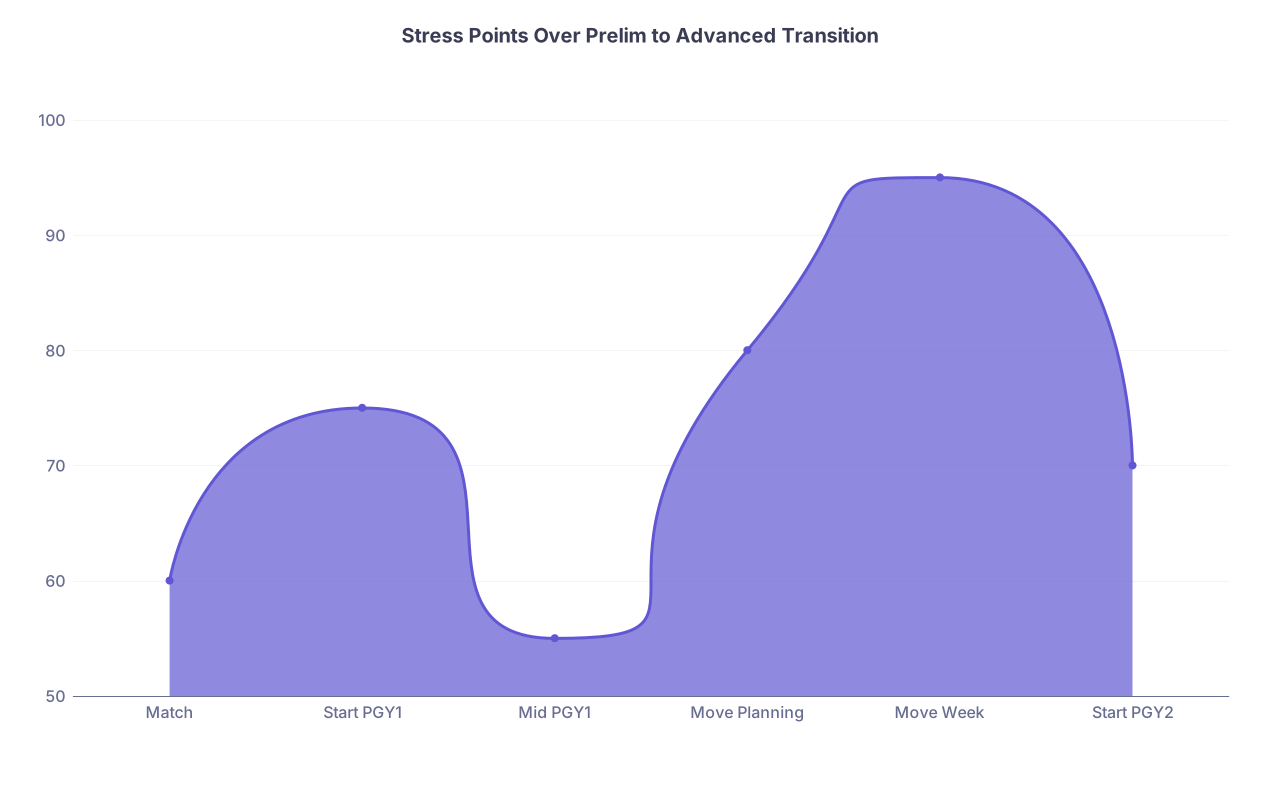
| Category | Value |
|---|---|
| Match | 60 |
| Start PGY1 | 75 |
| Mid PGY1 | 55 |
| Move Planning | 80 |
| Move Week | 95 |
| Start PGY2 | 70 |
11. Concrete 30-Minute Action Plan (If This Is You)
If you’re already matched prelim + advanced in different cities, sit down today and:
- Open a blank document titled: “Prelim to Advanced Transition Plan.”
- Make 4 headings: Housing, Move, Money, Scheduling.
- Under each, write:
- What you already know
- What you still need to find out
- Send exactly 2 emails:
- One to your prelim coordinator: ask for last-day-of-contract and typical end-of-year scheduling flexibility
- One to your advanced coordinator: ask for first mandatory in-person date and any provided housing resources
- Put a calendar reminder 2 weeks from today: “Update transition plan.”
You do that, and you’ve already handled this better than 90% of residents in your situation.