
The honest truth: most program directors are suspicious of preliminary-only applicants until you give them a very clear reason not to be.
Not hostile. Suspicious. There’s a difference. And if you do not understand that difference, your prelim applications will get quietly buried under the categorical pile and you will never know why.
Let me walk you through what actually goes through a PD’s head when they see “Preliminary only” on ERAS — the parts they will never say in an info session or a Zoom open house.
First, understand what a prelim year really is to a PD
To applicants, a prelim year is “a stepping stone,” “a backup,” or “a way to stay in the game.” That’s the language you use.
To many program directors, a prelim year is this: a necessary headache.
They see:
- Extra recruitment work for people who are guaranteed to leave
- More scheduling complexity, especially in July when they all vanish to their advanced programs
- Higher risk of disengagement (“I’m leaving anyway”)
- Extra evaluation, paperwork, and future letters for someone who will not be around long
But they also see something else:
- Cheap labor for high-intensity rotations (medicine wards, ICU, surgery nights)
- A way to cover service lines that categorical residents hate
- A chance to recruit “quiet rockstars” as PGY-2s when categorical spots unexpectedly open
So PDs put prelims into three mental buckets:
- Workhorses who will show up, work hard, and not cause chaos
- Flight risks or drama magnets
- Potential future categorical residents
Your job is to make it blindingly obvious you’re category #1 or #3. If you let them guess, they assume #2.
What “preliminary-only” signals to a busy PD
Let me be blunt. When a PD filters ERAS applications and sees “Preliminary only,” they instinctively run a short, ruthless internal script.
It sounds like this.
1. “Why only prelim? What’s the catch?”
They scan for:
- Step failures or marginal scores
- Extended time in med school
- Gaps after graduation
- Prior match failure or SOAP history
- Visa issues
- Weak or generic letters
- A “generic to everything” personal statement
If they cannot quickly tell why you’re only applying prelim, they’ll assume you’re hiding something or you don’t know what you’re doing. Neither is good.
2. “Are they using me or is there mutual benefit?”
Programs do not like feeling like a layover airport. They accept that prelims are transient, but they want assurance you’ll:
- Show up reliably
- Care about their patients
- Not check out once your advanced spot is secured
- Not poison morale by constantly saying “I’m leaving anyway”
If your application screams “I’m here because I have to be somewhere,” you’re done.
3. “Will this person embarrass me in front of my chairs?”
This is the selfish part program directors usually won’t admit.
They worry about:
- Interns failing to function on high-acuity services
- Constant hand-holding on days that should run on autopilot
- Angry calls from ICU, surgery, or ED chiefs: “Why did you send me this prelim?”
Prelim interns are often front-loaded into hard services. If they crumble, the PD eats the political fallout.
So when they see “Preliminary only,” they’re really thinking:
“Is this person going to survive July in the MICU or SICU without me getting five emails a day?”
The unspoken hierarchy of prelim applicants
Not all prelim applicants are treated the same. Let me show you the pecking order as it actually plays out in selection meetings.
| Rank (Best to Worst) | Type of Prelim Applicant |
|---|---|
| 1 | Matched to strong advanced program, needs TY/Prelim |
| 2 | Applying advanced this cycle, clear plan and specialty |
| 3 | Unmatched applicant with clear, fixable gap |
| 4 | Career drifter: vague goals, scattered story |
| 5 | Red flag factory: professionalism/failed exams |
1. Already matched to advanced (the “safe bet”)
These are the applicants with a confirmed PGY-2 or advanced position somewhere else (radiology, anesthesia, PM&R, derm, ophtho, neuro, etc.), just needing a prelim or transitional year.
PDs love them on paper because:
- Someone else has already “vetted” them via NRMP rank
- They have a defined destination and timeline
- They’re usually focused on doing well (they need a good prelim eval for boards/advanced program)
Medicine PDs know: “This radiology-bound intern will do a solid job, study, and then leave. Fine.”
Surgery prelim PDs often think: “This anesthesia-bound intern will work their tail off trying to impress. Good.”
2. Applying advanced this cycle (the “driven strivers”)
This is the person trying to land an advanced spot while starting a prelim year. They might be shooting for:
- Neuro, rads, anesthesia, PM&R, ophtho, derm, etc.
- Or have applied categorical and prelim as a hedge with a clear plan
PDs tolerate this group because there’s obvious drive. The risk is they’ll spend too much time on applications and interviews during the year. The PD will silently ask:
“Will they miss shifts, be distracted, constantly asking for time off for interviews?”
If your application + personal statement clearly shows a realistic, mature plan, they give you a shot. If you sound delusional (“I’ll just match derm next cycle”), less so.
3. Unmatched once, clear story (the “redemption arc”)
These are people who:
- Went all-in on something like ortho, ENT, derm, plastics and didn’t match
- Applied too top-heavy, or with one weak aspect (late Step 2, weak letters, no home program support)
- Are pivoting to a more realistic advanced path
PDs actually respect this group when you own the narrative. A medicine PD might say:
“Yeah, they shot too high in ortho, but their medicine evals are good, their Step 2 is fine, and they wrote an honest statement. Let’s bring them in.”
But if you play victim or sound bitter (“my school didn’t support me,” “the match is unfair”), that’s a hard no.
4. Vague goal, fuzzy future (the “drifters”)
These are the people who cannot clearly state what they want:
- “I’m applying prelim to keep my options open.”
- “I’m not sure which specialty is right for me yet, hoping to figure it out.”
- “I just want clinical experience first.”
I’ve heard PDs literally say in committee:
“If they don’t know what they want now, they’re going to flounder all year and then we’re writing another round of generic letters for nothing.”
Programs don’t want to be your career exploration year. That’s what med school was for.
5. Red flag factories
Failed exams with no remediation story. Multiple professionalism comments. Vague LORs that say “adequate” instead of “strong.” Five-year gaps with no clear explanation.
“Preliminary only” plus big unexplained red flags is the kiss of death.
No amount of “I’m passionate about learning” will overcome “We had repeated concerns about reliability” in an MSPE.
How different specialties view prelim-only applicants
The dirty little secret: “prelim” means very different things depending on the department.
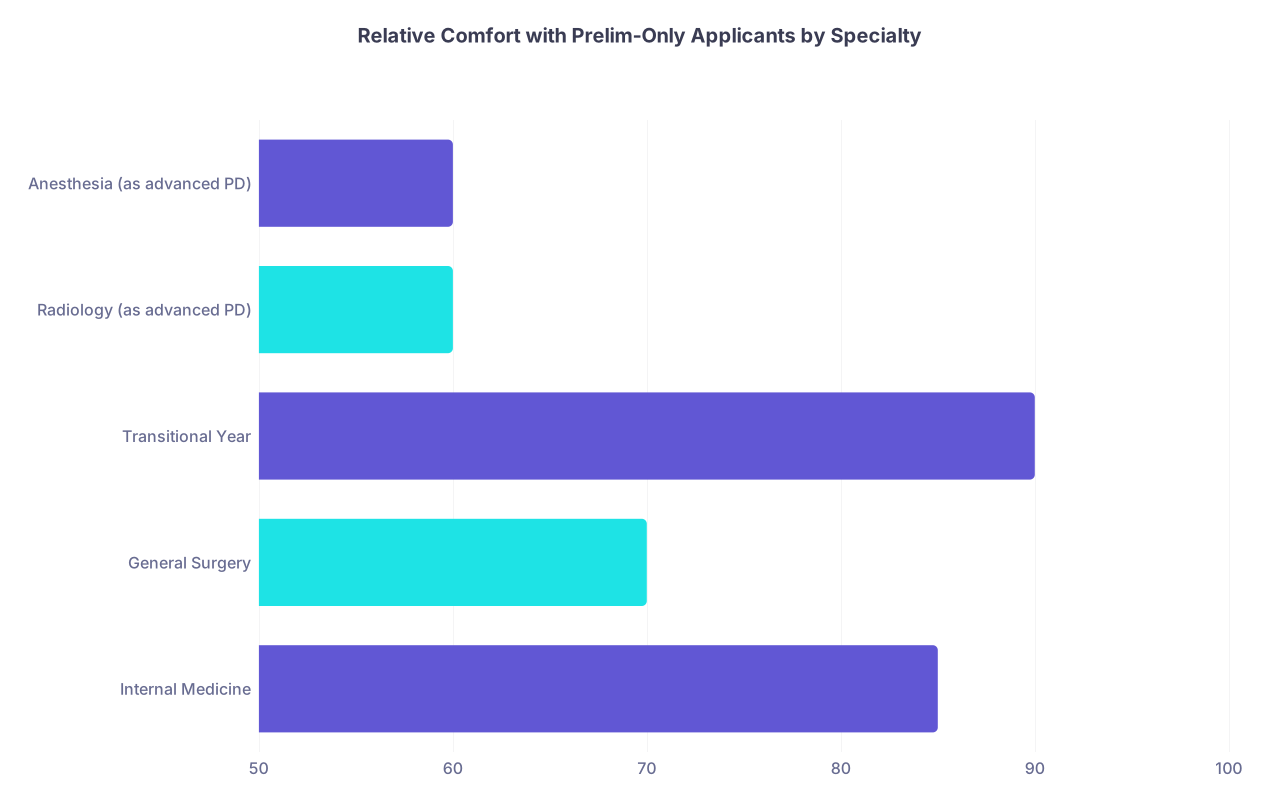
| Category | Value |
|---|---|
| Internal Medicine | 85 |
| General Surgery | 70 |
| Transitional Year | 90 |
| Radiology (as advanced PD) | 60 |
| Anesthesia (as advanced PD) | 60 |
(Think of these numbers as “comfort level” out of 100, not exact data, but this matches the attitudes I’ve heard in real meetings.)
Internal Medicine prelims
Medicine PDs are used to prelims. Rads, anesthesia, neuro, ophtho, and derm all feed off them.
They tend to think:
- “Give me someone who can manage a list, call consults, and not implode on nights.”
- “If they’re advanced-bound, great. If they’re unmatched but solid, we can help them land somewhere.”
They don’t require you to want a career in medicine. They do require:
- Clear communication of your specialty plan
- Realistic understanding of workload
- No entitlement about ignoring medicine responsibilities because “I’m going into radiology anyway”
Surgery prelims
Surgery is harsher, and the politics are different.
Gen surg programs often use prelims to:
- Cover brutal services no one wants
- Trial potential future categoricals when they anticipate attrition
- Fill call schedules cheaply
Surgery PDs frequently think:
- “Is this person a categorical-level surgeon who we just don’t have space for yet?”
- Or: “Is this someone who failed to match anywhere and will bleed on service?”
If you’re prelim-only in surgery with no clear reason, you’re assumed to be weak until proven otherwise. But if you communicate, “I want surgery, I missed this cycle for X reason, I’m here to prove I can function at categorical level,” they may see you as a high-upside gamble.
Transitional year programs
TYs are blunt: they rarely pretend they’re anything other than a one-year on-ramp.
They know they exist to keep Rads/Anes/PM&R/Heme-Onc pipelines flowing. They want:
- Low drama
- High reliability
- People who understand that TY ≠ vacation year
If you sound like you’re shopping for “the easiest intern year possible,” they will absolutely clock that in your interview.
What PDs really read in your prelim personal statement
Here’s the secret: PDs don’t care if your prelim personal statement is poetic. They care if they can answer 3 questions in under 60 seconds.
- Why prelim and not categorical?
- What is your actual long-term specialty plan?
- Will you show up and work hard for my patients, even though you’re leaving?
They’re reading between the lines for:
- Entitlement (“My dream is derm, I just need a place to park for a year.”)
- Resentment (“The match screwed me so I’m forced to do a prelim year.”)
- Ambiguity (“I just love all of medicine and haven’t decided.”)
The strongest prelim personal statements usually:
- Name the intended specialty explicitly
- Acknowledge why a prelim year fits into that path
- Show respect for the hosting specialty (“I want to be a radiologist who truly understands how inpatient medicine works…”)
- Hint at maturity: owning past missteps, not blaming systems or people
I’ve seen PDs reject otherwise numerically strong applicants purely because their PS said — almost verbatim — “I just need a spot for a year while I figure out my life.”
They might not say that’s why. But that’s exactly why.
How PDs view prelim-only applicants with low or failed Step scores
This is where a lot of applicants are misinformed.
Many students think: “I’ll just do a prelim year, crush it, and then everything will be fine.” PDs are far more cynical.
Here’s the internal logic chain they actually use:
- “Low Step 1 or Step 2? Okay, do they at least have strong clinical evaluations and letters?”
- “If they failed Step, did they pass on second attempt with a clear upward trend?”
- “If we help them and they still can’t land an advanced or categorical spot, are we stuck writing letters for years?”
The hard truth: a prelim year does not magically erase a failed board exam. It can prove:
- You are clinically strong despite test history
- You are reliable, professional, resilient
But advanced programs still see your transcript. PDs know this. So they ask:
“Is this someone where a strong prelim year will actually change their match odds next cycle? Or are we setting everyone up for disappointment?”
If your scores are marginal, you can still win a PD over by:
- Showing a clear pattern of improvement
- Having faculty who went to bat for you: “This student is one of our hardest workers, I would absolutely trust them with my patients.”
- Being brutally honest about your plan: “I know I won’t be at MGH Anesthesia next year. I’m targeting realistic programs and specialties.”
Interview day: what PDs are really testing in prelim-only applicants
By the time you’re in the chair (or on Zoom), most PDs already know your numbers. They are not interviewing you to rehash your CV.
They are trying to answer three unspoken questions:
- Are you going to complain all year?
- Can I trust you at 3 a.m. on a step-down unit with no backup immediately present?
- Are you going to make my life harder or easier?
They’ll prod this with questions like:
- “Tell me about a time you got difficult feedback.”
- “Describe a challenging call night.”
- “What will you do if you don’t match into your ideal specialty next year?”
If you respond with:
- Blame
- Defensiveness
- Unrealistic optimism
- Or clear bitterness about your prior match outcome
…you drop several spots on the rank list.
The prelims who rise are the ones who say — in their own words —
“I understood that my first application cycle had gaps. I own that. I’m here to work, to grow, and to be a good colleague. Whatever happens with the next match, I’m going to give my patients and this program my best year.”
That’s the sentence that gets repeated when the PD defends you in the rank meeting.
The hidden opportunity: how prelims become categoricals
One more thing the brochures never tell you: many categorical residents were originally prelims. It happens more than you think.
Here’s the back-room version.
Every year, programs have:
- Unexpected resignations
- People switching specialties mid-residency
- Residents who fail boards
- Visa issues or personal crises that force someone to leave
A smart PD looks at their prelim class and thinks:
“Who here could I convert to categorical if I suddenly have a hole?”
The ones they consider are:
- Consistently strong on rotations
- Not toxic, not whiny
- Act like they’re already part of the program, even knowing they might leave
- Have clear career goals aligned with that specialty
I’ve watched a prelim medicine intern who thought they were rads-bound end up a categorical hospitalist-track star because the PD called them into the office one day and said: “We had a spot open. The faculty all mentioned your name.”
That offer is never going to the intern who spent all year saying, “I’m just here for rads, I don’t really care about medicine.”
How to make PDs actually like prelim-only applicants
Let me tie this together into something actionable, because this isn’t just therapy — you need a strategy.
Spell out your path. Explicitly.
Stop being mysterious. PDs are not impressed by vague “keeping doors open” language. Tell them: “I am pursuing anesthesiology. I am applying to TY and medicine prelim programs because I want a strong clinical foundation before advanced training.” That’s what wins.Respect the hosting specialty, even if it’s not your endgame.
Never act like you’re “using” them. Frame it as: “I want to be a radiologist who understands inpatient medicine enough to be a real consultant.” They’ve all heard the opposite. Your respect stands out.Own your losses without wallowing.
If you went unmatched or switched late, write and talk about it like an adult. “I aimed too high and didn’t have the research. I’ve adjusted my plan and I’m focused on being the best intern I can be this year.” That sort of line makes PDs relax.Signal that you won’t be a problem.
This matters more than your Step score once you’re already above the cut. Letters that say “hard-working, shows up, gets along with everyone” are gold. Anything implying drama or fragility is radioactive.During the year, act like it counts — because it does.
If you match an advanced spot later, great. But your prelim PD will be writing your letters, talking to future employers, and answering phone calls for years. You are building your reputation in real time.
The bottom line
Program directors do not hate preliminary-only applicants. They hate unclear, entitled, or risky applicants — and too many prelims fall into that trap.
If you:
- Make your specialty plan explicit and realistic
- Show that you will work hard for a program even though you’re leaving
- And own your story without self-pity
You move from “suspicious gamble” to “useful, safe, maybe even high-upside intern.”
Understand that is the game you’re actually playing. Then play it deliberately.