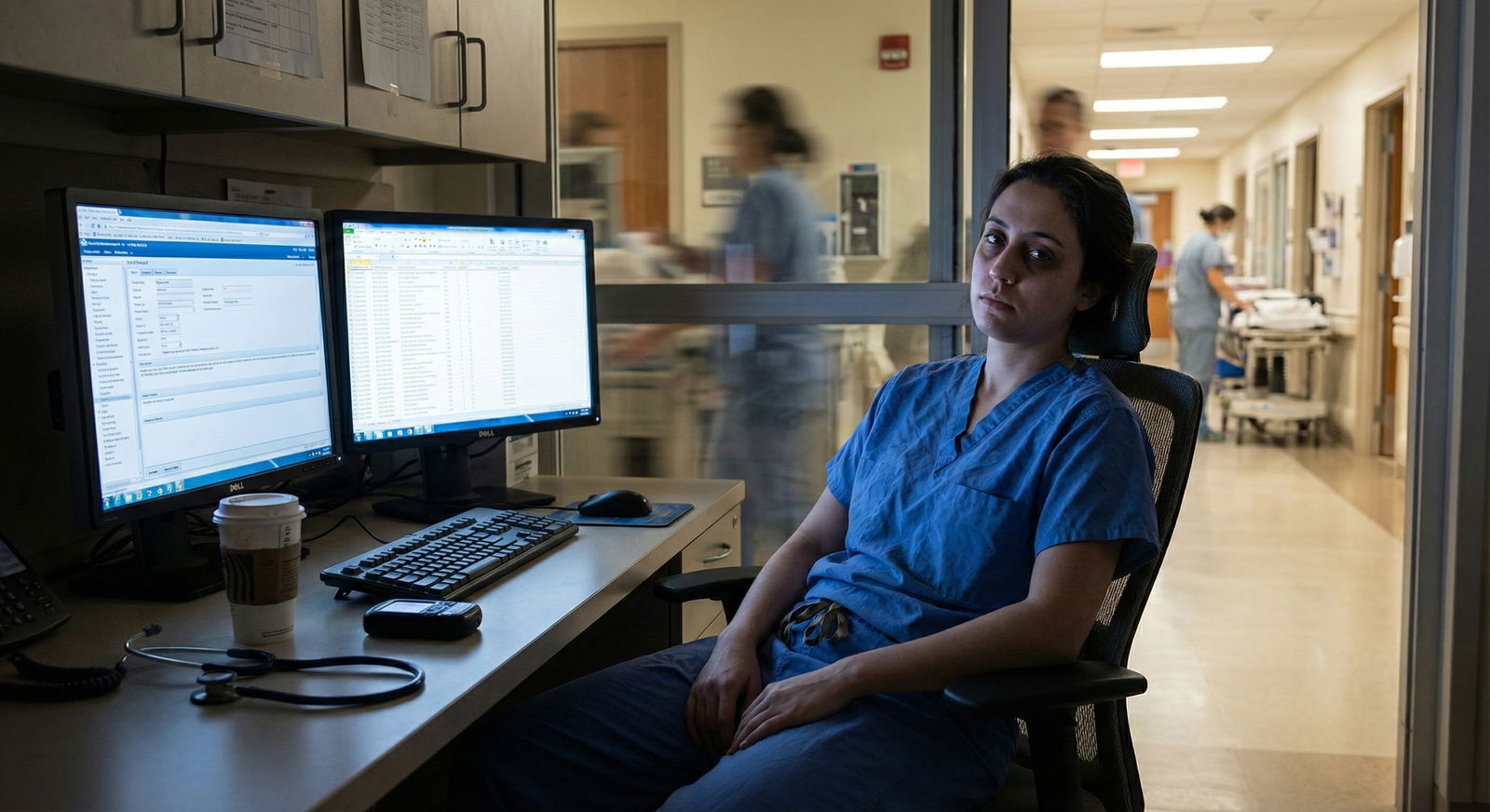
You are holding a neurology (or radiology, anesthesia, ophtho, derm) interview invite, and the coordinator just emailed: “Please indicate whether you will be applying for a preliminary year here or elsewhere.” Your spreadsheets have “Prelim IM – community?” and “Prelim TY – big university?” in angry red. You know you need a PGY‑1, you know there are “prelim” and “transitional” options, but you do not actually know how a community prelim year feels different from a university one.
This is exactly where people make quietly disastrous choices. Because on paper, many of these programs look similar. On the ground, they are not.
Let me break this down specifically.
1. Quick framework: what a prelim year actually is
First anchor the basics so the community vs university contrast makes sense.
A preliminary year is:
- A one‑year, non‑continuity internship (usually PGY‑1) that does not guarantee continuation to PGY‑2 in that same field.
- Required for “advanced” specialties: neurology, anesthesia, radiology, PM&R, dermatology, radiation oncology, sometimes ophtho and urology (depending on structure).
- Most commonly:
- Preliminary Internal Medicine (categorical‑style year without the guaranteed PGY‑2+)
- Preliminary Surgery
- Transitional Year (TY) – broad mix, usually lighter, more elective heavy
You match to this separately (NRMP codes ending in “P” or “R” for prelim / TY; “C” for categorical; “A” for advanced).
What the prelim year actually does:
- Gets you licensed (meets internship / GME requirements).
- Teaches you to function as an intern: cross‑cover, write orders, call consults, survive Q4 call.
- Either:
- Serves as a “service engine” for the hospital, or
- Gives you a flexible, somewhat cushioned bridge into your advanced specialty.
The community vs university distinction is about how that service vs education balance plays out.
2. Structural differences: how the programs are built
Before we get into “feel,” look at basic architecture. The setting shapes everything: workload, autonomy, politics.
| Feature | Community Hospital Prelim | University Hospital Prelim |
|---|---|---|
| Size of program | Smaller, 6–12 prelims/year | Larger, 10–30+ prelims/TYs/year |
| Subspecialties on site | Limited, many off-site consults | Broad spectrum, in-house |
| Fellowship presence | Few or none | Multiple fellowships |
| Research infrastructure | Minimal | Robust (IRB, labs, statisticians) |
| EMR | Often one system, simpler | Complex, multiple instances |
Community hospital prelim year – classic pattern
Think a 300‑bed regional medical center affiliated with a university “on paper” but functionally independent.
Common traits:
- Fewer learners competing for procedures. Maybe IM residents, a small FM program, a couple of surgery residents. No swarm of fellows.
- Attendings are often private practice groups contracted to the hospital. Less “academic politics,” more “clinical throughput.”
- Case mix: lots of bread‑and‑butter medicine – CHF, COPD, DKA, sepsis, cellulitis, nursing home disasters.
- Call systems may be old‑school: 24‑hour calls, big cross‑cover lists, a true “workhorse intern” feel.
University hospital prelim year – classic pattern
Think a large tertiary / quaternary center with multiple residencies and fellowships, NIH funding, and an institutional obsession with metrics.
Common traits:
- Large residency cohorts. Your prelim class might be embedded inside a 40+ person IM program, or 15 person TY linked to a big anesthesia department.
- Strong subspecialties: advanced heart failure ICU, neuro ICUs, transplant services, bone marrow transplant, ECMO.
- Case mix: rare pathology, referred zebras, high acuity; heavier ICU exposure.
- Structure is formal: competency committees, Milestones, structured simulation, formal noon conferences that actually happen.
Same one‑year duration. But the environment your body and brain live in is very different.
3. Day‑to‑day life: service, autonomy, and supervision
This is what you actually feel at 2 AM when the pager does not stop.
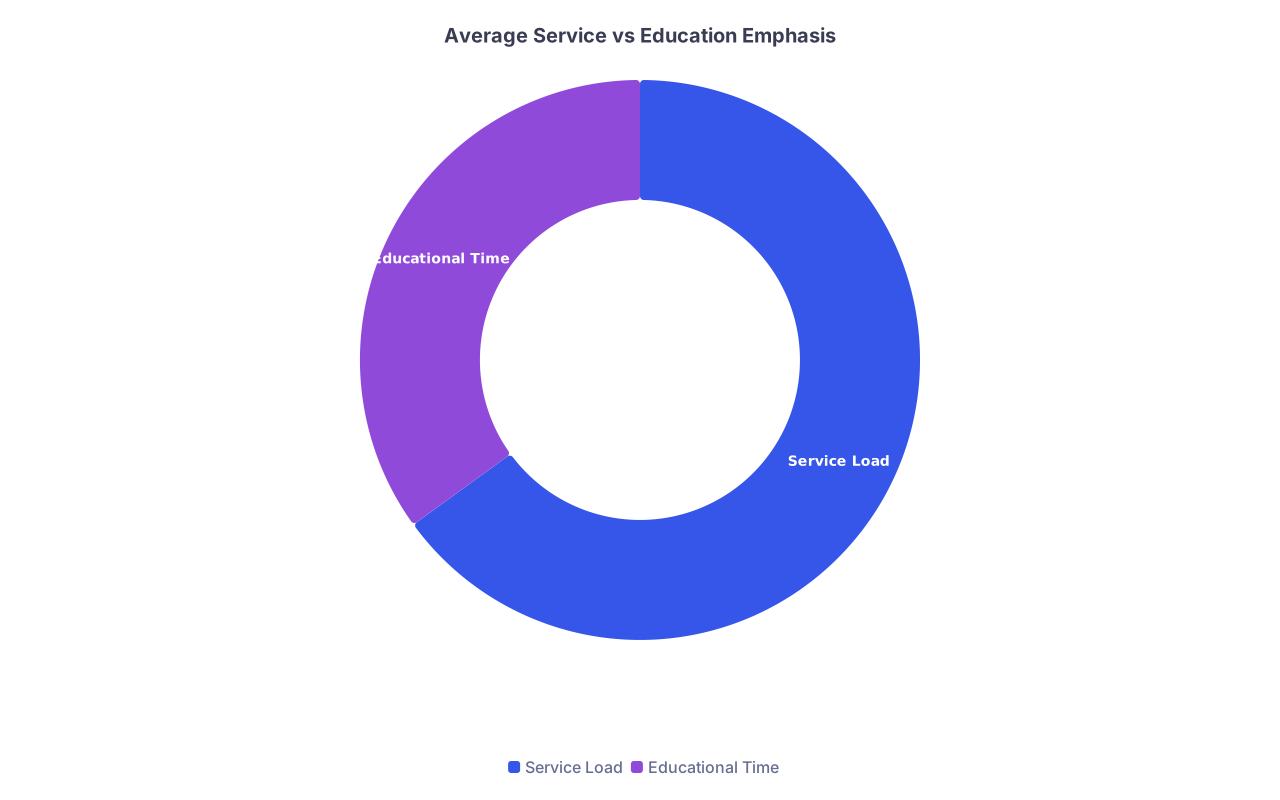
| Category | Value |
|---|---|
| Service Load | 65 |
| Educational Time | 35 |
Numbers vary, but the split above is not crazy for many prelim programs.
Workload and scut
Community prelim
At a lot of community sites, prelims are the affordable workforce.
Typical pattern I have seen:
- Wards cap may be “officially 10–12” but you will carry that full cap all the time because there are fewer teams.
- Cross‑cover nights can be brutal: you cover half the medicine service, sometimes admitting as well, with a senior “available by phone.”
- You personally call consults, coordinate transfers, chase down outside records, arrange SNF, sometimes literally faxing forms.
- Less “protected” time. Noon conference might exist on paper but attendings pull you out constantly because they need you to discharge two patients by 1 PM.
Is that all bad? Not necessarily. You will be competent, fast, and unflappable by July 1 of your advanced program. But it is physically draining.
University prelim
Service is still heavy, but diluted by volume of trainees.
What changes:
- You are part of a layered team: student(s) → intern(s) → senior → fellow (sometimes) → attending. That means some scut gets pushed downhill to students.
- Night float systems tend to be more modern. Less true Q3–4 24‑hour call, more 5–7 night blocks.
- Consults are easier: almost always an in‑house team, with electronic consult orders and a predictable response system.
- More non‑clinical obligations: structured teaching, simulation, research electives, evaluation forms. Less pure service, more “residency as product.”
The net effect: still tired, but usually less “abandoned.” Fewer nights where you are the only physician in the building.
Autonomy and supervision
This is the big difference that people underestimate.
Community
- Early autonomy. On day 3, the ED calls you directly: “We are sending up a septic 72‑year‑old, can you put in admit orders?” Nobody pre‑screens that patient for you.
- Attendings may round quickly and disappear to clinic. You own the day‑to‑day, for better and worse.
- Supervision varies widely. Some hospitals have very present hospitalists; others function with a true “resident‑run service” vibe at night.
You learn to make decisions without someone holding your hand. But you need to be good at knowing when you are out of your depth and escalating.
University
- Tighter supervision, especially early.
- Many decisions flow through a senior or fellow first. “Present to the cardiology fellow, then they present to the attending.”
- Escalation chains are clear. You rarely feel truly alone, but your individual decision‑making muscle can atrophy if you lean too hard on the layers above you.
It is harder to “hide” as a shaky intern in a small community group. In a large university machine, you can coast more, but you also risk becoming passive.
4. Educational environment: conferences, feedback, and culture
You are not doing this year purely to be a workhorse. Or at least, you should not be.
Didactics and formal teaching
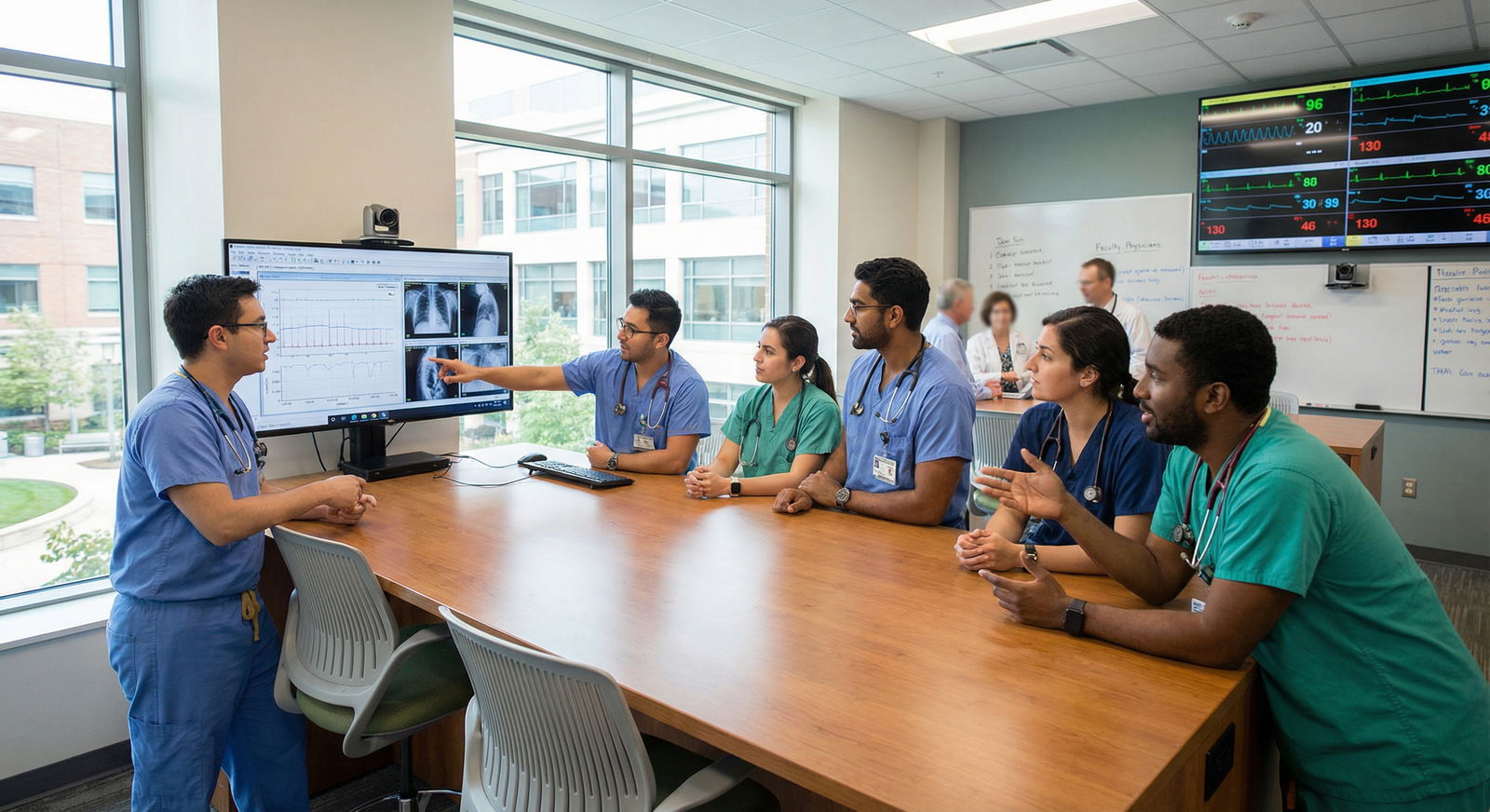
University
- Regular noon conferences. If it is a serious program, they hit 70–90% of scheduled sessions actually happening.
- Subspecialty conferences: tumor boards, M&M, grand rounds, ICU teaching, EKG or radiology teaching sessions.
- Access to simulation labs, ultrasound workshops, mock codes, OSCEs.
You will be exposed to current guidelines, subspecialty thinking, and practice patterns that your advanced field will expect you to know.
Community
- Often fewer formal sessions, and the ones that exist may be more sporadically attended.
- Teaching is more “on the fly”: discussing the COPD patient during rounds, learning vent adjustments overnight from the RT, watching a senior handle a crashing GI bleed.
- Fewer subspecialty‑specific conferences on site; you might join some virtually with an affiliated university.
The education is more organically clinical, less curated. If you are self‑driven and read on your own, you can do very well. If you need structure, you can flounder.
Feedback and evaluation culture
University programs are usually obsessed with evaluation infrastructure:
- Milestones, semiannual CCC (Clinical Competency Committee) reviews.
- Written 1–5 Likert scales, frequent “you are a Level 1 for Patient Care, Level 2 for Systems‑based Practice.”
- Program leadership who actually track your “areas for growth” and pull you in for a plan if you are struggling.
Community programs vary:
- Some are excellent – small, tight‑knit, with direct verbal feedback that is more candid than any official eval.
- Others are loose. You get generic “meets expectations” forms and maybe one 10‑minute sit‑down in June.
Ask specific questions on interview day:
- “How often do residents receive formal feedback?”
- “What is the process if a resident is struggling clinically?”
- “Are prelims included fully in the same evaluation system as categoricals?”
If they hand‑wave, take note.
5. Case mix and skill set: what you walk out with
Let us be practical. Your advanced program cares about what you can actually do on July 1.
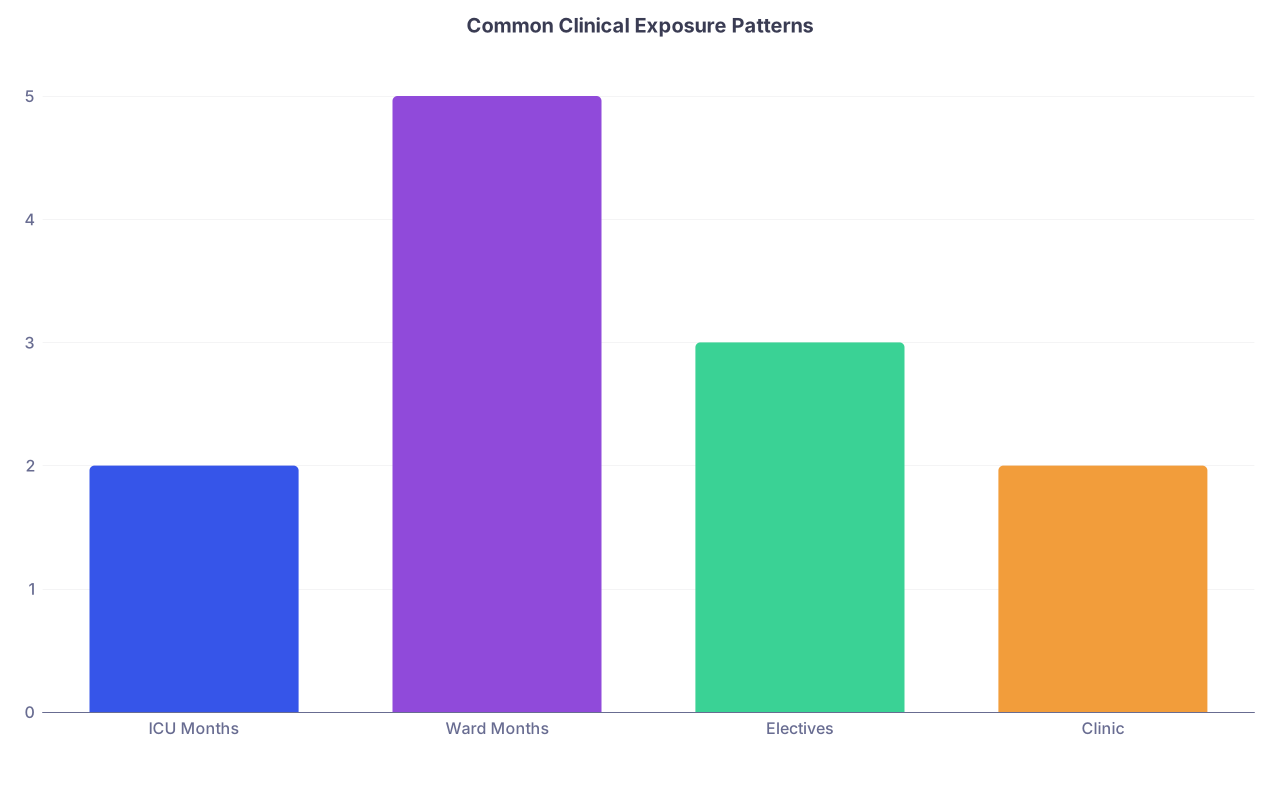
| Category | Value |
|---|---|
| ICU Months | 2 |
| Ward Months | 5 |
| Electives | 3 |
| Clinic | 2 |
The numbers above are a generic prelim IM distribution. Community versus university shifts where the complexity sits.
Community prelim skill set
You will tend to be:
- Very comfortable with:
- Uncomplicated sepsis, CHF exacerbations, COPD, DKA, alcohol withdrawal, failure to thrive.
- Discharge planning, home health, SNF, rehab logistics.
- Running simple cross‑cover: chest pain at 3 AM that is 99% GERD but 1% NSTEMI.
- Good at procedures if the hospital relies on residents for:
- Paracentesis, thoracentesis, LP, central lines in some places.
- Joint aspirations in a few.
You see fewer rare diseases, but you see the same common problems again and again until you can manage them in your sleep.
University prelim skill set
You will tend to be:
- Comfortable with higher acuity:
- ICU patients on multiple pressors, advanced ventilator modes, post‑transplant immunosuppression, chemo complications.
- Coordinating with multiple subspecialty teams and navigating complex inpatient politics.
- Better oriented to academic medicine:
- Interpreting guideline recommendations.
- Using decision support tools, quality metrics, institutional protocols.
You might do fewer basic procedures personally if there are fellows or procedure teams. Or you might do more, if the program is procedure‑heavy and driven by resident staffing.
A radiology PD or neurology PD looking at two applicants with similar Step scores will recognize both paths as valid. They will ask: “Does this person seem operationally ready?” Both settings can get you there, in different ways.
6. Research, networking, and future doors
Now the part everyone quietly cares about but does not want to say out loud: will this prelim year help or limit me later?
Research and academic footprint
If you are going into a research‑heavy specialty (derm, rad onc, academic neurology), this matters.
University prelim
- Easier to plug into:
- Ongoing projects.
- Departmental QI.
- Fellows and faculty who are writing case reports and reviews every month.
- IRB, stats, and mentorship infrastructure are onsite. You can walk down the hall to the epilepsy fellow and ask to help with a project.
In one year, you can realistically add:
- 1–2 abstracts.
- Maybe a case report.
- Letters from academic faculty in your field.
Community prelim
- Research is possible, but you have to chase it:
- Often QI oriented rather than basic/translational.
- Case series and retrospective chart reviews rather than RCTs.
- Many residents do zero research by default.
If you already matched your advanced spot and do not care about an academic career, that may be perfectly fine. If you are entering your prelim year still hoping to re‑match into a more competitive specialty, a completely research‑barren environment is a strategic handicap.
Connections and letters of recommendation
Letters from your prelim year rarely alter your already‑secured advanced spot, but:
- They matter if:
- You are trying to switch specialties.
- You are applying for fellowships early.
- Your advanced program values recent clinical performance.
University settings give you:
- Nationally known names. A letter from the program director of IM at a top‑30 university carries some weight anywhere in the country.
- Networking: meeting fellows who trained where you might want to go.
Community settings give you:
- Often very personal, detailed letters. “I have worked with this intern on 6 different rotations. I saw them manage 20+ ICU admissions. This is who they are.”
- But fewer “name recognition” benefits.
This is not binary. There are community programs with very strong reputations and university programs nobody outside the region cares about. You have to judge each one individually. But the pattern holds often enough that you should factor it in.
7. Lifestyle, wellness, and “survivability”
Here is where a lot of applicants make category mistakes. They assume “community = cushy” and “university = brutal.” Reality is more nuanced.

Work hours and call
- Some community prelims are absolutely malignant. Chronic under‑staffing, high volume, no fellows, limited ancillary support. You stay till 9 PM daily and do Q3 24‑hour calls.
- Some university TYs are comparatively light. One call per week, a lot of electives, off‑service rotations carefully guarded from abuse.
The only way to know is to ask hard questions and talk to current residents:
- “How often do you actually stay past 7 PM?”
- “Do you realistically get one day off in seven?”
- “What is your worst rotation, and why?”
- “How many 24‑hour calls in a typical month?”
If on interview day everyone gives you vague smiles and “it is busy but manageable,” push for specifics. If they dodge, your alarm bells should ring.
Geographic and cost‑of‑living differences
Community hospitals are often:
- In smaller cities / suburbs.
- With cheaper rent, easier commutes, free parking, and less traffic.
Even if hours are tough, your commuting and cost of living can be dramatically better. That matters when you are an intern making ~$60K.
University hospitals can be:
- In dense urban centers with horrific commuting (Boston, NYC, LA).
- Parking is expensive or nonexistent, rent eats half your paycheck, your day off vanishes into laundry and logistics.
Again, not a rule. Some university centers sit in affordable college towns. But if you are choosing between a downtown Manhattan prelim and a suburban community hospital with equivalent training quality, lifestyle may nudge you strongly.
8. Strategic fit by specialty and career goals
Let me get prescriptive now. Here is how I would think about this if you told me your specific path.
| Future Plan | Better Fit Tends To Be* |
|---|---|
| Academic neurology, IM subspec | University prelim or TY |
| Pure community anesthesia | Either; slight edge to community |
| Competitive fellowship (cards, GI) | University prelim if possible |
| Radiology private practice | Either; choose lifestyle + autonomy |
| Still undecided / switching | University with strong support |
*There are exceptions. This is a directional guide, not dogma.
If you are firmly headed to academia
Lean toward a university prelim if:
- You want fellowship in cardiology, GI, heme‑onc, pulmonary/critical care, etc.
- You care about research.
- You value close contact with subspecialists in your field.
You will finish the year speaking the dialect of academic medicine. That helps in fellowship interviews and in day‑to‑day interactions.
If you are headed to community practice
You can absolutely choose either.
- Community prelim: builds the exact practical skill set you will use. High throughput, real‑world discharge work, less academic bureaucracy.
- University prelim: gives you a deeper exposure to complex pathology that will still come your way, just less frequently, in community practice.
I tend to recommend: if two programs are equal in quality and culture, pick the city and lifestyle where you can remain functional and somewhat happy. Burnout in PGY‑1 is a dumb reason to be a worse senior later.
If you are still not sure about your ultimate field
Then the stakes of this prelim year go up.
You want:
- A place with:
- Multiple specialties on site.
- Program leadership open to re‑match discussions.
- Real mentorship.
That often points to university‑based settings. Not always, but often.
You also want guardrails against being buried. A malignant year when you are trying to re‑orient your entire career is a bad combination.
9. What to ask on the interview: community vs university specifics
Let me give you concrete questions that cut through brochure language. Ask them at both types of programs.

| Step | Description |
|---|---|
| Step 1 | Identify Prelim Offer |
| Step 2 | Prioritize university |
| Step 3 | Community or smaller university |
| Step 4 | Rank highly |
| Step 5 | Seek alternative |
| Step 6 | Need research or academics? |
| Step 7 | Value autonomy and hands on? |
| Step 8 | Lifestyle reasonable? |
| Step 9 | Residents seem happy? |
Targeted questions:
Service vs education
- “On wards, what is the typical census per intern? What is the hard cap and how often is it reached?”
- “How often are conferences protected? Are residents actually excused from clinical duties?”
Prelim vs categorical treatment
- “Do prelims share all rotations with categoricals, or are there ‘prelim‑heavy’ services?”
- “Are prelims included fully in retreats, wellness days, and didactics?”
Autonomy and nighttime structure
- “At night, who is physically in the hospital above the intern level? Senior? Fellow? Attending?”
- “Can you describe a typical night shift for a prelim?”
Support and wellness
- “What is the worst rotation, and what has the program done to improve it?”
- “How does leadership respond if a resident is clearly struggling or burned out?”
Career support
- “For past prelims who were undecided or wanted to switch specialties, what outcomes have they had?”
- “How many prelims in the last 3–5 years have failed to complete the year?”
The way they answer matters as much as the content. Defensive, vague answers are a red flag. Clear, detailed, occasionally self‑critical answers are a good sign.
10. Pulling it together: core differences that actually matter
Strip away the marketing, and the core distinctions look like this:
Community prelims:
- Smaller systems, fewer layers, more autonomy.
- Heavier emphasis on service and throughput.
- Variable formal education, often excellent hands‑on learning.
- Less research / academic exposure, fewer big‑name letter writers.
- Lifestyle can be better or worse; you must verify.
University prelims:
- Large, structured systems with more supervision and formal teaching.
- More complex pathology and subspecialty interaction.
- Stronger research and networking opportunities.
- Potentially more bureaucratic, sometimes less autonomy.
- Lifestyle highly variable; some TYs are cushioned, others are meat grinders.
Neither is inherently superior. The right answer is: “Which environment will make me the strongest and sanest version of myself by the time I start PGY‑2 in my real field?”
Get that right, and the prelim year becomes a powerful launchpad rather than a sad war story.
With those distinctions clear, you are in a better position to read between the lines of program websites and interview day platitudes. The next step is using this lens on your actual list—ranking specific programs, not abstractions. But that is the next phase of your journey.
FAQ (exactly 5 questions)
1. Is a community prelim year viewed as ‘inferior’ by competitive fellowships later on?
No, not by default. Fellowship directors care far more about your performance, letters, and trajectory than about whether your prelim was community or university. If you did well, have strong clinical skills, and built some academic work during residency, a community prelim year will not hold you back. The only time it hurts is if it left you with poor habits, no mentorship, and no one who can vouch for you.
2. For radiology or anesthesia, is a transitional year always better than a medicine or surgery prelim?
Not always. A well‑designed medicine prelim that teaches you to run a code, manage sepsis, and handle complex inpatients can be extremely valuable. Some TYs are very light and leave interns underprepared clinically. Others are well balanced. You judge based on rotation mix, call load, ICU exposure, and how many graduates say they felt prepared for PGY‑2. The label “TY” by itself guarantees nothing.
3. Should I avoid programs where prelims are mostly separate from categoricals?
Separate is not automatically bad, but it is a risk factor. If prelims are used as a buffer for the heaviest services while categoricals get protected electives, that is a problem. If “prelim‑only” rotations exist and are notorious among residents, be cautious. Ideally, prelims share the bulk of core rotations, conferences, and resources with the categorical residents.
4. How much should location and cost of living influence my prelim choice if I already matched an advanced spot?
More than students admit. You have one year to get competent and not break yourself. Crushing commutes, outrageous rent, and zero support erode your bandwidth quickly. If training quality is roughly similar, it is rational to choose the program where you can afford to live decently, sleep on your days off, and maintain some semblance of a life.
5. Can I switch into that institution’s categorical program from a prelim spot if I change my mind?
Occasionally, but you must never assume it. Some programs explicitly say “no internal transfers.” Others have a track record of taking one prelim every few years into categorical when someone drops out. Ask directly: “In the last 5 years, how many prelims have transitioned into your categorical program?” Past behavior is the only reliable predictor here.