
Using a Prelim Year to Build Core Skills for Future Critical Care Training
It is 02:37 on your second month as a prelim. You are technically on “medicine wards,” but your census looks like a step-down unit: DKA on an insulin drip, decompensated cirrhosis on high‑flow, a septic neutropenic patient whose MAP is creeping down despite 3 liters of fluids. The senior is stuck in the ICU admitting a GI bleed. Respiratory wants to know if you are OK with increasing FiO₂. Nursing wants parameters for the norepinephrine the ICU team “temporarily” started in the ED.
You matched into anesthesia, EM, maybe radiology. Critical care fellowship is the long game. And right now, this prelim year is your only guaranteed year of broad, hands-on medicine before your world narrows.
If you approach this year passively, you mostly suffer and forget. If you approach it deliberately, you can walk into future critical care training already fluent in the fundamentals: resuscitation, ventilators, hemodynamics, ICU communication, and actual clinical judgment under pressure.
Let me break down exactly how to use a preliminary year to build those core skills.
First: What a Prelim Year Actually Is (and Why It Matters for Critical Care)
A “prelim” year is a one‑year training position. You are an intern, but without a guaranteed categorical spot in that same field. For people aiming at future critical care, the most common prelim year flavors are:
- Preliminary Internal Medicine
- Transitional Year (TY)
- Preliminary Surgery
Each has a different ceiling for what you can realistically get out of it.
| Pathway | ICU Exposure | Floor Resuscitation | Procedure Volume | Cognitive Medicine Depth |
|---|---|---|---|---|
| Prelim IM | High | High | Moderate | High |
| Transitional Yr | Variable | Moderate | Low-Moderate | Moderate |
| Prelim Surgery | Moderate | High (surgical) | High | Low-Moderate |
For someone serious about future critical care training (anesthesia-critical care, pulmonary-critical care, EM-critical care), a well-structured prelim internal medicine year is simply the best platform. More time in:
- Sepsis, shock, respiratory failure
- Non-procedural decision-making
- Longitudinal management of multi-system illness
Transitional years can still work, but they’re heterogeneous. Some are glorified vacation. Others are just IM prelims with extra outpatient. Plenty of people waste that year.
Surgery prelims? Excellent for procedures, acute abdomen, trauma physiology. But you will often be peripheral to vent management, complex medical reasoning, and longitudinal ICU care, unless you are at a very ICU‑heavy surgical program.
So before we talk skills, be honest about what environment you’re actually in. The goal then becomes: extract maximum critical care value from the rotations you do have.
Core Critical Care Domains You Can (and Should) Build in a Prelim Year
If you strip away the branding, almost all critical care practice boils down to a few domains:
- Initial recognition and resuscitation of the crashing patient
- Mechanical ventilation and oxygenation strategies
- Hemodynamic assessment and vasoactive support
- Procedural skills
- Complex medication and organ support management
- Communication, team leadership, and end-of-life discussions
You can start building all of these robustly as a prelim. The catch: nobody is going to structure it for you. You have to intentionally chase the experiences.
1. Acute Recognition and First-Hour Resuscitation
You will not be the final decision-maker in the ICU as a prelim, but you absolutely can become “the intern who does the right things in the first 30–60 minutes.” That is gold in critical care.
On the wards: own the first 10 minutes
When a nurse calls, “He does not look right,” your brain should default to a short, reliable pattern:
- Bedside in 2 minutes, not 20
- Vitals + look at the patient yourself, not “read me the numbers”
- Simplified ABC check (airway, breathing, circulation, mental status)
- Focused problem list: sepsis? bleeding? arrhythmia? respiratory failure? DKA/HHS?
Get good at ordering the right immediate labs and interventions before the senior appears:
- Lactate, blood cultures, CBC, CMP, VBG/ABG when indicated
- Broad-spectrum antibiotics within 1 hour if sepsis is on the table
- Fluid challenge with a clear target and re-evaluation plan
- EKG and bedside fingerstick glucose on basically any crash
If you start doing this early in the year, your seniors and ICU fellows will notice. They will start trusting you with more autonomy. That matters.
In the ED and ICU rotations: study the first hour like a playbook
When you are off the floor and in a more acute environment, consciously watch:
- How attendings structure the first note or orders for septic shock
- Fluid choices and volumes: LR vs NS vs albumin, when to stop
- What triggers the move from “just observe” to “we are intubating”
Ask annoying, specific questions once stabilized:
- “What would have changed your decision to intubate earlier?”
- “Why norepi first and not vasopressin / phenylephrine here?”
- “If we re-scan lactate and it is higher, what is your next step?”
You are not collecting trivia. You are building pattern recognition. Shock looks messy, but the logic behind each step is repeatable.
2. Ventilators and Oxygenation: Do Not Waste This Exposure
Prelims waste an absurd amount of vent exposure by letting RT and seniors “just handle it.” Then they show up as anesthesia or EM residents still intimidated by basic modes.
Make yourself do the work.
Build a mental schema, not a pile of facts
At minimum, by the end of your prelim year, you should be comfortable with:
- The difference between volume vs pressure modes (what is actually being targeted)
- How to set a starting ventilator prescription in:
- de novo hypoxemic respiratory failure (e.g., pneumonia, ARDS-ish)
- pure hypercapnic respiratory failure (e.g., COPD exacerbation)
- How to respond to: high peak pressures, worsening hypoxia, rising CO₂, auto-PEEP
On every intubated patient on your list:
- Write down the current vent settings in your progress note
- Ask RT what they changed overnight and why
- Correlate ABGs with what changed on the vent
Within 3–4 months, ventilator settings should feel like adjusting a medication: you know the mechanism and the expected effect, not just the numbers.
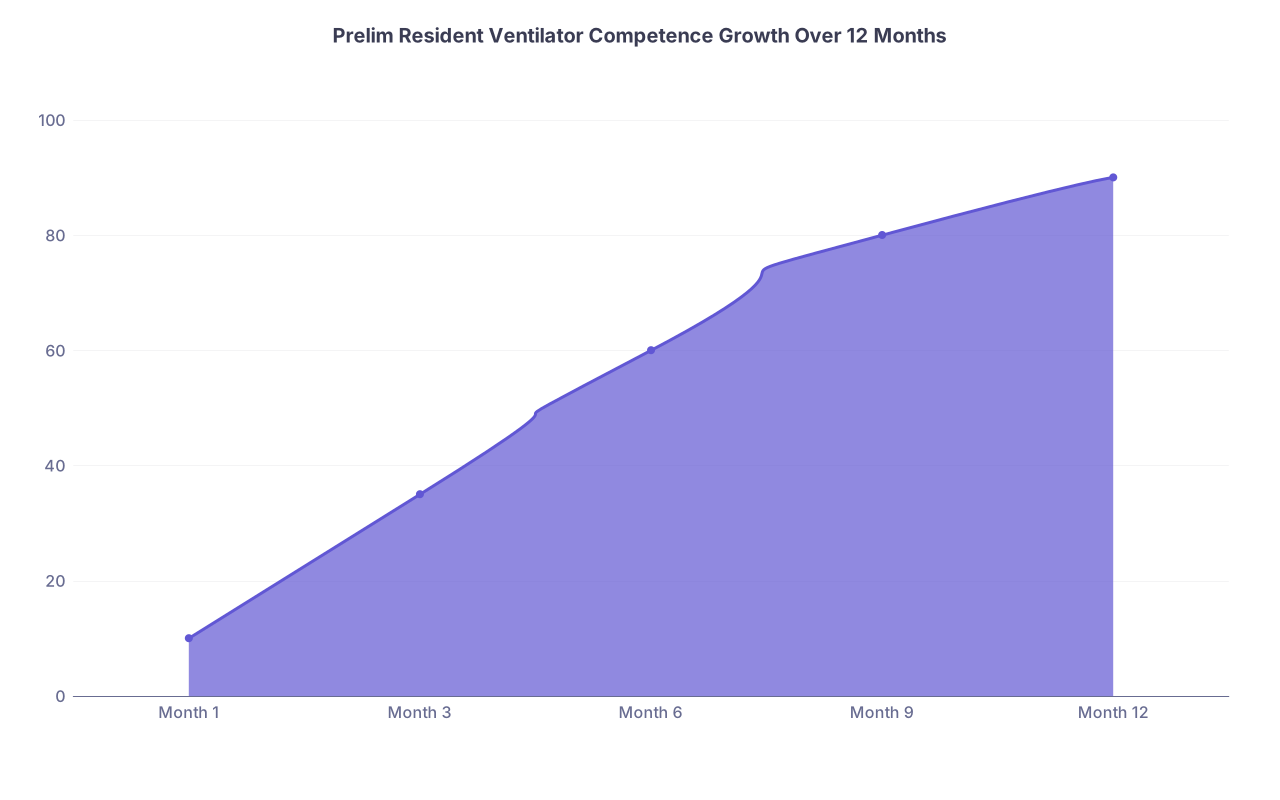
| Category | Value |
|---|---|
| Month 1 | 10 |
| Month 3 | 35 |
| Month 6 | 60 |
| Month 9 | 80 |
| Month 12 | 90 |
(Values here are the percent of common ventilator scenarios you can manage with only senior review rather than senior takeover. Yes, that can be 80–90% by the end of a strong prelim year.)
Follow one ARDS patient obsessively
During an ICU month, pick one patient with bad lungs and track everything:
- P/F ratio daily
- PEEP and FiO₂ changes
- Plateau pressures if measured
- Diuretics vs fluids
- Sedation vs spontaneous breathing efforts
Ask the ICU fellow: “If this chest X-ray and P/F ratio looked like this but the blood pressure was worse, how would you change your priorities?” That sort of conditional thinking is exactly what you will need later.
3. Hemodynamics, Pressors, and the “Why” Behind the MAP Goal
Interns frequently memorize “MAP > 65” and “start norepi if fluids fail.” That is entry-level. If you want a future in critical care, you should push far past that as a prelim.
Make every hypotensive patient a mini-hemodynamics case
On the wards:
- Try to identify the primary shock type: distributive, hypovolemic, cardiogenic, obstructive
- Write that explicitly in your assessment, even if you are not 100 percent sure
- Tie each intervention to that hypothesis: “We are giving 1 L LR because we suspect hypovolemia from diarrhea, but if no response we will consider cardiogenic features and get an echo.”
Ask your seniors and ICU attendings to tear your logic apart. Being wrong is fine. Being nonspecific and hand-wavy is not.
Learn vasoactive meds like you learn antibiotics
For norepinephrine, vasopressin, epinephrine, phenylephrine, and dobutamine, by end of year you should know cold:
- Receptor targets
- Typical starting dose and titration increments
- Side effects that actually matter at the bedside
- Situations where that particular drug is clearly preferred or avoided
Do not just “have a sense.” Make a one-page table for yourself, revise it after each ICU month.
4. Procedures: What You Can Actually Build as a Prelim
Critical care is not only about lines and tubes, but you will be behind your peers if you show up to fellowship having never held an ultrasound probe on a jugular.
You do not control how “procedure-friendly” your program is, but you can control how aggressively you seek opportunities.
Basic target list
As a medicine or TY prelim aiming at CC, your realistic procedural goals should be:
- Central venous lines (IJ and femoral, subclavian if your institution still uses them regularly)
- Arterial lines
- Ultrasound-guided peripheral IVs
- Paracentesis and thoracentesis
- ABG from radial (and understanding when not to bother)
You do not need 50 of each. Volume matters less than quality + confidence. Even:
- 10–15 central lines
- 5–10 arterial lines
- 10 paracenteses
- 5–10 thoracenteses
With supervision and feedback is enough to arrive at anesthesia or EM training able to progress quickly.
How to actually get them
Do not wait for someone to “offer” a procedure. Say:
- To your senior on rounds: “If there are any lines or paras today, I want to do them. Please page me even if I am on the other side of the floor.”
- To ICU fellows: “I am prelim but I am serious about critical care. I want to get as many supervised lines and chest procedures as possible. Can I text you my number?”
Yes, this is a little pushy. So what. The quiet intern who “doesn’t want to bother anyone” ends the year with three central lines, all with maximal help, and no real confidence.
5. Medication and Organ Support Management
This is where a prelim IM or strong TY year can separate you from your peers later: wrestling with complex, multi-organ patients over days or weeks.
Renal
Use your CKD and AKI admissions to establish instincts you will use constantly in the ICU:
- Volume status assessment vs numbers on the chart
- When to hold vs continue ACE inhibitors, diuretics, metformin
- How to adjust renally cleared antibiotics in unstable patients
Follow at least one patient from “oliguric and borderline” to “dialysis started.” Watch what actually triggered the nephrologist to move from “watch” to “start RRT.”
Hepatic
Cirrhotics are hemodynamic land mines. Prelims who manage enough of these cases:
- Learn to balance diuresis vs perfusion
- See real-world consequences of massive transfusion in portal hypertension
- Get comfortable with complex coagulopathy, encephalopathy, variceal bleed workups
Every time you are frustrated that you are not in the ICU, remind yourself: this is building the exact pattern recognition you will fall back on when you are the critical care fellow who has to decide whether the crashing variceal bleed gets another liter, another unit of blood, or the operating room.
6. Communication, Leadership, and End-of-Life Work
People underestimate this. The hardest part of critical care is not the ventilator. It is talking to a daughter at 02:00 explaining why her father is not waking up after two weeks on a ventilator.
You can start building those muscles now, even as a prelim.
Hard conversations on the floor
Volunteer to be part of family meetings and code status discussions, not just the note-writer.
- Ask your senior, “Do you mind if I start, and you jump in and correct me?”
- Draft your own wording beforehand. Avoid euphemisms.
- Watch how different attendings phrase prognosis and uncertainty. Steal what works.
If your program lets interns lead straightforward DNR/DNI talks, take that responsibility, but always check your framing with your senior beforehand.
Running the small team
Nights on wards or step-down are perfect leadership labs. You may be the only physician in-house for your unit.
- Be explicit with nurses: “If you are worried, I want to hear from you early. I would rather be paged too much than too late.”
- Communicate your plan clearly after seeing a sick patient: “OK, here is what we are doing in the next 30 minutes…”
Critical care fellowship will demand the ability to calmly direct RT, nursing, consultants, and families under pressure. The prelim year gives you hundreds of repetitions at smaller stakes.
Choosing Rotations and Electives with Critical Care in Mind
Within the constraints of your program, you can usually steer some portion of your schedule. Be strategic.
High-yield rotations for future critical care:
- Medical ICU (obviously; more than one month if possible)
- Step-down / intermediate care
- ED (especially at centers where ED manages vents and starts pressors)
- Cardiology (for familiarity with heart failure, arrhythmia management, post-MI complications)
- Nephrology (for RRT decision-making and electrolyte disorders)
- Pulmonology consult (for advanced oxygenation strategies, chronic lung disease)
Lower, but still useful:
- Infectious Disease consult (sepsis source control, antibiotic selection)
- Palliative Care (goals-of-care language, symptom control)
Electives I would not prioritize for someone with a strong CC focus and limited elective time:
- Excessive outpatient clinic blocks
- Light electives that do not touch acutely ill adults (derm, PM&R outpatient, etc.), unless you truly need a break at that point in the year
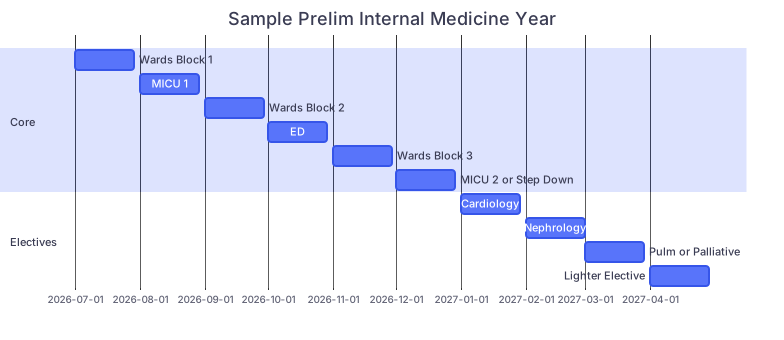
| Task | Details |
|---|---|
| Core: Wards Block 1 | a1, 2026-07, 4w |
| Core: MICU 1 | a2, 2026-08, 4w |
| Core: Wards Block 2 | a3, 2026-09, 4w |
| Core: ED | a4, 2026-10, 4w |
| Core: Wards Block 3 | a5, 2026-11, 4w |
| Core: MICU 2 or Step Down | a6, 2026-12, 4w |
| Electives: Cardiology | b1, 2027-01, 4w |
| Electives: Nephrology | b2, 2027-02, 4w |
| Electives: Pulm or Palliative | b3, 2027-03, 4w |
| Electives: Lighter Elective | b4, 2027-04, 4w |
Your exact calendar will differ, but you get the idea: alternate heavy acute blocks with slightly lighter but still high-yield electives.
How to Study During a Prelim Year Without Burning Out
You are not going to run a full-time textbook curriculum on top of Q4 or Q5 call. But you also cannot show up to anesthesia or EM training having learned nothing from the onslaught.
The trick is to tie your learning directly to your patients and to critical care themes.
Build “patient-based” micro-curricula
For every major ICU/step-down problem you encounter repeatedly, build a one-page note or mini-outline in a note app:
- Sepsis and septic shock
- Acute hypoxemic respiratory failure / ARDS
- Acute decompensated heart failure with pulmonary edema
- Status asthmaticus / COPD exacerbation requiring BiPAP or vent
- DKA / HHS
- GI bleed with hemodynamic instability
- Acute liver failure / decompensated cirrhosis with encephalopathy
- AKI with potential indication for dialysis
Every time you admit or follow one of these patients, add a nuance:
- A drug dose you did not know yesterday
- A decision criterion (e.g., when to start steroids in septic shock, when to pull the trigger on intubation in severe asthma)
- A trick from an attending (“I always check X before increasing PEEP in this scenario…”)
By the end of the year, you will have your own critical care handbook based on real cases, not random board-review abstractions.
Deliberate reading, not volume reading
Pick one core ICU text or resource that you actually like: Marino’s ICU Book, EMCrit posts / podcasts, or a good online curriculum from your institution.
For each ICU or high-acuity week, commit to:
- One focused chapter or topic that aligns with the sickest patient on your list
- 10–15 minutes per day reading after sign-out, not 2 hours of mindless skimming
You are playing a long game. A steady drip of context-rich learning beats a fake “I will read the entire ICU book this month” resolution that implodes by day 3 of nights.
Turning Your Prelim Year into a Positive Story for Future Critical Care Applications
Down the line, you will be applying to critical care fellowships (through anesthesia, IM, EM, surgery, etc.). Program directors will see “Preliminary Year” on your CV and ask themselves:
- Was this just a required year they survived?
- Or did this person actually build a foundation that will make them a high-functioning fellow on day one?
Your job now is to create evidence for the second narrative.
Concrete things that program directors like to see
- Strong ICU evaluations with comments about your work ethic, clinical reasoning, or maturity
- At least one letter from an intensivist or ICU-heavy hospitalist who watched you function under pressure
- A small QI, education, or clinical project tied to critical care (e.g., sepsis bundle compliance, vent-associated pneumonia prevention, crash cart organization)
Do not overcomplicate this. A modest QI project with a clean poster and clear results looks better than a giant “multi-center trial” that never progressed beyond vague promises.
How you talk about your prelim year
When you eventually interview for critical care, you want to be able to say:
- “During my prelim year at X, I made it a priority to get as much time in the MICU and step-down as they would let me. I focused on building early resuscitation instincts, ventilator fluency, and procedural comfort. By the end of that year, I was consistently the intern called to evaluate decompensating ward patients first, before my senior arrived.”
That is the kind of sentence that gets faculty nodding. It tells them you were intentional, not just dragged along.
Common Ways Prelims Waste the Year (And How to Avoid That)
I have watched this play out in real time.
Here is what people do wrong:
- Treat ICU months like “spectator rotations” where the fellow does everything and the intern just writes notes
- Hide from nights, rapid responses, and sick admits because they feel overwhelming
- Dump hard conversations on seniors, never practicing framing or language themselves
- Choose “easy” electives just to rest, then complain they are underprepared in PGY‑2
- Study for in‑service or Step 3 in a vacuum, ignoring the actual patients in front of them
If you recognize yourself starting to slip into that pattern mid-year, reset. It is still salvageable.
Even in a malignant or poorly structured program, you can often carve out:
- Real procedural experience by being present and vocal
- Repeated exposure to crashing patients by showing up early to rapid responses
- Mid-level autonomy on wards by becoming the intern known for seeing patients quickly and coming with a plan
You are not powerless here.
Final Thoughts: What You Should Walk Away With
By the end of a well-used prelim year, if you are aiming at critical care, you should be able to say honestly:
- “When a patient is crashing, I know how to structure the first hour: assessment, labs, initial interventions, and when to call for help.”
- “Ventilators, pressors, and basic ICU organ support are familiar tools to me, not black boxes. I may not be an expert, but I know what knobs exist and what they do.”
- “I have had enough repetitions in hard conversations and team leadership that I am not paralyzed by them. I can function as the calm person in the room when things go sideways.”
If those three statements are true at the end of your prelim year, you are already ahead of a lot of people who will be applying beside you for critical care fellowships. The difference is not talent. It is how deliberately you use the twelve chaotic, exhausting, incredibly valuable months you have right now.