Only 41% of preliminary surgery interns finish the year wanting to stay in surgery; the majority say the training intensity was higher than they expected, even compared with their medicine colleagues on the same wards.
Let me break this down specifically, because applicants consistently underestimate how different a surgical prelim year feels from a medicine prelim year, even when the “hours” look similar on paper.
You are not choosing between two generic intern years. You are choosing between two very different ways of being used by a hospital.
1. The Core Structural Differences: Same PGY-1, Completely Different Job
Everyone gets told the same script: “A PGY-1 is a PGY-1; they all meet ACGME requirements.” Technically true. Functionally misleading.
Here is the blunt version.
- Medicine prelim = ward-based cognitive workload, high patient volume, fewer procedures, often better control of the clock.
- Surgery prelim = service-based workload, high task intensity, OR exposure, procedure-heavy, the clock owns you.
You will see this on any big academic campus – think a place like UAB, Michigan, or UT Southwestern. Same building. Same EMR. Same cafeteria. But the way the system uses a prelim in surgery vs prelim in medicine is not remotely symmetrical.
| Feature | Surgery Preliminary PGY-1 | Medicine Preliminary PGY-1 |
|---|---|---|
| Typical Week Hours | 70–80+ | 60–75 |
| Main Work Location | OR + surgical wards | Medicine wards + stepdown/ICU |
| Primary Role | Task work, consults, OR help | Primary manager of ward patients |
| Procedures | Frequent basic procedures | Occasional, mostly ICU/ED-based |
| Call Style | Q3–Q4, in-house common | Variable, more night float usage |
| Autonomy Type | Technical & logistics | Cognitive & diagnostic |
How the hospital “uses” you
On a medicine prelim year, you are usually integrated into the same schedules, rotations, and roles as categorical medicine interns. You carry your own list, write notes, call consults, run codes, staff with your senior and attending. The system sees you as a functioning intern on the team. You just leave after a year.
On a surgical prelim year, you are often slotted where the service needs bodies. Covering floor calls. Pre-rounding on a bloated list. Pulling drains. Discharging patients fast. Getting consents signed at 5:45 a.m. Helping transport a sick patient to CT at 2 a.m. The system sees you, frankly, as a disposable workhorse. There are exceptions, but they are exactly that: exceptions.
I have watched this play out at places like NYU, big community programs, and small county hospitals. The pattern is depressingly consistent.
2. Day-to-Day Training Intensity: Clock Hours vs Cognitive Load
Everyone asks, “Which one is harder?” Wrong question. They are hard in different ways.
Surgical prelim: compressed, physical, relentless
A very typical surgical prelim weekday on a busy general service might look like:
- 4:45–5:15 a.m. – Pre-rounding on 12–18 patients, many you barely met yesterday afternoon because you were in the OR. Try to check labs, drains, vitals, and dressings. Half of your “exam” is glancing at the probe on the Foley and the amount in the JP bulbs. Let’s be honest.
- 6–7 a.m. – Rapid-fire sit-down rounds with the chief or fellow. If you do not know every drain output or every WBC trend, you get called on it. Publicly. The emotional intensity here is no joke.
- 7 a.m.–5 p.m.+ – OR cases, consults, procedures, answering nurse pages for “tube feed orders” and “pull the Foley so he can go home.” Running to the ED for another SBO, while your pager is going off about tachycardia in 3 different post-ops.
The “training intensity” is:
- Physical: You stand most of the day. You skip meals. You push stretchers. You are on your feet in a case at 3 p.m. when you woke up at 4:15 a.m.
- Task-saturated: There is almost always something urgent. Very little downtime between cases and floor issues.
- Emotionally sharp: Surgical culture tolerates blunt criticism. You will get called out, sometimes unkindly, for not being fast enough, not writing orders early enough, or not anticipating a complication.
Even on “light” rotations (breast, endocrine, elective cases), you often still carry some of the scut that the categorical juniors avoid.
Medicine prelim: continuous, cognitive, mentally draining
Medicine prelim schedule samples:
- 6:30–7 a.m. – Arrive, check overnight events, pre-round briefly on 6–10 patients.
- 7–8 a.m. – Table rounds/board work rounds with senior and attending. You present, formulate differential, adjust plans.
- Day – Admissions, follow-ups, family meetings, calls from consultants, code blues, ICU transfers.
The intensity is:
- Cognitive: You are thinking, arguing with yourself, justifying every choice. You read more about hyponatremia than you ever wanted.
- Continuous: Nurses, pharmacists, case managers, families, consultants all want time. You are constantly integrating information and reprioritizing.
- Emotionally diffuse: No one screaming at you in the OR, but frequent moral distress: poor-prognosis cancer patients, endless goals-of-care conversations.
It is a different kind of exhaustion. Less acute adrenaline. More slow-burn fatigue.
The “time pressure” difference
On surgery, everything is fast:
- “I need that consent in 5 min.”
- “Get the CT ordered stat and talk to radiology now.”
- “We are starting this case in 10, why are we still waiting for blood?”
On medicine, the time pressure is real but more often about:
- Discharge before noon metrics.
- Admit two more boarders before 9 p.m.
- Get this patient to ICU before they crash on the floor.
You rarely sprint physically on medicine. You sprint mentally.
3. Procedures, OR Time, and What Actually Counts as “Training”
This is where surgical prelim years feel seductive on paper and sometimes disappointing in real life.
Surgical prelim: what you get technically
You almost always get:
- Lines, chest tubes, and bedside procedures, especially on trauma/ICU rotations.
- Exposure to OR workflow: sterile technique, basic suturing, tying knots, placing ports, closing skin, sometimes more.
- A sense for surgical disease: who is a good operative candidate, who is not, how surgeons think in terms of anatomy and risk.
The catch:
- As a prelim, you are often not “protected” for particular cases. A categorical resident may bump you from a case so they can hit their case log numbers.
- Your OR role can be minor: retracting, suctioning, closing skin. Important, but not exactly glamorous.
- Some services use prelims as pure floor coverage with minimal OR time. I have seen prelims go a whole month on a vascular or transplant service and scrub twice.
If you match into something like interventional radiology, anesthesia, or advanced GI later, this technical year may be very helpful. But it can also be wildly uneven.
Medicine prelim: far fewer procedures, different gains
Procedural volume on a medicine prelim varies hugely:
- Big academic IM: a few central lines, maybe some paracenteses and thoracenteses, often more in the ICU rotations.
- Community IM: sometimes more procedures, but still not close to surgical numbers.
However, you gain:
- Real comfort managing complex medical problems solo. Hypertensive emergency at 2 a.m. DKA. Sepsis. You run with it.
- Strong note-writing, documentation, and communication habits that are actually what many future specialties care about (anesthesia, neuro, PM&R).
- Cross-coverage confidence: answering 8 nurse pages at once, triaging what matters.
If you are headed to dermatology, radiology, neurology, etc., this “soft” training is actually more relevant than learning to place a chest tube.
4. Culture and Hierarchy: Why the Same Mistake Hurts More in Surgery
Training intensity is not just the workload. It is how mistakes are treated, how feedback is given, and how safe you feel to say “I do not know.”
Surgical prelim culture
The surgical environment, especially on busy general/trauma services, tends to have:
- Clear hierarchy: Attending → Chief → Senior → Junior → Interns → Students.
- Direct feedback: You will hear the phrase “This is not acceptable” more than once.
- Performance memory: Your reputation gets set early. A chief will remember that you were the one who “lost track” of a postop fever.
As a prelim:
- You are at the bottom of the pecking order, below categoricals.
- Chiefs may prioritize teaching and protecting categoricals because they invest in them long term.
- You can feel invisible. Or like a pure resource.
This amplifies the emotional impact of long hours. The same 80-hour week feels different when you sense you are expendable.
Medicine prelim culture
Medicine culture is not soft. But it is usually:
- More flattened hierarchy: Interns do present to attendings. Seniors do not always act as gatekeepers in the same way.
- More deliberate about feedback: ACGME and program leadership have hammered home “no humiliation” for years. It is not perfect, but it is different from many surgical departments.
- Better integration of prelims: You function almost identically to categoricals on ward months. Attendings often forget who is prelim vs categorical, which is a good sign.
So the same clinical misstep – missing a lasix dose adjustment, misunderstanding a CXR – tends to be handled with more discussion, less volume.
5. Schedules, Call, and Sleep: The Unromantic Math
You cannot talk about training intensity without talking about nights and weekends. This is where a lot of medical students lie to themselves. “I can handle hard work.” Sure. But the pattern matters.
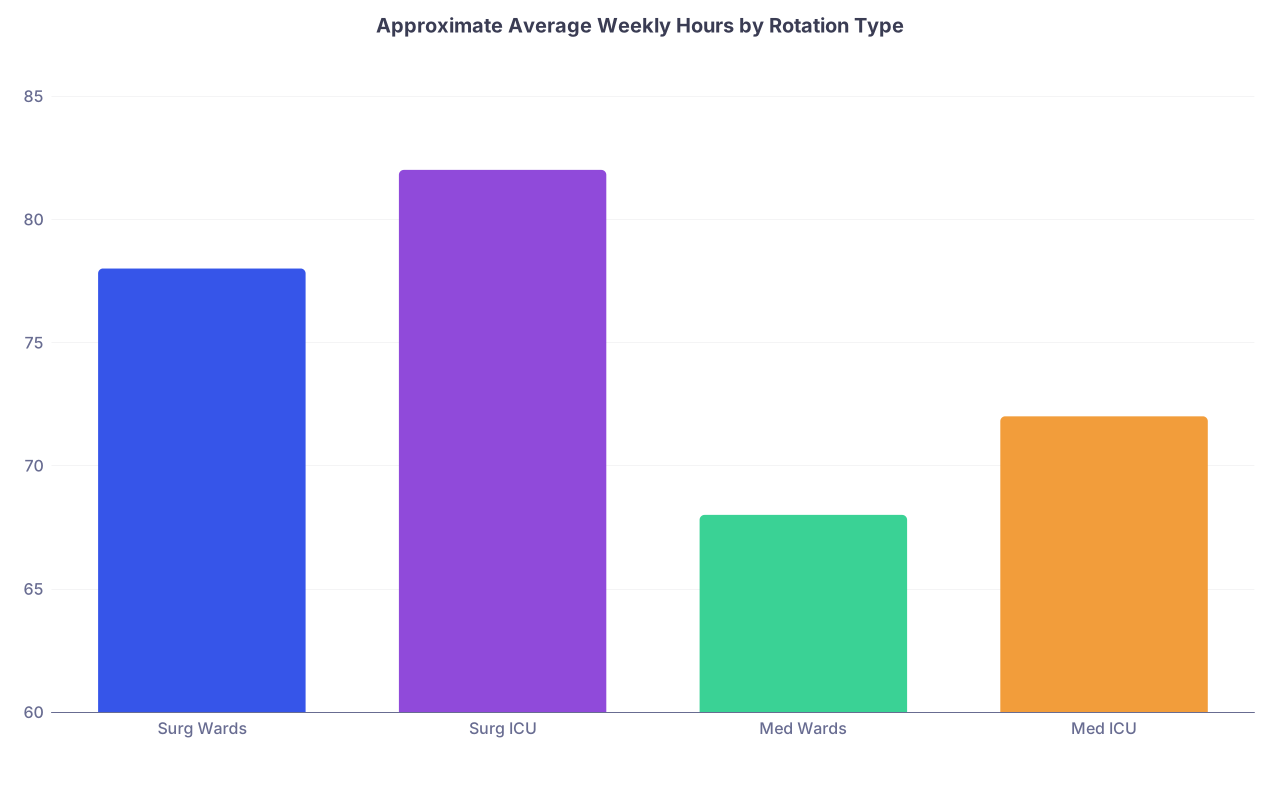
| Category | Value |
|---|---|
| Surg Wards | 78 |
| Surg ICU | 82 |
| Med Wards | 68 |
| Med ICU | 72 |
Surgical prelim call reality
Common patterns:
- Q3 or Q4 in-house call on trauma, general surgery, or ICU services.
- 24-hour call that becomes 28–30 with sign-out, plus a “post-call” day that still runs into the afternoon because the work list is long.
- Weekends: 2 out of 3 or 3 out of 4, depending on service.
The practical impact:
- You string together 3–4 hours of sleep in bleary on-call rooms.
- You are more likely to be physically unsafe driving home post-call.
- You often do not truly disconnect; your “post-call” day gets blown up by pending notes, last-minute issues, or meetings.
Medicine prelim call reality
Patterns vary more because medicine embraced night float earlier:
- 4+4 or 5+2 schedules with night float blocks.
- 12–16-hour calls that actually end near the scheduled time because of tighter supervision on duty hours.
- Weekends: More like 1–2 per month “off-off” even on busy programs, especially on elective and clinic months.
You are still tired. But you have:
- More predictable sleep during night float.
- More genuine days fully off.
- Less truly brutal post-call bloat.
The intensity still exists, but the floor is higher. You are less likely to string together 2 weeks with zero real rest.
6. Impact on Future Competitiveness: How PDs View Each Path
For many applicants, the prelim year is a bridge. Into advanced specialties (anesthesia, radiology, PM&R, neuro, ophtho) or into reapplying for categorical surgery.
If you want categorical surgery later
Program directors in surgery will look at:
- How you performed relative to their own categorical interns or others at that level.
- Whether you were reliable, hungry, and tough enough to survive their culture.
- LORs from surgical attendings that say more than “hard working and pleasant.” They want “I would take this person as a categorical tomorrow.”
Doing a strong prelim surgical year at a program with a history of absorbing prelims can help. Examples: Some university programs explicitly note “we often elevate 1–2 prelims to categorical each year.”
However:
- Many prelim spots exist purely as service positions with no intention of internal promotion.
- If you struggle or burn out, a mediocre surgical prelim year can actually hurt you more than a solid medicine prelim year would.
A surprising number of reapplying surgery candidates I have seen actually look better coming from a prelim medicine year with sky-high evaluations and a couple of surgical rotations than from a brutal surgical prelim year where they were average.
If you are headed to an advanced non-surgical specialty
Anesthesia, radiology, neurology, ophtho, PM&R, derm.
Program directors there care about:
- How well you manage bread-and-butter inpatient medicine. Every anesthesiologist or radiologist I know would rather work with a colleague who can stabilize a crashing patient than one who knows how to take out a gallbladder.
- Reliability, communication skills, and documentation. The things medicine hammers into you.
- Being rested enough and not so traumatized by your prelim year that you start your advanced position with burnout already brewing.
Most of them will openly state they prefer a medicine prelim or transitional year. Not because surgery is “worse,” but because the skill set translates better and the risk of outright burnout is lower.
If you already matched into, say, anesthesia with a required surgical prelim (this exists at a handful of programs), you do not really get a choice. But if you are picking your own prelims for a radiology or neuro position afterwards, medicine almost always wins.
7. Psychological Toll and Burnout Patterns
You can survive almost anything for a year. That is the argument students make. The problem is what that year does to your energy and outlook going forward.
Surgery prelim burnout pattern
Common themes I have seen:
- Cynicism: “I am just here to move meat and close skin.”
- Isolation: Very little peer bonding if the prelims are separate from categoricals.
- Identity hit: You went in thinking you were “surgical material.” Spending a year as the “extra” person can feel like rejection every day.
Training intensity here is not just hours; it is the feeling that your suffering is not building toward anything secure.
Medicine prelim burnout pattern
Different flavor:
- Emotional blunting: After 20 family meetings with nonsensical decisions, you stop caring a little.
- Compassion fatigue: Same COPD readmission, same cirrhotics, same people not taking meds.
- Cognitive overload: The documentation and endless documentation metrics can feel Sisyphean.
But often, medicine prelims have:
- Better peer support: You are usually mixed with categoricals closely, so you are part of a social unit.
- More variety: Clinic/ambulatory months, electives, electives that give some breathing room.
- Slightly more protected time: Noon conference that actually happens, didactics that are not constantly canceled for cases.
The net effect: Both groups are tired at the end of the year. Surgical prelims are more likely to be physically and emotionally wrung out. Medicine prelims are more likely to be mentally fatigued but still functional and somewhat optimistic.
8. How to Decide Which Intensity You Actually Want
Let’s be direct.
You should lean toward a surgical prelim year only if:
- You are dead-set on reapplying to surgery or a procedure-heavy specialty that values the technical grind (IR, vascular, trauma, etc.).
- You tolerate sharp criticism and high physical workload without imploding.
- You are going into a system that has a record of using prelims as true trainees, not just extra hands.
You should lean toward a medicine prelim year if:
- You matched (or reasonably expect to match) into an advanced non-surgical specialty.
- You want high cognitive load but a somewhat more stable environment.
- You care about starting your PGY-2 with a functioning brain and some emotional reserve.

| Step | Description |
|---|---|
| Step 1 | Need a prelim year |
| Step 2 | Consider surgical prelim |
| Step 3 | Prefer medicine prelim |
| Step 4 | Good option |
| Step 5 | High burnout risk |
| Step 6 | Focus on strong IM training |
| Step 7 | Future specialty |
| Step 8 | Program culture |
If you are undecided long-term and just “want to keep options open,” a medicine prelim year gives you more flexibility. From a solid medicine prelim, you can pivot into:
- Anesthesia
- Radiology
- Neurology
- PM&R
- Even surgery, with good surgical letters from electives and audition rotations
From a surgical prelim, it is much harder to reinvent yourself as someone with strong internal medicine fundamentals.
9. A Brief Reality Check: What PDs Actually Say Quietly
Behind closed doors, when PDs talk about prelim applicants, there is a theme:
- “The good surgical prelims are gold, but we chew up a lot of them.”
- “Most of my medicine prelims come out very solid and ready; a few burn out, but they still learn a ton.”
The training intensity differential is not just folklore. It is acknowledged behind the scenes.
One chief of surgery put it bluntly to a group of fourth-year students:
“If you come here as a prelim, understand: the work will be harder, the stakes will feel higher, and we cannot promise you a categorical spot. Do this only if you are obsessed with surgery.”
Compare that with a medicine PD at a comparable institution:
“A prelim here will work hard, but they will get the same education as our categoricals. After a year, they will be ready for any advanced position.”
That is the gap.

, Emotional Stress](https://cdn.residencyadvisor.com/images/articles_svg/chart-perceived-training-intensity-surgery-vs-medicine-p-8275.svg "Perceived Training Intensity: Surgery vs Medicine Prelim")
| Category | Value |
|---|---|
| Physical Fatigue | 9 |
| Cognitive Load | 7 |
| [Procedural Volume](https://residencyadvisor.com/resources/preliminary-year-vs-categorical/procedural-exposure-in-prelim-im-vs-transitional-years-for-future-specialists) | 9 |
| Emotional Stress | 8 |
Key Takeaways
- Surgical prelim years concentrate physical, task-heavy, and emotionally sharp intensity; medicine prelim years emphasize continuous cognitive load with somewhat more structural support and rest.
- For non-surgical advanced specialties, a medicine prelim almost always aligns better with what you will actually need and protects you more from outright burnout.
- A surgical prelim year makes sense only if you are genuinely committed to surgery or a closely related procedural field and you know the specific program treats prelims as real trainees rather than expendable coverage.