
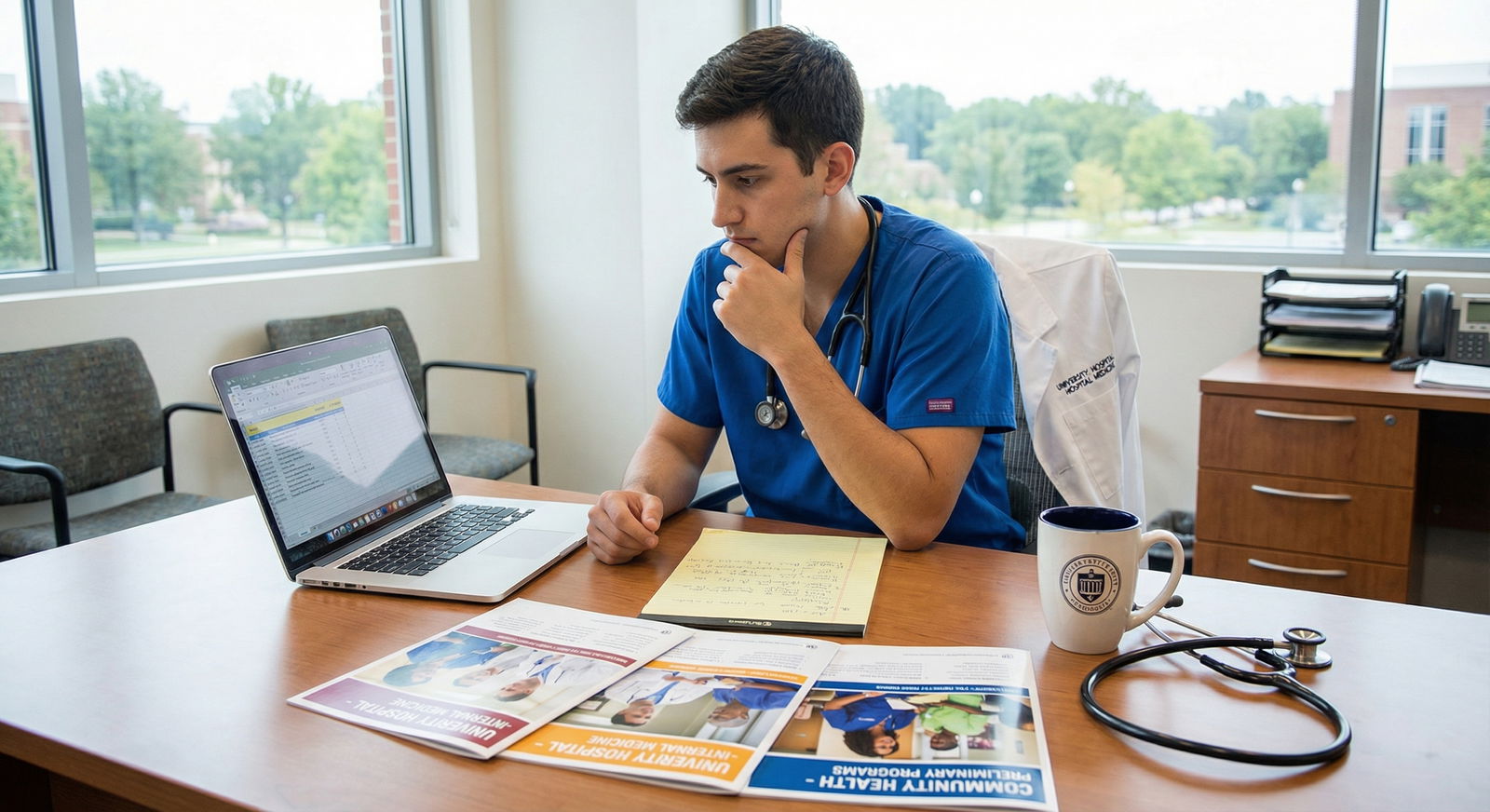
The Match did not “half-work.” It created a very specific problem you now have to solve quickly and surgically.
You matched into a prelim year. You did not match an advanced PGY‑2 spot. That’s not a fluke; it’s a new job: figuring out where you’ll be a year from now while working 70–80 hours a week.
Let’s walk through how to do that like an adult, not a panicked intern.
1. Get Absolutely Clear On What Your Prelim Year Actually Is
First, terminology. You cannot make good moves if you’re fuzzy on the basics.
There are three common situations people confuse:
| Pathway | PGY-1 Type | PGY-2 Status | Next Step Needed |
|---|---|---|---|
| Categorical IM / Surg | Categorical | Already secured | None |
| Prelim + Advanced | Prelim | Matched PGY-2 program | Just finish PGY-1 |
| Prelim only (you) | Prelim | Not secured | Find PGY-2 spot |
You are in that third box.
A preliminary year means:
- You have a one-year contract (PGY‑1) in something like internal medicine, surgery, or transitional year.
- After June 30 next year, you are unemployed unless you secure a PGY‑2 position somewhere.
- You are not “in” anesthesia, radiology, derm, ophtho, PM&R, etc. until a program explicitly gives you a PGY‑2 contract.
Own that reality. It’s harsh, but once you stop telling yourself “I sort of matched,” you’ll start acting like someone who needs and will get a new job.
Now, two critical questions you need to answer for yourself in the next week:
Are you still committed to your original advanced specialty?
Example: you applied anesthesia, matched a prelim IM only. Do you still want anesthesia, or are you now open to categorical IM, neurology, EM, etc.?Are you willing to move anywhere for PGY‑2, or do you have geographic constraints you can’t ignore (partner’s job, kids, visas)?
Your strategy hinges on those two answers.
2. Timeline Reality: What The Next 18 Months Actually Look Like
People underestimate the timing. You cannot “just figure it out later.” If you do that, you’ll be the PGY‑1 in March refreshing email in call room bathrooms and asking seniors if they know of any open PGY‑2s.
Here’s the rough structure.
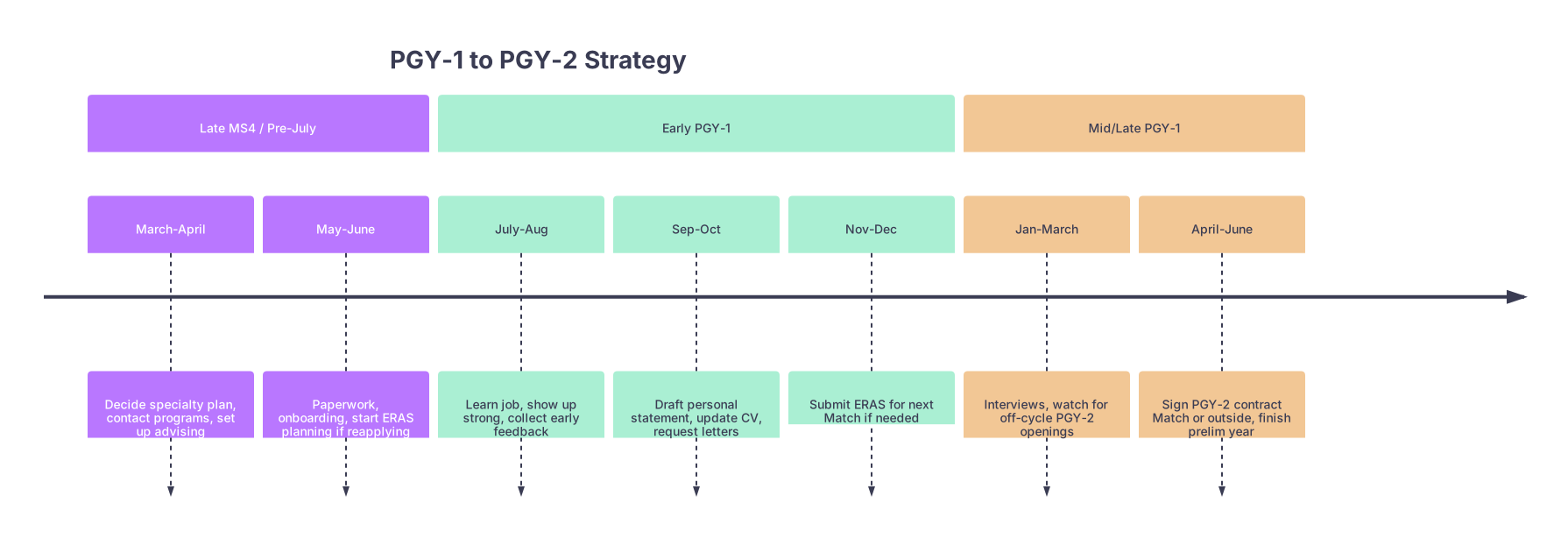
| Period | Event |
|---|---|
| Late MS4 / Pre-July - March-April | Decide specialty plan, contact programs, set up advising |
| Late MS4 / Pre-July - May-June | Paperwork, onboarding, start ERAS planning if reapplying |
| Early PGY-1 - July-Aug | Learn job, show up strong, collect early feedback |
| Early PGY-1 - Sep-Oct | Draft personal statement, update CV, request letters |
| Early PGY-1 - Nov-Dec | Submit ERAS for next Match if needed |
| Mid/Late PGY-1 - Jan-March | Interviews, watch for off-cycle PGY-2 openings |
| Mid/Late PGY-1 - April-June | Sign PGY-2 contract Match or outside, finish prelim year |
If you plan to:
- Re-enter the Match for a categorical or advanced spot:
You’ll be working on your application from about September–November of your intern year. - Find an “outside the match” PGY‑2 spot:
You start checking for openings as early as July of PGY‑1 and don’t stop until you sign a contract.
Do not wait for someone at your prelim program to bring this up. They’re busy staffing their own service. You drive this.
3. Decision Point: Stick With Specialty vs Pivot
Let’s separate two tracks. Your planning is totally different depending on which one you pick.
Track A: You Still Want Your Original Advanced Specialty
Example scenarios:
- Matched prelim IM, didn’t match advanced neuro, rad onc, or cards‑intended track.
- Matched prelim surg, didn’t match ortho or urology (yes, different match system, same concept).
Here’s what you do:
Brutally assess why you missed the advanced match.
Was it:- Board scores weak for that specialty (e.g., Step 2: 224 for anesth/rads/derm)?
- Late or poor-quality application?
- Limited or no research in that field?
- Weak or generic letters from people not in the specialty?
- Applied too few programs or only to “top” places?
Write this down. Not vibes, facts.
Talk to an actual program director or APD in that specialty.
Ideally at your prelim institution. Something like:“I matched a prelim IM year here and didn’t secure an advanced anesthesia position. I’m still very interested in anesthesia. Could I get 20 minutes for honest feedback on my application and to ask how to be a realistic reapplicant?”
Do not fish for compliments. You want the sentence that hurts: “You won’t match at big-name programs with these scores, but community programs might be reasonable if you X and Y.” That sentence is gold.
Decide: reapply in the next cycle, or build another year first.
- If your application was borderline but not catastrophic → you can reapply during PGY‑1.
- If your app was truly weak (no research, poor scores, no mentorship in that field) → consider doing prelim year + one extra year (research or a second year in same field) then reapply stronger.
Commit to your story.
Your narrative this time is: “I wanted X, tried, didn’t match advanced, did a strong prelim year, doubled down, and here is the evidence I’m genuinely committed and now a safer bet for you.”That means:
- Get at least one PGY‑1 rotation directly in that specialty if possible.
- Get a letter from someone in that field who can say “They functioned at a PGY‑1 level, reliable, teachable, I’d take them in my program.”
Track A is viable. I’ve seen anesthesia and rad onc applicants match the second time from exactly your situation. But they did the ugly introspection and then overcorrected hard.
Track B: You Pivot To A Different (Often Less Competitive) Specialty
Maybe you applied derm, matched prelim medicine only, and realized: you like patient care more than biopsy counts. Or your Step scores make a second derm attempt basically masochistic.
Common pivot directions from a prelim:
- To categorical internal medicine
- To family medicine
- To neurology
- To psychiatry
- To EM, sometimes
- From prelim surgery to general surgery categorical at a different level or to IM/EM
Now your new job is to present yourself as someone who figured it out, not someone who’s just falling downwards.
You need:
- A personal statement that explains the pivot in 1–2 clean paragraphs, not an apology essay.
- At least one letter from your prelim field saying “They are strong, and I would absolutely keep them here if we had a categorical spot.”
- Evidence you understand the specialty you’re pivoting into: rotations, shadowing, talks with faculty.
4. The Two Parallel Hunts: PGY‑2 Openings vs Re-Matching
Here’s where people get tangled.
There are two ways to get a PGY‑2 spot after a prelim:
- You find an open PGY‑2/PGY‑1.5 position outside the formal Match.
- You enter the Match again for the next cycle (either for a categorical or an advanced PGY‑2 that starts the following July).
You can and often should do both.
A. Hunting For Open PGY‑2 Positions
These are the “Hey, someone quit, we need another resident” spots.
They appear:
- Sometimes as early as spring of MS4 year.
- Frequently July–October of your prelim year.
- Randomly after that when people leave, fail boards, have family emergencies, etc.
Where to actually look:
| Source | How Often to Check | Notes |
|---|---|---|
| ACGME / AMA FREIDA listings | Weekly | Filter by open positions |
| Specialty listservs / websites | Weekly | E.g., ASA, APDR, AUR |
| ResidentSwap / FindAResident | Weekly | Often small community PDs |
| Program websites (target list) | Every 2–4 weeks | Look for 'vacant position' |
What to send when you see one:
- Updated CV (clearly showing you’re a current PGY‑1).
- One-page personal statement tailored to that specialty/program.
- USMLE/COMLEX transcript.
- If you already started prelim: a brief statement from your PD (or at least, that you’ll provide one soon).
Your email is short, concrete:
“I’m a current PGY‑1 preliminary internal medicine resident at [Hospital], finishing June [year]. I am seeking a PGY‑2 position in [specialty] starting July [year]. I saw your posting for an open PGY‑2 spot. Attached are my CV, exam scores, and personal statement. Happy to provide letters and a PD reference at your convenience.”
You do not wait three days and overthink it. You reply within hours.
B. Re-Entering The Match
If you want:
- A categorical spot in something like IM, neuro, psych, FM, EM
or - An advanced spot in your original specialty starting a year later
…then you’re playing the normal ERAS/NRMP game again, just as a PGY‑1 instead of an MS4.
That means:
- Update ERAS: add your prelim as current training, update experiences.
- New letters: at least two letters from residency faculty, ideally including your prelim PD or a core faculty member.
- New personal statement: incorporate what you actually learned taking care of real patients.
You’ll be doing this application work while learning to be an intern. So you need a realistic schedule.
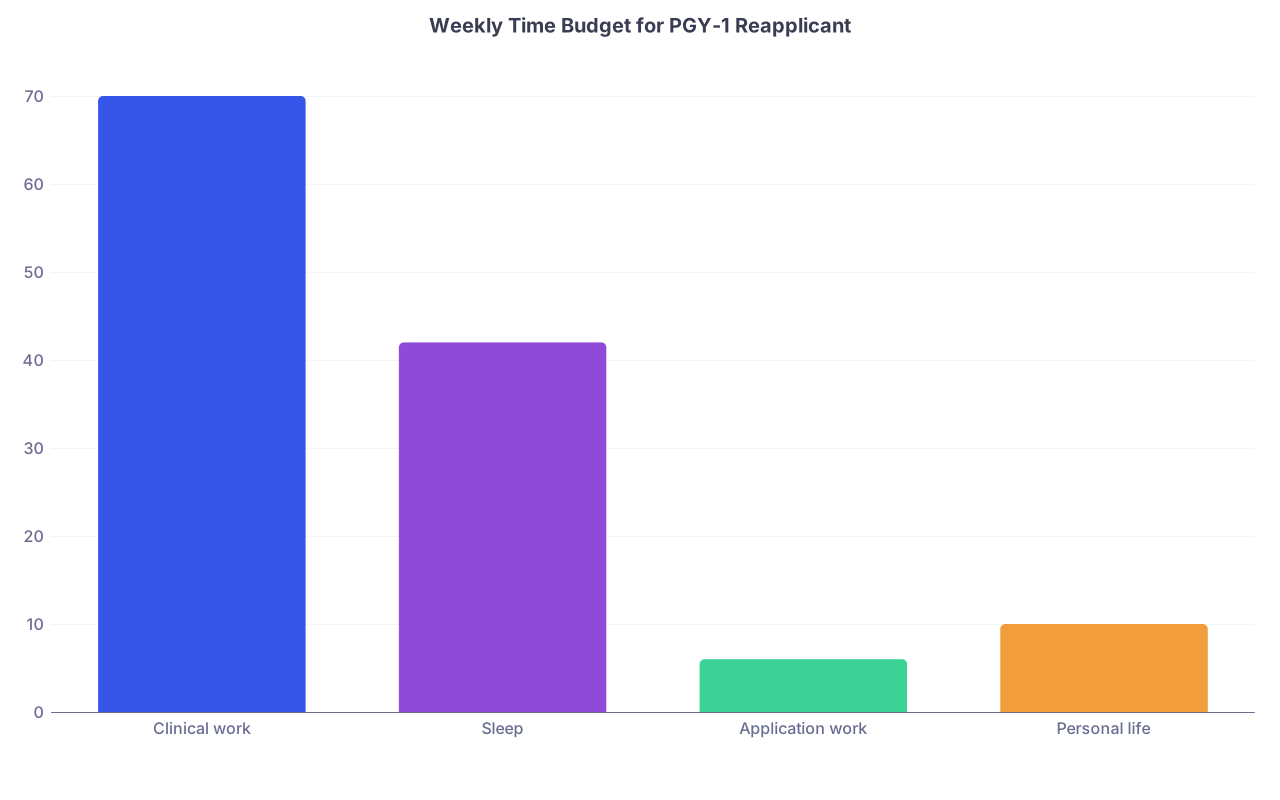
| Category | Value |
|---|---|
| Clinical work | 70 |
| Sleep | 42 |
| Application work | 6 |
| Personal life | 10 |
Those 6 hours per week for applications? Block them. Calendar them. Treat them like clinic. No one else will create that time.
5. How To Use Your Prelim Year To Make Yourself More Desirable
You can’t change your Step scores or your med school rank list. You can absolutely change what people say about you as a resident.
Your prelim program is essentially your one-year audition tape for another PD.
Here’s how to not screw that up.
Be The Intern PDs Want To Steal
You want your prelim PD or core faculty to be able to say to their colleagues in another specialty:
“We don’t have space to keep them, but we would in a heartbeat. They’re one of our best interns.”
Concrete behaviors that lead to that:
- Show up early. Not “on time.” Early enough to pre-chart.
- Do your notes the same day. Habit of late notes kills your letter.
- Own your patients. You know their meds, their code status, their follow-up plan.
- Don’t complain about being a prelim. Ever. Not to residents, not to nurses. It gets back to leadership.
- When there’s scut, do it cleanly and quietly. You’re being watched for attitude, not just brains.
Get The Right Rotations And People On Your Side
If your target specialty is:
- Anesthesia / Radiology / Derm / Neurology / PM&R:
Beg, barter, or horse-trade to get at least one elective month in that department. - IM / Psych / FM / EM:
Crush your core rotations: wards, ICU, ED. These faculty often have friends at other programs.
Before each rotation where you might want a letter:
- Introduce yourself Day 1: “I’m a prelim intern, planning to apply to [specialty] this fall. I’d really appreciate any feedback on how I can perform at the level of someone you’d recommend.”
- Ask for mid-rotation feedback. Then fix at least one thing they mention. People remember that.
Letters that move the needle say:
“They were functioning more like a late PGY‑1 or early PGY‑2 by the end of the month.”
Not: “Pleasure to work with. Showed up.” That’s a participation trophy.
6. Talking To Your Prelim Program Leadership Without Spooking Them
Many prelims are afraid to talk to their PD because they don’t want to look “disloyal.” That’s nonsense. Your PD already knows prelims are one-year. Their question is whether you’re professional about your next step.
Aim for a meeting in the first 2–3 months, once you’ve had time to prove you’re not a disaster.
What you say:
- “I really appreciate the chance to train here this year.”
- “I matched a prelim year only and didn’t secure an advanced position. My goals now are [X].”
- “I want to perform well for you and also make a plan for PGY‑2. How have prior prelims here successfully found PGY‑2 spots? Are there faculty you recommend I talk with?”
What you do NOT say:
- “I’m trying to get out of here as fast as possible.”
- “This was my backup; my real interest is somewhere better.”
- “Can you guarantee me a categorical spot if someone fails out?”
You’re looking for:
- Their honest assessment of your competitiveness.
- Permission to ask for letters.
- Maybe intel about historical connections (e.g., “We send a lot of people to [X] anesthesia program.”)
This is also where you clarify if your program could ever convert you to a categorical spot if someone leaves. Many can’t; some can. It’s worth knowing the rules, but don’t bank your whole plan on a unicorn opening.
7. Visa, Licensing, and Contract Landmines
If you’re an IMG or on a visa, you cannot treat this like a US grad with no constraints.
Three non-negotiables you track early:
-
- J‑1: Usually simpler to move programs, but you need both programs’ institutional sponsorship aligned.
- H‑1B: Much trickier; many PGY‑2 programs won’t take H‑1B transfers.
Before you apply widely, email programs to ask if they consider PGY‑2 transfers on your visa type. Do not waste energy on impossible options.
State licensing for PGY‑2
Some states expect a full license by PGY‑2. Others allow training licenses. Make sure you’ll have enough weeks of US training to qualify where you’re applying.Contract timing
If you sign an outside-the-Match PGY‑2 contract starting July [year+1], be 100% certain on:- Salary
- Credit for prior training (which PGY level you join, especially in IM/surg)
- Whether they require you to withdraw from the Match
Get things in writing. Being “promised” verbally that they’ll count your prelim year toward ABIM time and then learning later that they won’t is how you end up doing an extra year you never wanted.
8. How To Stay Functional (And Not Despairing) Through All This
This situation is emotionally brutal. You’re working like a resident while also carrying the anxiety of not knowing if you’ll have a job in 12 months.
A few things I’ve seen actually help people in your shoes:
Pick a “minimum acceptable outcome” and a “dream outcome.”
Minimum might be: “Any categorical IM spot in [three regions].” Dream might be: “Anesthesia PGY‑2 at a mid-tier academic program.”
It keeps you from spiraling when the dream looks shaky—you still know what success looks like.One application task per day rule.
Even on call months: one email, one CV tweak, one PD website checked. Tiny, but it keeps momentum.Limit the doom-scrolling.
Stop comparing yourself to your classmates who matched straight into derm, ortho, whatever. They’re on their path; you’re on yours. You’re not behind; you’re just taking an alternate route that still leads to being an attending.Know when to cut losses and pivot.
If October of your prelim year comes and your primary specialty doors are clearly closed based on direct feedback, don’t double down on a fantasy. Pivoting to something like IM, psych, or FM and building a good life there is not “failure.” It’s a rational decision.
9. A Simple, Aggressive Action Plan
Put it together. Here’s a stripped-down, no-fluff plan from now through the end of your prelim year.

| Step | Description |
|---|---|
| Step 1 | Start Prelim PGY-1 |
| Step 2 | Clarify specialty goal |
| Step 3 | Meet prelim PD by Sept |
| Step 4 | Crush early rotations |
| Step 5 | Update ERAS, get new letters |
| Step 6 | Focus on off cycle PGY-2 openings |
| Step 7 | Apply broadly in Sept-Nov |
| Step 8 | Interview, monitor openings all year |
| Step 9 | Finish prelim strong |
| Step 10 | Reassess, consider extra year or pivot |
| Step 11 | Reapply via Match? |
| Step 12 | Signed PGY-2 contract |
Also, build a target list. Don’t apply blindly.
| Program Type | Region | Priority Level |
|---|---|---|
| Community Anesthesia | Midwest | High |
| Academic IM Categorical | Northeast | Medium |
| University PM&R | South | High |
| Community Neuro | West | Low |
Update this monthly. Track where you’ve emailed, who responded, whose website mentions vacancies.
Key Takeaways
- A prelim-only match is not a dead end, but you now have a second full application cycle to manage while working as an intern. Treat it like a second job.
- Decide quickly whether you’re doubling down on your original advanced specialty or pivoting to a different field; your letters, rotations, and narrative all depend on that choice.
- Make your prelim year an asset: be the resident other PDs want to steal, aggressively hunt both open PGY‑2 positions and Match options, and secure a signed PGY‑2 contract well before your PGY‑1 year ends.


