
The fastest way to tank a prelim application is to reveal, in five minutes, that you do not understand what a preliminary year actually is. Programs are listening for it. And they are ruthless about it.
If you walk into a prelim interview treating it like a consolation prize, a gap-year job, or a generic “one-year thing before I figure my life out,” you will not match. Not at a decent program, anyway.
Let me walk you through the interview blunders that quietly scream: “I do not get preliminary training.” And how to avoid looking like that applicant.
1. Treating a Prelim Year Like a Backup Transitional Year
The first deadly mistake: acting like all one-year programs are interchangeable.
A preliminary year is not a “soft” transitional year. It is usually:
- A categorical intern year minus guaranteed PGY-2
- Workforce support for the hospital
- A pipeline for advanced specialties (anesthesia, radiology, derm, rad onc, ophtho, PM&R, neuro, etc.)
Many applicants walk into prelim interviews talking like they are interviewing for a lifestyle transitional year at some community hospital. Faculty pick up on this instantly.
How this blunder sounds in the room
“I just want a broad clinical foundation before my specialty.”
Translation in their heads: This person has no idea what our service is like.“I heard prelim years are more flexible, so I can focus on research and Step 3.”
At a heavy IM prelim or surgery prelim program, that sounds delusional.“Any prelim year is fine; I am just looking for one year before my advanced spot.”
You just told them their specific curriculum does not matter to you. Fatal.
| Category | Value |
|---|---|
| Same as TY | 70 |
| Light workload | 55 |
| Guaranteed PGY-2 | 40 |
| Easy research time | 65 |
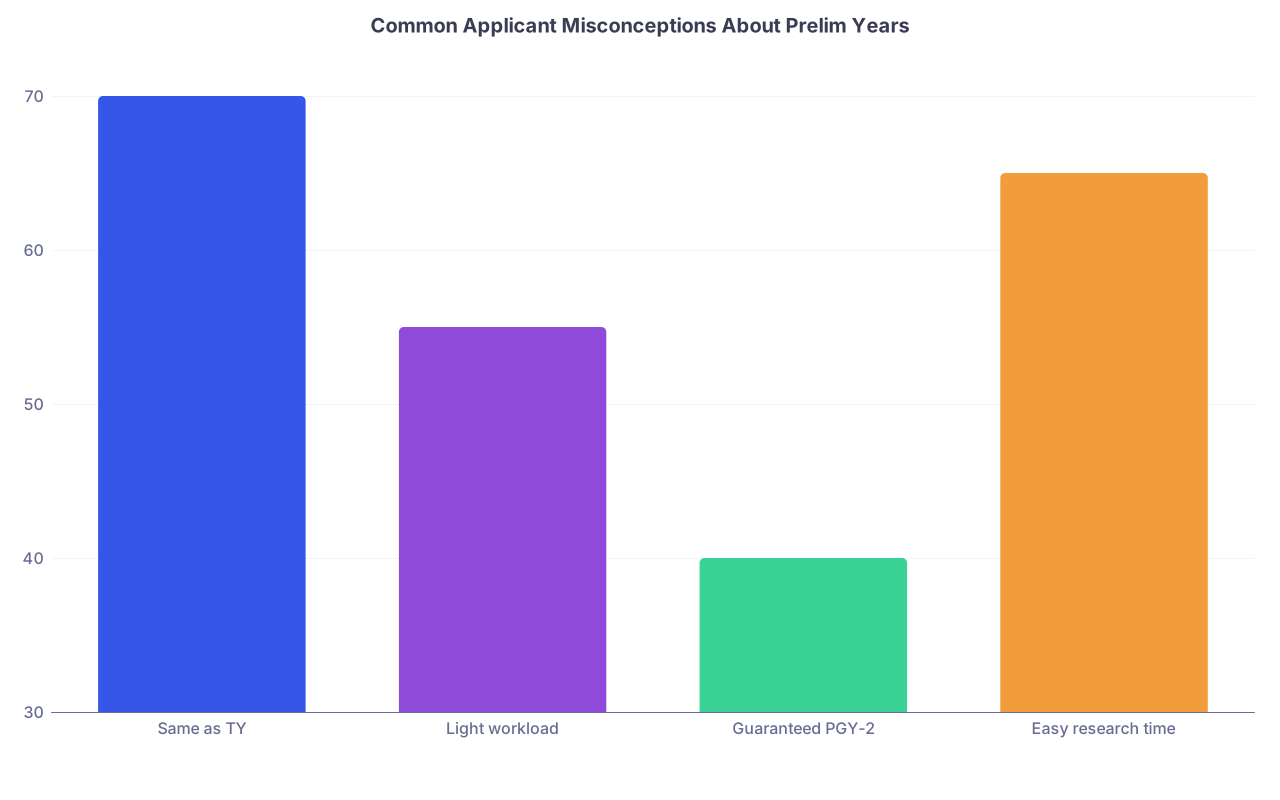
Percentages here are not exact, but I have heard some version of each misconception from >50% of prelim applicants.
What you must show instead
You need to demonstrate that you understand:
How prelim differs from categorical at that program
Same call? Same ICU expectations? Same clinic load? Or different?How prelim differs from transitional
Transitional = generally more electives; Prelim IM/Surgery = generally more inpatient grind.What the hospital gets from you
Coverage. Night float. Cross-cover. ICU work. Not “protected time to read Robbins at Starbucks”.
Safer language to use:
- “My understanding is that prelim interns here carry similar inpatient responsibilities as your categorical IM interns, with fewer continuity clinics and no PGY-2 guarantee. That aligns with what I need before starting anesthesia/rads/etc.”
- “I know this is more of a workhorse prelim than a cushy transitional year. I am looking for that volume and responsibility.”
If you cannot articulate that level of nuance, you look unprepared. Or worse: entitled.
2. Acting Like the Prelim Program Is Irrelevant Because You Have an Advanced Spot
Second red flag: you act like the only thing that matters is your advanced specialty. The prelim is just a box to check.
This is poison in prelim interviews.
Subtle ways this shows up
- You only talk about derm/rads/ophtho during “Why this program?”
- You describe your goals entirely in terms of the advanced field.
- You gush about the advanced program across town and barely mention where you are actually interviewing.
I have literally heard:
“I am mainly focused on matching into radiology; the prelim year is just to get through intern year.”
That applicant did not match prelim there. Shocking.
Why programs hate this
- They hear: “I do not care about your culture or your workload; I am using you.”
- They assume you will be miserable, disengaged, complaining all year.
- They worry you will burn out or become a weak link on already-stretched teams.
Prelim years are notoriously high-burnout. They do not want interns who are mentally somewhere else for 12 months.
What to do instead
You need a two-lane story:
Lane 1: The prelim year in itself
- “I want strong inpatient training, high-acuity exposure, and enough independence to feel comfortable managing sick patients before I move into anesthesia.”
- “I am specifically looking for a program where interns are trusted in the ICU and on nights, but with backup when needed.”
Lane 2: How that supports your advanced field
- “I know in radiology I will be called to weigh in on critically ill patients; this kind of hands-on floor and ICU experience will make me more effective later.”
Notice the order. Prelim first, advanced second. If you flip it, it sounds like you are using them.
3. Being Vague or Clueless About the Program’s Actual Structure
This one is unforgivable: you show up and clearly have not read the program’s website.
Prelim interviews are short. You do not have time to waste re-asking basic facts that are printed in huge font on the homepage.
Programs are watching for this mistake because it filters out lazy applicants.
Classic “I did not do my homework” lines
- “Do prelims here take call?” (They have a whole page about night float.)
- “Are there ICU rotations?” (They advertise ‘3 months ICU’ as a selling point.)
- “Is there any exposure to outpatient medicine?” (They literally have an outpatient block map online.)

At least skim:
- Rotation breakdown (wards, ICU, nights, electives)
- Call schedule structure (night float vs 24s)
- Any prelim-specific differences from categorical tracks
- Clinic responsibilities
How to signal you actually know what you are signing up for
Drop specifics in your answers:
- “I noticed prelims here do 2 blocks of MICU and 1 block of CCU, which I think will help me going into anesthesia.”
- “I saw prelims share the same night float rotation as the categorical interns, which I like because I will get real responsibility early.”
This is not brown-nosing. It is demonstrating you understand the job.
If your answers could be copy‑pasted to any prelim program in the country, you are doing it wrong.
4. Mishandling the “What If You Do Not Match Your Advanced Spot?” Question
This question exposes who has actually thought through their risk. And who is living in fantasy land.
Programs see a lot of:
“I am confident I will match derm / ophtho / rads.”
Confidence is fine. Arrogance and magical thinking are not.
Here is the trap: they are not asking because they want you to be insecure. They are asking whether you are mature enough to have a Plan B that does not implode your life or their workflow.
Answers that kill you
“I have not really considered that.”
Translation: naive. Poor insight.“I would just reapply and do research somewhere.”
So… you would leave them short-staffed mid-year if things go sideways?“I mean, my scores are strong enough that I am not too worried.”
You just told them you cannot see beyond your own stats.

| Step | Description |
|---|---|
| Step 1 | Program asks about not matching advanced |
| Step 2 | Red flag - poor insight |
| Step 3 | Reassuring |
| Step 4 | Stronger ranking |
| Step 5 | Lower ranking or no rank |
| Step 6 | Applicant answer |
What a mature answer sounds like
You want three elements:
Acknowledge uncertainty
- “The match is never guaranteed, even with strong stats.”
Concrete Plan B that still respects prelim training
- “If I did not match, my first priority would be to complete the prelim year at a high level, obtain strong letters, and then reassess with my mentors.”
A plausible alternative path
- “I would consider reapplying to the same specialty with a stronger application, and I would also keep an open mind to categorical internal medicine if that made more sense after intern year.”
That tells them:
- You are not planning to bail early.
- You are coachable and realistic.
- You see prelim as part of your training, not a throwaway year.
5. Sounding Entitled About Workload, Call, or “Lifestyle”
Big mistake: interviewing for a prelim IM or surgery spot and then complaining about call, hours, or inpatient-heavy rotations.
Yes, you should care about wellness. But when you are doing a one-year intensive training program, and you start fishing for “light” or “chill,” faculty hear laziness and entitlement.
Common red-flag comments
- “I am hoping to avoid too much night float.”
- “Is there a way to tailor the year to be more outpatient?”
- “I heard some prelims find time to moonlight on the side. Is that realistic here?”
Those might be honest questions. They are also catastrophic in a first‑round interview.
Programs expect prelim interns to:
- Work hard
- Carry real caps
- Take nights and weekends
- Manage high acuity
If you look like you are trying to escape that, you will be ranked accordingly.
Better approach: focus on support, not escape
Instead of: “How light are your calls?”
Try: “How is supervision structured on nights? How accessible are senior residents and attendings when things get busy?”Instead of: “Will I have time for outside research or side projects?”
Try: “Where have previous prelims found time to work on scholarly projects, if at all? I want to be realistic with my expectations.”
You are signaling: I am ready to work. I just want to know I will not drown.
6. Failing to Distinguish Yourself from Categorical Applicants
Another subtle blunder: answering questions like a generic IM or surgery categorical applicant, without ever addressing the one-year reality of prelim training.
Programs know your situation is different:
- You will not be here for PGY-2.
- You may not be in continuity clinic long-term.
- You might be mentally preparing for a very different specialty.
If every answer you give could be from a person begging for a categorical IM spot, it feels fake.
Where this shows up
“Where do you see yourself in 5–10 years?”
You mumble something like “as an academic internist” when your ERAS screams rads.“What are you looking for in a program?”
You say “longitudinal relationships with clinic patients” when prelim clinic is minimal.
Programs do not mind that you are future rads/derm/ophtho. They mind when your story does not line up.
How to do it right
You need to own the prelim identity while highlighting real value:
“In 5–10 years I see myself as an academic interventional radiologist. In the shorter term, I want this year to make me the kind of radiologist who understands the floor and ICU realities my referring teams face.”
“Because this is a one-year position, I am especially focused on:
- Strong ward and ICU blocks
- Supportive seniors who are willing to teach
- A culture that includes prelims, not just tolerates them.”
That answer tells them:
- You understand your lane.
- You respect the year.
- You know what you can and cannot reasonably get from 12 months.
7. Not Understanding the Match Risk of Prelim + Advanced Pairing
This is a quieter but deadly mistake: you signal to the program that you do not understand how risky your prelim + advanced strategy actually is. That makes you look careless.
Two main failure modes:
- Over-optimistic: Shooting for ultra-competitive advanced specialty + only applying to a handful of prelims “just in case.”
- Chaotic: Listing unrealistic geographic pairings with no backup plan.
Programs will often ask variations of:
- “How are you approaching pairing your prelim and advanced applications?”
- “Are you prioritizing geography or specific programs?”
| Category | Value |
|---|---|
| Many prelims + many advanced | 15 |
| Few prelims + many advanced | 35 |
| Many prelims + few advanced | 30 |
| Few prelims + few advanced | 60 |
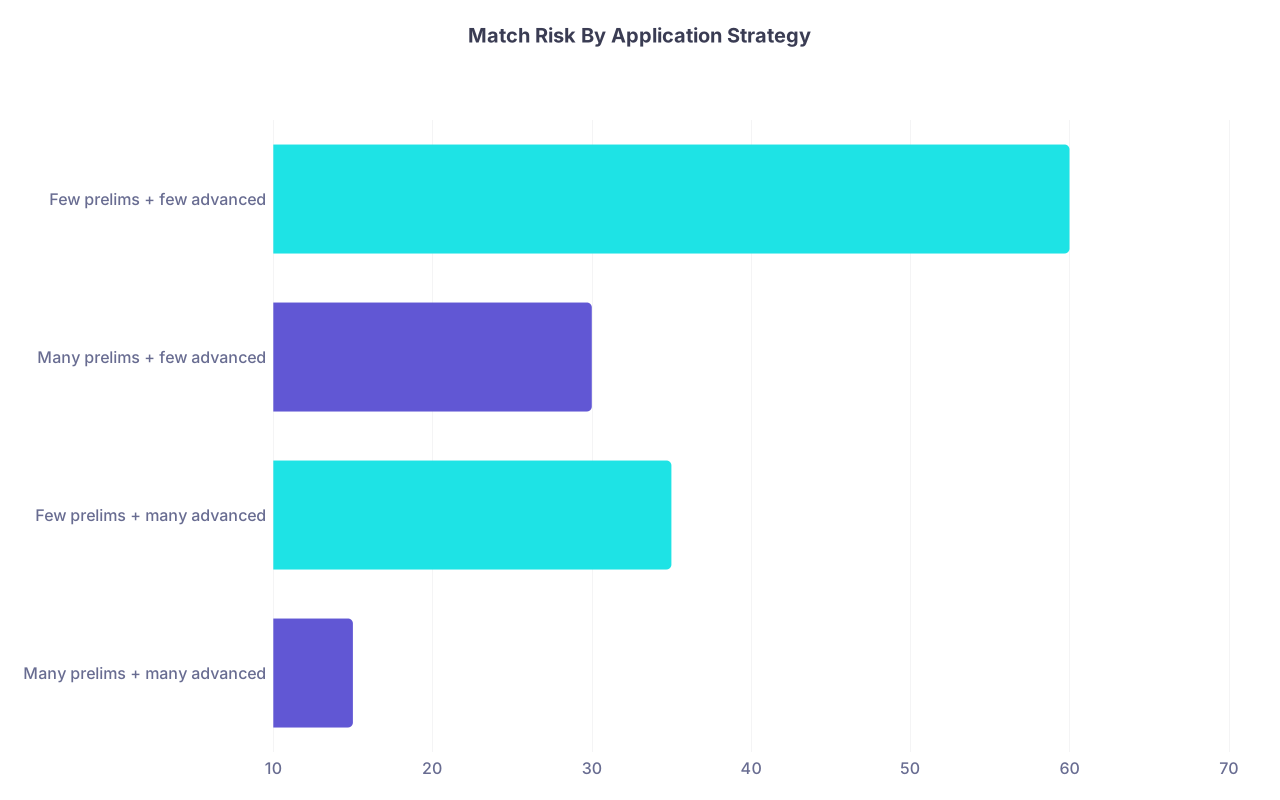
(Higher percentage = higher risk of going unmatched or scrambling.)
What they do not want to hear
- “I am not too worried; I am applying to 3 prelims and 15 derm programs.”
- “I only want to be in one city, so I am ranking very few combinations.”
That screams: I do not understand probability. Or the SOAP.
Smarter way to frame your strategy
“I am applying broadly in both prelim and advanced programs. I have structured my list so that I have:
- Several realistic pairings in my preferred region
- A set of combinations I would be comfortable with elsewhere if needed.”
“I have talked with mentors about match risk and I would rather have a solid prelim + advanced pairing in a less ideal city than risk not matching one side at all.”
You are showing:
- You understand the two‑list problem.
- You are not gambling recklessly.
- You will not become a cautionary tale in their alumni lounge.
8. Asking the Wrong Questions – Or None at All
Your questions at the end of the interview reveal exactly how much you understand about prelim life.
Bad questions usually fall into three buckets:
- Googleable basics (“Do you have an ICU rotation?” – it is on the website.)
- Self-centered lifestyle fishing (“How often do interns get out on time?” as your first and only question.)
- No questions at all (“No, I think you covered everything.” Translation: I did zero thinking ahead.)
High-signal, prelim‑savvy questions
Ask about things that matter specifically for a prelim year:
- “How integrated are prelims into team structures compared with categoricals? Are they treated as full members or more as float coverage?”
- “Where do your recent prelim graduates typically go for their advanced training? Do you maintain any relationship or feedback from those departments?”
- “What have been the biggest challenges for prelim interns here, and what changes have you made in response?”
These questions tell the program:
- You know prelims can be marginalized, and you care about not being invisible.
- You are thinking beyond match day to the realities of daily work.
- You respect their experience rather than assuming you know better.

9. Ignoring the Emotional Reality of a One-Year, High-Stress Job
This part almost no one talks about on interview day, but programs feel it acutely: prelim interns are often:
- Tired
- Disconnected (leaving after one year)
- Surrounded by categoricals who are building a 3‑year or 5‑year community
If you behave like some hyper-transactional careerist, they assume you will flame out emotionally.
Emotional red flags during the interview
- You show zero curiosity about mentorship or support.
- You never once ask about culture, wellness, or how prelims fit in socially.
- You talk about “getting through” the year, not growing during it.
No, you do not need to give a TED talk on resilience. But you should show that you understand prelim is not just “PGY-1 and done.” It is a legitimately tough, liminal year.
Healthier, mature signals
- “How do you help prelim interns integrate with the categorical residents, given that they are only here one year?”
- “Have you noticed any particular stress points for prelims, and how does the program support them?”
Those questions alone separate you from the applicants who think this is a throwaway.
| Area | Healthy Signal | Risky Signal |
|---|---|---|
| Understanding role | Knows prelim vs categorical vs TY differences | Thinks all one-year spots are identical |
| Workload attitude | Ready for hard year with support | Looking for easiest possible intern year |
| Planning & risk | Has realistic plan B, broad strategy | Overconfident, no backup, narrow applications |
| Emotional insight | Asks about integration and support | Only asks about schedule and time off |
FAQ (Exactly 3 Questions)
1. Do I have to pretend I love internal medicine or surgery if I am only doing a prelim year?
No. You do not need to fake wanting a categorical spot. You do need to respect the field you are training in for that year. Frame it honestly: you are committed to another specialty long term, but you value strong IM/surgery training as the backbone of good patient care and as essential for being competent in your chosen field.
2. Is it a mistake to say I am also open to a categorical spot if things change?
Not if you mean it. Programs actually like applicants who could realistically stay as categoricals if their plans shift. The mistake is using “I am open to categorical” as a desperate line when your entire application screams single-minded derm/ophtho obsession. Only say it if your application and your story make that pivot believable.
3. How honest should I be about targeting a competitive advanced specialty?
Be straightforward. Hiding your true target specialty looks dishonest. The error is not your ambition; it is sounding arrogant, unprepared, or ignorant of match risk. Own your goal, show that you understand the odds, have a Plan B, and respect the prelim year as serious training—not a waiting room for your “real” career.
If you remember nothing else:
- Do not walk into a prelim interview sounding like you think it is a generic, easy one-year formality.
- Do not treat the program as disposable just because you are leaving after a year.
- Do not dodge hard questions about workload, risk, and backup plans. Face them like an adult. Programs notice who does.