
The most dangerous prelim red flags are the ones you do not even know to look for.
Most applicants treat preliminary years like a throwaway box to check. That’s how people end up miserable, untrained, and scrambling for a categorical spot with a useless “intern year” behind them. You’re not going to be one of them.
Let’s walk through the traps.
First: Don’t Misunderstand What a Preliminary Year Actually Is
If you misunderstand what a prelim year is, you will miss every other red flag.
A preliminary year is usually:
- A 1‑year non-categorical position
- Commonly in Internal Medicine, Surgery, or Transitional Year
- Designed for people who:
- Already matched into an advanced specialty (Derm, Rad Onc, Neuro, Anesth, PM&R, etc.)
- Are trying to reapply to something else and need an intern year
- Want a single year of training (less common, but it exists)
Here’s the mistake: people assume “a PGY‑1 is a PGY‑1.” Wrong.
Some prelim years:
- Give you strong training + letters + interview time → they launch you
- Others chew through interns, dump scut on them, block their reapplications, and brag “we don’t care if prelims match elsewhere”
You need to be able to tell which is which before you rank.
Red Flag #1: “We Don’t Care Where Our Prelims Go”
This is the quiet, polite version of “You are cheap labor to us.”
You’ll see it in different forms:
- Website that lists categorical residents’ fellowship matches but says nothing about prelim outcomes
- Interview day where no one can clearly answer, “Where did your prelims go the last 3 years?”
- PD who says, “Our priority is our categorical residents” and then changes the subject
Let me be blunt: if a program cannot tell you exactly what happens to its prelims, the outcomes are bad. Good outcomes are advertised. Bad ones are buried.
You want specifics like:
- “Last year: 2 Derm, 1 Rad Onc, 1 Anesthesia, 1 Ophtho, 1 IM categorical”
- “We keep a spreadsheet of prelim destinations; we can send it to you”
- “Our chairman personally calls programs for strong prelims reapplying”
If all you get is hand-waving and “they do fine,” that’s a no.
| Program Type | What You Hear | What It Really Means |
|---|---|---|
| Strong prelim support | “Here’s our last 3 years of prelim matches by name and specialty.” | They actually invest in your future. |
| Mediocre | “I think most of them match…Derm, Anesthesia…not sure exactly.” | No tracking, no advocacy, luck-based. |
| Dangerous | “We don’t really track prelim outcomes.” | You’re labor, not a trainee. |
If you cannot get a straight answer on prelim outcomes, do not rank them highly. I’ve seen too many people stuck reapplying from a black hole.
Red Flag #2: Prelim and Categorical Residents Live in Different Universes
Do not ignore stratification. It predicts how you’ll be treated.
Signs of a two‑class system:
- Prelims have:
- Heavier call
- More nights
- More wards, fewer electives
- Excluded from teaching conferences “for categorical only”
- Prelims don’t attend:
- Resident retreats
- Wellness days
- Research meetings
- Prelim lounge? Nope. Prelim input on schedules? Absolutely not.
Ask directly:
- “Are prelim and categorical interns scheduled together or separately?”
- “Do prelims participate in all educational conferences?”
- “Are prelims eligible for chief roles if they stay? Committee positions?”
Listen for answers like:
- Green flag: “You’re indistinguishable from categoricals in terms of teaching, conferences, and most rotations.”
- Yellow: “You share most things, but some senior-track stuff is categorical-only.”
- Red: “Prelims mostly cover nights and off-service; categoricals do more electives and continuity.”
That last one is code for “you’re our coverage buffer.” Meaning: exhausted, invisible, and forgotten when it’s time for letters.
Red Flag #3: A Schedule Designed to Break You, Not Train You
A prelim year should be hard. It should not be sadistic or strategically designed to destroy your ability to apply again.
Red flag patterns I keep seeing:
Insane ward month concentration
- 8–10+ months of hard inpatient with almost no electives
- “You can have 1 elective in May…maybe”
This kills your chance to interview, do away rotations, or show face in another department.
No built-in interview flexibility
Programs that say:- “We don’t guarantee days off for interviews”
- “Use your vacation if you want to interview”
Translation: You’re going to be punished for trying to leave.
Mandatory research “on your own time”
Sounds good, until you realize:- Bolus of 80‑hour weeks
- Research expectations on top
- No time = no actual product
Ask for a sample schedule. Not a pretty PDF. The real rotation grid, month by month, for a current prelim.
Then ask:
- “Which months are typically used for interviews?”
- “How many elective months do prelims have, and can they be scheduled early?”
- “Do you allow schedule swaps for interview days?”
If the answer is basically “we can’t make any promises,” you are being warned.
Red Flag #4: Toxic Culture You’re Pretending You Didn’t Notice
People ignore this because they’re desperate. Don’t.
Culture red flags I’ve personally heard on the trail:
- Current intern says (when the PD steps out):
- “This place runs on fear”
- “Our seniors throw us under the bus to attendings”
- “People cry in the stairwell every few days”
- Faculty brag about:
- “We train the hardest residents in the city” (often code for abusive expectations)
- “We’re old-school; no one leaves early”
- You see:
- Residents apologizing constantly
- PD or chair publicly shaming someone for small mistakes
- Jokes about “burnout is just weakness”
Also watch how they talk about prelims specifically:
- Do residents know any prelim names?
- Do they mention prelims in stories, or are prelims ghosts?
- Is there an undercurrent of “prelims are just here to plug gaps”?

One blunt test I recommend:
Ask a current prelim, away from faculty, “If you had to do this year over, would you come here again?”
If they hesitate more than two seconds, believe the hesitation, not the words.
Red Flag #5: No Serious Plan for Your Specialty (If You’re Reapplying)
If you’re using a prelim year to reapply to Derm, Ortho, Anesthesia, whatever — you’re not just choosing a program. You’re choosing who will write the letters that make or break your second shot.
Red flags:
- Program leadership has no idea how your specialty works
- “Derm? I don’t really know how they match”
- “We don’t have anyone in Ophtho here”
- No history of sending people into your target specialty
- No structured way to help you:
- Research
- Away rotations
- Protected interview time
Green signs you want instead:
- A dedicated faculty mentor assigned by July
- A track record of sending 1–2 people each year into your specialty (even if they weren’t prelims)
- Agreements like:
- “We’ll protect one month early in the year for an away”
- “We’ll front-load your heavy rotations so you can interview later”
If you’re reapplying and the program doesn’t articulate a real, detailed plan for you, they’re not invested. Do not assume “I’ll just grind and make it work.” People have tried that. It ends badly.
Red Flag #6: No One Can Explain the Difference Between Their Prelim and TY
At some institutions you’ll see both:
- Preliminary Medicine/Surgery
- Transitional Year (TY)
And the program can’t articulate the difference. That’s a problem.
General patterns:
- Prelim Medicine/Surgery
- Heavier wards
- More nights
- Less elective time
- Closer to what a full IM/Surg intern does
- Transitional Year
- More electives
- Often more cushy, more outpatient
- Designed to be broad and less grueling
So what’s the trap?
When a program slaps the word “Transitional” on what is basically:
- 9 months ward + 1 clinic + 2 useless electives
Or when they say “Prelim and TY schedules are basically the same.” That usually means they’ve gutted the TY to service ward coverage.
Ask clearly:
- “For prelims vs TYs, how many months of:
- Inpatient wards
- ICU
- Nights
- Electives
do each group have?”
If they can’t give you numbers, you should assume you’re signing up for an 80‑hour service year with zero flexibility.
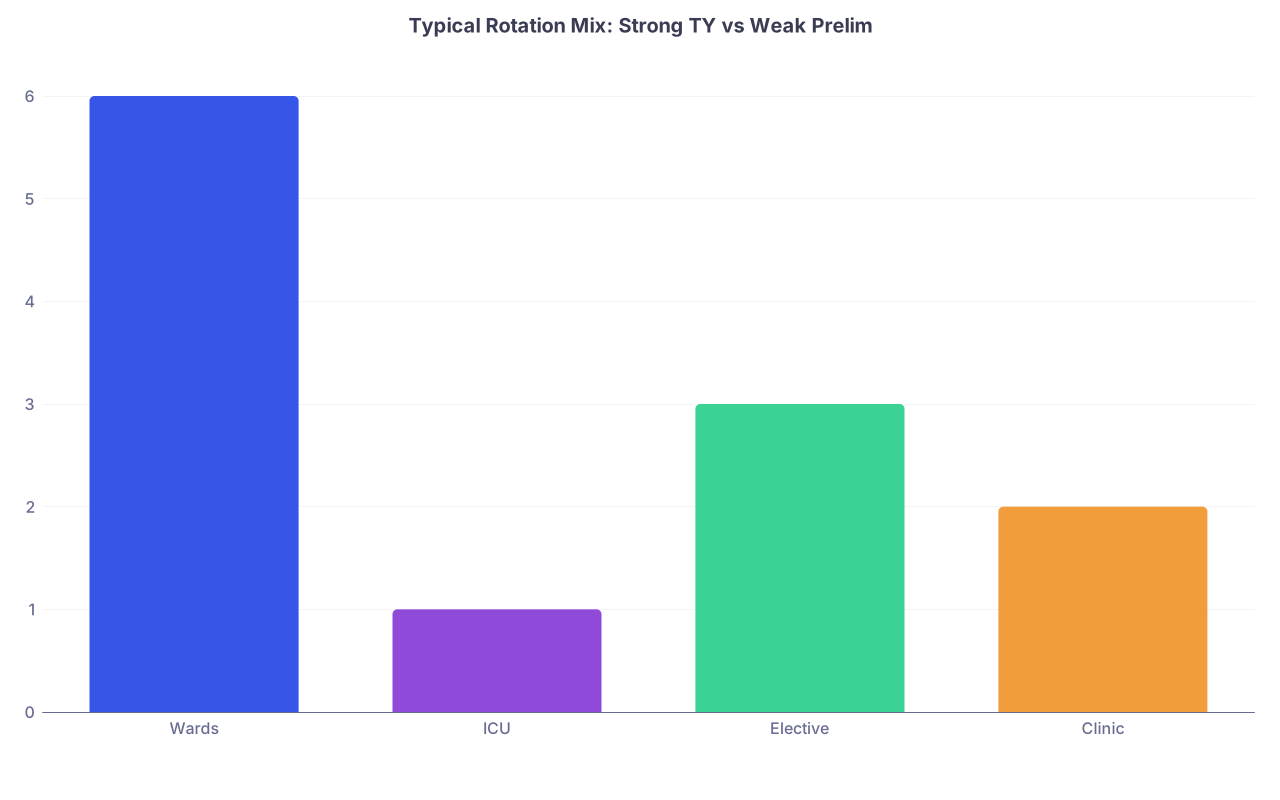
| Category | Value |
|---|---|
| Wards | 6 |
| ICU | 1 |
| Elective | 3 |
| Clinic | 2 |
(Imagine the “weak prelim” version where “Wards” is 9–10 and “Elective” is basically 0. That’s what you’re trying to avoid.)
Red Flag #7: Education in Name Only
Some programs talk a big game about education. But if you listen closely, the signals are bad.
Warning signs:
- Noon conference is technically scheduled…
but interns are constantly “too busy to go” and no one protects them - Morning report is for seniors only
- Simulation sessions are rare or “optional” for prelims
- No feedback structure
- You finish a rotation and literally no one sits down with you
You want to hear:
- “Interns are expected to attend noon conference; seniors cover the pagers.”
- “We track conference attendance and ask why if someone is consistently missing.”
- “Prelims participate in all M&Ms, grand rounds, and sim.”
If they tell you “we don’t really track” or “it just depends on the attending,” what they mean is: Service comes first, teaching when convenient. And for prelims, teaching is almost never “convenient.”
Red Flag #8: Sketchy Attrition and Replacement Behavior
You know those programs where residents mysteriously “resign” every year? That’s not random.
Ask this, out loud:
- “Did you have any residents leave the program in the last 2–3 years?”
- “Were any prelims unable to finish the year?”
- “Do you routinely fill mid-year spots?”
Listen very carefully.
If you hear:
- “We had a couple leaves but it was all personal” (with weird facial expressions)
- “Some people realized medicine wasn’t for them” repeated every year
- “We usually backfill with another prelim mid-year”
That’s a neon sign: something is off. Burnout, bullying, gaslighting, unsafe workload — pick your poison.
Strong programs will say things like:
- “We had one resident leave for family reasons; otherwise, people complete the year.”
- “We rarely have mid-year replacement spots; it’s unusual for anyone to leave.”
If they’re flipping through slides to remember how many people left, that’s your answer. They lose people regularly.
Red Flag #9: “We Don’t Offer Categorical Spots to Prelims…Ever”
Some people want a prelim that might convert to categorical. Others don’t care.
But here’s the dangerous mindset:
“I’ll do a prelim here and maybe they’ll keep me on if they like me.”
At some programs, that’s fantasy. They never convert prelims. Or they convert exactly one every 5 years when they accidentally under-recruit.
Ask directly:
- “Do prelims ever transition into categorical positions here?”
- “In the last 5 years, how many prelims have become categoricals?”
- “Is there a formal process for that, or is it ad hoc?”
Green:
- “Yes, one or two every year, depending on openings; the process is transparent.”
Yellow:
- “It’s rare but has happened once or twice. No formal path.”
Red:
- “No, prelims are strictly 1‑year only. We never keep anyone.”
If you absolutely must have the possibility of staying, do not rank programs that speak in absolutes about never converting.

Red Flag #10: Location Hype Covering Up Structural Problems
“I want to be in New York/LA/Chicago/Boston” has ruined a lot of prelim years.
Programs in desirable cities know you’re desperate. Some of them abuse that.
Common pattern:
- Website looks gorgeous
- City branding everywhere
- But:
- No specifics on prelim curriculum
- No clear list of prelim outcomes
- Vague about call schedules
- Residents look exhausted on interview day
Don’t get seduced by zip codes. Geography does not fix:
- Being unprotected when attendings scream at you
- 28 in a row on nights
- Missing every interview you begged for because “the schedule is too tight”
Look for city + structure. Not city vs structure.
Red Flag #11: No Backup Plan If You Don’t Match Again
This one is painful but real.
What if:
- You’re using this prelim year to reapply
- You don’t match again
What then?
At some places, the answer is:
“Good luck, thanks for your service. Door’s that way.”
You want to hear:
- “If a prelim doesn’t match into their target specialty, we:
- Help them apply to categorical IM/Surg/other spots
- Make calls
- Sometimes absorb them into our own categorical track if there’s capacity.”
If the answer is “we don’t really stay in touch with prelims after the year,” that should terrify you. That means you’re disposable.
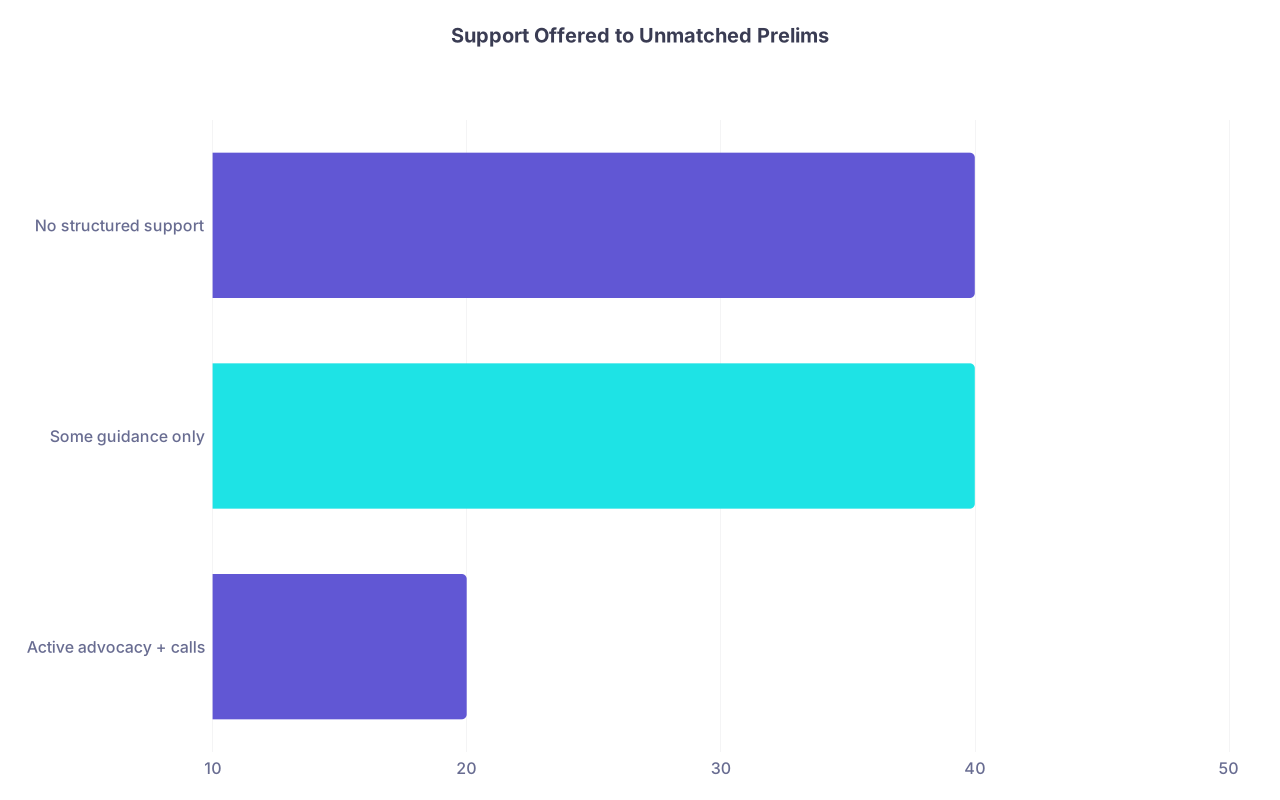
| Category | Value |
|---|---|
| Active advocacy + calls | 20 |
| Some guidance only | 40 |
| No structured support | 40 |
(Those numbers aren’t literal data; they represent what I keep seeing anecdotally: far too many programs in that last category.)
How to Actually Protect Yourself When You Rank
Let’s turn this from doom-listing into something you can use this week.
1. Build a ruthless question list
Before any interview or virtual meet-and-greet, have these written out:
- Where have your prelims gone in the last 3 years?
- How many elective months do prelims get, and when?
- How is interview time handled for prelims?
- Are prelims integrated with categoricals for education and social events?
- How many residents (especially prelims) have left early in the last 3 years?
- Do prelims ever convert to categorical here? How often?
- What happens if a prelim fails to match into their desired specialty?
If they dodge, minimize, or “don’t have that info,” that is your answer.
2. Talk to current prelims directly
Not just the handpicked happy ones.
Email the chief and say:
- “Could I get contact info for 1–2 current prelims to ask a few questions about their experience?”
Red flag if they only give you a PGY‑3 categorical who “used to be prelim” five years ago. You want the people stuck in the grind this year.
Ask them:
- “What surprised you in a bad way?”
- “If you could redo your rank list, where would this program fall now?”
- “How many interviews did you realistically get time off for?”
You’ll get more honesty in 10 minutes with a prelim than in 3 hours of curated interview day PR.
3. Don’t over-rank a “shiny” prelim that will wreck you
The worst mistake:
Ranking a prestigious-name prelim over a supportive mid-tier program that actually:
- Teaches you
- Protects your time
- Advocates for your future
Name helps. But one year of abuse and zero support can set your career back more than you think.
I have seen:
- An IMG with a 250+ Step 2 crushed in a malignant prelim → failed to reapply successfully because they had no letters and no interview time
- A Derm-bound student stuck in a “top hospital” medicine prelim where no one cared about their reapplication → ended up doing a 2nd prelim somewhere else
Don’t do that to yourself.
One Thing You Should Do Today
Open your rank list draft and pick one prelim program you’re not sure about.
Then do this:
- Go to their website and look for any specific data about:
- Recent prelim destinations
- Sample prelim schedule
- If you don’t find hard numbers, email the coordinator or PD today and ask:
- “Could you share where your prelims have matched in the last 3 years?”
- “Could I see a sample schedule for a current prelim resident?”
If they respond clearly and transparently, great — you’ve learned something real.
If they don’t respond, or send fluff with no data, move that program down your rank list.
Do not wait for March to realize you ignored the red flags. Catch them now, while you still have a choice.