
The most expensive residency mistake is not a bad Step score. It is a bad rank list.
Applicants routinely lose the program, the city, and even the specialty they wanted because they misunderstood how preliminary vs categorical spots work. Not because they were weak candidates. Because they ranked wrong.
Let me walk you through the traps that burn people every year.
1. Misunderstanding What a Preliminary Year Actually Is
Start with the basic distinction. Get this wrong, and everything that follows will be off.
A categorical position is a full residency track in one specialty at one program. For example:
- Categorical Internal Medicine (PGY1–3)
- Categorical General Surgery (PGY1–5)
- Categorical Neurology (often starts PGY2 but includes the linked prelim year if “advanced categorical”)
A preliminary position is usually a one-year training slot. Typically PGY1 only. It does not guarantee training beyond that year.
Common prelim types:
- Prelim medicine (often used before neurology, anesthesia, radiology)
- Prelim surgery (often before radiology, anesthesia, urology, ophthalmology)
- Transitional year (broad, cushier, often preferred before competitive advanced fields)
Here is where applicants quietly damage themselves: they treat prelim years as “just PGY1 wherever, I’ll figure out the rest later.” That mindset is wrong and dangerous.
You must never forget this:
A prelim year alone does not give you a complete residency. It is not a safety version of categorical. It is a different category of job.
| Feature | Preliminary (Prelim/TY) | Categorical |
|---|---|---|
| Length | 1 year (PGY1) | 3–7 years |
| Guarantees full training in a specialty | No | Yes |
| Requires separate match for advanced spot | Usually | No (except some “advanced categorical” setups) |
| Common linked to | Anesthesia, Radiology, Neuro, Derm | IM, Peds, FM, Surgery, EM |
The most basic but devastating error: ranking a prelim spot high without having a realistic, backed-up plan for the advanced or categorical specialty that will follow.
2. Confusing “Preliminary” with “Backup Categorical”
I have seen this exact conversation:
“I really want categorical IM at a big academic center, but I am worried. So I ranked some prelim medicine spots and a separate advanced Radiology program as a backup.”
That is not a backup. That is two different careers, loosely connected by one chaotic year.
Here is the trap:
- You think: “If I do not match categorical IM, at least I have a prelim. Then I can get into something.”
- Match reality: You might end up with only a prelim year and no advanced spot. After that year, you must reapply into a tight, often saturated market as a PGY2-seeking applicant.
Do not confuse these:
- Backup within the same field: Ranking more categorical IM programs at community hospitals, less prestigious places, different cities.
- Different path requiring a separate match: Prelim medicine + advanced Radiology → that is not backup IM. That is choosing Radiology over IM if that is what matches.
If you truly want categorical Internal Medicine as your main path, your backup is:
- More categorical IM programs (including community, less competitive, geographic compromises)
- Possibly categorical Family Medicine or combined Medicine-Psych, if you would genuinely accept that outcome
Your backup is not:
- Prelim medicine + no solid advanced plan
- Transitional year + hope
Do not list prelim-only combinations above categorical positions in the specialty you actually want, unless you understand you are literally choosing that alternate path over the categorical option.
3. Not Understanding How the NRMP Handles Advanced + Prelim
The NRMP algorithm is applicant-favoring. But only if you use it correctly.
For advanced specialties (Radiology, Anesthesia, Derm, PM&R, some Neurology, etc.), you will rank:
- An advanced position (starts at PGY2), and
- A separate prelim/TY for PGY1
If available, you can create “supplemental rank lists” linking advanced positions to prelims. This is where people mess up royally.
Common mistakes:
Not creating a supplemental list at all
Result: You match an advanced position but have no associated prelim year in that city (or at all).Creating only “dream” prelims with no realistic options
Result: You match Radiology PGY2 in Hot City Academic, but you did not link or rank the reasonable prelim in an unsexy community program nearby. So you end up with Radiology PGY2 and are scrambling to find any PGY1 spot via SOAP or off-cycle.Ranking unsupported geographic combos
Example: You rank advanced Anesthesia in New York with only California prelims on the linked list. You match Anesthesia in NY, but the algorithm cannot pair it with a prelim in CA. Those are separate jobs, separate systems, not a jointly negotiated package.
You must remember: the system is not a human committee gently hand-placing you. It is an algorithm. It will match you into absurd combinations if that is what your rank list mathematically asks for.

| Step | Description |
|---|---|
| Step 1 | Rank advanced positions |
| Step 2 | Create supplemental list |
| Step 3 | Risk unmatched prelim year |
| Step 4 | Advanced and prelim paired |
| Step 5 | Full training path secured |
| Step 6 | SOAP scramble or reapply |
| Step 7 | Supplemental list complete |
If you are applying to an advanced specialty, you cannot treat prelim ranking as an afterthought. It is integral to whether your “match” actually leads to a coherent training path.
4. Ranking “Any Prelim Anywhere” Above Unpopular but Solid Categorical Roles
The prestige trap hits hardest here.
I have seen applicants rank:
- Transitional year in a glamorous city
- Prelim medicine at a big-name academic center
- Advanced Radiology at the same city
- Only then, categorical Internal Medicine at a smaller community hospital that actually liked them and would train them fully
They think they are “keeping options open.” They are not. They are choosing:
- A one-year job with no guaranteed continuation
over - A full multi-year categorical residency that lines them up for board eligibility
Here is the mental error: equating brand name and location with long-term career security.
Programs know this. Some big-name places crank through prelims with minimal interest in your long-term path. You are cheap, smart labor. They will not necessarily help you find a PGY2, especially if you are just “one of 22 prelims” they will replace next year.
Be very suspicious of:
- Programs that clearly advertise prelims as scut-heavy with little mentorship
- Locations where advanced specialty spots are limited, but prelim positions are abundant
- A rank list where almost all your top choices are PGY1-only roles
If you actually want to be an internist, pediatrician, surgeon, or family doctor, then a solid categorical spot at a non-fancy institution is usually safer—and often better for your life—than a prestigious but terminal transitional year.
5. Overestimating How Easy It Will Be to “Find a PGY2 Later”
This is the comforting story people tell themselves:
“If I just get any prelim year, then I can work hard, make connections, and easily slide into a PGY2 spot somewhere. Programs always need warm bodies.”
Dangerous myth.
The reality:
- PGY2 openings are irregular and often due to bad reasons:
- Residents fired or quitting
- Programs losing accreditation
- Funding issues
- Many open PGY2 spots want very specific backgrounds (surgical prelim vs medicine prelim, etc.)
- You will be competing against:
- People who matched PGY2 already and just need transfer
- International graduates with multiple years of experience
- Other desperate prelims
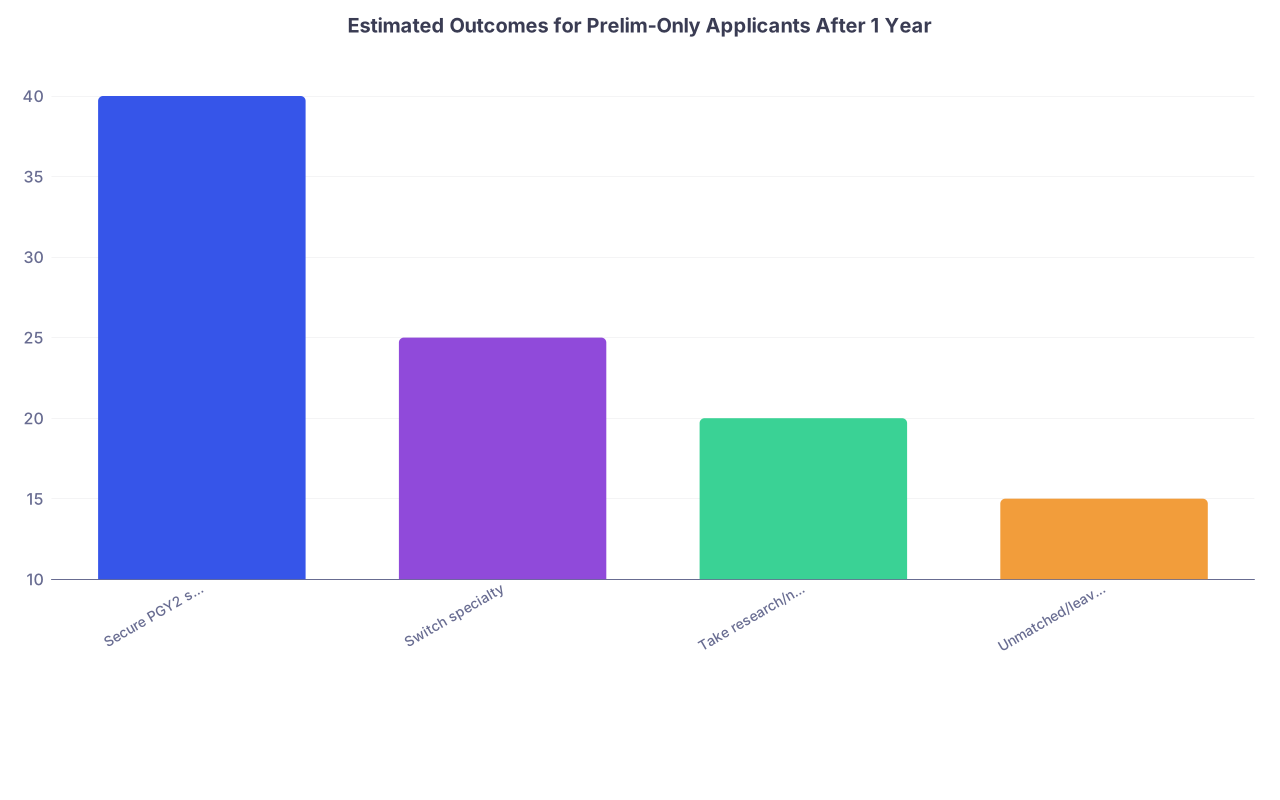
| Category | Value |
|---|---|
| Secure PGY2 same specialty | 40 |
| Switch specialty | 25 |
| Take research/non-clinical gap | 20 |
| Unmatched/leave training | 15 |
These numbers are illustrative, not an official dataset, but they match what I have repeatedly seen and heard from program directors: some prelims land smoothly, many struggle, and a nontrivial fraction end up in limbo.
You absolutely may make it work. Many do. But do not build your rank list on the assumption that “I will obviously pick up a PGY2 somewhere.” That is like planning your finances on lottery winnings.
If you are ranking prelim spots high without a matched advanced position, you are choosing to accept this uncertainty.
6. Ignoring Lifestyle and Workload Differences Between Prelim Types
Another subtle error: believing all prelim years are interchangeable.
They are not.
- Prelim surgery: Often brutal workload, heavy call, lots of scut. Great if you are heading into surgical fields and need operative exposure. Misery if you are ultimately planning Radiology and just need basic clinical time.
- Prelim medicine: Variable. Can be solid training, but some programs clearly prioritize their categorical residents and leave prelims last for opportunities.
- Transitional year (TY): Often easier, more electives, less call. Very popular with Radiology, Derm, Anesthesia, PM&R applicants.
The mistake: ranking a punishing prelim that does not align with your future specialty goals, solely because it is at a famous institution or in a cool city.
Ask yourself:
If my advanced specialty fell through, would I want to be here for categorical?
If the answer is a hard no, why are you ranking it above a full categorical option you could live with?Does this prelim year give me useful skills for where I am headed, or is it just 80 hours a week of unrelated suffering for a name brand?
Do not sacrifice your long-term trajectory to a prestige badge for 12 months.
7. Failing to Build a Coherent, Redundant Rank Strategy
Your rank list should tell a clear story about your priorities. Too many applicants end up with a Frankenstein list that reflects panic, ego, and last-minute edits more than a coherent plan.
For someone between categorical and prelim-heavy paths, a “protected” strategy might look like:
- Top section: Categorical positions in your primary desired specialty
- Middle section: Categorical positions in your genuine backup specialty (if you have one)
- Lower section: Advanced + prelim combinations for your alternate high-prestige specialty, but only if you understand you would truly accept those outcomes over the categorical backups above
The mistake is when the list looks like this:
1–4: Advanced Radiology at top programs with no realistic supplemented prelim lists
5–8: Transitional years in fun cities
9: One or two categorical IM programs added at the last minute “just in case”
This structure practically begs for:
- Matching a one-year job with no long-term clarity
- Or worse, ending up unmatched from everything except a prelim medicine slot that was tossed in haphazardly
Build layers. Decide what you would rather be:
- A full trained internist in a modest city
- Or someone who did a glamorous transitional year and then scrambled for a PGY2
There is no universal right answer. There is only the wrong answer: refusing to choose and letting the algorithm choose for you.
8. Not Talking to the Right People Before Certifying Your List
Too many people create rank lists in isolation:
- They listen mostly to co-applicants, who are just as confused
- They read random anonymous Reddit threads
- They treat NRMP as an abstract math puzzle instead of a real employment contract
You should get grounded feedback from:
- A program director or associate program director in your specialty
- A trusted faculty mentor who understands the match mechanics
- Recent grads who did exactly what you are trying to do (e.g., prelim → Radiology, or categorical IM vs prelim plan that went wrong)
Red flags in advice you should ignore:
- “Just rank the most prestigious at the top; it always works out.”
- “You can always pick up a PGY2 later, programs are desperate.”
- “Prelim is fine as a backup for anything; at least you are in the system.”
These are not strategies. They are rationalizations.
Before you certify your list, you should be able to explain, out loud, to someone savvy:
- Why each prelim is ranked where it is
- How each advanced position is properly paired with prelim options
- Which outcome you would consider a true failure—and how you have minimized that probability
If you cannot explain that, your rank list is not ready.
FAQ: Common Panic Questions About Prelim vs Categorical Ranking
1. If I rank a prelim + advanced combo above a categorical spot, am I really choosing that over a full residency?
Yes. The algorithm will try to match you to the highest-ranked spot where a job is available and you are acceptable. If that is a prelim + advanced Radiology combination ranked above a categorical IM position, you are explicitly saying: “I prefer this path to a full IM residency.” Do not put it higher unless you truly mean it.
2. I matched to an advanced position but not a prelim. Did I make a mistake on my list?
Probably. Either you did not create a supplemental list, you ranked only unrealistic prelims (overly competitive or geographically incompatible), or you did not include a “safety” prelim that almost everyone can match. This is a classic technical mistake that forces you into SOAP chaos or delayed start. It usually is preventable with a carefully constructed supplemental rank list.
3. Is it ever smart to use a prelim year as a planned “reapply” strategy?
Sometimes, but it is inherently risky. If you are going to do it, you must:
- Choose a prelim where faculty actually support reapplicants
- Accept the real possibility of not matching into your target specialty even after the prelim
- Rank categorical backups somewhere on your list so you are not left with only a one-year job
What you must not do is treat a prelim plan as a guaranteed stepping stone. It is a bet. Make it with your eyes open.
Key Takeaways
- A prelim year is a one-year job, not a soft version of categorical. Do not rank it as a “backup” to a full residency without understanding the risk.
- The NRMP will give you exactly what your rank list implies you want—even if that is a badly mismatched prelim + advanced combo or a lonely PGY1 with no future.
- A lower-status but solid categorical position is often safer and smarter than a prestigious but terminal prelim year, unless your rank list clearly reflects a deliberate, informed risk you are willing to own.