
The most dangerous rank lists are written by people who think they understand prelim and transitional years—but don’t.
If you’re mixing transitional year (TY) and preliminary (prelim) programs on your rank list, you’re walking through a minefield. The Match algorithm is not out to get you, but it does not forgive sloppy strategy. I’ve watched smart applicants end up unmatched to an advanced spot, stuck with a prelim they never wanted, or scrambling post‑Match because they misunderstood how these pieces fit together.
Let’s keep you out of that mess.
The Core Concept People Get Wrong
Here’s the blunt version:
You are not applying to “a prelim year.” You are applying to two different things that talk to the NRMP in different ways:
- An advanced program (like radiology, anesthesia, derm, PM&R, neuro) that starts PGY‑2
- A one‑year program (prelim or transitional) that fills your PGY‑1
They are linked by supplemental rank order lists (SROLs), not by wishful thinking. If you screw up that linkage—or misunderstand what each type of PGY‑1 year actually offers—you can:
- Match an advanced program with no PGY‑1 spot
- Match a PGY‑1 spot with no advanced program
- Match a miserable prelim year when you had better options (but ranked them wrong)
- Or, worst of all, go completely unmatched while having “wasted” interviews
You avoid those outcomes by understanding what prelim vs transitional actually are and exactly how to rank them.
Prelim vs Transitional: The Differences That Actually Matter
Stop thinking of this as “easy year vs hard year.” That’s shallow and often wrong. The key differences are:
Transitional Year (TY)
Usually:
- Mix of medicine, surgery, ER, electives
- Often more electives, more outpatient
- Lifestyle often better (though not always)
- Popular with applicants going into rads, derm, ophtho, anesthesia, PM&R
- Some TYs are extremely competitive and academic; some are chill community programs
The typical trap:
People romanticize TY as “a vacation year” and chase any program with “transitional” in the name without checking workload, call schedule, or whether it actually lines up with what their advanced program expects.
Preliminary Year
Usually either:
- Prelim Medicine – rotations heavier in inpatient medicine, wards, ICU
- Prelim Surgery – surgical services, often brutal hours, lots of scut
- Sometimes prelim years attached to big academic programs are essentially service work
The typical trap:
Assuming “I’ll just do any prelim, it’s just one year.” Bad call. A malignant prelim will wreck your mental health and make PGY‑2 unnecessarily miserable. Or you end up in a surg prelim when your advanced specialty wanted strong internal medicine exposure.
Here’s how they stack up in a clean snapshot:
| Feature | Transitional Year (TY) | Preliminary Year (Prelim) |
|---|---|---|
| Structure | Mixed rotations, more electives | Focused (medicine or surgery) |
| Lifestyle (typical) | Often lighter | Often heavier |
| Competitiveness | High at popular sites | Varies widely |
| Best for | Rads, Derm, Anesthesia, Ophtho, PM&R | Specialties needing strong IM or surg base |
| Flexibility | More | Less |
The mistake isn’t choosing one over the other. The mistake is choosing blindly—or ranking them as if all TYs are the same and all prelims are the same.
How the Match Actually Handles Mixed TY/Prelim Ranking
This is where people quietly ruin their futures with one stupid spreadsheet.
You basically operate in two layers:
Your primary rank list
- Categorical programs (start at PGY‑1 and go through residency, e.g., categorical IM, general surgery)
- Advanced programs (PGY‑2 start, e.g., diagnostic radiology, anesthesiology, PM&R, neurology in many places)
Supplemental rank lists (SROLs) attached to each advanced program
- For each advanced program you rank, you can create a separate list of PGY‑1 options (TY and/or prelim) you’d accept only if you match that advanced program.
So:
- You rank advanced programs on your main list.
- Under each advanced program, you attach a mini‑list of TY/prelims in order of preference.
- The algorithm tries to match:
First: you to an advanced program on your primary list
Then: if you match an advanced spot, it searches its attached SROL to find a PGY‑1 match.
The deadly misunderstanding:
Thinking that ranking a TY/prelim on your main list “covers” that PGY‑1 for your advanced programs. It doesn’t. If you want a specific TY linked to a specific advanced program, it must appear on that advanced program’s supplemental list, not just somewhere on your primary list.
Classic Ranking Strategy Mistakes When Mixing TY and Prelim
Let me walk through the exact patterns that burn people every year.
1. Ranking Categorical Programs Below Advanced + Weak PGY‑1 Options
Scenario I’ve seen:
Student wants radiology. They have:
- A solid categorical internal medicine offer
- A decent radiology advanced offer
- A horror‑story prelim surgery year at a malignant program
- One dream TY they’re not that competitive for
They rank like this:
- Rads Advanced – Dream City
- Rads Advanced – Mid City
- IM Categorical – Home Program
But on the SROL for Rads – Dream City, they rank:
- Dream TY only
- (and that’s it)
And on SROL for Rads – Mid City, they rank:
- Malignant Prelim Surg
What can happen?
- They don’t match Dream TY
- They do match Rads – Dream City but have no PGY‑1 available on that SROL → they might not match that program
- Or they match Rads – Mid City + malignant surg prelim
- Meanwhile, the perfectly reasonable IM categorical option is sitting as a distant backup that the algorithm never reaches because they got pulled into a bad advanced+prelim combo earlier
The smarter approach:
- Decide: would you rather do good categorical IM than bad advanced+toxic prelim?
If yes, rank the categorical IM above that advanced option paired with the malignant prelim. - Make sure each advanced program’s SROL includes all PGY‑1 options you’d actually accept in realistic order, not just your fantasy TY.
2. Mixing “Any Prelim Anywhere” Without Thinking About Geography
Huge, painful mistake. I’ve seen applicants accept the idea of doing a prelim on one coast and their advanced program on the other because they thought, “It’s just a year.”
Then life happens. Partner, family, fatigue, moving expenses. It’s brutal.
Don’t blindly fill SROLs like this:
- Advanced Rads – West Coast:
- TY Midwest
- Prelim Med East Coast
- Prelim Surg South
You just told the algorithm:
“If I match this West Coast rads program, I’m okay flying around the entire country for one year before PGY‑2.”
If that’s not actually true, don’t rank like it’s true.
You should:
- Group TY/prelims by regions you can live with
- Be honest: are you really okay moving twice in 2 years cross‑country? Or would you rather take a slightly less “prestigious” advanced program with local PGY‑1?
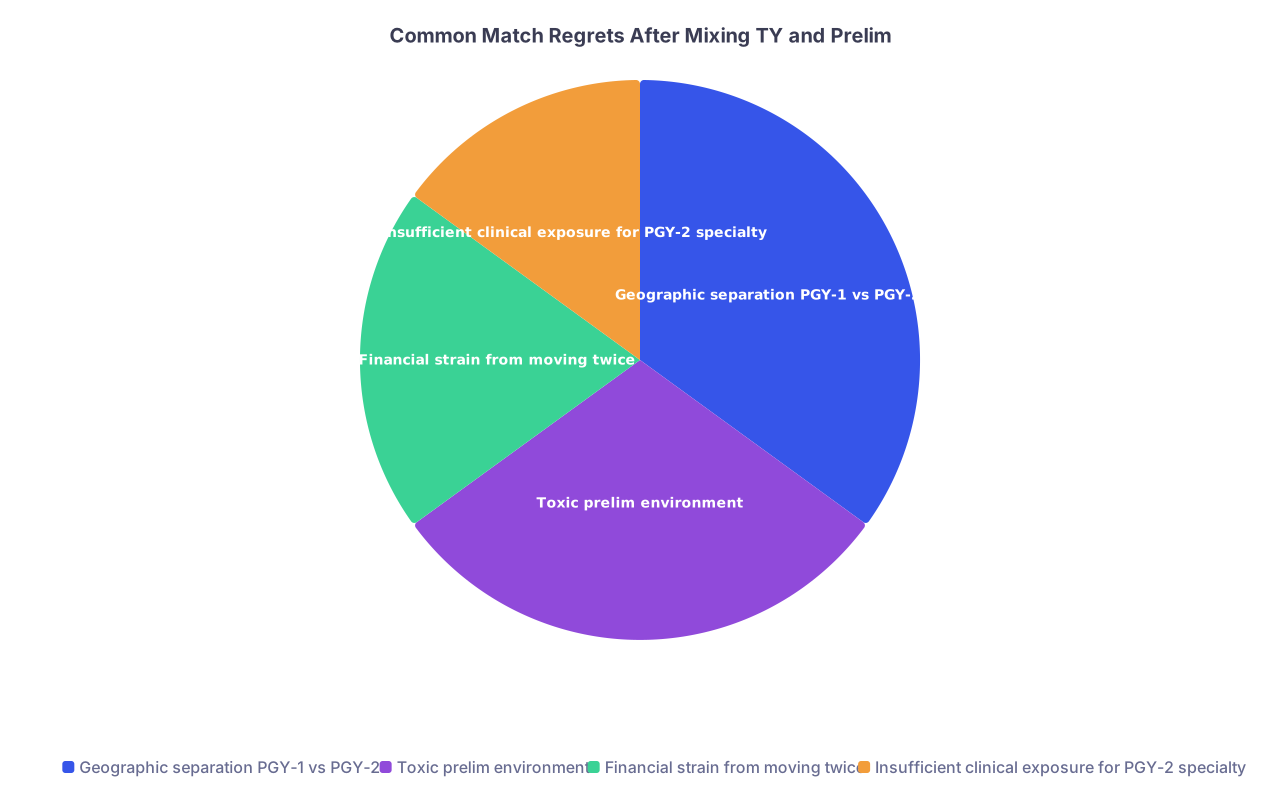
| Category | Value |
|---|---|
| Geographic separation PGY-1 vs PGY-2 | 35 |
| Toxic prelim environment | 30 |
| Financial strain from moving twice | 20 |
| Insufficient clinical exposure for PGY-2 specialty | 15 |
3. Ranking Prelim Surgery When You Don’t Need Surgery
For anesthesiology, radiology, derm, PM&R, etc., a medicine‑heavy prelim or TY is usually more appropriate than a punishing surg prelim. Yet every year, I see applicants rank prelim surgery spots simply because they interviewed there and “wanted more options.”
Reality check:
- Surg prelims are often service work, night float, floor scut
- Not designed around continuity clinic, broad medicine, or the kind of exposure your advanced speciality needs
- Can destroy your bandwidth for Step 3, research, or board prep
If you don’t need surgery for your PGY‑2 field, be very cautious about ranking any surgical prelim above:
- Reasonable medicine prelims
- Reasonable transitional years
- Or even categorical programs in a nearby field you’d actually be okay doing if things go sideways
4. Assuming All Transitional Years Are Cushy
Another fantasy story: “TY = chill, more time to travel, study, enjoy life.”
Not always. I can name specific TYs where interns are essentially medicine residents with extra clinic thrown in, plus call. Schedule: brutal. Support: minimal.
The mistake:
Ranking any program with “transitional” in the title above better‑structured prelim medicine years without:
- Checking call schedule
- Number of inpatient months
- ICU exposure
- Clinic load
- Resident feedback
I’ve seen a “chill” community TY turn out to be a disorganized mess with zero education and constant staffing shortages. Meanwhile, the nearby academic prelim medicine program had strong teaching, sane schedules, and happier residents—but it got ranked lower because “TY sounds lighter.”
Don’t rank on the label. Rank on the reality.
How to Build a Sane Ranking Strategy When You’re Mixing TY and Prelim
Here’s the part where we prevent the disaster.
Step 1: Decide Your Non‑Negotiables
You need a simple hierarchy before you touch the NRMP interface. For example:
Would you rather:
- Match a strong categorical backup (like IM) OR
- Take a risk on an advanced specialty plus a really risky prelim/TY?
How far are you truly willing to move for one year only?
Are there any settings you refuse outright?
Examples: No malignant surgery prelims, no ICU‑heavy prelim if you’re already on the edge burnout‑wise.
Write this out. Literally. On paper.
Step 2: Rank Categorical Programs First, Honestly
Most people under‑value their categorical backups. That’s a mistake.
On your primary rank list:
- Put your dream advanced programs high, yes
- But do not bury a categorical program you’d actually be okay with so far down that you end up matched to a worse advanced+PGY‑1 combo by accident
Example of a smarter main list:
- Derm Advanced – Program A
- Derm Advanced – Program B
- Categorical IM – Strong academic program you like
- Derm Advanced – Program C (only paired with prelims you’re not thrilled about)
- Categorical IM – Decent community program
This way, the algorithm knows:
You prefer Programs A/B in derm, but you would choose a good categorical IM over a sketchy derm + terrible prelim scenario.
Step 3: Build Clean Supplemental Lists for EACH Advanced Program
For every advanced program you rank, you’ll create an SROL that might look like:
For Rads – Big City Academic:
- Local TY – Big City
- Local Prelim Med – Same institution
- Nearby City Prelim Med
- Regional TY – same coast
For Rads – Mid City Community:
- Local Prelim Med
- Nearby small city TY
Notice what’s missing?
No random “prelim surgery in completely different region that I’d hate but I interviewed there so why not.” That’s ranking by fear, not by judgment.

| Step | Description |
|---|---|
| Step 1 | List all programs |
| Step 2 | Decide non negotiables |
| Step 3 | Rank categorical programs |
| Step 4 | Rank advanced programs |
| Step 5 | Create SROL for each advanced |
| Step 6 | Check for conflicts and bad combos |
| Step 7 | Finalize rank list |
Step 4: Sanity‑Check Combos You Might Accidentally Create
Ask yourself for each advanced program + SROL:
- If I match this exact pair (Advanced X + PGY‑1 Y), am I happy enough?
- Would I honestly prefer a solid categorical spot instead?
If yes, then that categorical program needs to be ranked above that advanced program on your main list.
You’re not ranking programs in a vacuum. You’re ranking lives you’ll actually live.
Hidden Pitfalls Almost No One Warns You About
A few under‑the‑radar traps:
The “Orphaned” Advanced Program
You rank an advanced program but forget or screw up its SROL (too short, too unrealistic). You technically match into the advanced spot but don’t land a PGY‑1 that year.
Outcome?
You might be forced into scrambling for a prelim/TY in SOAP or even delaying PGY‑2. That’s avoidable.
Your rule:
If you rank an advanced program, its SROL must be:
- Complete
- Realistic
- Reflecting options you’d genuinely attend
Over‑stacking Impossible TYs
If you’re an average applicant, ranking a bunch of top‑tier, hyper‑competitive TYs first is fantasy strategy.
I’m talking about:
- Top coastal academic TYs in saturated cities
- Programs that historically match from their own med school + high‑scoring candidates only
You can still rank them. Just do not make your first 4 SROL slots nothing but “reach” TYs. Mix:
- A couple reach TYs
- Then realistic TYs/prelims you are actually likely to match
- Then your true floor (lowest you’d accept)
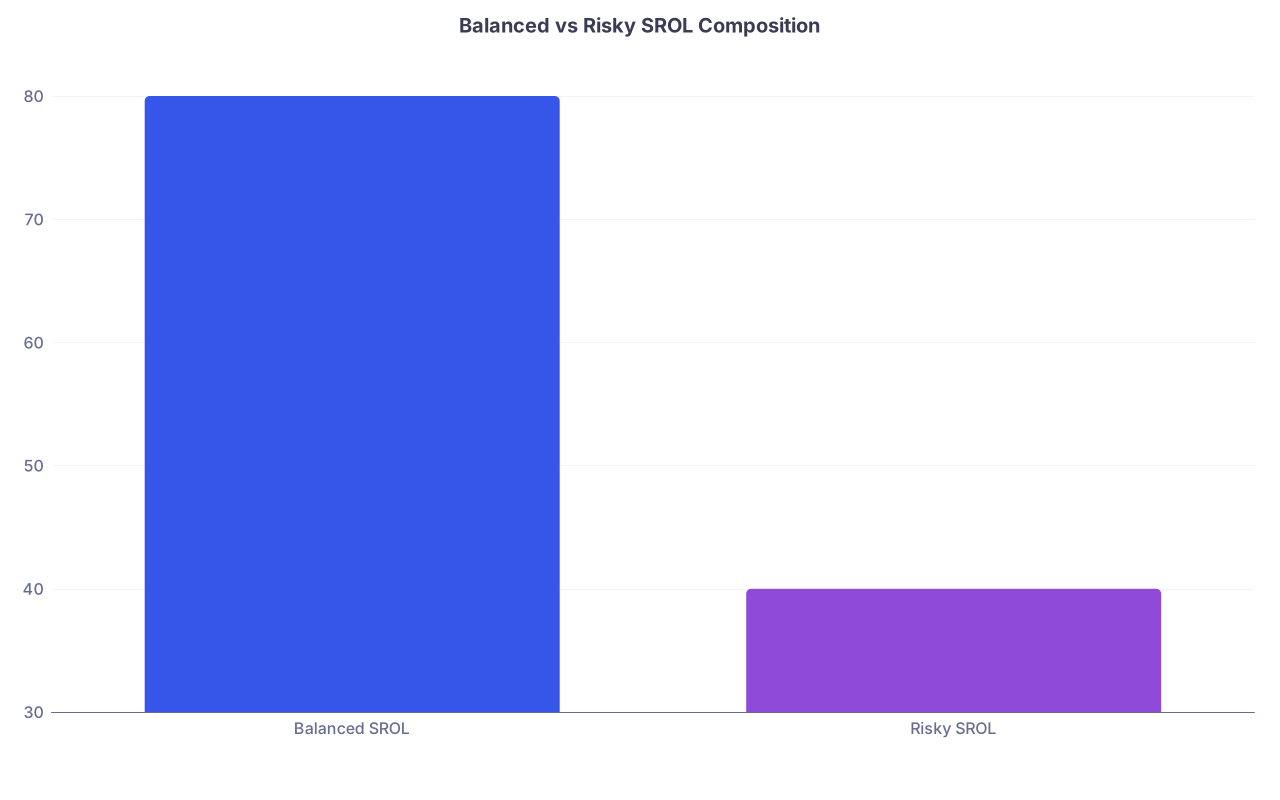
| Category | Value |
|---|---|
| Balanced SROL | 80 |
| Risky SROL | 40 |
(Think of those numbers as “likelihood that at least one SROL option is realistically matchable.” Balanced lists win.)
Misalignment With Your Advanced Specialty
Some advanced programs care what your PGY‑1 looks like. For example:
- Certain neurology or PM&R programs prefer a solid IM prelim or a particular mix of rotations
- Some anesthesia programs want more ICU exposure
- Some rads programs are fine with almost any decent TY, others want strong medicine
You don’t want to show up PGY‑2 with a year of scattered outpatient electives and almost no inpatient experience when your residency needs you to hit the ground running.
Before ranking:
- Ask current residents what kinds of PGY‑1 backgrounds are common at that program
- Make sure your top TY/prelim choices align with this
Quick Example: Good vs Bad Mixed Strategy
Let’s make this concrete.
Bad Strategy
Student wants anesthesia. They have:
- 3 anesthesia advanced interviews
- 1 awesome IM categorical
- 5 PGY‑1 options: 2 dreamy TYs, 1 surg prelim, 2 solid IM prelims
They:
- Rank all 3 advanced anesthesia programs highest on main list
- Attach SROL with both dream TYs, then surg prelim, and forget to list the IM prelims
- Rank the categorical IM way down “just in case”
Risk:
- Don’t match any TY (too competitive)
- Match anesthesia advanced with only the surg prelim left → brutal year
- Or fail to match a PGY‑1 at all for that advanced spot
- Lose out on excellent categorical IM spot they’d actually prefer over toxic prelim
Better Strategy
Main list:
- Anesthesia Advanced – Program A
- Anesthesia Advanced – Program B
- Categorical IM – Strong academic
- Anesthesia Advanced – Program C
SROLs for anesthesia:
Program A:
- Dream TY 1
- Solid IM prelim 1
- Solid IM prelim 2
- Dream TY 2
Program B:
- Solid IM prelim 1
- Dream TY 1
- Solid IM prelim 2
Program C:
- Solid IM prelim 2
Notice:
- Categorical program is high enough that they avoid a bad advanced+PGY‑1 combo
- Solid IM prelims are not forgotten; they’re placed where they realistically belong
- Surg prelim is not on any list because they decided it’s below their minimum acceptable threshold
That’s what protecting your future looks like.
FAQ (Exactly 4 Questions)
1. Can I rank the same transitional or prelim program on multiple supplemental lists?
Yes, and you should if you’d accept it with more than one advanced program. If TY Awesome City would work for both your rads and your anesthesia advanced spots, list it on both SROLs. The algorithm will sort out which combination is highest on your priorities. Just be consistent: if you wouldn’t actually attend that PGY‑1 with a specific advanced program (due to geography, cost, or culture), don’t list it there.
2. Should I rank a “bad” prelim year just to avoid going unmatched?
Only if you’re genuinely willing to work there for a year. Ranking a malignant or unsafe program “just to have more lines” is a trap. If you rank it and the algorithm lands there, you go there. If you’d honestly rather reapply, SOAP, or pivot to a categorical backup than spend a year miserable or unsafe, do not rank that program. Your rank list is a contract with your future self.
3. Do I need both a TY and a prelim if I’m applying to advanced programs?
No. You just need some PGY‑1 positions (TY and/or prelim) that your advanced programs will accept. You can match an advanced program paired with either a TY or a prelim. The key is alignment: what does your advanced field prefer, what schedule can you handle, and where are you realistically willing to live? Many successful applicants use only prelim medicine, only TYs, or a mix. The mistake is throwing everything on the list without strategy.
4. If I match a categorical program high on my list, can I still match an advanced program?
No. Once you match a categorical program, the Match stops for you. That’s your residency. You can’t simultaneously match a categorical IM and an advanced derm or rads program. That’s why your main rank list has to reflect your true preference order—do you want to prioritize categorical safety or aim higher for advanced spots with carefully built SROLs? Align your list with your actual risk tolerance, not your ego.
Key points:
- Prelim and transitional years are not interchangeable, and the Match won’t fix a sloppy rank list for you.
- Every advanced program you rank needs a realistic, thought‑out supplemental list of TY/prelim choices.
- Never rank a PGY‑1 or advanced+PGY‑1 combo you wouldn’t honestly be willing to live with.