
The fastest way to wreck a perfectly good advanced Match is to get sloppy about your prelim year scheduling.
If you think “Oh, I will just match an advanced program and then grab any prelim spot,” you are already in danger. The system does not protect you from bad combinations. It lets you make disastrous choices—silently.
I have watched smart applicants end up:
- With a 3‑month gap and no paycheck.
- In two different cities with no feasible moving window.
- “Double‑booked” in July on paper and then forced to beg for changes.
- Technically matched but functionally unemployable for several months.
You do not want to be that story people whisper about on orientation day.
This is about pairing a preliminary year (typically TY, prelim medicine, or prelim surgery) with an advanced residency (like radiology, anesthesia, derm, ophtho, PM&R, radiation oncology, neuro, etc.) without falling into the scheduling traps NRMP and programs will not fix for you.
Let me walk through the mistakes that burn people every single year—and how you avoid them.
1. Misunderstanding What a Prelim Year Actually Is
The first trap is conceptual. If you misinterpret what a prelim year is, your scheduling decisions will be garbage.
A preliminary year is:
- A 1‑year position (PGY‑1).
- Often internal medicine, surgery, or a transitional year (TY).
- Meant to satisfy the “clinical base year” requirement before you start an advanced specialty.
It is not:
- Automatically aligned with your advanced program’s schedule.
- Guaranteed to be in the same institution or city.
- Designed with your advanced start date in mind.
| Feature | Preliminary Year | Advanced Program |
|---|---|---|
| Typical PGY Level | PGY-1 | PGY-2 and above |
| Duration | 1 year | 3-5+ years |
| Match Type | Categorical/Prelim | Advanced (starts PGY-2) |
| Start Date | Usually July 1 | Usually July 1 next year |
| Specialty Examples | IM, Surgery, TY | Rads, Anes, Derm, PM&R |
The scheduling catch: both the prelim and advanced slots usually start July 1. Different years, same calendar day. Your prelim runs July 1–June 30. Your advanced starts July 1 of the following year.
That only works if:
- Your prelim truly ends June 30.
- Your advanced truly starts July 1.
- You do not have required orientation that conflicts with end‑of‑year obligations.
Most of the time, it is fine. Until it is not. Which leads to the next trap.
2. Ignoring Orientation and End‑of‑Year Realities
On paper, it looks clean: PGY‑1 ends June 30, PGY‑2 starts July 1. You think, “No problem.”
Here is the problem: programs do not care about your other contracts when they schedule orientation or mandatory sessions.
Common pattern I have seen:
- Advanced program orientation: Last week of June (sometimes June 24–28).
- Prelim program: “No vacations in June; must be on site for sign‑out, finals, or Step‑down call.”
- Result: You are scheduled for inpatient wards at your prelim and told to show up for 4 days of in‑person orientation 500 miles away.
You cannot be in both places.
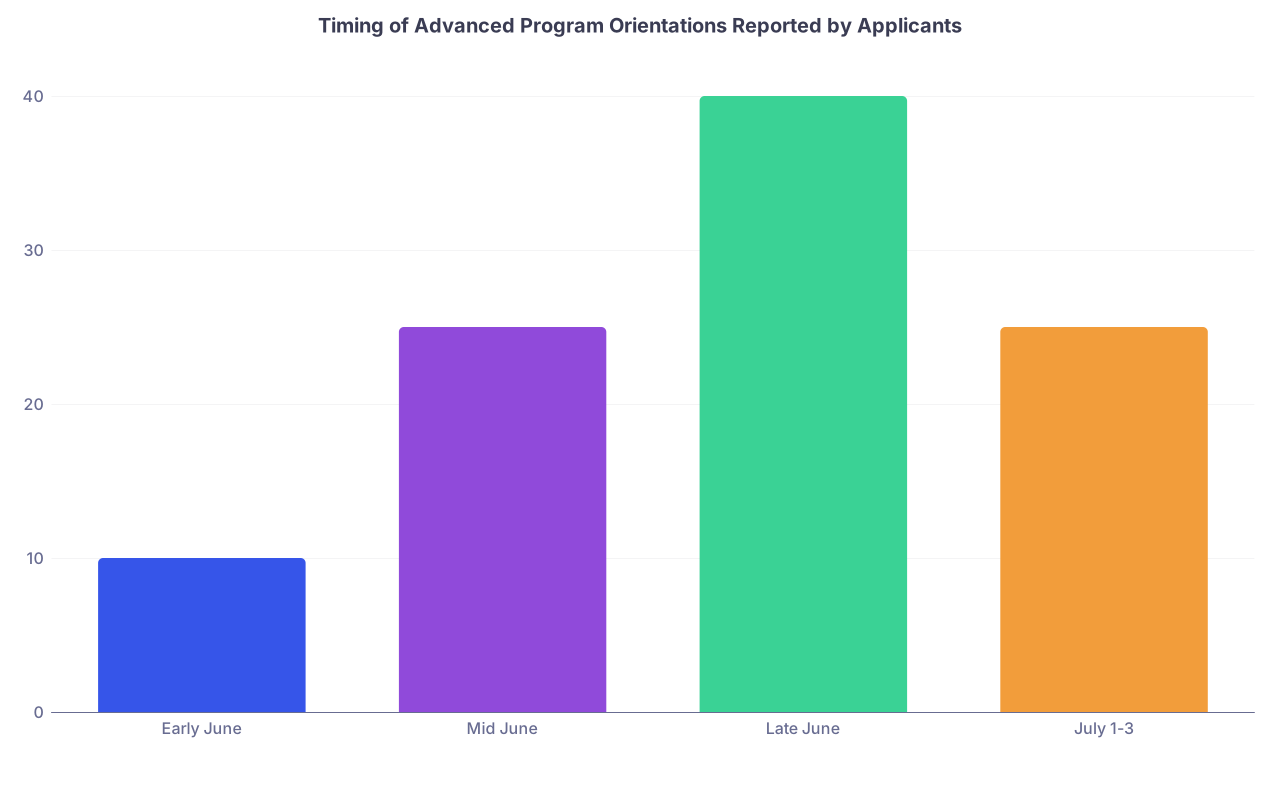
| Category | Value |
|---|---|
| Early June | 10 |
| Mid June | 25 |
| Late June | 40 |
| July 1-3 | 25 |
What not to do:
- Do not assume orientation will be a quick Zoom on July 1.
- Do not assume “they will make it work” if there is a conflict.
- Do not count on your prelim PD being thrilled that you are missing call to attend your next job.
How to avoid this:
Ask specific questions early.
When you interview (or soon after you match), ask:- “When are your mandatory orientations for incoming PGY‑2s?”
- “Are remote/recorded options possible for those finishing prelim years elsewhere?”
- “Do you have current residents who did prelims at other institutions—how did that scheduling work?”
Ask your prelim program about June flexibility before you rank.
Exact phrase I have heard chief residents use: “We do not approve June vacations for interns, period.”
Translate: you will be stuck.Document what is promised.
If a PD says, “We always work with prelims who need a couple of days in late June,” write that down. Names, dates, exact wording. You might need leverage later.
Red flag: Any program that reacts vaguely or annoyed when you ask orientation timing questions is likely not organized around prelim/advanced pairings. That will become your problem.
3. Pairing Incompatible Locations Without Time to Move
The romantic idea: “I will do a prelim in NYC then go to an advanced program in California. New adventure every year.”
The reality:
- You finish a 28‑hour call on June 30.
- You are expected at 7 am orientation 2,500 miles away on July 1.
- You have an apartment lease, furniture, maybe a partner, maybe kids.
There is no gap built into standard contracts to move across the country. None. J‑1 and H‑1B visa processing can make this even uglier.
Common mistakes:
- Ranking a prelim in one city and an advanced program in another with no thought to moving logistics.
- Assuming “they will give me a few days.” Many will not.
- Forgetting that some hospitals demand in‑person onboarding for EMR, HR, and hospital credentialing before July 1.

| Step | Description |
|---|---|
| Step 1 | Rank Prelim Far Away |
| Step 2 | Rank Advanced Program Different Region |
| Step 3 | No Built in Move Time |
| Step 4 | High Risk Schedule Clash |
| Step 5 | Possible But Stressful |
| Step 6 | Same Start Date? |
| Step 7 | Programs Flexible? |
How to protect yourself:
- Same city pairing is safest.
Prelim and advanced at the same institution or in the same metro area eliminates 80% of the moving chaos. - If different cities, interrogate the schedule.
Ask both programs:- “Is there any pre-July 1 orientation I must attend in person?”
- “Can I complete any onboarding remotely in June?”
- Think about your actual body.
A 6‑hour flight and a 3‑hour time zone change immediately after an ICU month is not just annoying. It is unsafe.
If you must pair distant cities, prioritize:
- Prelim program with reasonable June schedule, not ICU/wards + no-vacation rules.
- Advanced program with July 1 or later orientation and willingness to do HR/EMR online.
4. Screwing Up Rank Lists: Not Using Supplementary Lists Correctly
This one is brutally common. People do not understand how supplemental rank order lists (SROL) for advanced positions work.
For advanced programs (PGY‑2+) you can create a supplemental list of prelim programs that are automatically paired if you match the advanced spot.
Common blunders:
- Ranking prelim and advanced programs only on your main list and ignoring SROL.
- Pairing advanced programs with no prelims in the supplement, assuming you will “just SOAP” if needed.
- Putting totally incompatible prelims on the SROL (wrong state, wrong start date, wrong visa capability).
| Strategy | Risk Level | Why |
|---|---|---|
| No supplemental list | Extreme | You can match advanced with no PGY-1 |
| Random prelims on supplemental list | High | Geography and schedule conflicts |
| Carefully curated, same-city list | Low | Built to actually work |
Do not assume you will easily fix a missing prelim in SOAP. SOAP is chaos. Transitional and prelim spots are some of the first to vanish.
How to avoid the rank-list trap:
For every advanced program you rank, build an SROL that:
- Includes compatible prelims you would actually attend.
- Does not list programs that cannot sponsor your visa if you need one.
- Avoids prelims that are geographically insane relative to that advanced program.
Think of each advanced program + SROL as a “package.”
Would you be okay living where the advanced program is and doing any of the prelims on its SROL? If not, your list is dangerous.
I have seen people match a dream advanced spot and then realize they paired it with a prelim 1,000 miles away with no moving window. That was not “bad luck.” It was bad list design.
5. Overlooking Visa, Licensing, and Contract Timing
Visa‑requiring applicants and IMGs get hit hard by this one.
Key traps:
- Matching an advanced program that wants you credentialed and licensed before July 1, but your prelim hospital drags on paperwork and does not release verification letters quickly.
- Prelim in a state with different GME rules that delays your ability to start in another state.
- Visa transfers that require clean, non‑overlapping contract dates—but your contracts literally overlap or leave problematic gaps.
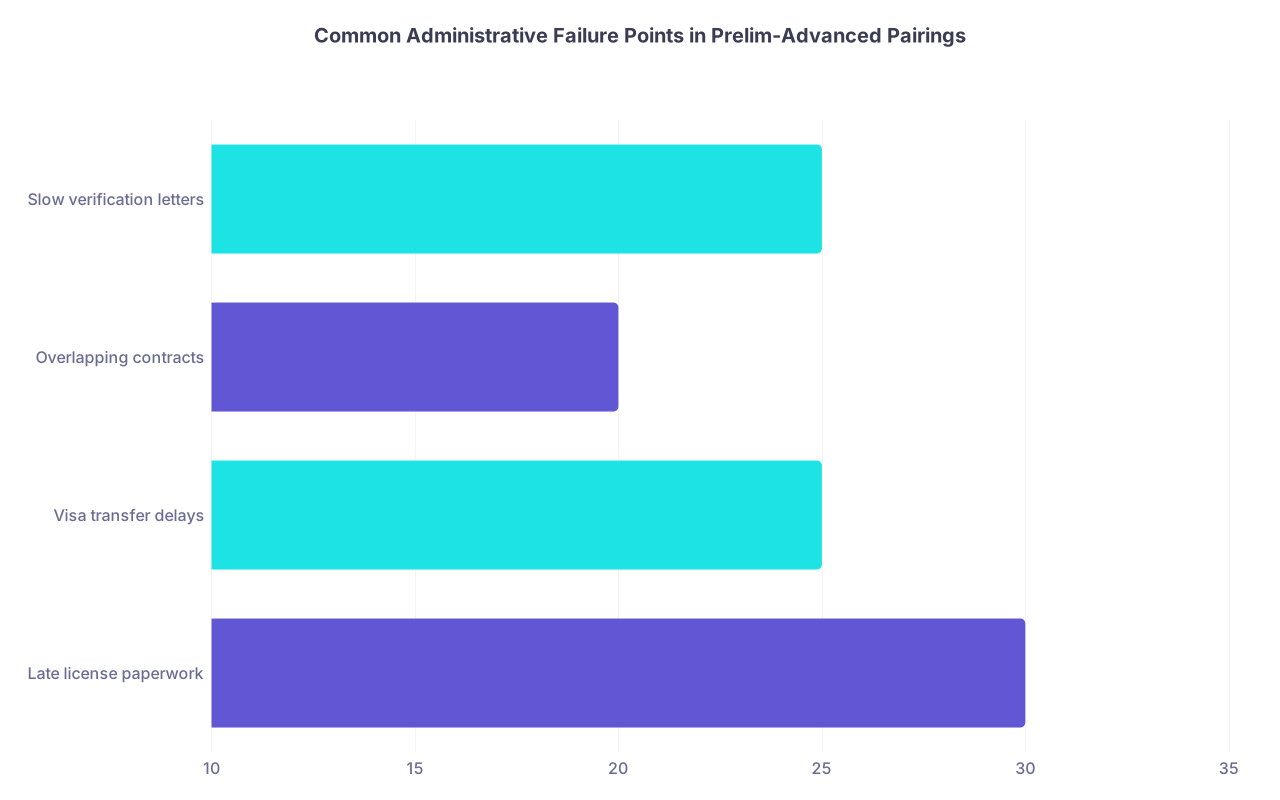
| Category | Value |
|---|---|
| Late license paperwork | 30 |
| Visa transfer delays | 25 |
| Overlapping contracts | 20 |
| Slow verification letters | 25 |
How this hurts you:
- You can technically “match” but struggle to start on time.
- HR may treat any gap or overlap as a red flag.
- You might spend your last few months of prelim chasing forms instead of focusing on learning.
Prevention steps:
- Ask advanced programs explicitly:
“Do you require state license / full credentialing before July 1, or can those finalize in July while I start supervised?” - Confirm prelim program’s track record:
“Do you routinely process final verification letters and evaluations in June so residents can start their next programs on time?” - If on a visa, involve GME immigration early, not after Match Day. Your timeline is tighter than you think.
Any vagueness or “we usually figure it out” should trigger follow‑up questions. You are the one who suffers if the admin chain fails.
6. Underestimating Schedule Intensity of the Prelim Year
Too many future dermatologists, radiologists, anesthesiologists treat prelim year like an annoying checkbox. “I just have to survive, and then the real residency starts.”
That attitude gets people nailed by:
- Taking the most malignant prelim they can find “because it is prestigious.”
- Choosing a surgery prelim when they have zero surgical interest and poor procedural stamina.
- Pairing an ICU‑heavy prelim with an advanced program that expects you to hit the ground running, rested and eager.
You can absolutely burn out before you ever start your advanced specialty.

Scheduling trap here:
- An extremely heavy prelim schedule means you enter PGY‑2 already depleted.
- June often combines hardest rotations + end‑of‑year exams + moving + orientation. Disaster cocktail.
Better approach:
- Do not rank prelims solely by brand name or “reputation of the main department.”
- Look at:
- Call frequency and type (q4 28‑hour calls vs night float vs mostly outpatient).
- ICU/ward heavy months, especially in May–June.
- Historical burnout and attrition. Ask current prelims bluntly: “Would you do it again?”
You are not weak for wanting a reasonably humane prelim. You are smart. Annihilating yourself in PGY‑1 does not make you a better anesthesiologist.
7. Assuming Transitional Years Are Always Safer or Easier
Transitional Years (TYs) have a reputation: cushy, easier, more elective time. Sometimes true. Often myth.
I have seen TYs that were:
- Call‑heavy.
- Packed with ED and ICU.
- Administered with rigid vacation blocks that made June completely off‑limits.
TY scheduling traps:
- A “cushy” TY that front‑loads all the elective time, leaving your last 3 months as back‑to‑back ICU and wards when you need to pack, move, and do orientation.
- TYs that require in‑person end‑of‑year exams, ceremonies, or capstone projects the last week of June.
| Factor | Transitional Year | Prelim Internal Med |
|---|---|---|
| Elective Time | Often higher | Variable |
| Schedule Predictability | Variable | Often more structured |
| June Flexibility | Program dependent | Program dependent |
| Reputation for Lifestyle | Often better | Often worse |
Do not just think “TY = easy, problem solved.”
Ask:
- “How is the schedule distributed across the year?”
- “Are there restrictions on when prelims can take vacation?”
- “Do you have any flexibility for people moving to advanced programs out of state?”
If they dodge those questions, that TY may be prettier on ERAS than it is in real life.
8. Forgetting to Check for Out-of-Sync Start Dates
Believe it or not, not every advanced program starts exactly July 1. A few:
- Start mid‑June.
- Have mandatory “boot camp” in the second half of June.
- Start PGY‑2 orientation the last week of June and run it as paid employment.
That is a direct collision with a standard July 1–June 30 prelim.

| Step | Description |
|---|---|
| Step 1 | Prelim Ends June 30 |
| Step 2 | Compatible |
| Step 3 | Conflict |
| Step 4 | You Cannot Be in Two Places |
| Step 5 | Requires Special Arrangements |
| Step 6 | Advanced Start? |
| Step 7 | Program Flexible? |
You must explicitly identify:
- Does the advanced program hire you as an employee before July 1?
- Is their orientation considered mandatory employment or just “recommended sessions”?
- Have they actually worked with outside prelims before?
If the advanced program has mostly categorical residents and very few PY‑2 entries, they might be sloppy about making their start date compatible with external prelims. You do not want to be their test case.
9. Not Coordinating Vacation, Exam, and Move Timing
Even when both contracts say July 1–June 30, the real workable window is created by:
- Vacation scheduling.
- Step 3 timing (for those who take it).
- Lease dates and moving company availability.
A nasty but common scenario:
- Prelim requires you to schedule all vacations in fall and winter.
- You are stuck on busy blocks in May and June.
- You try to take Step 3, pack, and attend advanced orientation during those months. Something gives. Usually your sanity.
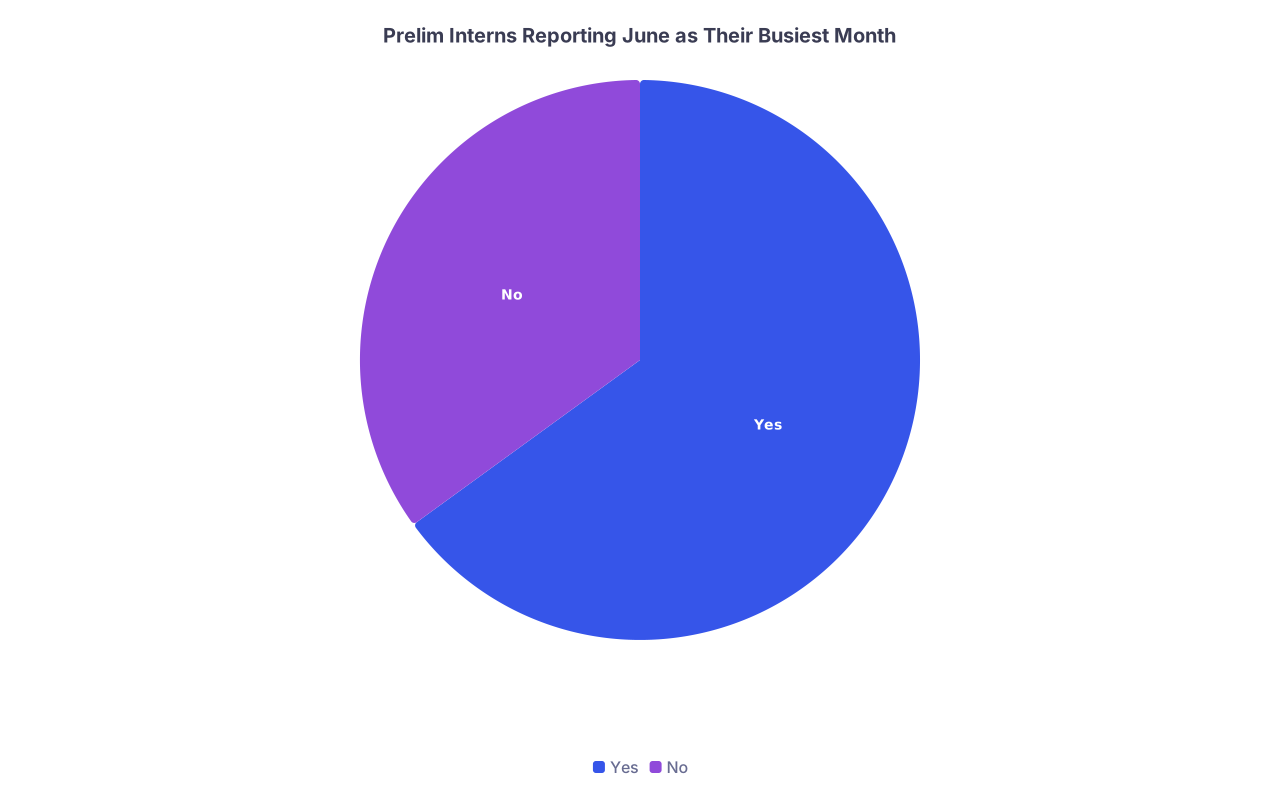
| Category | Value |
|---|---|
| Yes | 65 |
| No | 35 |
Avoid this mess by:
- Asking directly: “Can prelim interns take vacation in May or June?”
If the answer is no, assume your move will be compressed into literally a few days. - Planning Step 3 strategically.
Many advanced programs do not require Step 3 on day one. Confirm their policy. Taking Step 3 during your heaviest rotations while trying to move is asking for trouble. - Getting lease dates that overlap by a few days if you are moving across the country. A one‑day overlap is a fantasy.
You are not just scheduling jobs. You are scheduling your physical life.
10. Failing to Talk to Actual Residents Who Did the Same Path
Program directors will usually paint the rosiest picture. Coordinators will give you what the policy should be.
The people who will tell you what actually happens:
- Current PGY‑2s and PGY‑3s who did their prelim somewhere else.
- Recent grads from your medical school who matched the same combination (e.g., prelim IM in Chicago + advanced rads in Boston).
Ask them very specific questions:
- “Did your prelim schedule in June allow you to move and attend orientation?”
- “Were there any hidden mandatory things at the end of the prelim year?”
- “If you could redo your prelim–advanced pairing, what would you change?”
The red flag answer I see: “It was technically possible, but I would not do that pairing again.” Translation: it almost broke them.
You are not the first person to try your combination. Find the ones who already paid the price and listen carefully.
FAQ (Exactly 4 Questions)
1. What happens if I match an advanced program but not a prelim year?
You can end up with an advanced PGY‑2 position and no required PGY‑1. That is a serious problem. You would need to secure a prelim year through SOAP or outside the Match, which is extremely uncertain, especially in competitive specialties. Never rely on “I will figure out a prelim later.” Your rank list and supplemental lists should be built to avoid this gap entirely.
2. Is it safer to only rank categorical positions and avoid advanced + prelim entirely?
Safer, yes. Always the best choice, no. Many fields (rads, anesthesia, derm, ophtho, PM&R, rad onc) are structured around advanced positions. If you want those specialties, you must deal with prelim pairing. The key is not to avoid advanced spots, but to treat prelim selection and scheduling as equally critical, not an afterthought.
3. Should I prioritize a cushy prelim over prestige if my advanced program is demanding?
In most cases, yes. A reasonable, humane prelim year will leave you functioning when you start a tough advanced residency. Killing yourself in a malignant or hyper‑prestigious prelim rarely pays off, especially if your career is not in that field. You do not get bonus points in radiology for having suffered horribly in a surgical prelim.
4. What is one concrete question I should ask every prelim program about scheduling?
Ask: “How do you handle June scheduling and vacation for prelims who are moving to advanced programs in other cities?” Then be quiet and let them talk. If the answer is vague, inflexible, or “We do not really do anything special,” treat that as a major risk signal.
Open your current rank list or target list right now and circle every prelim–advanced pair that is in different cities. For each of those, write down: “Exact orientation dates? June vacation allowed? Move time?” If you cannot answer those three questions, you are walking into preventable trouble—fix it before the Match does it for you.