
The fastest way to sabotage your future Match is to sign a prelim contract you barely skimmed.
You think it is “just one year.” Programs and advisors call it a “transition year,” a “bridge,” a “temporary thing.” That language is exactly how people sleepwalk into contracts that quietly choke off their options for the next cycle.
I’ve watched smart, capable interns realize in October that a single clause they ignored in May has boxed them into fewer interviews, weaker letters, and, in some cases, no viable categorical spot at all. Not because they were lazy. Because they trusted the process more than the paperwork.
Let’s not let you be the cautionary tale.
First: What a Preliminary Year Really Is (Not the Sugar-Coated Version)
A preliminary year is a one‑year residency position—often in internal medicine, surgery, or a “transitional year”—that’s separate from a full, multi‑year categorical spot.
You usually end up in a prelim year for one of these reasons:
- You matched into an advanced specialty (like neurology, radiology, anesthesia, derm, PM&R) that starts at PGY‑2 and you need a PGY‑1.
- You didn’t match into a categorical program and took a prelim as a foothold.
- You’re trying to “rebrand” yourself for a different specialty with fresh letters and performance.
Here’s the part most people gloss over:
A prelim year is not a safety net by default. It’s a one‑year job with its own rules, priorities, and politics. The institution’s commitment to you ends on June 30. Full stop. Everything you hope to get out of that year—letters, time to interview, a chance at a categorical position—depends on what’s actually written in that contract and how the program applies it.
If you treat it like a formality, you’re handing all the leverage to a program that’s primarily focused on service coverage, not your future Match.
The Contract Landmines That Quietly Wreck Your Next Match
Let me walk you through the most dangerous sections people skim or ignore. These are the spots where I’ve seen careers get delayed a full year—or more.
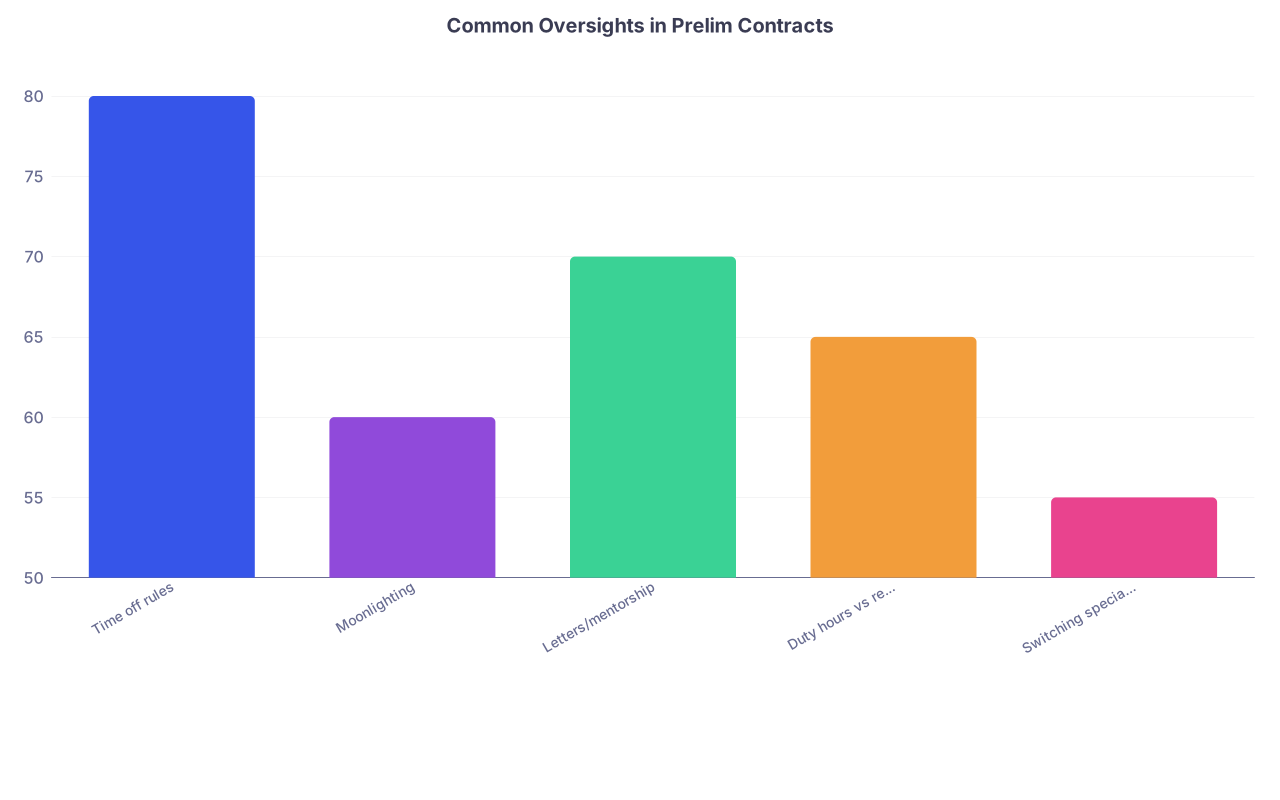
| Category | Value |
|---|---|
| Time off rules | 80 |
| Moonlighting | 60 |
| Letters/mentorship | 70 |
| Duty hours vs reality | 65 |
| Switching specialties | 55 |
1. The “Time Off” and Interview Clause: Your Calendar Trap
This is the big one.
Your ability to interview in your PGY‑1 year is entirely dependent on:
- How much leave you get (vacation, personal days, educational days).
- How those days can be used.
- How flexible your program is about switching shifts or making up call.
Common painful discoveries in October/November:
- Vacation must be taken in 1‑week blocks, pre‑assigned by chief residents, with no swapping.
- “Interview days” are not explicitly recognized; anything not called “conference” is vacation.
- No more than X days off per rotation—even if you’re under ACGME maximums for the year.
- Educational leave is only for in‑person conferences in your current specialty, not interviews for another field.
You do not want to learn in November that your “5 interview days” actually means “if you’re presenting a poster, in our specialty, and even then only if coverage allows.”
What to hunt for in the contract and handbook:
- Total number of paid days off and how they are categorized.
- Any mention of “interview days,” “professional leave,” “educational leave.”
- Restrictions on when time off can be taken (specific blocks, blackout months).
- Whether switching rotations or call shifts “for interviews” is prohibited, allowed, or ignored.
If it’s not in writing, you are depending on goodwill. Some programs are great. Some are not. You don’t stake your Match on vibes.
2. Non‑Compete or “No Internal Transfer” Language: The Hidden Cage
Yes, even for residents. I’ve seen clauses that say, sometimes in soft legalese:
- You will not seek or accept employment within the same institution in another residency program during this contract term without prior written approval.
- You may not apply to other programs within this hospital system until completion of the contract and fulfillment of all duties.
If you’re thinking, “Surely they won’t enforce that,” you’re betting your career on “surely.”
I’ve watched prelims who were stellar but blocked from sliding into unfilled categorical spots in the same institution because their home program did not want to lose a reliable intern who covered nights and ICU.
Do not assume being well‑liked will override a line in a contract that protects their staffing.
- “Employment within the Institution or Affiliate Programs”
- “Internal transfer”
- “Contractual obligation to complete term”
- “No concurrent appointment”
You want clarity on whether:
- You can apply to categorical positions at the same hospital.
- You can accept an off‑cycle categorical spot if one opens.
- Your current PD has veto power over your moving to another department.
If any of that sounds murky, get it clarified in email before you sign. Paper. Trail.
3. Moonlighting and Outside Clinical Work: The Performance Time Bomb
You think moonlighting is just about money. Programs think it’s about liability and performance.
Here’s where people get burned:
- Contract prohibits all outside clinical work, but you assume you’ll pick up shifts anyway “once they trust you.”
- Moonlighting is technically allowed but only if you’re “meeting all program expectations” and “in good standing.” The moment you hit a rough rotation or have a minor remediation, they can yank it.
- Step 3 study time evaporates because you’re counting on moonlighting pay to cover fees and travel, then suddenly can’t moonlight.
For next Match, what matters is:
- Your Step 3 timing (many specialties and PDs now want it done early).
- Your ability to stay rested and not show up to interviews exhausted or making mistakes at work.
If your contract is strict and you ignore it, you risk:
- Disciplinary action for unauthorized work.
- Negative comments in your summative evaluation (“difficulty following policies”).
- PDs reluctant to write strong letters because they see you as “not fully committed.”
Those subtle phrases show up on the back‑channel calls. And they follow you into the second Match.
4. Evaluation, Probation, and Non‑Renewal Policies: The Silent Reputation Killers
Programs talk to each other. PDs text, call, and email in ways you’ll never see.
Your prelim contract and handbook often spell out:
- How you’re evaluated.
- What triggers probation or formal remediation.
- When and how you’re informed of “concerns.”
If the policy allows vague or late feedback, you can end up with:
- A marginal evaluation that nobody told you about.
- A formal “performance plan” six months into the year.
- A non‑renewal letter that, even if “just politics,” looks terrible to future programs.
Here’s the catch: future PDs often care less about why you were on probation and more that you were on it at all.
Language to scrutinize:
- “Residents may be placed on probation at the discretion of the Program Director.”
- “Concerns may be documented in the permanent resident file.”
- “Non‑renewal decisions will be communicated to the resident in accordance with institutional policy.”
Ask yourself: How early will I know if something is going sideways? Is there a structured process that lets me course‑correct before someone writes a lukewarm letter that tanks my next Match?
5. Rotations, Electives, and “Flex Time”: Where Your Application Narrative Lives or Dies
Your prelim year isn’t just service. It’s your last, best chance to build:
- Specialty‑specific letters.
- Case volume and experiences to write about.
- A coherent story: “I’ve done X rotations that prove I want and can handle this field.”
The mistake: only looking at the glossy rotation schedule PDF and not what the contract and handbook say about changing it.
| Program Type | ICU Months | Ward Months | Elective Months | Flexibility |
|---|---|---|---|---|
| Prelim Medicine A | 3 | 6 | 3 | Medium |
| Prelim Medicine B | 4 | 7 | 1 | Low |
| Transitional Year C | 2 | 4 | 6 | High |
| Prelim Surgery D | 4 | 7 | 1 | Very Low |
| Community TY E | 1 | 5 | 6 | Medium |
Hidden in the policy documents you’ll often find:
- Elective blocks that are “subject to service needs” (translation: may disappear).
- Requirements that a certain number of rotations must be in the sponsoring department (which can crowd out the specialty you want).
- Caps on away rotations or observerships in your desired field.
If you’re doing a prelim medicine year but trying to Match anesthesia, radiology, or EM, you need some time on their services or at least ICU/ED experiences that translate well and give you appropriate letter writers.
If the contract makes electives fragile or cancelable at the PD’s discretion, you’re building your future application on quicksand.
6. Step 3, Exams, and “Board Eligibility” Requirements: The Mistimed Deadline
This one blindsides a lot of people who are re‑applying:
- The contract or handbook might require taking and/or passing Step 3 by a certain point in the year.
- Failure to do so can trigger remediation, probation, or in extreme cases, non‑renewal.
Now tie that to your next Match:
Many PDs love seeing Step 3 done early in PGY‑1 for re‑applicants. It reassures them you’re serious and academically solid.
But if:
- You don’t get protected time to study.
- Every “educational day” is used for mandatory internal conferences.
- Failing or delaying Step 3 puts you at risk in your current program.
You’re in a double bind: Study and risk bad performance at work, or work and show up to applications without Step 3, which weakens your file.
Look for:
- Explicit language about exam deadlines.
- Whether study days or exam days are paid or unpaid leave.
- How failures are handled—supportive remediation vs punitive.
You want a program whose rules align with your plan, not one that sets a trap you discover too late.
How These Contract Mistakes Actually Limit Your Next Match
Let’s connect the dots. Here’s how not reading your prelim contract turns into a worse Match (or no Match) the second time around.
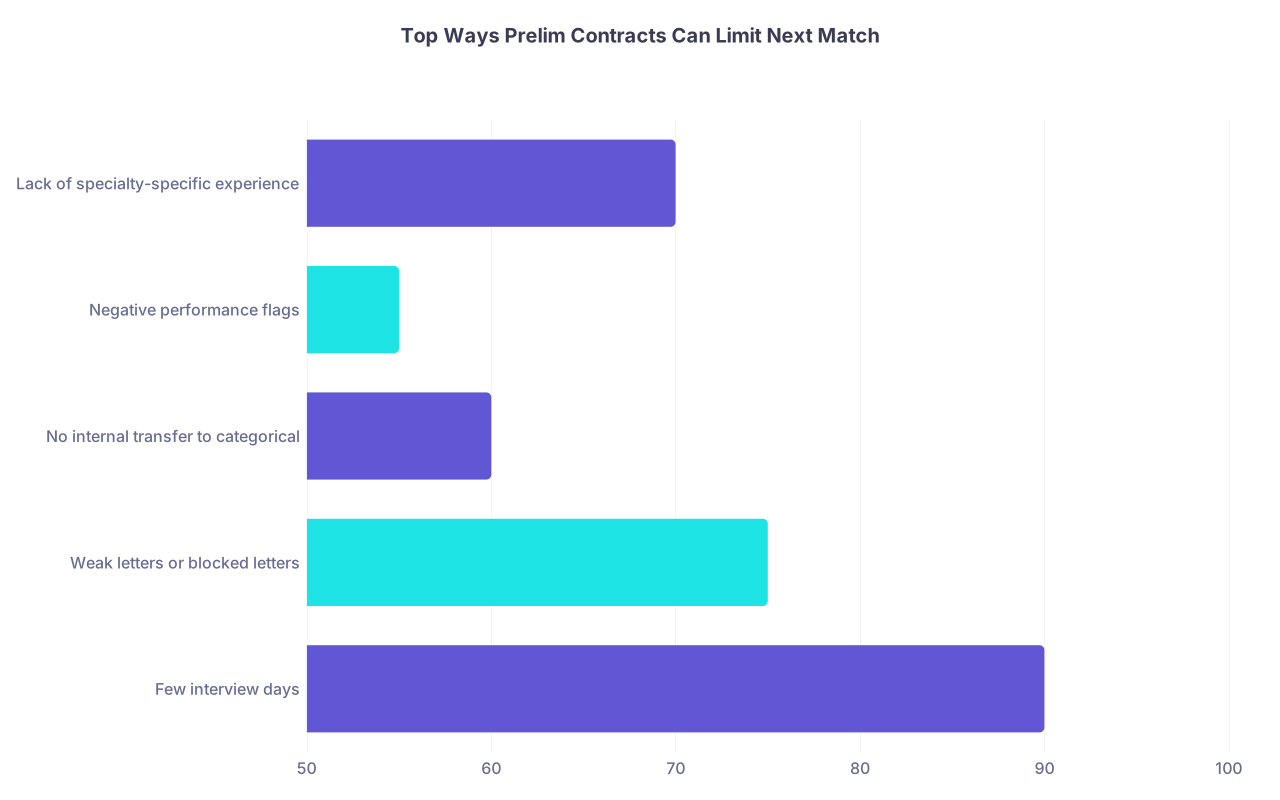
| Category | Value |
|---|---|
| Few interview days | 90 |
| Weak letters or blocked letters | 75 |
| No internal transfer to categorical | 60 |
| Negative performance flags | 55 |
| Lack of specialty-specific experience | 70 |
1. Fewer Interviews Because You Literally Can’t Get There
You match into a prelim medicine year, planning to reapply to IM and neurology. Your contract:
- Gives 15 vacation days.
- No stated interview days.
- Vacation is pre‑assigned for 3 consecutive weeks during non‑peak months. No swaps.
By the time interview season hits:
- Your vacation is burnt.
- “Unpaid leave” is technically possible but only if you make up call—on your “days off.”
Result: You cancel interviews or show up exhausted, and it shows. You might even pass on interviews you needed because you’re terrified of being labeled “unreliable” at your current program.
All because you didn’t realize your “3 weeks vacation” were locked.
2. Weaker Letters or No Letters From Key People
You planned to get:
- A strong PD letter from your prelim program.
- 2 specialty‑specific letters from rotations in your chosen field.
Then you discover:
- Your elective in that specialty has been reassigned to wards because service is short.
- Policies require 6+ months on core services, leaving only 1 elective month that gets consumed by random filler.
- Your PD is annoyed you’re applying out and gives a generic, lukewarm letter.
So your new application doesn’t look “much stronger.” It looks like the same candidate in a holding pattern.
3. Blocked From Sliding Into a Categorical Spot
This one is brutal.
Story I’ve seen play out more than once:
A prelim internal medicine resident crushes the year. There’s a categorical PGY‑2 spot opening at the same institution. The categorical PD wants them. But:
- Their prelim contract and institutional policy require the home PD’s approval for internal transfer.
- The home PD says, “We really need them to finish the year; we’re already short.”
- HR shrugs and points at the contract.
By the time legal or GME tries to mediate, the opening is gone or offered to someone else. That resident ends up scrambling for another prelim or a research year they never wanted.
Was that predictable from the contract? Often yes—if you knew to look.
4. Performance Flags That Poison Back‑Channel Calls
Programs call each other informally. What they say when you’re not in the room matters more than the one‑page “verification of training” you see.
If your contract and policies are harsh or vague about:
- Probation.
- “Concerns.”
- Documentation of professionalism.
You might end the year with a tiny blemish that turns into a huge red flag when someone asks, “Would you rehire them?”
All because you were:
- Overworked without real protections.
- Denied interview days, so you called out last minute.
- Studying on nights, made one documentation error, and got written up.
None of that is inevitable. But it’s made much more likely when you have no idea what your contract allows, expects, or punishes.
How to Read a Prelim Contract Like Your Future Depends on It (Because It Does)
This is where you protect yourself. No legal degree needed—just discipline and a willingness to ask questions before you sign.

Step 1: Identify the High-Risk Sections
Skip the fluff. Go straight to:
- Leave / vacation / time off.
- Moonlighting and outside employment.
- Evaluation, remediation, and non‑renewal.
- Duty hours and scheduling authority.
- Rotations and elective policies.
- Internal transfer and non‑compete type language.
- Exams (USMLE Step 3/COMLEX 3) and education requirements.
If those sections seem missing, the policies may live in a separate resident handbook or GME policy manual. Ask for those too. Do not sign based only on a one‑page offer letter.
Step 2: Cross‑Check With Your Next Match Plan
You’re not reading this in a vacuum. Decide now what you need from this prelim year:
- Will you be re‑applying to the same specialty or switching?
- Do you need Step 3 done by a certain time?
- How many letters, and from whom, do you realistically need?
Then line that up against what the contract allows.

| Step | Description |
|---|---|
| Step 1 | Receive Prelim Offer |
| Step 2 | Get Contract and Handbook |
| Step 3 | Review Leave, Evaluations, Electives |
| Step 4 | Clarify Minor Questions by Email |
| Step 5 | Request Changes or Clarifications |
| Step 6 | Get Promises in Writing |
| Step 7 | Consider Declining or Ranking Lower |
| Step 8 | Sign With Eyes Open |
| Step 9 | Supports Next Match Plan |
| Step 10 | Program Flexible |
If they clash—no electives in your target specialty, almost no interview leave, Step 3 deadline that conflicts with interview season—you need to rethink either your strategy or your rank list.
Step 3: Ask Direct, Written Questions Before You Rank or Sign
Programs love to answer vaguely in person: “We support residents applying to advanced specialties.” That phrase is useless.
You want answers like:
- “How many days were PGY‑1 residents typically able to use for interviews last year?”
- “Are interview days counted as vacation or educational leave?”
- “Can prelims rotate with [specialty] here? How many months is realistic?”
- “Have past prelims been able to transfer into categorical spots here? What is the process?”
Then—this matters—follow up by email:
“Thank you for discussing X. Just to confirm, you mentioned prelims can typically have around Y days for interviews using vacation or educational leave. Is that correct?”
Their written response is your insurance. If later someone acts like you invented the idea of interview days, you have documentation.
Step 4: Do Not Be Afraid to Walk Away—or Rank a Safer Program Higher
You’d be surprised how many people lock themselves into toxic prelim years because “it’s at a big name hospital” or “it’s attached to the specialty I want.”
Prestige will not help you if:
- You can’t interview.
- You’re sleep‑deprived and under fire.
- You leave with mediocre letters because the culture is punitive.
A community prelim or transitional year that:
- Gives real electives.
- Has a reputation for supporting re‑applicants.
- Gives flexible interview time.
…is vastly better than a famous institution that grinds you to dust and blocks your next move.

What If You Already Signed and Just Realized the Problems?
If you’re reading this post‑Match or post‑signature, you’re not doomed. But you can’t stay passive.
1. Learn the Rules Early and Completely
Get:
- The contract.
- The resident handbook.
- The GME policies.
Read them now. Mark the sections we talked about. Find the actual levers you do have—things like:
- Max vacation days per quarter.
- How schedule requests work.
- When elective requests are due.
2. Meet With Your PD or APD Early in the Year
Not to complain. To align.
You say, calmly:
- “I plan to apply to [specialty] this cycle.”
- “I’ll need [rough number] of interview days.”
- “I’m planning to take Step 3 around [time].”
- “What’s the best way to arrange my rotation schedule and time off so this doesn’t interfere with my responsibilities here?”
You’re signaling two things:
- You respect the program’s needs.
- You’re serious and organized about your next Match.
People are much more flexible in August when they can plan, versus November when you spring requests on them.
3. Protect Your Reputation Ruthlessly
If your contract is rigid, your main asset is how people talk about you.
So:
- Be relentlessly reliable on the job.
- Document all approved time off and schedule changes.
- Avoid any behavior that can be spun as “unprofessional.”
You want PDs, chiefs, and attendings to say on back‑channel calls: “They were excellent. We couldn’t give them time off sometimes because of system rules, but they were always upfront and responsible.”
That can partially offset a bad contract environment.

The Bottom Line
If you remember nothing else, remember this:
- A prelim year contract is not a formality. It’s a set of levers and traps that can either support or sabotage your next Match.
- The biggest career‑limiting clauses hide in leave policies, rotation flexibility, evaluation/remediation rules, and internal transfer restrictions.
- You protect yourself by reading every word, asking focused questions before you rank or sign, and making sure the written rules actually support the story you need to tell in your next application.
Do not hand a program that much control over your future without knowing exactly what you’re agreeing to.