
Not securing a PGY‑2 after a prelim year isn’t the end of your career. It’s a painful detour, not a dead end.
Let me be blunt: failing to line up a PGY‑2 after a preliminary intern year feels awful. It hits your ego, your plans, and your sense of stability. You’ll watch co‑interns move on to advanced positions while you’re staring at an empty calendar.
But I’ve seen people in this exact spot go on to anesthesia, radiology, EM, even competitive fellowships. The ones who do well don’t sit and spiral; they treat this like a serious problem that needs a structured plan.
Here’s what actually happens, what risks you’re facing, and the concrete moves that will give you the best chance to recover.
1. First, what “not securing a PGY‑2” really means
You’re usually in one of these situations:
- You matched into a prelim year only (IM, surgery, transitional), planning to start an advanced specialty (e.g., anesthesia, radiology, derm, neuro, rad onc) at PGY‑2.
- Or you did a prelim year while trying to switch specialties, and you didn’t match into anything else.
- Or your advanced spot fell through (program closed, visa issues, professionalism/performance problems, contract not renewed).
End result: your prelim year ends, and you don’t have a PGY‑2 position secured to follow it.
You are then:
- A physician who has completed PGY‑1
- Usually eligible for a license in some states as an “independent” physician (depending on state rules)
- Not in a categorical residency, not on track for board eligibility in anything
- At risk of a gap on your CV, which programs will absolutely question
This is uncomfortable. But it’s also clear: your next 12–18 months need to be laser‑focused on getting back into a structured training path.
2. Immediate consequences at the end of your prelim year
Here’s what happens in practical terms when your prelim year finishes and you have no PGY‑2:
- You lose your resident salary, benefits, and training status.
- You lose automatic clinical supervision and institutional “home base.”
- You may lose access to EMRs, letters-on-demand, and easy networking.
- Your malpractice coverage through GME ends (unless extended for tail only).
And your problems cluster into three buckets:
- Licensure & income
- Future residency prospects
- Visa / immigration (if applicable)
Let’s break those down.
3. Can you work as a doctor after just a prelim year?
Sometimes, yes. Just not in the glamorous way people imagine.
Whether you can practice independently with one year of residency depends entirely on state medical board rules. Some states require 1 year of GME, some 2, some 3 for full licensure.
| State | Minimum GME Years | PGY‑1 Only Eligible? |
|---|---|---|
| California | 1–2 (depends on IMG/US) | Often Yes |
| New York | 1–3 (varies) | Sometimes |
| Texas | 1–2 (varies) | Sometimes |
| Florida | 2 | No |
| Massachusetts | 2–3 | Rarely |
You need to look up your exact state’s requirements on the medical board website or call them. Don’t guess.
If you can get licensed after PGY‑1, realistic work options might include:
- Hospitalist “PGY‑2”‑type roles in community settings (rare, and many require full IM residency)
- Urgent care or low‑acuity clinics (more common in underserved areas or locums situations)
- Telemedicine jobs (often want board‑eligible/board‑certified, but a few will consider prelim‑only with license)
- Occupational medicine / employee health
- Research roles with some clinical overlay (e.g., clinical trials physician, depending on the company and state rules)
These jobs pay less than full attending roles and may be more limited, but they can:
- Keep you clinically active
- Pay your bills
- Strengthen an argument to future residency programs that you stayed engaged and competent
If your state requires more GME for licensure, then your options shift to:
- Research positions (clinical or bench)
- Non‑clinical roles (industry, consulting, education)
- GME‑adjacent jobs (simulation, curriculum, quality improvement)
Bottom line: You might be able to “work as a doctor,” but it will be constrained, and it’s not a substitute for board‑eligible residency training.
4. Residency prospects after a “wasted” prelim year
This is where most people panic: “Did I just burn my only shot?”
No. But your leverage drops and the story you tell matters a lot.
Here’s how programs think when they see a prelim‑only year with no PGY‑2:
Why didn’t this person move on?
- Didn’t match? Red flag or circumstance?
- Performance issues?
- Professionalism concerns?
- Bad luck and timing?
What have they done since?
- Stayed clinical?
- Gaps with no clear explanation?
- Strong letters from prelim faculty?
Are they going to complete our program?
- Or are they a flight risk / burnout risk?
You need to answer those questions directly in your application and during interviews.
Realistic paths back into residency
Your main pathways are:
- Re‑apply in the Match to:
- Categorical IM, FM, psych, peds, or prelim again
- Advanced specialties (if your scores and application are still competitive)
- Scramble / SOAP into open PGY‑2 or PGY‑1 spots (yes, this happens)
- Directly email PDs about off‑cycle or unexpected vacancies (death, illness, dismissal, expansion)
If you’re thinking “I’ll just wait, then jump straight into radiology/anesthesia/derm from a gap year,” you’re overestimating how forgiving those fields are. It happens. But not by accident. Those people have strong Step scores, supportive PDs, and a very clear narrative.
5. The smart 12‑month plan if you don’t have a PGY‑2
Here’s the practical framework I give prelims in this position.
Step 1: Exit your prelim year as strongly as possible
- Ask for specific, written feedback before the final evaluation.
- Request letters from faculty who genuinely liked working with you.
- Make sure your final summative evaluation doesn’t contain fatal language (“unsafe,” “unprofessional,” “significant concerns”). If there are issues, address them head‑on and work to improve in the last months.
Your prelim PD’s perception of you can make or break future applications. I’ve seen marginal candidates survive because their PD went to bat for them.
Step 2: Secure bridge work that helps, not hurts
Ideal bridge year roles:
- Clinical research in your target specialty or in IM if you’re pivoting to categorical
- Chief prelim / transitional year roles (occasionally exist; ask if your program has any hybrid roles or extensions)
- Hospital‑based non‑resident roles (clinical coordinator, QI lead on an academic project, etc.)
Avoid disappearing into a random, unexplainable non‑medical job for a year unless you truly have no choice. If you do, you’ll need a very clean explanation: family illness, personal health, immigration issues, etc.
Step 3: Decide your specialty strategy—no more vague “see what happens”
You can’t spray applications across 8 specialties and hope someone bites. Programs can smell desperation.
Decide:
- Am I committing to a more accessible field (IM, FM, psych, peds, pathology)?
- Or am I doubling down on my original advanced specialty with a very clear plan to strengthen my application?
Sometimes the right move is to get into a categorical IM or FM spot first, then pivot later through fellowship or subspecialty. Is that perfect? No. Is it better than indefinite limbo? Usually.
6. Using the Match and SOAP when you’ve already done a prelim
You can absolutely enter the Match again after a prelim year. Many do.
Key requirements/checkpoints:
ERAS application updated with:
- Completed prelim experience
- New letters (at least 1–2 from your intern year)
- Clear, honest but concise explanation in your personal statement
NRMP rules:
- You must disclose prior Match participation and any contract violations or discipline
- If you were dismissed or failed to get a contract renewed, this must match what your former PD will say
PLAY THIS STRAIGHT. PDs talk to each other. If your story doesn’t align with what they hear from your old program, you’re done.
During SOAP (if you go unmatched again):
- Rank your priorities:
- Any categorical vs any PGY‑2?
- Geography vs specialty flexibility?
Don’t be too picky in SOAP if your priority is simply re‑entering residency. You can rebrand yourself once you’re back in a categorical program and performing well.
7. What if there were performance or professionalism problems?
This is the hard one. You can’t just bury it.
If you had:
- A failed rotation,
- Formal remediation,
- A non‑renewed contract, or
- A professionalism incident…
Then programs are going to look for three things:
- Acknowledgment – You know what happened and don’t deflect blame on everyone else.
- Insight – You can explain what you’d do differently.
- Evidence of change – Concrete steps and positive evaluations since then.
Here’s the wrong way to talk about it:
“I had a difficult attending and it tanked my evaluation. It wasn’t fair.”
Here’s the right structure:
“I struggled with time management and prioritization on busy ward rotations. That led to delayed notes and care plan communication issues. I addressed it with my PD, implemented specific checklists and earlier pre‑rounding, and my last two rotations were rated at or above level with explicit comments on improvement.”
Programs don’t demand perfection. They demand honesty plus a believable improvement arc.
8. Visa holders: your situation is more fragile
If you’re on a J‑1 or H‑1B, not securing a PGY‑2 can jeopardize your stay in the country.
You need to:
- Talk to your GME office and an immigration attorney early (mid‑year, not in June)
- Understand how long you can stay between positions
- Prioritize any ACGME‑accredited slot that can sponsor your visa, even if it’s not your dream specialty
I’ve watched very strong residents get forced out of the system simply because they misread their visa timelines. Don’t wing this.
9. Emotional reality: it’s going to sting, but don’t go dark
There’s a psychological trap here. Shame, isolation, and paralysis.
I’ve seen people in this situation do two self‑destructive things:
- Hide from mentors and PDs because they’re embarrassed.
- Avoid applying aggressively because “If they didn’t want me this year, why would they next year?”
That’s backwards.
You need:
- At least two mentors (one from your prelim year, one from med school or elsewhere) who know your full story.
- A tight written timeline: when you’ll finalize your specialty choice, draft your PS, request letters, submit ERAS, and start cold‑emailing for off‑cycle slots.
You’re allowed to be upset. You’re not allowed to vanish.
10. Concrete moves you can start this week
Here’s a quick, no‑nonsense action list:
- Email your prelim PD: request a meeting focused specifically on your future plans and ask directly, “What could I realistically match into, and will you support me?”
- Make a short document (<1 page) listing:
- Step scores
- Exam failures (if any)
- Honors/awards
- Any professionalism or remediation history
- Your honest specialty options (tiered by competitiveness)
This is what PDs will see, so you should see it too.
Identify 2–3 realistic specialties and list 10–15 programs that:
- Historically take non‑traditional or reapplicant candidates
- Are community‑based or less name‑brand
- Have a track record of accepting IMGs or prelim‑to‑categorical transitions
Start reaching out early (late fall / early winter before Match season ramps) about:
- Off‑cycle PGY‑2 spots
- Potential PGY‑1 categorical spots opening if someone resigns or is dismissed
| Category | Value |
|---|---|
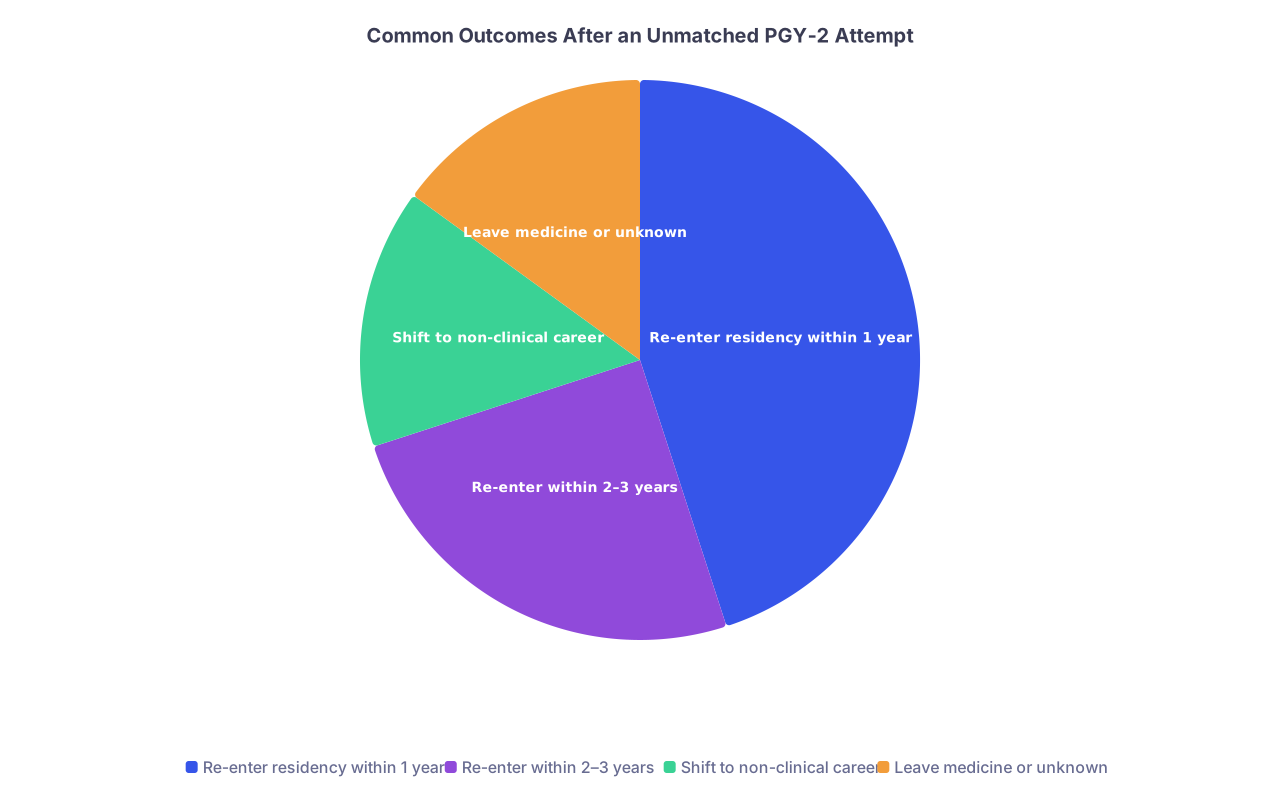
| Re-enter residency within 1 year | 45 |
| Re-enter within 2–3 years | 25 |
| Shift to non-clinical career | 15 |
| Leave medicine or unknown | 15 |

| Step | Description |
|---|---|
| Step 1 | End of Prelim Year |
| Step 2 | Start Advanced or Categorical PGY 2 |
| Step 3 | Seek clinical work with supervision |
| Step 4 | Research or non clinical role |
| Step 5 | Plan reapplication strategy |
| Step 6 | Apply in Match and SOAP |
| Step 7 | Re enter residency |
| Step 8 | Expand options or consider non clinical path |
| Step 9 | PGY 2 position secured? |
| Step 10 | Eligible for license? |
| Step 11 | Match? |
FAQ: What Happens If I Don’t Secure a PGY‑2 After Completing a Prelim Year?
Can I still become board‑certified if I don’t get a PGY‑2 right away?
Yes, as long as you later enter and complete an ACGME‑accredited categorical residency that’s recognized by the specialty board. The gap itself doesn’t disqualify you. But if you never complete a full residency in any specialty, you won’t be board‑eligible.Is a gap after prelim year a deal‑breaker for residency programs?
It’s a negative, but not automatically fatal. Programs will ask why there’s a gap and what you did during that time. If your gap is filled with clinical work, research, or other productive activity plus strong references, many programs will still consider you seriously, especially in less competitive fields.Should I do another prelim year if I can’t get a categorical or PGY‑2?
Usually, no. A second prelim without a clear reason and pathway is a tough sell and can look like flailing. The exception is if a second prelim is explicitly linked to a future categorical spot (for example, a program plans to convert you to categorical if you perform well), and you have that in writing and trust the PD.Will programs think I’m “damaged goods” if I didn’t move into PGY‑2 right away?
Some will, frankly. Others will see you as a risk‑managed candidate who might be incredibly grateful, hardworking, and mature if you’re transparent and show growth. Your job is to make it very easy for them to see that the issue was either timing, mismatch, or a fixable problem that you’ve already addressed.What should I say in my personal statement about not securing a PGY‑2?
Be concise and honest: 2–4 sentences, not a full sob story. Briefly state what happened, what you learned, and how you’ve used the time since to strengthen your skills. Focus more on what you’ve done and who you are now than replaying the failure in detail.Is switching to a “backup” specialty like IM or FM after a failed PGY‑2 attempt a bad idea?
Not at all. For many people, it’s the most logical way to get back into GME, earn a stable career, and later sub‑specialize if they want. It’s better to be a happy, successful internist or family physician than be stuck in limbo chasing a hyper‑competitive field that’s not moving.What can I do today if I’m mid‑prelim year and worried I won’t get a PGY‑2?
Email your PD and one trusted attending to request feedback on your performance and ask directly whether they’d support you for categorical or advanced spots. At the same time, start a document listing programs you’d consider for categorical IM, FM, or other realistic fields. Then outline what you need this month (more procedures, better evals, a research project) to strengthen your case.
Open your calendar right now and block off one hour this week labeled “Post‑prelim plan.” During that hour, list your realistic specialty targets, your current liabilities (scores, gaps, evaluations), and three people you’ll email for honest feedback. That’s how you start turning this from a crisis into a comeback.