
The wrong prelim year can quietly sabotage your future; the right one can launch it.
You’re not choosing between “two versions of intern year that are basically the same.” You’re choosing the on-ramp to the rest of your career. Transitional year vs internal medicine prelim is one of those decisions people hand-wave… then regret.
Let me be blunt:
- If you’re going into a non-medicine specialty that values lifestyle and broad exposure, a strong Transitional Year (TY) is usually better.
- If you’re headed toward a medicine-heavy or academic path—or you even might want to switch into Internal Medicine, Cards, GI, etc.—a Medicine Prelim is often the safer and more flexible play.
- Your specific specialty, competitiveness, and risk of needing to re-apply matter more than generic advice.
Let’s break it down like someone who’s actually sat in resident workrooms and heard the “I wish I’d known this last year” conversations.
Quick Definitions: What You’re Really Choosing Between
Transitional Year (TY)
Rotations are split between:
- Internal medicine
- Surgery and/or surgical subs
- Emergency medicine
- Electives in fields like radiology, derm, anesthesia, neuro, etc.
- Usually more elective time and often a better lifestyle
TY is designed as a broad, flexible internship. Historically made for advanced specialties (like radiology, anesthesiology, derm, ophthalmology, PM&R).
Medicine Preliminary Year
Rotations are mostly:
- Inpatient internal medicine wards
- Night float
- ICU (sometimes)
- Possibly a small amount of outpatient or electives
- Culture and workload very similar to a categorical IM intern
Medicine prelim is essentially year one of internal medicine without the guaranteed PGY-2+ years.
| Feature | Transitional Year (TY) | Medicine Prelim (IM Prelim) |
|---|---|---|
| Main focus | Broad, mixed | Internal Medicine |
| Elective time | Usually more | Usually less |
| Typical workload | Often lighter | Often heavier |
| Best for | Non-IM advanced specs | Medicine-heavy paths |
| Switching into IM | Harder | Easier |
Step 1: Start With Your Target Specialty
Here’s the answer you’re really looking for: what’s better for your career goals. Not anyone else’s.
If you’re going into these specialties, a Transitional Year is usually better:
- Diagnostic Radiology / Interventional Radiology
- Anesthesiology
- Radiation Oncology
- Physical Medicine & Rehabilitation (PM&R)
- Dermatology
- Ophthalmology
- Neurology (many allow either TY or prelim)
Why? Because:
- You don’t need deep internal medicine board-style training for most of these fields. You need to not be unsafe, and to handle acute issues, yes—but you don’t need to live and breathe IM wards.
- A good TY lets you:
- Protect some sanity before a demanding advanced residency
- Explore electives in your future field
- Work more closely with your advanced program, if linked
- Many advanced program directors quietly prefer TY grads because they’re less burned out and more broadly trained.
That said, a high-quality medicine prelim can still be completely fine for these—especially if it’s strongly affiliated with your advanced program.
If you’re going into or considering these, Medicine Prelim is often better:
- You’re seriously thinking about Internal Medicine as a backup or future career
- You’re interested in Cardiology, GI, Heme/Onc, Pulm/CC, etc. (but don’t yet have a categorical IM spot)
- You’re considering Neurology at academic programs that prefer IM-heavy training
- You’re reapplying to competitive specialties (derm, ortho, ENT, plastics) and want a strong academic IM year with letters and research options
Why? Because:
- You get credible, detailed IM letters from big-name attendings.
- You keep the door open to slide into a categorical IM spot if one opens or in next year’s Match.
- You show you can handle volume-heavy, complex inpatient medicine—PDs respect that.
If you know Internal Medicine is your long-term Plan B (or even Plan A eventually), do not get cute. A solid IM prelim is safer than a cushy TY.
Step 2: Understand How Each Year Shapes Your Day-to-Day Life
People massively underestimate how much quality of life matters during intern year.
Typical Transitional Year Experience
At many (not all) TY programs, you’ll hear things like:
- “We actually get golden weekends once a month.”
- “I had time to study for Step 3 and work on a paper.”
- “We still work hard, but it’s not malignant.”
You’ll likely see:
- More elective months
- Genuine variety in rotations
- Less chronic 80-hour-week grind (often closer to 55–65 hours depending on program)
- Sometimes more support and a stronger culture of wellness, especially at community TYs
Be careful though: not all TYs are cush. Some are basically medicine prelims with a different label.
Typical Medicine Prelim Experience
Medicine prelim = intern on medicine. Period.
You’ll likely see:
- Lots of ward months
- High patient volume
- Tons of notes, discharges, complex medical management
- Night float that feels endless
- Real exposure to sick patients and multi-morbidity
It can be grueling. But you walk out much more comfortable managing CHF, COPD, DKA, sepsis, AFib, etc. Which matters if you’re going into fields like neurology, anesthesia, cards, pulm/CC.
Ask yourself honestly:
- Do you want maximum clinical challenge and IM competence?
- Or do you want solid but balanced exposure, with time and bandwidth to prepare for your advanced residency?
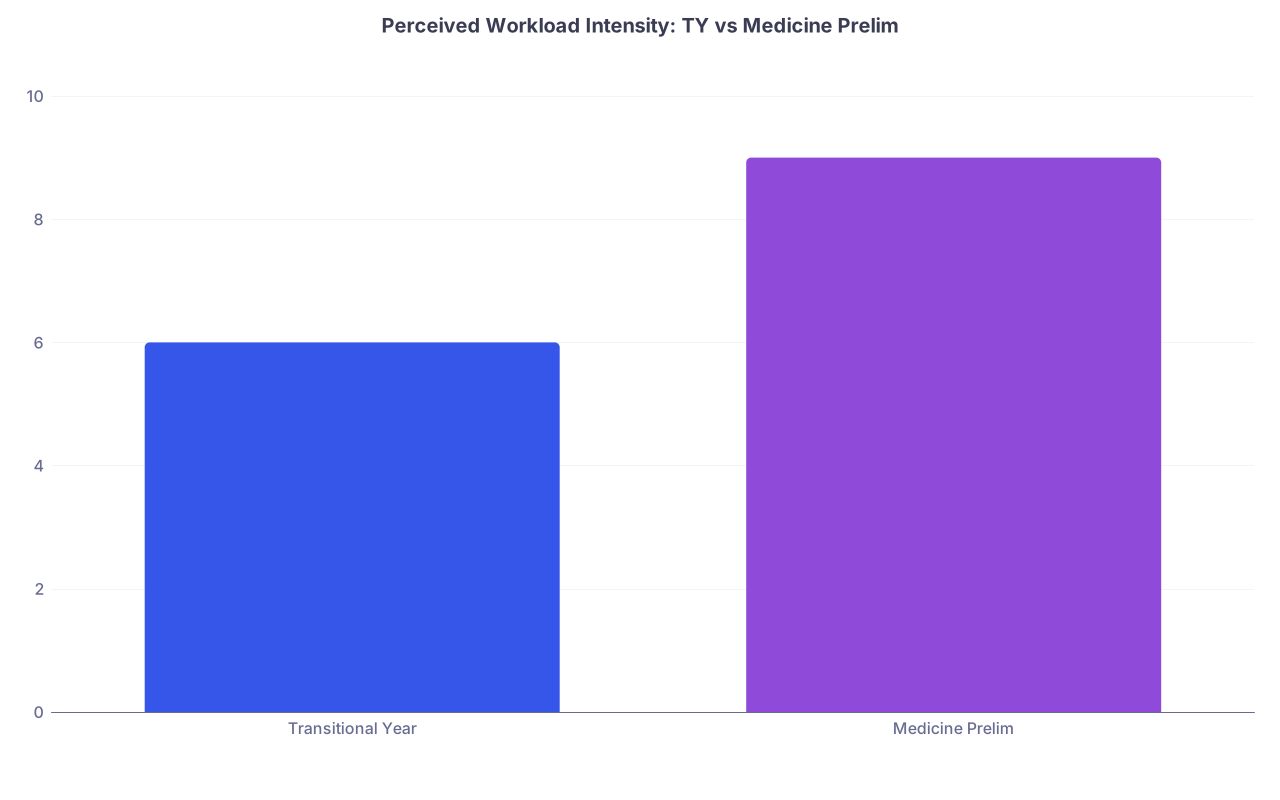
| Category | Value |
|---|---|
| Transitional Year | 6 |
| Medicine Prelim | 9 |
(Scale 1–10 based on typical resident reports; your mileage will vary by program.)
Step 3: How Much Do You Care About Future Flexibility?
This is where most MS4s make mistakes. They assume their specialty and path are locked in stone. Then reality hits.
When a Medicine Prelim Gives You a Safety Net
A medicine prelim year puts you in a good position if:
- You fail to match or SOAP into your desired advanced specialty
- You change your mind after 6–9 months and realize you actually like IM
- A categorical IM position opens up late at your institution
- You want a strong IM base to switch into cards, GI, heme/onc later
Program directors in IM look differently at:
- Someone with a solid IM prelim year and good letters
vs - Someone who did a lightweight TY with limited complex inpatient exposure
If there is any real non-zero chance you might want Internal Medicine long-term, the prelim IM path is the smarter hedge.
When a Transitional Year Is “Enough” Flexibility
A TY can still give you options, just fewer in medicine-heavy pathways.
You’re fine with a TY if:
- You’re going into rads, anesthesia, PM&R, ophtho, derm, rad onc, etc. and not planning to pivot to categorical IM or subspecialty IM later
- Your advanced program director literally tells you “TY or prelim IM—doesn’t matter to us”
- You value learning broadly and maintaining quality of life more than being IM-deep
You can still switch from TY into other specialties, but matching into categorical IM or cards-style paths from a weak TY is just harder than from a strong IM prelim.
Step 4: Look Beyond the Label — Program Quality Matters More
This part is underappreciated: a bad TY is worse than a good prelim. And vice versa.
Red Flags for Both TY and Medicine Prelim Programs
- You cannot talk to current residents without going through a coordinator “filter”
- Residents sound exhausted, bitter, or vague when you ask “Would you choose this program again?”
- High PGY-2+ attrition or frequent transfers
- Shaky ACGME accreditation history
- No clear structure for teaching or regular feedback
If you hear “We just survive” over and over: believe them.
Green Flags That Actually Matter
- Current residents are honest but not miserable
- Graduates match into strong advanced programs or fellowships consistently
- Clear curriculum with dedicated teaching conferences
- Reasonable call structure and coverage
- PD knows where prelims/TYs end up and can name recent examples
If you’re picking between:
- A highly malignant IM prelim at a big-name academic center
vs - A supportive, well-run TY at a solid community hospital
For radiology, anesthesia, PM&R, ophtho, etc., I’d pick the strong TY nine times out of ten.
For someone who might want IM, or needs strong IM letters to reapply in a competitive field? I’d lean toward the academic IM prelim, but only after you’ve talked to actual interns there.

Step 5: Narrow It Down by Your Actual Scenario
Let’s simplify this with some concrete situations.
Scenario 1: Matching into Radiology or Anesthesiology
If you’ve already matched an advanced DR, IR, or Anesthesia spot:
- Prefer: A good Transitional Year, ideally at the same institution or nearby.
- Acceptable: Medicine prelim if that’s what’s available or if institution strongly prefers it.
- Avoid: Programs with toxic culture, regardless of TY vs prelim label.
Scenario 2: You’re Reapplying to Derm, Ortho, ENT, Plastics
You didn’t match. You SOAPed into a prelim or TY. Now you need to strengthen your app.
If you can: Choose a medicine prelim at a place where:
- There’s real research in your target field
- PDs have connections and will support your re-application
- You can get high-quality letters
Transitional Year is fine if:
- It’s strongly tied to your target specialty department
- You’ll have actual time and support for research and networking
Priority here isn’t “medicine vs TY” as much as “Where will PDs advocate for me and give me time to build my application?”
Scenario 3: You’re Undecided Between Advanced Specialty and IM
You like anesthesia or rads, but you also can picture yourself as a hospitalist or going into cards.
Choose: Medicine prelim at a program with a history of taking prelims into categorical spots or helping them match elsewhere.
This buys you the maximum number of future doors.
Scenario 4: You Care A Lot About Not Burning Out Early
You’re going into rads, derm, ophtho, PM&R, rad onc. You know these will be intense in different ways, and you want to enter reasonably intact.
Choose: A strong Transitional Year with:
- Reasonable hours
- Enough ICU/wards to feel competent
- At least a few elective months in or adjacent to your field
Healthy, well-rested interns do better in advanced residencies. That’s not soft—it’s just true.
Practical Decision Checklist
Use this when comparing offers:
What is my target specialty?
- Medicine-heavy or IM backup needed → favor medicine prelim.
- Non-IM advanced specialty, confident in choice → favor TY (if strong).
Does my future specialty/program specifically prefer one?
- Some anesthesia, rads, or neuro programs do quietly prefer IM prelims. Ask directly.
How miserable or supported are current residents?
- Culture > label.
Do I need strong IM letters or an IM safety net?
- Yes → medicine prelim.
- No → either, lean toward quality of life and fit.
Will this program help my next step?
- Reapplication support, research, networking, PD advocacy.
If you answer those honestly, the “TY vs medicine prelim” question usually answers itself.

| Step | Description |
|---|---|
| Step 1 | Know Target Specialty |
| Step 2 | Leaning Medicine Prelim |
| Step 3 | Leaning Transitional Year |
| Step 4 | Prioritize Program Quality and Culture |
| Step 5 | Compare specific programs |
| Step 6 | Non IM advanced specialty? |
| Step 7 | Need IM backup or strong IM letters? |
| Step 8 | Considering IM or IM subspecialty? |
FAQ: Transitional Year vs Medicine Prelim
1. Will doing a Transitional Year hurt me compared to a Medicine Prelim when I start radiology/anesthesia/etc.?
Usually not. For most advanced specialties (rads, anesthesia, PM&R, ophtho, derm, rad onc), a solid TY prepares you just fine. Program directors usually care more about your attitude, work ethic, and baseline competence than whether you saw 10 vs 20 DKA patients as an intern. The main exception is if your specific advanced program or specialty culture clearly prefers IM prelims—then listen to them.
2. If I think I might want to switch to Internal Medicine later, is a Transitional Year enough?
It can work, but it is objectively harder. IM program directors prefer applicants who’ve done an IM prelim or categorical year because they’ve already proven they can handle wards. A TY with heavy medicine rotations at a respected institution might still open doors, but if switching to IM is a real possibility, you’re handicapping yourself by not doing an IM prelim.
3. Are Transitional Years always easier than Medicine Prelims?
No, and this myth gets people in trouble. Some TYs are essentially IM prelims with slightly more electives and the same brutal schedule. Others are truly cush. You have to ask current residents directly about:
- Average weekly hours
- Number of ward/ICU months
- Call structure and nights
Never assume “TY = chill” just based on the name.
4. For neurology, should I pick TY or medicine prelim?
Depends on the program and your goals. Some neurology residencies strongly prefer or require a medicine prelim because neurology is very medicine-heavy. Others accept either and don’t care. If you’re aiming for a top academic neuro program or might want neurocritical care, stroke, or other intensive paths, an IM prelim is usually safer. If your neuro program explicitly accepts TY and you value a broader year, TY is fine.
5. I didn’t match. Should I SOAP into any TY/IM prelim I can, or be picky?
You don’t have the luxury of being super picky, but you shouldn’t be blind either. During SOAP, prioritize:
- Programs with a track record of helping prelims/TYs match the next year
- Places with your specialty of interest on-site and open to research/rotations
- Reasonable culture (even if busy) over malignant big-name places
If you’re reapplying to a competitive specialty, an academic IM prelim or TY closely tied to that department is ideal.
6. What’s one question I should always ask current residents before ranking TY or prelim programs?
Ask: “If you had to do intern year over again, at this program, would you?” Then shut up and listen to how they answer. The words matter, but the tone and hesitation matter more. If they dodge, laugh nervously, or say “Well… it’s intern year everywhere,” that’s a red flag. If they acknowledge the hard parts but still say yes, you’ve probably found a decent place.
Open your rank list or program spreadsheet right now and label each option clearly: “Best for advanced specialty,” “Best for IM backup,” or “Best overall culture.” If a program doesn’t land solidly in at least one of those categories, move it down.