
What actually happens if you match advanced PM&R, radiology, or anesthesia…but your prelim year isn’t the “right” one? Are you screwed, or is most of the panic you’re hearing just noise?
Here’s the answer you’re looking for: for most advanced specialties, you do not need one magic, ultra-specific prelim year. But there are real rules, some traps, and a few specialties that care a lot more than others.
Let’s untangle it.
Step 1: Know What a “Preliminary Year” Actually Is
Quick definitions first so we’re speaking the same language.
There are three common PGY‑1 setups:
| Type | Length | Future Years Included? | Typical Label |
|---|---|---|---|
| Categorical | 3–7 yrs | Yes (full residency) | IM, Gen Surg |
| Preliminary | 1 yr | No | Prelim IM/Surg |
| Transitional | 1 yr | No | TY |
- Categorical: You match once and you’re set from PGY‑1 through completion (e.g., categorical IM, categorical surgery, categorical EM).
- Preliminary: One year only. Mostly core rotations in IM or surgery. After that year, you need an advanced spot to continue.
- Transitional Year (TY): Also one year, usually a mix of IM, electives, maybe some ER, maybe some outpatient. Considered “cushier” at many places.
Advanced specialties (the ones that start at PGY‑2) will tell you exactly what kind of PGY‑1 you must complete. That’s your real rulebook.
Step 2: The Core Question – Do You Need a Specific Type?
Here’s the direct breakdown:
- Some specialties: very specific about PGY‑1
- Some: mildly picky
- Some: almost anything ACGME-accredited is fine
Let’s go specialty by specialty for the common advanced ones.

Step 3: Specialty-by-Specialty Requirements (The Stuff That Actually Matters)
1. Diagnostic Radiology (DR)
Do you need a specific prelim year?
Usually: No. But they prefer certain types.
Most DR programs accept:
- Preliminary Internal Medicine
- Transitional Year
- Sometimes Preliminary Surgery (less common preference, but usually still acceptable)
What they actually require (from the ACGME language): a clinical PGY‑1 in an ACGME-accredited program, often with at least 3 months of direct patient care in internal medicine or similar fields.
What this means for you:
- TY at a solid hospital? Usually perfectly fine.
- Prelim IM? Also fine, and sometimes viewed as slightly more rigorous.
- A hardcore prelim surgery year? Often fine, but you’ll be miserable if you hate surgery and early mornings.
If a DR program wants something specific, they’ll say so on their website or FREIDA:
“Completion of a clinical PGY‑1 year in internal medicine, transitional year, or equivalent is required.”
Bottom line: For radiology, you don’t need a hyper-specific “radiology prelim.” You need a standard, clinical PGY‑1. TY or prelim IM is usually safest.
2. Anesthesiology
Very similar to radiology.
Commonly accepted:
- Prelim Internal Medicine
- Transitional Year
- Sometimes Prelim Surgery
ACGME anesthesiology requirements emphasize 12 months of clinical training with direct patient care, including experience with:
- Internal medicine
- Emergency medicine
- ICU or similar
Programs differ in taste:
- Some old-school anesthesiologists love applicants with strong prelim medicine exposure.
- Others don’t care as long as it’s clinical and accredited.
If you’re torn, a prelim IM or solid TY is the most versatile and safest bet.
3. Physical Medicine & Rehabilitation (PM&R)
PM&R is more specific than people realize.
Many PM&R programs require:
- At least 6 months of Internal Medicine or related fields (like neurology, family med, etc.)
- Some specify: “An ACGME-accredited clinical year with a minimum of 6 months in Internal Medicine or its subspecialties.”
What they’re not thrilled with:
- A heavy prelim surgery year with almost zero IM might be a problem.
- A super-elective-heavy TY with minimal IM might also be borderline if it doesn’t meet the 6-month IM bar.
So do you need “Prelim IM” specifically? Not always. But you do need:
- Enough medicine-heavy time in your PGY‑1.
- A program that can document those IM rotations clearly.
If you’re serious about PM&R, pick:
- Prelim IM, or
- TY that clearly includes 6+ months of IM/medical wards
And double-check: many PM&R programs list their PGY‑1 expectations very clearly. Read them.
4. Dermatology
Derm is an advanced specialty with high standards but not wildly specific PGY‑1 rules.
Allowed in most:
- Prelim Internal Medicine
- Transitional Year
- Sometimes Family Medicine (categorical PGY‑1, then jump to derm)
- Occasionally Prelim Surgery (less ideal without clear outpatient/IM exposure)
Programs often say: “An accredited clinical PGY‑1 year is required, preferably in Internal Medicine or Transitional Year.”
Between options:
- Prelim IM or a strong TY is ideal.
- Surgery prelim is usually not the best fit; derm is outpatient-heavy, medicine-based.
So no, you don’t need a “Derm-specific” prelim. You just need a solid, clinical PGY‑1. With at least a few months that look like real outpatient/IM experience.
5. Neurology (when offered as advanced)
Neurology can be either categorical or advanced, depending on the program.
For advanced neurology:
- Many require or prefer Prelim Internal Medicine
- A few accept Transitional Year with strong IM exposure
ACGME neurology standards often include:
- At least 8 months of Internal Medicine or pediatrics (for child neuro) in the preliminary year
So here the answer is closer to yes, you do need something specific:
- For adult neuro: a PGY‑1 that’s basically an IM year (categorical IM + then switch, or prelim IM).
- TY is only safe if it’s clearly structured to meet that requirement.
6. Radiation Oncology
Radiation oncology is a bit like PM&R in that they care about the clinical base.
Typically accepted:
- Prelim Internal Medicine
- Transitional Year with strong IM exposure
- Sometimes Prelim Surgery, if it includes medical oncology/IM-type rotations
They often specify something like:
- 9–12 months of direct patient care in specialties such as internal medicine, pediatrics, family medicine, surgery, OB/GYN, or emergency medicine.
Again, prelim IM or a robust TY is usually the best play.
7. Ophthalmology
Ophtho runs through SF Match and has its own setup.
Most ophthalmology programs require:
- A clinical PGY‑1 year in:
- Transitional Year
- Prelim Internal Medicine
- Prelim Surgery
- Occasionally categorical IM or FM
They typically don’t insist on a single specific type, but they want:
- Solid inpatient experience
- Adequate exposure to medicine or surgery
Ophtho folks usually lean:
- TY or prelim IM (more balanced, less surgical misery unless you enjoy that)
8. PM&R, Neurology, and “We Need X Months of Y”
These are the specialties where the structure of your PGY‑1 actually matters, not just the label.
If a program says:
- “At least 6 months of Internal Medicine”
- “At least 8 months of Internal Medicine or Pediatrics”
Then:
- A random, elective-heavy TY might not cut it.
- A prelim surg year with 10 months of trauma nights is a bad idea.
You need to know your block structure ahead of time or choose a prelim that is obviously IM-based.
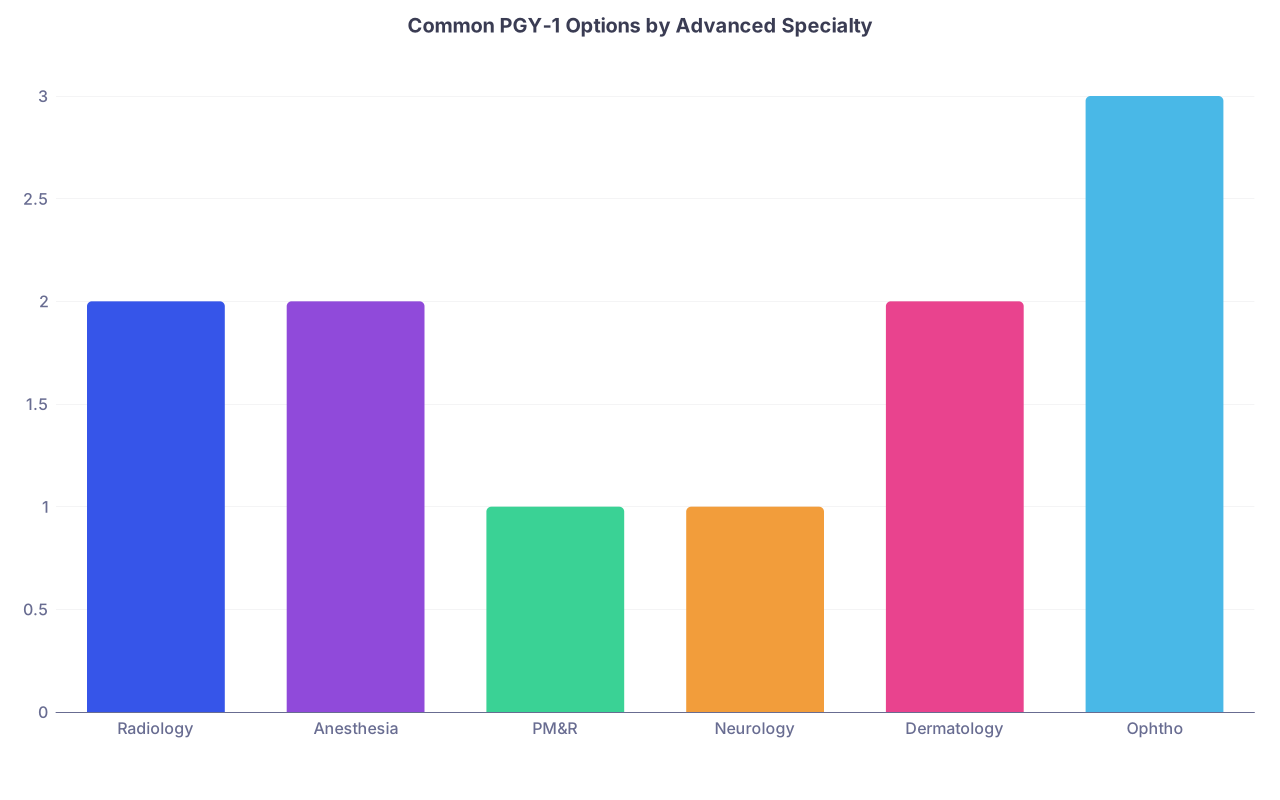
| Category | Value |
|---|---|
| Radiology | 2 |
| Anesthesia | 2 |
| PM&R | 1 |
| Neurology | 1 |
| Dermatology | 2 |
| Ophtho | 3 |
(Where 3 = very flexible, 2 = moderately flexible, 1 = more specific/internal-medicine-heavy expectations.)
Step 4: Transitional Year vs Prelim IM vs Prelim Surgery – Which One Should You Pick?
If you’re applying to radiology, anesthesia, derm, ophtho, rad onc, PM&R, or similar, here’s the honest breakdown.
Transitional Year (TY)
Pros:
- Often more electives, less grueling than pure wards or surgery.
- Great for studying, research, Step 3, and not burning out.
- Very popular among radiology, anesthesia, and derm applicants.
Cons:
- If it’s too elective-heavy and light on IM, it may be a poor fit for PM&R or neurology if they require specific IM months.
- Quality varies wildly by program. Some are cake. Some are stealth prelim IM.
Preliminary Internal Medicine
Pros:
- Safest and most versatile for almost all advanced fields.
- Neurology, PM&R, rad onc, and many others explicitly prefer/require it.
- You’ll actually learn medicine, which doesn’t hurt no matter what you do later.
Cons:
- Can be intense. Wards, admits, cross-cover, etc.
- Less elective time.
Preliminary Surgery
Pros:
- Only a good idea if:
- You’re genuinely into surgery-ish advanced specialties (e.g., some ophtho people still like this)
- Or it’s the only prelim you can get and your advanced program accepts it
Cons:
- Long hours, physically demanding, least aligned with fields like derm, rad, PM&R.
- Can fail to meet IM month requirements for certain specialties.
If you’re unsure what to do: Prelim IM is the safest generic choice.
Step 5: What Happens If Your Prelim Year Doesn’t “Match” Perfectly?
Here’s where people really start to panic: “I matched advanced PM&R, but my TY only has 4 months of IM. Am I dead?”
Usually, one of three things happens:
You’re fine
If your PGY‑1 is ACGME-accredited and reasonably clinical, many programs will work with you, especially if you’re close to the requirements.They ask you to adjust rotations
Programs can ask:- Your prelim program to shift a couple of electives to IM/wards
- You to arrange certain rotations to meet the minimum IM months
Worst-case: you technically don’t meet ACGME rules
Pretty rare if you and your future program are awake at the wheel.
But if you completely ignore written requirements and choose a super-elective, non-IM TY when PM&R requires 6+ months of IM, you can run into real certification and credentialing issues.
How to avoid this:
- Read: ACGME program requirements for your specialty (they’re public).
- Read: Your matched advanced program’s PGY‑1 requirements on their site.
- Send a short email to the program director or coordinator asking:
“I’m planning to do X type of PGY‑1 with Y months of IM. Will that fully satisfy your PGY‑1 requirement?”
That one email prevents 95% of problems.
Step 6: Common Myths You Can Ignore
Let me kill a few myths that float around lounges and Reddit:
“You must do a prelim year at the same institution as your advanced program.”
False. Many people do PGY‑1 at one hospital and move across the country for PGY‑2. Totally normal.“Transitional years are not respected.”
Also false. Some TYs are excellent and very well respected; some are fluff. Same as IM programs.“If you don’t do Prelim IM, you’ll be bad at radiology/anesthesia.”
No. Plenty of great radiologists and anesthesiologists came from TYs.“Prelim surgery looks more ‘hardcore’ and will impress everyone.”
It mostly impresses people who like suffering. If it doesn’t align with your future specialty or requirements, it’s just needless pain.
Step 7: How to Decide YOUR Preliminary Year – A Simple Framework
Take 10 minutes and answer three questions:
What are my realistic target specialties?
- If neuro or PM&R is high on your list → lean Prelim IM or IM-heavy TY.
- If rads, anesthesia, derm, ophtho, rad onc → TY or Prelim IM.
What does my top-choice advanced program say about PGY‑1?
Actually look up their requirements. Don’t guess.What kind of year will keep me functional and not burned out?
If you despise the OR, don’t sign up for prelim surgery to “look tough.”
If you like structure and inpatient medicine, prelim IM might fit you better than a hazy TY.
Once you’ve checked those three boxes, your choice is usually obvious.
FAQ – Exactly 7 Questions
1. If I match an advanced position, can my advanced program force me to change prelim types?
No. They can set requirements for what counts as a valid PGY‑1 for their specialty, but they can’t rewrite your NRMP contract.
The practical issue is this: if your prelim year doesn’t meet ACGME or program rules, you might not be able to start PGY‑2 until those requirements are satisfied. That’s why you confirm ahead of time.
2. Can I switch from a prelim surgery year to prelim medicine after starting?
Sometimes, but it’s not easy. You’d need:
- An open PGY‑1 medicine spot
- Approval from both programs
- NRMP/contractual logistics handled correctly
Don’t bank on this as your plan. Choose wisely up front.
3. Is a Transitional Year ever “not enough” for an advanced specialty?
Yes. For some neurology and PM&R programs that explicitly require 6–8 months of IM, a weak TY that’s heavy on electives and light on IM can be a problem.
If you pick a TY, make sure it clearly meets the IM month requirements of your future specialty.
4. Does it matter if my PGY‑1 is at a “big-name” institution?
For most advanced specialties? Not really. Once you’re in residency, what matters more:
- Your performance
- Your letters
- Your reputation as a colleague
A functional, well-run community TY or prelim IM can be far better than a “name brand” malignant program that crushes you.
5. What if I’m applying to multiple advanced specialties with different preferences?
Go with the most restrictive one that’s still tolerable to you.
Example: if you’re torn between radiology (flexible) and PM&R (IM-heavy), choose Prelim IM or an IM-heavy TY. That will work for both.
6. Can I use a Family Medicine intern year as my required PGY‑1?
Sometimes, yes:
- Dermatology, PM&R, and some others may accept a categorical FM PGY‑1 if you then switch into their PGY‑2.
- Neurology and others are more rigid and may need internal medicine specifically.
You have to check each target specialty and program. Don’t assume.
7. What’s the single safest prelim choice if I have no idea what I’ll end up in?
Unpopular answer but honest: Preliminary Internal Medicine.
It’s the most broadly acceptable, meets the strictest IM-month requirements, and keeps nearly all advanced doors open. Not always the easiest year, but it’s the most future-proof.
Open your spreadsheet or notes doc right now and write down your top 1–2 advanced specialties plus their PGY‑1 requirements from their websites. Once that’s in front of you, circle the one PGY‑1 type that satisfies both. That’s your target.